Showing posts with label Art Deco. Show all posts

Sunday, November 15, 2026

E Flat afloat / a mind that lapses into total fog

Above
Jan Lavies, Art Deco era poster (n.d.)

•••

Anon, in Steven J. Zeitlin, et al., A Celebration of American Family Folklore (New York: Pantheon, 1982), p. 53—

We've always been a musical family. When my grandfather was old, he elapsed into a complete fog. He wouldn't say a sensible word, week in and week out. But his nurse would bring him to the dinner table and he'd sit there and he'd eat. The night boat to Norfolk from Baltimore would come by every night at eight o'clock and it would go "Booooooaaah" as it went by the house. One night, out of this total fog he had been in for months, grandfather stood up, went over to the piano, poked it, and said, "E Flat." Then he sat down and went right back into the fog.

Saturday, November 25, 2023

she spent half her life in a pink chenille robe

Above Image sequence from a talk I once presented on the history of chair design, called Sitting Down with Frank Lloyd Wright.

•••

Richard Critchfield, Those Days: An American Album. New York: Dell, 1986, pp. 376—

In one corner of the dining room, by the hot-air register, was a big old Morris chair, where Betty, when she still worked at the bakery, would sit and fall asleep, she was so tired. Billy used to say, "Betty's spent half her waking life in a pink chenille robe." The stairwell to the attic was always loaded with things left there by somebody intending to take them up later: books, clothes, tennis rackets, skates, Tinker Toys, little trucks that always seemed to have a wheel missing. Like the road to hell, the stairs were paved with good intentions. 

Wednesday, February 23, 2022

inoculated bodies, the stench of sick horses

Marcel Ponty, travel poster (c1925)
Maurice Browne, Too Late to Lament: An autobiography. Bloomington: Indiana University Press, 1956, pp. 50-51. This is his eyewitness description of what it was like to be a British soldier aboard a troop ship, sailing to South Africa, during the Boer War in 1899. If this isn’t vivid enough, imagine later experiences of American soldiers on World War I troop ships, as they were being transported to France (c1918), stricken by mal de mer (seasickness) and the equivalent then of COVID-19, called Spanish flu—

A rolling, pitching ship; packed hammocks; beasts held upright by the sides of their narrow stalls; the stench of horses sick at both ends; on decks slippery with fifith, vomiting men leading voiding horses; a beast falling, a broken leg, a shot: another carcass heaved overboard; aching bodies, inoculated for typhoid, strewn about the deck; hard-bitten faces at poker round a barrel: “Keep out of this, young Browne—it’s no game for children”; the stillness of tropic seas; long glamorous days; endless blue; uproar amid endless hush.

Saturday, February 5, 2022

ode to Phyllis / love and golf must not be mixed

Above Advertising poster for Anic cigarettes by Sepó (Severo Pozzati), Italian-born artist and advertising designer, 1938.

•••

Alfred D. Godley, “Love and Golf” in VERSES TO ORDER. London: Methuen and Co, 1892, pp. 51-52—

Hear my swearing, fairest Phyllis!
—Golfers all know how to swear—
Though, of course, your presence still is
Most attractive everywhere,
Links were ne’er designed for lovers:
Do not, Phyllis, deem me rude,
When I hint that man discovers
Charms at time in solitude.

Lips like yours should never utter
Ugly words that golfers speak—
“Dormy,” “stimy,” “mashy,” “putter,”
“Driver,” “brassy,” “bunker,” “cleek”!
Sooner read—though Cultured Woman
Is a thing I hate and shun—
Horace, that distinguished Roman,
Than Horatius Hutchinson.

Though, in hours of deep dejection,
When the disappointing ball
Takes, if hit, the wrong direction,
Sometimes can’t be hit at all,—
Though whate’er the golfer says is
Justified by reason due,
Still I hold his Saxon phrases
Most unsuitable for you.

Tennis be your sole endeavor
If you must aspire to fame!
But at golf—believe me, never
Can you hope to play the game.
There, your “swing” but courts the scoffer,
Boors and clowns your “driving” mock;
Fate, who made the clown a golfer,
Meant you, Phyllis! for a “crock.”

Meet me then by lawn or river,
Meet me then at routs or rinks,
Meet me where the moonbeams quiver,
Anywhere—but on the links!
Thus of you I’ll fondly ponder
O’er the green where’er I roam,
(Absence makes the heart grow fonder),
Only, Phyllis, stay at home!


Thursday, February 18, 2021

Harold Lloyd's walking wooden hobby horse

Above World Cinema poster depicting American film star Harold Lloyd (designer and date unknown).

•••

S. Howard Bartley, A Bit of Human Transparency. Bryn Mawr PA: Dorrance and Company, 1988, p. 73—

[Hollywood film star Harold Lloyd designed a wooden] walking hobby horse large enough for adults to ride…[It] looked much like a regular hobby horse except it was not on rockers. As the rider would lean forward the horse would tilt forward, pivoting (or rocking) on its front legs. This would lift the rear end of the horse and lift the hind legs off the floor. They would swing forward to reach what would now be the perpendicular. As the rider would then lean back, the front end of the horse would lift off the ground and in tilting back the front legs would swing to a new position. The pivot for this second phase of action (tilt) would be the hind legs. So as the rider would alternately tilt forward and backward the animal would carry its rider across the floor. 

Harold Lloyd in Safety Last (1923)


Thursday, January 14, 2021

artist Orr Fisher in process of painting his mural

In the previous post, we featured a delightful WPA post office mural, called The Corn Parade, by Iowa artist Orr Cleveland Fisher. At the time, we didn't realize that someone named Blake Schnormeier has put up a multi-page Sutori site on the same artist. It offers interesting snippets of text, news clippings, paintings, cartoons, and a selection of vintage photographs, including the one posted above, which shows Orr Fisher putting the finishing touches on his wall-sized masterpiece.

Saturday, January 9, 2021

favorite feather in the cap of Ringgold County

Above Detail of Orr Fisher's WPA mural, The Corn Parade (1941), in the US Post Office in Mount Ayr IA. 

•••

Roy R. Behrens, THE CORN PARADE: Orr Fisher's wacky WPA mural, in The Iowa Source (Fairfield IA), Vol 38 No 1 (January 2021), pp. 10-11—

American astronaut Peggy Whitson was born in south central Iowa, in Riggold County, and attended high school in Mount Ayr, the county seat. She is that region's claim to fame, although it should also be noted that the parents of Abstract Expressionist artist Jackson Pollock also grew up in that county. My favorite feather in the cap of Ringgold County is a Depression-era WPA mural that hangs in the US Post Office in Mount Ayr. Created in 1941 by local artist Orr Cleveland Fisher (1885-1974), it is titled The Corn Parade.…more>>>

Wednesday, January 6, 2021

how structured and deliberate designers are

Above Streamlined-era magazine page layout for an Oldsmobile advertisement.

•••
Mirra Merriman in Wendy Deutelbaum and Carol de Saint Victor, “The Art of Teaching: Interviews with Three Masters” in The Iowa Review Vol 28 No I (1998), p. 13—

One of the illusions people have who don't know about the making of art is that it’s an activity that comes out of a creative surge, a genius or passion. What is missed most of the time is how deliberate and how structured the choices that artists [especially designers] make are, and how one can read in the works of art the intellectual process that was taking place in the mind of the artist.

Thursday, March 26, 2020

The ingenious posters of designer Abram Games

Abram Games, WWII-era poster
Without hesitation, one of the finest designers in modern history was British graphic designer Abram Games (1914-1996). Shown here are two rather similar but equally excellent posters he made during World War II, both of them appealing to the wartime public to be self-sufficient. As is characteristic of many of his posters, they are astonishing visual puns. In an essay in his book, Topics of Our Times (London: Phaidon, 1991), British art historian E.H. Gombrich acknowledged that Games was indebted to the "deliberate ambiguities and illogicalities" of the work of such Surrealists as Max Ernst and Salvador Dali. But many of those works, he went on to say—

were pointless… [and] were aimed at defying the canons of reason to shake our complacency. In the art of Abram Games the very puzzlement caused by such arresting images is given an added purpose. We attend because we are momentarily baffled, and thus we are ready to seek for the message, which we will remember all the better for having discovered it in such a flash of recognition.

Abram Games, WWII-era poster

Saturday, November 9, 2019

Humanities Iowa | Program opportunities 2019

WPA mural by Orr Fisher
Since the mid-1990s, I've been associated with the Humanities Iowa Speakers Bureau. For all those years, I've been available to speak on subjects that pertain (in one way or another) to the history of the state. I've often given talks (sometimes as many as ten per year) at public libraries, historical societies, community centers, and so on. The talks are free and open to the public. They are funded by Humanities Iowa, which is part of the National Endowment for the Humanities. The requesting organization is charged only $50, while the HI picks up the additional costs of travel expenses, speaker's honorarium, and so on. What a great program.

Over the years, the talks I've offered have usually been about Frank Lloyd Wright, Grant Wood, Buffalo Bill, World War I camouflage (which Iowans contributed to), and so on. A few days ago, I gave my presentation on Buffalo Bill (which includes an account of the plight of the Native Americans during the dreadful Indian Wars) at the Story County Conservation Center, just north of Ames IA. The large audience (around 100 people) was absolutely wonderful, and, as usual, I had a truly delightful time.


The downside is that it was probably the last time I'll present my talk about Buffalo Bill, which has easily had the most requests. With my retirement from teaching, I decided it was time to offer new topics. My new talks are listed on the HI website here. One of those talks is about the WPA (Works Progress Administration), one of the government programs set up by Franklin D. Roosevelt in the Depression Era, as I described in an essay I wrote years ago. One facet of that enabled unemployed artists to apply to create public murals for permanent installation in US post offices. It's surprising how many of these have survived. Reproduced above is one of my favorites, titled The Corn Parade, a painting by Orr Fisher in the US Post Office in Mount Ayr IA.

Friday, September 7, 2018

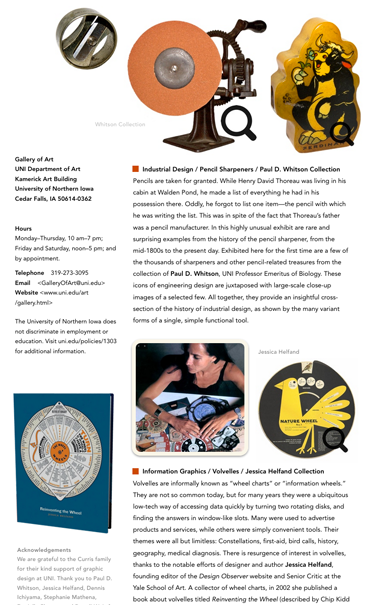
Elena Diane Curris Design Exhibition | 2018

Opening on October 8, 2018, at the Gallery of Art at the University of Northern Iowa is the first of an on-going series of biennial design-themed exhibitions. Titled The Reach and Richness of Design: The Elena Diane Curris Biennial Design Exhibition, it consists of five components representing architectural design, editorial illustration, industrial design, information graphics, and wood type and typography. Included are works by Frank Lloyd Wright, Dennis Ichiyama, Ad Reinhardt and others, as well as historical artifacts from the collections of Jessica Helfand, and Paul D. Whitson. The exhibition is one part of The Elena Diane Curris Endowment, which also provides for the return to campus annually of past graduates of the UNI Graphic Design program, which is housed within the Department of Art. more>>>


Wednesday, May 25, 2016

Font Specimen Poster | Rachel Bartholomay

Font Specimen Poster © Rachel Bartholomay 2016
Above Font specimen poster by design student Rachel Bartholomay (©2016) at the University of Northern Iowa.

•••

Recently while reading Nicholas Fox Weber, The Bauhaus Group: Six Masters of Modernism (New Haven CT: Yale University Press), I ran across a passage about a class exercise that the painter Paul Klee witnessed in a course at the Bauhaus taught by Johannes Itten. It required his students to draw in the dark, and of course this reminded me of the later, related experiments by Hoyt Sherman at Ohio State University, which I wrote at length about in the early 1990s. Here is the passage from Weber's interesting book (p. 115)—

At 5 pm that same day, Itten gave another course in a large lecture hall constructed like an amphitheater, where people sat on the steps rather than on seats. This time the master projected on the wall a large image of Matisse's La Danse and had the students draw its essential compositional elements in the dark. Itten's wife sat at his feet, with everyone else huddled in close. The sole exception was Klee, who sat as far away as possible, at the very top of the amphitheater, in a proper chair. Looking on from this perch, he smoked his pipe.

Tuesday, March 17, 2015

Vesterheim Talk on Mid-Century Modernism

Vesterheim Museum talk (Decorah IA)
Above Coming soon to the Vesterheim, The National Norwegian-American Museum & Heritage Center, in Decorah IA, at 2:00 pm on Sunday, March 29, 2015. Less Is More, More Or Less: The Roots of Mid-Century Modern Design, a richly illustrated talk by author and graphic designer Roy R. Behrens, Professor of Art and Distinguished Scholar at the University of Northern Iowa. More>>>

Sunday, December 28, 2014

Miami Art Deco Postage | Stephanie Berry

Stephanie Berry © 2014
Above Hypothetical postage stamp, commemorating Art Deco architecture, by University of Northern Iowa graphic design student Stephanie Berry (2014). Reproduced below is a block of stamps that repeats and juxtaposes the single stamp to produce a synergistic whole.

•••

British sculptress Clare Sheridan, in a diary (1921) as quoted in Teresa Carpenter, ed., New York Diaries. NY: Modern Library, 2012, pp. 16-17—

Mr. [Horace] Liveright, my publisher, fetched me and took me to the Ritz where we dined with [various notable people, among them American financier and presidential adviser Bernard Baruch]…Mr. Baruch (whose name I mistook for Brooke) has white fair, fine features and stands 6 ft. 4. I gathered from the general conversation that I was talking to someone whom I should have heard of, and as I could think of no distinguished Brooke but [English poet] Rupert Brooke, I asked if he was related. And then Mr. Baruch rather reprovingly spelt his name for me. Instantly by a faint glimmer of memory, "Wall Street" came to my mind and I seemed to have heard in London that he was a friend of [her cousin] Winston [Churchill].

Stephanie Berry © 2014

Miami Art Deco Postage | Danielle Schweitzer

Danielle Schweitzer © 2014
Above Hypothetical postage stamp, commemorating Art Deco architecture, by University of Northern Iowa graphic design student Danielle Schweitzer (2014). Reproduced below is a block of stamps that repeats and juxtaposes the single stamp to produce a synergistic whole.

•••

Richard Neutra (Austrian-born American architect) in his autobiography, Life and Shape. New York: Appleton-Century Crofts, 1962, p. 123. In this passage, he describes his experience as an army officer during World War I, when, accompanied by an orderly, he traveled on horseback through northeastern Montenegro—

[My orderly] was not obnoxious in any way. He didn't step on anybody's toes, or kiss any girls, or do anything else that might have caused trouble. His slow talk was like that of his Saxon ancestors. He came from Transylvania, the southeastern section of of Hungary near the mountainous Rumanian border. His home village was so underdeveloped that he had never seen a stairway. When he first beheld stairs, later on in a "hinterland" hotel, he climbed them on his hands and feet; he only knew how to use a ladder.

Danielle Schweitzer © 2014

Tuesday, November 25, 2014

Miami Art Deco Postage | Gina Hamer

Gina Hamer © 2014
Above Block of synergistic postage stamps by University of Northern Iowa graphic design student Gina Hamer (2014), commemorating historic Art Deco architecture in Miami. Scroll down to see the single stamp from which the final block was made.

•••

Peter De Vries—

Life is a zoo in a jungle.

Miami Art Deco Postage | Bailey Higgins

Block of stamps © Bailey Higgins 2014
Above Block of synergistic postage stamps by University of Northern Iowa graphic design student Bailey Higgins (2014), commemorating historic Art Deco architecture in Miami. Scroll down to see the single stamp (one of several variations) from which the final block was made.

•••

Ralph C. Wood, The Comedy of Redemption (Notre Dame IN: University of Notre Dame Press, 1988, p. 230—
[American comic novelist] Peter De Vries is so funny a writer that it may seem inappropriate to take him seriously. His puns are unabashed. Like the cleaning lady, he says, we all come to dust. The mere thought of cremation turns one of his characters ashen. De Vries's aphorisms are no less outrageous. The American home, we are told, is an invasion of privacy. Never put off until tomorrow, we are advised, what you can put off indefinitely. What is an arsonist, we are asked, but someone who has failed to set the world on fire? De Vries's vignettes are even more discerningly surreal. A chiropractor attending a patient throws out his own back. A husband who demands that his wife explain why she bought a mink coat is told that she was cold. Another wife sues her husband's mistress for alienation of his affections, and asks for $65 in damages.

Art Deco Stamp © Bailey Higgins 2014
 

Tuesday, November 11, 2014

Miami Art Deco Postage | Kat Bartlett

Miami Art Deco Stamp © Kat Bartlett
Above Block of synergistic postage stamps by University of Northern Iowa graphic design student Kat Bartlett (2014), commemorating historic Art Deco architecture in Miami. Scroll down to see the single stamp from which the final block was made.

•••

Alec Guinness, My Name Escapes Me: The Diary of a Retiring Actor (New York: Viking Penguin, 1997), p. 46—

During one Christmas holiday in London I was taken to a fancy dress ball at the Town Hall in Kensington and I went as a candle and candlestick. I was sixteen. I fashioned a white tubular arrangement out of cardboard to go on my head, and from crepe paper a yellow and blue candle flame; also a wide white cardboard collar. I won the first prize, which was a large, brown, fiber suitcase. But it was a humiliating experience as so many people flicked their cigarettes into my collar and then said, "Sorry, thought you were an ashtray."

Miami Art Deco Stamp © Kat Bartlett

Sunday, November 9, 2014

Miami Art Deco Postage | Andrew Girod

Andrew Girod © 2014
Above Block of synergistic postage stamps by University of Northern Iowa graphic design student Andrew Girod (2014), commemorating historic Art Deco architecture in Miami. Scroll down to see the single stamp from which the final block was made.

•••
 
Dard Hunter, American Arts and Crafts-era designer and papermaker, My Life with Paper: An Autobiography. NY: Alfred A. Knopf, 1958—

A newspaper composing stick held about two inches of type—fifteen or sixteen lines. My father would always refer to the length of an editorial or any set matter as so many “sticks.” At noonday lunch I have often heard my mother ask about articles that were to appear in the paper that evening. For instance, my mother would say: “Did they have a large funeral for old Joe Basler?” and my father would answer: “One of the largest this year, about eight and a half sticks” (p. 10).

•••

[On a visit to Hammersmith, England, in 1912] I was only a few blocks from [Kelmscott Manor] where the famous modern edition of Chaucer had been printed, but the irregular streets had misled me. Upon inquiring the way to the old workshop of William Morris, I was surprised to be told by the young real estate agent that he did not know where William Morris had lived. He had never heard of Morris, and asked me if he had previously been the proprietor of a low rooming house for mendicants (p. 56).

Andrew Girod © 2014

Miami Art Deco Postage | Shane Rumpza

Shane Rumpza © 2014
Above Block of synergistic postage stamps by University of Northern Iowa graphic design student Shane Rumpza (2014), commemorating historic Art Deco architecture in Miami. Scroll down to see the single stamp (one of several variations) from which the final block was made.

•••

William L. Shirer, 20th Century Journey : A Memoir of a Life and the Times (Vol 1). Boston: Little Brown, 1976, p. 193—

We stage-struck youngsters (sometimes I would work as an extra stagehand, moving scenery and props between acts [at Green's Opera House in Cedar Rapids IA], when a great star I wanted to see at close hand came to town) grew up in Cedar Rapids on a strange legend about Sarah Bernhardt. It was that she had been born Sarah King in the village of Rochester [IA], twenty-five miles down the Cedar River from us, that her mother had died when she was five, that she had run away soon afterward, entered a French convent at St Paul [MN], and, having learned the new language, set off to Paris, where she began her fabulous career in the theater. The legend grew when in 1905 it was reported that a veiled but elegantly dressed woman had stopped off briefly at Rochester to lay a bouquet of roses on the grave of the elder Mrs. King. When reporters noted that Sarah Bernhardt had played an engagement at nearby Iowa City the previous evening, they put two and two together, as reporters sometimes are tempted to do, and concluded that it was the great Parisian actress who had made the mysterious visit to the grave of one who must have been her mother. Ergo! The great Sarah Bernhardt, the most famous French actress of our time, was an Iowa girl!

•••

William L. Shirer, ibid, p. 18—

[The American novelist] Sinclair Lewis had worked as a telegraph editor and editorial writer on the [Waterloo IA] Daily Courier in 1908, the year after he graduated from Yale. He was fired after ten weeks, the editor informing him, Lewis told me once, "Young man, you'll never make it as a newspaperman. You can't write."

Shane Rumpza © 2014