Showing posts with label pun. Show all posts

Sunday, March 29, 2026

dream-like substitutions / Guiseppe Arcimboldo

Arcimboldo, Fruit Basket (upsidedown reversible)
During all the years I taught university-level art and design (about 45 years), among the most pleasurable aspects was the process of inventing hands-on studio exercises which I presented to students to solve. 

Everyone was given the same problem, but the solutions that resulted were invariably different, often surprisingly. Each problem was presented to the assembled group, but each student worked alone on his / her answer. No one knew what the other would do until the day of the critique, at which time everyone's work was revealed.

The problems were sometimes derivative of certain kinds of imagery, which often as not were indebted to historical styles of art. In one of those problems for example (of which five responses are reproduced below), which I presented to freshmen, I gave a prefatory talk about the portrait paintings of the Italian Mannerist artist Giuseppe Arcimboldo (1527-1593), one of which is shown in the reproduction above.

In the Modern era, it was often claimed that Arcimboldo had anticipated the dream-like qualities of Surrealism, since the bulk of his paintings consist of surprising portraits that were made by combining bits and pieces of non-portraits, such as plants, animals, flowers, fish, and so on. Using cut-out fragments of magazine photographs (this predates the use of computers), the students were instructed to devise comparable portraits.

Five of those are shown below. I regret that so many years have passed that I no longer have a record of the names of the students who made these.


Thursday, March 5, 2026

the purposeful use of confusion / invention is

Hans Richter
, Dada: Art and Anti-Art (New York: McGraw-Hill, n.d.), p. 145—

One day [German Dadaist artist Kurt] Schwitters decided he wanted to meet [German artist] George Grosz. George Grosz was decidedly surly; the hatred in his pictures often overflowed into his private life. But Schwitters was not one to be put off. He wanted to meet Grosz, so [Walter] Mehring took him up to Grosz's flat. Schwitters rang the bell and Grosz opened the door.

"Good morning, Herr Grosz. My name is Schwitters."

"I am not Grosz," answered the other and slammed the door. There was nothing to be done.

Half way down the stairs, Schwitters stopped suddenly and said, "Just a moment."

Up the stairs he went, and once more rang Grosz's bell. Grosz, enraged by this continual jangling, opened the door, but before he could say a word, Schwitters said "I am not Schwitters, either." And went downstairs again. Finis. They never met again.

Thursday, September 26, 2024

there is no better book about human creativity


Douglas Fowler, S.J. Perelman. Boston: Twayne Publishers, 1983, p. 83—

Continuing an ancient and honorable line of speculation into the nature of humor, Arthur Koestler has theorized [in The Act of Creation] that human laughter may be a sort of alternative satisfaction of “biological drives,” a substitute for “killing and copulating,” for planting antipersonnel bombs. The aggression implied in laughter—and laughter almost always involves ridicule, bringing low—is “sublimated, often unconscious,” but the mechanism of laughter surely involves a psychic effort to reduce or even imaginatively destroy its objects; and we can agree that a good part of the comic phenomenon might be understood as brutality without consequence.

•••

I discovered The Act of Creation, Arthur Koestler’s classic book on science, art and humor, as a college freshman in 1965. It had been published the year before. At nearly 500 pages, it is not an easy read. Or, it might be better to say that the text, as one moves through it, is immensely pleasurable, stirring and insightful. That is especially true of Part One. In Part Two, as Koestler cautions, the wording thickens somewhat and the content grows more technical. But you must not be put off by this. 

Over the years, I have owned six or seven copies of this book, and yet I have never read the entire text in sequence, page by page from beginning to end. I don’t think it works best for that. But most likely I’ve read every word, in session lengths and sequences that seemed appropriate at the time. Even today, I still go back to it, because its concepts are so illuminating, and the writing is so perfectly phrased. I have learned immeasurably, I don’t deny, from other educational opportunities, and from other published sources, but I continue to be convinced that, at a critical point in my life, Koestler’s book provided a “big picture” framework for those.  


The entire book is now available free online. If the book seems somewhat daunting, you might first read an essay I wrote in 1998. More recently, I produced a short video talk on the subject, which is also free online. Near the end of the video, I recall an incident that took place in my classroom, back in 1968, when I was a 7-12 art teacher in a public school. In subsequent years, as a university professor (and as a grapher design and writer) I made frequent use of Koestler's approach to innovation—and I still use it to this day.

Tuesday, December 4, 2018

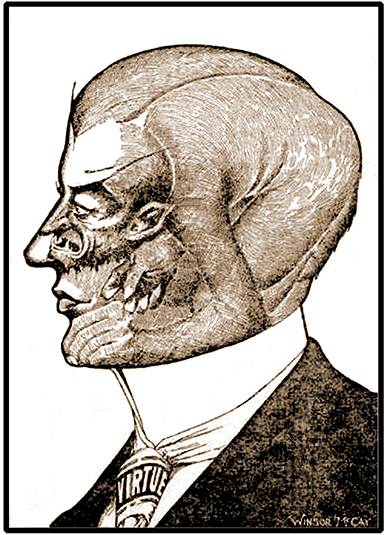
Winsor McCay | Brute in the Brain Illustration

The Brute in the Brain by Winsor McCay
Above An early uncharacteristic illustration by legendary comic page illustrator Winsor McCay, titled "The Brute in the Brain" (date and source unknown).

•••

Cornelius Weygandt, On the Edge of Evening: The Autobiography of a Teacher and Writer Who Holds to the Old Ways (New York: G.P. Putnam's Sons, 1946), p. 107—

In 1902 we went to Ireland…As we got off the ship there were women selling gooseberries on the quay. I had often heard of the proficiency in bad language of alewives. I was now to hear it. It was the time of the Boer War. A Tommy came by with a hat about the size of a teacup on one side of his head and the strap from it around under his chin to hold it in place. He said to the woman with the gooseberries, "Mother, how much the gooseberries?"

"You blank blank bastard of a blankety blank blank. I'm not your mother, and you may be very sure that I wouldn't have been. I'd have no child by a man that would get the like of you." And more of the same. And more of the same. I had been told by numerous kindly Irish people that the gooseberries in Ireland were as big as English walnuts in America. It is true they were. I was waiting for the old woman to show her dexterity by driving them at the offending Tommy, but she didn't. They were, I suppose, too previous. I had been intending to buy some, but she lost the sale. I was too afraid of what she might say to me to offer to buy any of them.

Thursday, April 9, 2015

Typographic Poster | Alexandria Toszegi

Typographic poster © Alexandria Toszegi 2015
Above Poster by Alexandria Toszegi, graphic design student, Department of Art, University of Northern Iowa (2015), in celebration of type designer Paul Renner and his design of the typeface Futura.

•••

Fran Lebowitz—

If thine enemy offend thee, give his child a drum.

•••

Judith and Neil Morgan, Dr. Seuss and Mr. Geisel. New York: Random House, 1995, p. 73—

One unborn scheme [devised by Dr. Seuss and his friend Hugh Troy] was to launch a private detective agency named Surely, Goodness and Mercy. Its slogan was to be biblical: "[Surely, Goodness and Mercy] Will follow you all the days of your life."

Saturday, December 20, 2014

Image Font | Andy Snitker

Image Font © Andy Snitkner (2014)
Above Image font designed by University of Northern Iowa graphic design student Andy Snitker (2014).

•••

Theodore Roethke [American poet, recalling a manic episode] , quoted in Allan Seager, The Glass House: The Life of Theodore Roethke (Ann Arbor: University of Michigan Press, 1991), p. 101—

For no reason I started to feel very good. Suddenly I knew how to enter into the life of everything around me. I knew how it felt to be a tree, a blade of grass, even a rabbit. I didn’t sleep much. I just walked around with this wonderful feeling. One day I was passing a diner and all of a sudden I knew what if felt like to be a lion. I went into the diner and said to the counter-man, "Bring me a steak. Don’t cook it. Just bring it." So he brought me this raw steak and I started eating it. The other customers made like they were revolted, watching me. And I began to see that maybe it was a little strange. So I went to the Dean [at the school where he was teaching] and said, "I feel too good. Get me down off this." So they put me into the tubs.

Tuesday, October 9, 2012

Walt Whitman | Maggie Reifert

Portrait of Walt Whitman (2012) © Maggie Reifert

Above A few weeks ago, in a class about designing digital images, I asked my students to invent "interpretive portraits" of extraordinary men or women from the past, sung or unsung. One of the most interesting results was this image of American writer (poet, essayist, journalist) Walt Whitman (1819-1892), designed by Maggie Reifert.

***

Algernon C. Swinburne—

…he [Whitman] is a writer of something occasionally like English, and a man of something occasionally like genius.

***

John Jay Chapman—

In Whitman's works the elemental parts of a man's mind and the fragments of imperfect education may be seen merging together, floating and sinking in a sea of insensate egotism and rhapsody, repellent, divine, disgusting, extraordinary.