 |
| Installation view © Sergio Gomez |
Friday, April 8, 2016
Iowa Insect Series Installed

Tuesday, March 29, 2016
Digital Montage | Gina Hamer
 |
| Digital montage © Gina Hamer 2016 |
•••
Liam Hudson, “Texts, Signs, Artefacts” in W.R. Crozier and A.J. Chapman, eds., Cognitive Processes in the Perception of Art. Elsevier 1984—
The arts in particular are seen [in our society] as peripheral, or—even worse—as “fun”; that is to say, as a simple emotional release that receives little professionally academic attention because it deserves none. Yet the briefest glance shows that poems, novels, paintings, photographs, plays, films of any quality are rarely fun, either for the artist or for the spectator; what is more, that they are at least as carefully poised, as subtly calculated in their effects, as any other genre of intellectual activity. Many take months, years, to put together, and at least as long to assimilate in any but a superficial way.
Iowa Insects | Roy Behrens and David Versluis
 |
| Iowa Insect Series © Roy Behrens and David Versluis c2012-13 |
The exhibit features digital montage collaborations created by Graphic Design professor Roy R. Behrens, University of Northern Iowa, and Art & Graphic Design professor David Versluis, Dordt College. Various artworks from the Iowa Insect Series have been exhibited in group shows at the Washington Pavilion Visual Art Center in Sioux Falls, South Dakota; Nemeth Art Center in Park Rapids, Minnesota; University of Northern Iowa Gallery of Art in Cedar Falls, Iowa; and the 27th McNeese National Works on Paper Exhibition at McNeese State University Grand Gallery in Lake Charles, Louisiana. This exhibit at South Suburban College is one of the first times that the collection Iowa Insect Series will be shown together.
 |
| Iowa Insect Series © Roy Behrens and David Versluis c2012-13 |
“The process of creating the collaborative images began in 2012 with me sending Roy scanned images of insects from my personal collection. One image at a time, we challenged each other to respond to each image, building a digital montage, using Adobe Photoshop®,” said Versluis. “We would then pass the image back and forth, responding to each other’s move.” The images were built with about five or six back and forth exchanges between Behrens & Versluis, until the two graphic designers mutually decided that the artwork was finished.
Professor Versluis will be at the college as visiting artist in the digital arts lab and Dorothea Thiel Gallery for a 1:00 p.m. reception on Thursday April 21st. The public is welcome to visit the art exhibition and reception at no charge. The Thiel Gallery is located on the 4th floor in the Art & Design hallway, Room 4333. SSC Galleries are open at minimum Mondays through Thursdays from 9:00 am–6:00 pm, and Fridays from 9:00 am–4:00 pm. The galleries are closed on weekends and holidays. For more information, please call (708) 596-2000, ext. 2316, or visit www.ssc.edu/art. SSC is located at 15800 South State Street, South Holland, Illinois.
 |
| Iowa Insect Series © Roy Behrens and David Versluis c2012-13 |
Sunday, March 27, 2016
Collections Poster | Maris Price
 |
| Poster © Maris Price 2016 |
•••
Mircea Eliade, Journal IV, 1979-1985 (University of Chicago Press, 1990)—
22 June 1979
At 7:30, at the Tacous’: reception for the marriage of their daughter, the beautiful Florence, to the son of Claude Mauriac. At 8:00, with G. Dumézil at the home of his son, the doctor. Splendid apartment. At dinner, Claude Lévi-Strauss—very charming toward me. But we didn’t talk much. Only in the taxi did I realize I’d taken Lévi-Strauss’s raincoat by mistake.
 |
| Poster © Maris Price 2016 |
Collections Poster | Rachel Bartholomay
 |
| Poster © Rachel Bartholomay 2016 |
•••
Joseph Gerard Brennan in The American Scholar (Autumn 1978)—
[British philosopher Alfred North Whitehead] himself had moments when he was not quite sure where he had put things. One day in the early 1930s he had Professor James Melrose of Illinois to tea at the Whitehead cottage…It occurred to Whitehead that his guests might like to see the work in progress on a library addition to the house. So he led them outside, first carefully putting on Professor Melrose’s hat which he found in the coatroom closet and assumed was his own. After the excursion he returned the hat to the closet, but at tea’s end, when he and Mrs. Whitehead prepared to accompany the guests to their car, he went there once more for his hat. This time Melrose beat him to it and retrieved his lawful property. Whitehead reached up to the place where his visitor’s hat had been, made a little exclamation of surprise, then trotted some distance to a spot where his own hat hung on a hook. It was clear to his guests that the author of Process and Reality did not realize there were two hats, but believed that his own had in some unaccountable way changed its place.
Friday, March 25, 2016
Typographic Poster | Hastings Walsh
 |
| Poster © Hastings Walsh (2016) |
•••
Samuel Butler, The Way of All Flesh. New York: Dover Publications, 2004—
He [Ernest] was, however, very late in being able to sound a hard “c” or “k,” and, instead of saying “Come,” he said “Tum, tum, tum.”
“Ernest,” said Theobald, from the arm-chair in front of the fire, where he was sitting with his hands folded before him, “don’t you think it would be very nice if you were to say ‘come’ like other people, instead of ‘tum’?”
“I do say tum,” replied Ernest, meaning that he had said “come.”
Thursday, March 24, 2016
Jared Rogness Exhibition at UNI Rod Library
 |
| Jared Rogness Exhibit Poster |
This exhibit both predates and coincides with RodCon 2016, the Rod Library’s annual mini comic con, which takes place on Saturday, April 2, from 10 am to 4 pm. Throughout the day, the various featured events include comics, crafts, games and a costume contest.
 |
| © Jared Rogness |
Artist Jared Rogness is a storyboard artist and illustrator living in Los Angeles. He earned his Bachelors of Fine Arts degree at UNI in 2003. As a student he was a frequent contributor of outspoken political cartoons to The Northern Iowan (student newspaper) under the pen name e-Chicken.
He has illustrated short stories for magazines, produced motion picture storyboards, and created the graphic series "Green Street" for Little Village magazine. The works in the exhibition are a mix of selected components from a variety of his projects.
 |
| © Jared Rogness |
Friday, March 11, 2016
Collections Poster | Heidi Schmidt
 |
| Poster © Heidi Schmidt 2016 |
•••
Anton Bilek, American Army soldier, interviewed in Studs Terkel, The Good War (New York: Pantheon, 1984)—
One time [during WWII, while interned in a Japanese prison camp, where he worked underground in a coal mine], at the end of the day, while I was waitin’ for the little train to take our shift out, I laid back against the rock wall, put my cap over my eyes, and tried to get some rest. The guy next to me says, “God damn, I wish I was back in Seattle.” I paid no attention. Guys were always talking about being back home. He said, “I had a nice restaurant there and I lost it all.” I turned around and looked and it’s a Japanese [soldier]. He was one of the overseers. I was flabbergasted.
He said, “Now just don’t talk to me. I’ll do all the talkin’.” He’s talkin’ out of the side of his mouth. He says, “I was born and raised in Seattle, had a nice restaurant there. I brought my mother back to Japan. She’s real old and knew she was gonna die and she wanted to come home. The war broke out and I couldn’t get back to the States. They made me come down here and work in the coal mines.” I didn’t know what the hell to say to the guy. Finally the car come down and I says, “Well, see you in Seattle someday.” And I left. I never saw him after that.
National Park Posters | Allison Rolinger
 |
| Poster © Allison Rolinger 2016 |
•••
Joseph Epstein, A Line Out for a Walk (New York: W.W. Norton, 1992)—
One of the things that college taught me was that I cannot be taught in the conventional manner. Autodidactically, I have to go about things in my own poky way, obliquely acquiring on my own such intellectual skills as I have, assembling such learning as I possess from my odd, unsystematic reading. Are there many such people as I? The inefficacy of teaching in his own life, if I may say so, is an unusual thing to have to admit on the part of a man who spends a good part of his own time teaching others. But there it is—or rather, there I am.
 |
| Poster © Allison Rolinger 2016 |
 |
| Poster © Allison Rolinger 2016 |
Thursday, February 25, 2016
Letters to Guy Davenport | Roy R. Behrens
 |
| Blog post from Paris Review (2016) |
 |
| Blog post Harry Ransom Center (2016) |
Sunday, January 10, 2016
Game Parody | Janey Graveman
 |
| Game parody © Janey Graveman 2015 |
•••
Studs Terkel in Touch and Go: A Memoir. New York: The New Press, 2007, p.232 and 236—
“Banality” is the operative word…
Britney Spears, a pop singer, shaves her head and goes into rehab. Most Americans know her name. She is a celebrity. None of the contestants in a recent episode of Jeopardy, a popular TV quiz show, knew who Strom Thurmond was. For most of the twentieth century, on the floor of the Senate, he was the drum major of segregation. Not even his fathering a black child was within the ken of the Jeopardy participants. Nor did they know the name of Kofi Annan (the newly former United Nations secretary general).…
What happens to all Alzheimer’s sufferers is tragic. What I’m talking about is what I call a national Alzheimer’s—a whole country has lost its memory. When there’s no yesterday, a national memory becomes more and more removed from what it once was, and forgets what it once wanted to be.
We’re sinking under our national Alzheimer’s disease. With Alzheimer’s you forget what you did yesterday. With Alzheimer’s finally, you forget not only what you did, but also who you are. In many respects, we [in the US] have forgotten who we are.
We’re now in a war [in Iraq] based on an outrageous lie [about “weapons of mass destruction”], and we are held up to the ridicule and contempt of the world. What has happened? Have we had a lobotomy performed on us? Or it it something else? I’m saying it is the daily evil of banality.
Sunday, December 20, 2015
Trammels | Home II | Mary Snyder Behrens
 |
| Home II © Mary Snyder Behrens 2005 |
•••
Raphael Soyer, Diary of an Artist. Washington DC: New Republic Books, 1977, p. xi—
I had an exhibition, and nothing was sold. My vivid memory of that time is of a sense of embarrassment and a feeling that my paintings were of no value. We were in great financial need, and when someone offered to buy the contents of my studio—drawings and paintings, all for $1000 plus an old Packard—I consented. Two men came with a pushcart, and while they were loading my work, I was painting.
Sunday, December 6, 2015
Trammels | Gape | Mary Snyder Behrens
 |
| Gape © Mary Snyder Behrens, mixed media 2004 |
[American philosopher John] Dewey was speaking slowly and very carefully [in an evening class in 1935 at Columbia University], also in simply constructed sentences, which was typical of his style. I was listening intently to a point. Many of the class seemed to have left the area of thought. Dewey himself seemed to have left, to have gone into his own world. I felt that I was with him regardless of the seeming absence of the other members of the class. He hesitated after his point was made, and he looked at me through his thick bifocals. I said to him in a too loud, nervous voice, “Doesn’t emotion play a part in this thought process?” His stare fixed on me. I was embarrassed. He was silent—then he walked slowly over to the window and looked into the night, for the better part of two minutes. Then he looked back and fixed his stare at me (at least that is how I felt) and he said in a very slow and almost inaudible voice—but he knew I heard and he seemed to me not to care if anyone else heard or not—“Knowledge is a small cup of water floating on a sea of emotion.”
Saturday, December 5, 2015
Pencil Sharpener Poster | Sadé Butler Again
 |
| Exhibition poster © Sadé Butler 2015 |
•••
Anon Children's game verse, recorded in Edinburgh UK, c1940—
Shirley Oneple.
Shirley Twople.
Shirley Threeple.
Shirley Fourple.
Shirley Fiveple.
Shirley Sixple.
Shirley Sevenple.
Shirley Eightple.
Shirley Nineple.
Shirley Tenple.
•••
Shirley Temple (Hollywood child film star)—
I stopped believing in Santa Claus when I was six., Mother took me to see him in a department store and he asked me for my autograph.
•••
Robert Craft, An Improbable Life (Vanderbilt University Press, 2002), p. 147—
In 1953, he [Russian-born composer Igor Stravinsky] broke off his connection with Hollywood's two Russian [Orthodox] churches, for the reason that the priest-confessor had asked him for his autograph.
Pencil Sharpener Poster | Madi Luke
 |
| Exhibition poster © Madi Luke 2015 |
•••
Sir Compton MacKenzie, Poor Relations (New York: Harper and Brothers, 1919)—
She was a well preserved woman and reminded John of a crystallized pear; her frosted transformation glistened like encrusted sugar round the talk, which was represented by a tubular head-ornament on the apex of the carefully tended pyramid; her greeting was sticky.
Pencil Sharpener Poster | Lexy Deshong
 |
| Exhibition poster © Lexy Deshong 2015 |
•••
Ralph Waldo Emerson, "Thoreau" in his Lectures and Biographical Sketches (Boston, 1889)—
A fine house, dress, the manners and talk of highly cultivated people, were all thrown away on him [Henry David Thoreau]…[he] considered these refinements as impediments to conversation, wishing to meet his companion on the simplest terms. He declined invitations to dinner parties, because there each was in every one's way, and he could not meet the individuals to any purpose. "They make their pride," he said, "in making their dinner cost much; I make my pride in making my dinner cost little." When asked at table which dish he preferred, he answered, "The nearest." He did not like the taste of wine, and never had a vice in his life.
Pencil Sharpener Poster | Sadé Butler
 |
| Exhibition Poster © Sadé Butler 2015 |
•••
Ralph Waldo Emerson, "Thoreau" in his Lectures and Biographical Sketches (Boston, 1889)—
He [Henry David Thoreau] thought the scent a more oracular inquisition than the sight…[because it] reveals what is concealed from the other senses. He delighted in echoes, and said they were almost the only kind of kindred voices that he heard. He loved Nature so well, was so happy in her solitude, that he became very jealous of cities and the sad work which their refinements and artifices made with man and his dwelling. The axe was always destroying his forest. "Thank God," he said, "they cannot cut down the clouds!…"
Pencil Sharpener Poster | Jillianne Sanders
 |
| Exhibition poster © Jillianne Sanders 2015 |
•••
Ralph Waldo Emerson, "Thoreau" in his Lectures and Biographical Sketches (Boston, 1889)—
He [Henry David Thoreau] could find his path in the woods at night, he said, better by his feet than his eyes. He could estimate the measure of a tree very well by his eye; he could estimate the weight of a calf or a pig, like a dealer. From a box containing a bushel or more of loose pencils, he could take up with his hands fast enough just a dozen pencils at every grasp.
Pencil Sharpener Poster | Janey Graveman
 |
| Exhibition poster © Janey Graveman 2015 |
•••
Ralph Waldo Emerson, "Thoreau" in his Lectures and Biographical Sketches (Boston, 1889)—
…those pieces of luck which happen only to good players happened to him [Henry David Thoreau]. One day, walking with a stranger, who inquired where Indian arrowheads could be found, he replied, "Everywhere," and, stooping forward, picked up one on the instant from the ground.
Friday, December 4, 2015
Pencil Sharpener Poster | Sawyer Phillips Again
 |
| Exhibition poster © Sawyer Phillips (2015) |
•••
Ralph Waldo Emerson, "Thoreau" in his Lectures and Biographical Sketches (Boston, 1889)—
His [Henry David Thoreau's] father was a manufacturer of lead pencils, and Henry applied himself for a time to this craft, believing he could make a better pencil than was then in use. After completing his experiments, he exhibited his work to chemists and artists in Boston, and having obtained their certificates to its excellence and its equality with the best London manufacture, he returned home contented. His friends congratulated him that he had now opened his way to fortune. But he replied that he should never make another pencil. "Why should I? I would not do again what I have done once."
Sunday, November 29, 2015
Pencil Sharpener Poster | Tyler Hillis
 |
| Exhibition poster © Tyler Hillis (2015) |
•••
Rudolf Arnheim, in a letter to Roy R. Behrens, 1993—
The physicist George Gamow was also an entertaining popularizer. He once told me a story of how with his wife and their baby daughter he visited the Leaning Tower of Pisa. As they climbed the steps, they noticed an increasingly musty smell, which they first attributed to the ancient walls of the building. Then, however, they began to suspect their little girl, and by the time they reached the top it was clear that she needed immediate attention. "And from the very place," explained Gamow, raising his arm and his voice dramatically, "where Galileo launched his experimental objects we also propelled…"
Pencil Sharpener Poster | Kyler Smith
 |
| Exhibition poster © Kyler Smith (2015) |
•••
Mircea Eliade, Journal II 1957-1967. University of Chicago Press, 1989, p. 270—
Richard Stern arrived and told us some juicy anecdotes about two Rumanian "princesses" ninety years old whom he had met in Venice. One of them, drinking coffee, brought the cup too close to her face‚ and, Stern went on, the nose, probably restored with a wax cast, began to melt and finally fell into the coffee.
Pencil Sharpener Poster | Hastings Walsh
 |
| Exhibition poster © Hastings Walsh (2015) |
•••
Carl Sandburg (recalling a ventriloquist act at the circus ), Always the Young Strangers (New York: Harcourt Brace and Company, 1953), p. 191—
I had a dime and a nickel in my pocket. With the dime, the tenth part of a dollar, I bought a ticket. I went in and heard the ventriloquist and his dummy: "Will you spell a word for me, Danny?" "I'll try, what's the word?" "Constantinople." "Why do you tell me you can't stand on an apple?"
Monday, November 23, 2015
Pencil Sharpener Poster | Shay Petersen
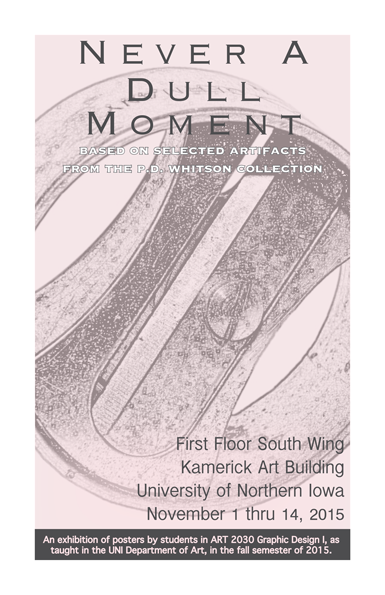 |
| Exhibition poster © Shay Peterson (2015) |
•••
Sam Kashner, When I Was Cool: My Life at the Jack Kerouac School (New York: HarperCollins, 2003), pp. 33-34—
He [novelist William S. Burroughs] liked talking about being eight years old. At that age Burroughs had a secret hiding place under the back steps of his parents' house, a secret place where he kept a box, and in the box was a spoon, a candle, and some type of instrument for investigating the forging of hard metals for weapons. It was also around the time he said that he shot off his first gun and wrote his first story. It was called "Autobiography of a Wolf," a ten-page story about an animal who lost his mate and was killed by a grizzly bear. Burroughs said his parents had listened politely to the story. "Surely you mean biography of a wolf," he father had told him. "No," Burroughs insisted. "I mean the autobiography of a wolf." They sent him to Harvard.
Pencil Sharpener Poster | Sawyer Phillips
 |
| Exhibition poster © Sawyer Phillips (2015) |
•••
Alan Bennett, Writing Home (New York: Picador, 2003), p. 179—
I am reading a book on Kafka. It is a library book, and someone has marked a passage in the margin with a long, wavering line. I pay the passage special attention without finding it particularly rewarding. As I turn the page the line moves. It is a long, dark hair.
Thursday, November 19, 2015
Pencil Sharpener Poster | Tricia Riley
 |
| Exhibition poster © Tricia Riley 2015 |
•••
George Carlin as interviewed
in David Jay Brown, Conversations on the Edge of the Apocalypse (NY:
Palgrave Macmillan, 2005), p. 191—
Pencil Sharpener Poster | Maris Price
 |
| Exhibition poster © Maris Price 2015 |
•••
George Grosz, An
Autobiography (Berkeley: University of California Press, 1998), pp. 90-91—
Pencil Sharpener Poster | Samuel Skvor
 |
| Exhibition poster © Samuel Skvor |
•••
Michael Ondaatje in Robin Robertson,
ed. Mortification: Writers’ Stories of Their Public Shame (NY:
HarperCollins, 2004), p. 129—
Halfway through the talk she began to feel sick and, knowing she was soon going to throw up, announced in a calm voice that she had left a few pages of her speech offstage, in her bag. She walked off slowly and as soon as she was out of sight ran to the bathroom and threw up noisily. She had been doing this for about a minute when someone came into the bathroom to tell her that the lapel mike was still on.
Pencil Sharpener Poster | Molly Watson
 |
| Exhibition poster © Molly Watson 2015 |
•••
David Attenborough Life on Air (London: BBC Books, 2002).
[During a live interview on
BBC, Austrian ethologist Konrad Lorenz agreed to appear on camera, unrehearsed,
with a greylag goose. Moments later,] a keeper from the London Zoo walked on to
the set carrying a goose which he put down on a low table that stood between
the professor and myself. The goose, naturally enough, was somewhat perturbed
at suddenly being thrust under the bright televison lights and began to flap
its wings.
“Komm, komm, mein Liebchen,”
said Konrad, soothingly, putting his hands on either side of the goose’s body
so that its wings were held folded down. He was holding it so that its head was
pointed away from him. This was sensible in that he was not then within range
of the goose’s beak which it showed every wish to use, if it got the chance.
But that, of course, meant that its rear was pointing towards the professor and
the goose, in the flurry, squirted a jet of liquid green dung straight at him.
“Oh dear dear,” said Konrad.
“All over der trouserz.” He released the goose, which flapped off the set and
was neatly fielded by its keeper, took out his handkerchief and carefully wiped
his trousers clean. Then, finding his handerchief in his hand, in his embarrassment,
he promptly blew his nose on it.
He completed the interview
with a green smear down the side of his face…
Pencil Sharpener Poster | Heidi Schmidt
 |
| Exhibition poster © Heidi Schmidt 2015 |
•••
Bernard Wolfe, Memoirs of a
Not Altogether Shy Pornographer (Garden City NY: Doubleday and Company, 1972),
p. 157—
Pencil Sharpener Poster | Tad Klenske
 |
| Exhibition poster © Tad Klenske 2015 |
•••
Bernard Wolfe, Memoirs of a
Not Altogether Shy Pornographer (Garden City NY: Doubleday and Company, 1972),
p. 47-48—
Pencil Sharpener Poster | Amber Claus
 |
| Exhibition poster © Amber Claus 2015 |
•••
J.J. Oppenheimer, quoted in
Robert Bruce Williams, ed., John Dewey, Recollections (Washington DC:
University Press of America, 1970), pp. 123-124—
Tuesday, November 17, 2015
Pencil Sharpener Poster | Rachel Bartholomay
 |
| Exhibition poster © Rachel Bartholomay 2015 |
•••
John C. Thirlwall, quoted in
Robert Bruce Williams, ed., John Dewey, Recollections (Washington DC:
University Press of America, 1970), p. 157.
Pencil Sharpener Poster | Reilly Stratton
 |
| Exhibition poster © Reilly Stratton 2015 |
•••
Ginu Kamani, “Code Switching”
in Meri Nana-Ama Danquah, ed., Becoming American: Personal Essays by First
Generation Immigrant Women (New York: Hyperion, 2000), p. 99—
Subscribe to:
Posts (Atom)