Showing posts with label misrepresentation. Show all posts

Monday, April 11, 2022

blind prejudice / the thing to fear is fear itself

Gypsy family, public domain
Jay Partridge, A Wonderful Experience: A Memoir. Independence IA: Privately published, no date, p. 29—
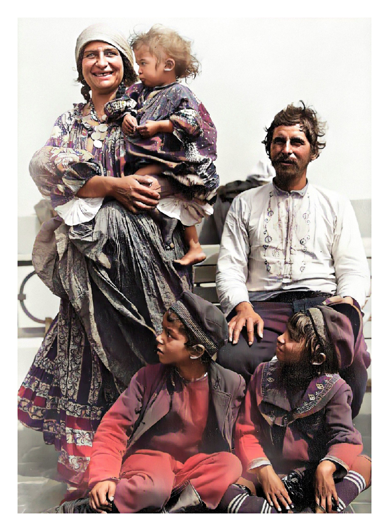
[Growing up in southern Iowa] I remember only one fear I had when I was a child. It was a fear of Gypsies. Someone said Gypsies steal little boys to work for them. Every year Gypsies would camp over-night, sometimes stay a day or two, at the Mount Vernon school grounds on the corner west of the house.

Their dark skin, black hair and long dark dresses with capes or shawls all scared me. Mom thought their dress was better to hide things they stole. She always tried to keep them out of the house. They were always coming over to get something to eat and feed for their horses.

They traveled in little buildings on wagons pulled by horses. Sometimes there might be five or six loads of them. Seemed like next morning our cows never gave as much milk. The folks always though the Gypsies had come during the night and milked the cows. The folks also thought some chickens, eggs, feed, and maybe a pig were missing after the Gypsies were gone.

Anyway, I breathed easier when they left, because then I knew three little boys they hadn’t stolen.

 ••• 

William L. Shirer, 20th Century Journey. New York: Simon and Schuster, 1976, p. 83—

[While growing up in Cedar Rapids IA] The fear of Indians by the acquisitive white settlers persisted for some time…Sometimes a stray and hungry Indian from the nearby Tama Reservation would come to the back door of our house to beg food and my worried mother would lock the doors and windows and, if the man persisted in knocking, call the police. We were brought up to believe that “the only good Indian was a dead Indian” and nothing was said to us in those days of the cruel and savage slaughter and the robbery of the Indians by the white Americans, one of the darkest sides of our history.

Monday, February 14, 2022

i can always remember the place on a page…

Max Eastman, Enjoyment of Living. New York: Harper and Brothers, 1948, pp. 54-55—

I never remember anything without remembering its position. I can always predict the place on a page where I will find a missing quotation, even when I cannot remember the book that contained it. I can recall now the exact position in which I sat, and the position in which another person sat in relation to me, when he or she threw a cigarette stub and burned a hole in my sweater, but I cannot remember who it was, or where it was, or when it was, or what color the sweater was, or how I felt about it. This keen sense of spatial relation has something to do, I suppose, with my pleasure in putting things in order whether in a room, an essay, or an argument. I am not overconfident of my taste in colors or sounds, but I am always ready to state categorically whether a composition is good. Sometimes in a hotel room I feel so crisscross that I move the bed and bureau into their places before I can go happily to sleep.

Tuesday, November 23, 2021

WWI American actions and attitudes at home

Above 19th century Victorian wood type catalog page, 1874. Public domain.

•••

Edward Robb Ellis, Life in the United States 1914-1918. New York: Coward, McCann and Geoghegan, 1975, p. 428, describing the actions and attitudes of Americans during World War I, after the US declared war against Germany—

Anything mindful of German culture became suspect. Vigilantes inspected public libraries and invaded private homes and burned books by Goethe and Heine and Kant, broke Victrola records that preserved the music of Beethoven and Bach and Wagner. School after school forbade the teaching of the German language, while in clubs and churches and halls there was a ban against speaking German. [In the Iowa home of my father's parents, whose parents had immigrated from Germany in the 1850s, German was guardedly only spoken at home.]

With trembling fingers people plucked their gardens free of bachelor buttons, which was Germany’s national flower. Sauerkraut was renamed Liberty cabbage, hamburger became Salisbury steak. German measles were called Liberty measles, German dishes disappeared from restaurants, seed catalogs referred to German clover as Liberty clover, and bartenders removed pretzels from their free lunch counters.

Saturday, October 10, 2020

Diversion by wagging the dog whistle

Eviatar Zerubavel, HIDDEN IN PLAIN SIGHT: The Social Structure of Irrelevance. New York: Oxford University Press, 2015, pp. 47-48—

…diversionary tactics are sometimes also used by politicians to keep certain things out of the public's awareness. They thus strategically time unpopular or embarrassing acts such as announcing controversial appointments or firing senior officials, for example, to coincide with other events that they hope will overshadow them. They likewise manufacture crises (and might even start wars) to divert the public's attention from economic problems or political scandals—a tactic also known since Barry Levinson's [1997] cinematic account of such an attempt at "wagging the dog." "'To wag the dog,'" in other words, means "to purposely divert attention from what would otherwise be of greater importance, to something else of lesser significance."