Showing posts with label Civil War. Show all posts

Sunday, September 7, 2025

Webster City, Iowa / author witnesses atrocities

Near the end of WWII, [Iowa-born novelist Mackinlay] Kantor was serving in Europe as an American war correspondent. Embedded with the US Army, he arrived at Buchenwald, the German concentration camp, in April 1945, one day after its liberation by the Allies.

Twelve days later, he wrote a letter to his wife, Irene, attempting to convey the dread of what he had recently witnessed. That letter has survived and is quoted in a memoir by the couple’s son. While its content is disturbing, it does not begin to compare with the horror of having been present.

Shortly after the end of WWII, Kantor embarked on writing Andersonville, for which he won the Pulitzer Prize. During the American Civil War, Andersonville had been a camp for Union POWs, where 13,000 prisoners died from malnutrition, scurvy, diarrhea, and dysentery.

In side-by-side comparisons of photographs of starving inmates in German concentration camps and the barely-surviving prisoners at Andersonville, the resemblance is all too disturbing—especially at this moment when the world is once again at war, and non-combatant fatalities and other atrocities are as commonplace as ever.

•••

The full story is told in a new book of essays by Roy R. Behrens, titled DREAMS OF FIELDS: Memory Traces of Iowa’s Past (Ice Cube Press 2025), which can be ordered online here.  

Friday, March 15, 2019

Oh, the farmer and the cowman must be friends

Dude (2019)
Rodgers and Hammerstein, Oklahoma! (1943)—

The farmer and the cowman should be friends,
Oh, the farmer and the cowman should be friends.
The cowman ropes a cow with ease, the farmer steals her
butter and cheese,
But that's no reason why they cain't be friends—

Oh, the farmer and the cowman should be friends.

•••

The American poet Robert Penn Warren (whose voice I love to listen to) came from Southern roots, and some of his ancestors had served on the Confederate side during the American Civil War. In Warren's wonderful memoir (which I have just finished reading), Portrait of a Father (Lexington: University Press of Kentucky, 1988), he recalls a misunderstanding he had when, as a boy, he was visiting his maternal grandfather's home. Here's the story—

There was another remark among the daughters which seemed related to the notion that the old man [his grandfather] was a visionary. They had said, more than once in their protracted and loving diagnosis of their father, that he was a "Confederate reader." Or so it seemed. I would wonder what a "Confederate reader" might be. But as my vocabulary widened, it suddenly dawned on me that the old man was an "inveterate reader." In fact, he was. As long as eyes held out.

Saturday, August 25, 2018

Frederick Douglass Poster | Libby Schwers

Above This wonderfully eloquent poster is the work of Libby Schwers, graphic design student in the Department of Art, University of Northern Iowa. She designed it in connection with her internship (working under Sarah Pauls) in the Marketing and Promotions section of the Office of the Dean of the College of Humanities, Arts and Sciences (2018).

•••

UNI Frederick Douglass POWER OF WORDS Festival. September 18-22, 2018 at the Rod Library on the UNI campus. Social Justice | Human Rights.

Tuesday, October 9, 2012

Walt Whitman | Maggie Reifert

Portrait of Walt Whitman (2012) © Maggie Reifert

Above A few weeks ago, in a class about designing digital images, I asked my students to invent "interpretive portraits" of extraordinary men or women from the past, sung or unsung. One of the most interesting results was this image of American writer (poet, essayist, journalist) Walt Whitman (1819-1892), designed by Maggie Reifert.

***

Algernon C. Swinburne—

…he [Whitman] is a writer of something occasionally like English, and a man of something occasionally like genius.

***

John Jay Chapman—

In Whitman's works the elemental parts of a man's mind and the fragments of imperfect education may be seen merging together, floating and sinking in a sea of insensate egotism and rhapsody, repellent, divine, disgusting, extraordinary.

Saturday, April 24, 2010

Rope Trick


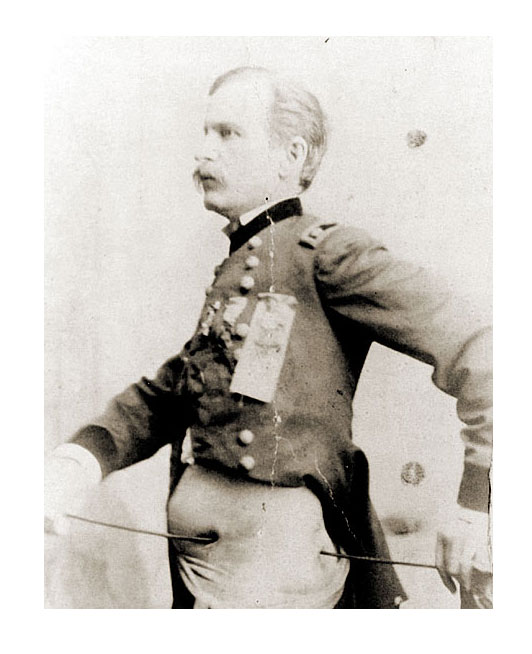
Above Historical photograph of US Civil War General Henry A. Barnum (1833-1892), who received what should have been a mortal gunshot wound through the left hip at the Battle of Malvern Hill in 1862. Although he survived, the wound became infected and required that an oakum cord (shown here) be passed through the bullet hole several times daily, to enable it to drain. There is an account of this in the autobiography of S.J. Woolf, Here Am I. New York: Random House, 1941, p. 13—

Among his [father's] friends were many Civil War veterans. The one with whom he was most intimate was General Henry Barnum, who had been on Sherman's staff during the war. Barnum had been wounded at Malvern Hill. With a bullet through his hip, he had been left for dead on the battlefield. Someone noticed him moving and he was carried to the hospital. He eventually recovered, but the wound was not permitted to close and all his life he carried a rope through it, which he had to pull back and forth a certain number of times every day.