Showing posts with label books. Show all posts

Tuesday, January 6, 2026

I mean the thing you use to rub out mistakes

Altered book montages, Roy R. Behrens © 2004
Bessie Head
[South African novelist], "Some Happy Memories of Iowa" in Paul Engle, et al., editor, The World Comes to Iowa (Ames: State University of Iowa Press, 1987), pp. 86-87—

American English isn't the British English that is spoken in southern Africa. I walked into a stationery shop and said to the man behind the counter, "I would like to buy a rubber, please." The man said: "We don't sell them in ones. We sell them in threes." I said: "But I want only one rubber." The man became hostile: "But I told you we only sell them in threes." I said: "All right, I'll take three then." The man walked to the back of the shop and returned with a small packet of prophylactics that he handed to me. He had such a peculiar look in his eyes that I thought he believed I was a prostitute who had suddenly invaded Iowa City. Half fainting with shock I struggled to explain, "I mean the thing you rub mistakes out with." "Oh," he said, "you mean an eraser."

awaiting the shared use of a set of false teeth

Altered book montages, Roy R. Behrens © 2004
Kingsley Amis
, Memoirs (New York: Summit Books, 1991), p. 1.—

[My paternal grandfather] was a great teller of jokes, typically without preamble, to trap you into thinking you were hearing about some real event. One of these horrified me so much [as a child] that I have never forgotten it. A Scotsman (I was still so young that I had not heard about Scotsmen being supposed to be mean) took his wife out to dinner. Both order steak. The wife started eating hers at top speed, but the man left his untouched. "Something wrong with the steak, sir?"—" No, no, I'm waiting for my wife's teeth." I had not then heard of false teeth either, and imagined the living teeth being torn from the woman's jaws on the spot and inserted into her husband's.

milkman comes up the walk and pauses to talk

Altered Book Montages / Roy R. Behrens © 2004
Susanah Mayberry
, My Amicable Uncle: Recollections About Booth Tarkington (West Lafayette, IN: Purdue University Press, 1983), p. 4—

Early one morning during this period he [Booth Tarkington] went for a walk after an unusually long writing session. He met the milkman coming up the walk and stopped to talk: ''You been up all night?" he [the milkman] asked. ''Yes," I answered. "What you been doin'?" he went on. "Working," said I. "Workin'!" said he. "What at?" "Writing," said I. "How long?" said he. "Since yesterday noon," said I. "About sixteen hours." "My God," said he. ''You must have lots of time to waste!"

Sunday, September 7, 2025

Webster City, Iowa / author witnesses atrocities

Near the end of WWII, [Iowa-born novelist Mackinlay] Kantor was serving in Europe as an American war correspondent. Embedded with the US Army, he arrived at Buchenwald, the German concentration camp, in April 1945, one day after its liberation by the Allies.

Twelve days later, he wrote a letter to his wife, Irene, attempting to convey the dread of what he had recently witnessed. That letter has survived and is quoted in a memoir by the couple’s son. While its content is disturbing, it does not begin to compare with the horror of having been present.

Shortly after the end of WWII, Kantor embarked on writing Andersonville, for which he won the Pulitzer Prize. During the American Civil War, Andersonville had been a camp for Union POWs, where 13,000 prisoners died from malnutrition, scurvy, diarrhea, and dysentery.

In side-by-side comparisons of photographs of starving inmates in German concentration camps and the barely-surviving prisoners at Andersonville, the resemblance is all too disturbing—especially at this moment when the world is once again at war, and non-combatant fatalities and other atrocities are as commonplace as ever.

•••

The full story is told in a new book of essays by Roy R. Behrens, titled DREAMS OF FIELDS: Memory Traces of Iowa’s Past (Ice Cube Press 2025), which can be ordered online here.  

Friday, August 22, 2025

Fort Atkinson IA: a sad Machine Age sacrifice

Fort Atkinson, Iowa
What can we do? Probably nothing, one suspects, as we witness individual lives daily impaired (while others of course are enabled) by the radical changes brought about by the “digital revolution”? 

I am reminded of the previous century and the devastating consequences of the “industrial revolution.” It took the lives of both my grandfathers, far in advance of my being born. 

One died from the lingering effects of his hand being mangled in a butterpress, when a fellow worker standing by inadvertently hit the power switch as my grandfather tried to repair the machine. The other died in a farm field, while helping his neighbors in harvesting wheat. 

In my new book, DREAMS OF FIELDS: Memory Traces of Iowa’s Past (Ice Cube Press 2025) I tell the story of my grandfather’s death in a threshing machine, and how his wife and children (my father among them) somehow survived the following year by living in the ruins of an old US Army fort in northeast Iowa, called Fort Atkinson, adjacent to the Iowa town with the same name. Available to purchase now.

More info


Thursday, August 24, 2023

new poetry book with Mary Snyder Behrens art

It has been a pleasure to learn today about the upcoming publication of a new book of poetry by American poet J.D. Schraffenberger, titled American Sad. Its projected publication date is February 2024, but copies can be pre-ordered now, at an advance sale discount price. The author is editor of the North American Review and professor of English at the University of Northern Iowa. More book information, examples of the author's poems, and ordering information can be found here.

Full disclosure: Personally, I am especially pleased that a major artwork by my wife, Mary Snyder Behrens, as been chosen by the author for use on the cover. I live with this work, since it has been on view in our dining room for years, and I pass it multiple times in the course of a day. It is large, for the scale of a dining room wall (48h x 30w x 4d), encased in a plexiglas cover, and so multi-faceted and visually provocative that one cannot help but be drawn in. Titled American Canvas II, it is one of several comparable-sized, related works that she completed in 2002 (can it really have been 21 years ago?).  All of them are mixed media, dimensional compositions of cast-off detritus from our farm, bits of junk that farmers buried years ago (in the manner of amateur landfills), and which, during heavy rains, rise up again to the surface—and, in some cases, cause us harm. 

I for one could not be more delighted that the writer J.D. Schraffenberger has found some strand of common ground between the art he makes with words, and the visual verse that Mary constructs.

Monday, June 19, 2023

a new practical guide to art in relation to seeing

coming soon
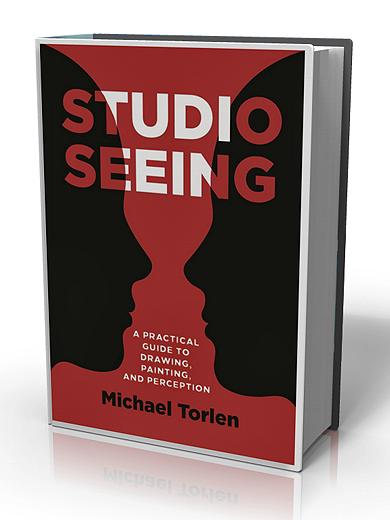
There’s a new book in the works—it isn't out yet, but it's coming. Issued by the University of Chicago Press, it will soon be available in hardbound, paperback, and E-book formats. The title peaks my interest: STUDIO SEEING: A practical guide to drawing, painting, and perception. It is due out in September. The author is Michael Torlen, a painter, printmaker and writer who retired from teaching in 2012, and now resides in Maine. A graduate of Ohio State University and Cranbrook Academy, he taught courses in visual arts for many years at the University of Georgia at Athens, and at Purchase College in New York.

How do I know him? I don’t, or at least we've never met in person. But we are well-acquainted “online,” as they say, because about ten years ago, by chance we discovered that we have a common interest in, not just art and vision, but in the writings and teaching practices of an artist / teacher (in the 1940s and thereafter) named Hoyt Sherman. At OSU, Sherman was the teacher of Pop Artist Roy Lichtenstein. But he was also the teacher of one of my most influential teachers, a man named David Delafield. Torlen’s link to Sherman is far more direct: he earned an MFA at OSU and actually worked closely with Sherman.

My additional interest in Sherman is through his connection to artist and optical physiologist Adelbert Ames II, who invented the Ames Demonstrations, about whom I have written, and more recently made a three-part documentary video on.

At OSU, Sherman reconstructed many of the Ames Demonstrations. But the achievement for which he was famous (or, as his detractors would probably say, “infamous”) was his attempt to teach drawing in the dark. He devised a method of teaching drawing in a pitch dark studio (called a “flash lab”) in which his students drew from abstract images that he projected on a screen, using a tachistoscope, for a fraction of a second. His students included members of the OSU football team, who (it was claimed) improved their passing accuracy by wearing a hooded contraption called a “flash helmet.”

Judging from its table of contents (as well as the title), the key concern in Torlen’s book is perception in relation to art, from the view of a long-experienced teacher. You can learn much more about him as well as updates on his book at <https://www.michaeltorlenauthor.com/>.


Monday, March 27, 2023

South Bear School reopens for summer 2023


In a series of online talks on the history of design that I recently gave for Drake University's OLLI life-long education program, I spoke about the Bauhaus, which began in Germany in 1919. I discussed the influences of its teachers and students, some of whom emigrated to the US, where they joined existing schools or established their own. One of those schools was called Pond Farm, near Guerneville CA, where Marguerite Wildenhain worked with about twenty students each summer. 


Iowa potter Dean Schwarz and I were among her students in 1964. He returned in later years to be her assistant, and then established his own summer school, called South Bear School, near Decorah IA. He and his wife, writer Geraldine Schwarz, compiled and edited a huge, rich book about Wildenhain's life, titled Marguerite Wildenhain and the Bauhaus: An Eyewitness Anthology (South Bear Press, 2007), as shown in illustrations here. 


South Bear School, Decorah IA
The senior Schwarzes have retired, but there is a coalition of younger ones who are carrying on the tradition. In the coming summer (2023), they are again offering workshops at South Bear School, and the call for registration is out. More online information is here.

Monday, February 20, 2023

novelist jerzy kosinski / visage of a painted bird

The Embellished Bird
James Park Sloan, Jerzy Kosinski. New York: Dutton, 1996, pp. 336-337—

On weekends he [the novelist Jerzy Kosinski] sometimes went with George and Freddie Plimpton and their crowd to Pimpton’s mother’s place in West Hills, where parlor games were the order of the day. They playing hiding games like “murder” and “sardines”…To Plimpton’s surprise, after all his talk about hiding, in his apartment and during the war, Kosinski was not particularly good at the hiding games…
On the other hand, he demonstrated his ability to fold himself neatly into a bureau drawer, and when the situation was under his control, he played his usual pranks. 

••• 

Gabrielle Selz, UnStill Life. W.W. Norton, 2014, p. 145—

In between her crying jags [in response to her husband’s departure], she [the author’s mother] dated. Once a man with thick black hair and the large beaked nose of a bird came to the front door to pick her up. He was introduced as Jerzy Kosinski, the author of a controversial book my mother had on her shelf, The Painted Bird, about a boy surviving the Holocaust. They didn’t go out for long. Kosinski was an eccentric who liked to disappear. Mom once discovered him curled up and hiding in a large bureau drawer. He was too strange for her tastes.

Tuesday, November 8, 2022

Armitage as impressario and aristocrat of art

Above I have written about the American graphic designer Merle Armitage because he was, undoubtedly, an accomplished book designer, whose primary income came from his activities as a "booking agent" or "impressario" for prominent performing artists, among them Anna Pavlova, Amelita Galli-Curci, Rosa Ponselle, and the Diaghilev Ballet. He wrote books about these and other artists because, as he once explained to Henry Miller, it provided him with the opportunity to design books, which is what he most enjoyed. My long essay on his life is online here. At the same time, I have also known that some of his personal qualities were less than admirable. I was reminded of that as I recently read this passage in Ione Robinson's autobiography (below).

•••

Ione Robinson, A Wall to Paint On. New York: E.P. Dutton, 1946, page 79—

The heat is stifling, and I have spent most of the day sitting [in Los Angeles] in the Plaza waiting to meet the Mexican Consul. I tried to forget the heat by reading something Merle Armitage gave me as I was leaving: a copy of his address before the California Art Club's Open Forum. It didn't help me bear the heat; in fact, it really frightened me, because Mr. Armitage seems to want to be the Lorenzo de Medici of Los Angeles. Already everyone listens to him, and the younger artists at home are under his thumb, simply because he can afford to buy a canvas when he wants to (although he never spends over a certain amount on any canvas, which is so small that in the end it does not really help a poor painter). But in this speech he is trying to prove that there is an “aristocracy in art”: he carefully quotes Webster on the definition of Aristocrat and Common, and then tries to twist a special meaning out of these words that will justify his right to judge esthetics. I really believe that he would like to feel that he is the arbiter of greatness in the art of our time. He believes that the masses of people have nothing to contribute to art, nor is their judgment to be relied upon, and argues that without people like himself there would never have been artists and writers like El Greco and Voltaire. What he forgets is that El Greco and Voltaire painted and wrote for the people, and not just for men like Merle Armitage. He actually wrote this: “How can the really common people have anything in common with, anything of sympathy for, as aloof and aristocratic a thing as art? If left to the common people, and I use the word ‘common’ as I have previously defined it, there would be no art.” The reason this frightens me is because Mr. Armitage is already the manager of the Los Angeles Grand Opera Association, and now seems on the verge of being the impresario of painters in California. I am glad I'm going to Mexico.

Ione Robinson (source)


Sunday, April 3, 2022

ham and bacon / let's say eggs for both of them

Vintage print advertisement
Richmal Crompton, William’s Treasure Trove. UK: George Newnes Ltd, 1962.

“I incline to the theory that the plays of Shakespeare were written by Bacon.”

“How could they be?” said William …“How could that man Ham—“

“I said Bacon.”

“Well, it’s nearly the same … Well, if this man Bacon wrote them, they wouldn’t put this man Shakespeare’s name on the books ...”

“Now, boys, I want you all please to listen to me … There was a man called Hamlet—“

“You just said he was called Bacon,” said William.

“I did not say he was called Bacon.”

“Yes, ‘scuse me, you did … When I called him Ham, you said it was Bacon, and now you’re calling him Ham yourself.”

“This was a different man…Listen! This man was called Hamlet and his uncle had killed his father because he wanted to marry his mother.”

“What did he want to marry his mother for?” said William …

“It was Hamlet's mother he wanted to marry.”

“Oh, that man what you think wrote the plays.”

“No, that was Bacon.”

“You said it was Ham a minute ago … I tell you what,” said William confidingly, “let's say Eggs for both of them.”

Thursday, March 31, 2022

Robert Frost / let what burrs will stick to them

Nature-Themed Poster © Roy R. Behrens 2019
Louis Untermeyer, FROM ANOTHER WORLD: The Autobiography of Louis Untermeyer. New York: Harcourt, Brace and Company, 1939—

…[the poet Robert Frost] was the friend of [British poet and critic Lascelles] Abercrombie whom [American poet Ezra] Pound had challenged to a duel, the weapons to be unsold copies of their books at thirty paces. (p. 208)

[Frost] wrote to me: “There are two types of realist—the one who offers a good deal of dirt with his potato to show that it is a real one, and the one who is satisfied with the potato brushed clean. I’m inclined to be the second kind. To me the thing that art does for life is to clean it, to strip it to form.” (p. 209)

[Quoting from Frost’s preface to his own Collected Poems:] “Scholars and artists thrown together are often annoyed at the puzzle of where they differ. Both work from knowledge; but I suspect they differ more importantly in the way their knowledge is come by. Scholars get theirs with conscientious thoroughness along projected lines of logic; poets theirs cavalierly and as it happens in and out of books. They stick to nothing deliberately, but let what will stick to them like burrs where they walk in the fields.” (p. 210)

Monday, February 28, 2022

hurly burly Morris with few detachable phrases

Review of Linda Parry, William Morris
Above Opening page of our published review of Linda Parry's biography of Arts and Crafts legend William Morris, as published in PRINT magazine (January / February 1997). Morris is featured briefly in the autobiography of one of his admirers, the Irish poet William Butler Yeats. In the passage quoted below, Yeats refers to Morris as having a "burly body." In reference to that, British satirist / caricaturist Max Beerhohm once wrote that Morris was "a wonderful all-round man, but the act of walking round him always tired me."

•••

William Butler Yeats, The Autobiography of William Butler Yeats: Consisting of reveries over childhood and youth, the trembling of the veil, and dramatic personae. New York: Macmillan, 1953, p. 89—

He had few detachable phrases, and I can remember little of his speech, which many thought the best of all good talk, except that it matched his burly body and seemed within definite boundaries inexhaustible in fact and expression. He alone of all the men I have known seemed guided by some beast-like instinct and never ate strange meat. “Balzac! Balzac!” he said to me once, “Oh, that was the man the French Bourgeoisie read so much a few years ago.” I can remember him at supper praising wine: “Why do people say it is prosaic to be inspired by wine? Has it not been made by the sunlight and the sap?” and his dispraising houses decorated by himself: “Do you suppose I like that kind of house? I would like a house like a big barn, where one ate in one corner, cooked in another corner, slept in the third corner, and in the fourth received one's friends”; and his complaining of Ruskin's objection to the underground railway [the Tube, the London subway]: “If you must have a railway the best thing you can do with it is to put it in a tube with a cork at each end." I remember, too, that when I asked what led up to his movement, he replied: "Oh, [John] Ruskin and [Thomas] Carlyle, but somebody should have been beside Carlyle and punched his head every five minutes.”

Saturday, June 12, 2021

if you want to see the sisters in their wimples

view larger
Above Roy R. Behrens, Baseline Shift. Digital montage, © 2021.

•••

Lawrence Crumb—

If you want to see the sisters in their wimples with the pimples on their dimples, making laces for the faces of the acolytes in surplices, with purples for the trimmings of the cassocks of the canons of the bishop of the diocese of Fond du Lac—you’re too late! They just passed by.

Friday, June 11, 2021

a crow crowd in the morning and made a noise

more
Above Roy R. Behrens, Baton Rouge. Digital montage, © 2021.

•••

Alex Osborn, Applied Imagination. New York: Scribner’s, 1963—

What is a double petunia? A petunia is a flower like a begonia. A begonia is a meat like a sausage. A sausage-and-battery is a crime. Monkeys crime trees. Tree’s a crowd. A crow crowd in the morning and made a noise. A noise is on your face between your eyes. Eyes is the opposite of nays. A colt nays. You go to bed with a colt, and wake up in the morning with a case of double petunia.

Friday, May 21, 2021

metaphor / two things come together as one

view larger

Above
Roy R. Behrens, Bird Repair. Digital montage, © 2021.

•••

Robert Frost

Man likes to bring two things together into one…He lives by making associations, and he is doing well by himself and in himself when he thinks of something in connection with something else that no one ever put with it before. That's what we call a metaphor.

the one way by which new ideas come about

view larger
Above Roy R. Behrens, Carry Out. Digital montage, © 2021.

•••

Francis A. Cartier—

There is only one way in which a person acquires a new idea: by the combination or association of two or more ideas he already has into a new juxtaposition in such a manner as to discover a relationship among them of which he was not previously aware. An idea is a feat of association.

the unlikely marriage of cabbages and kings

view larger
Above Roy R. Behrens, Bid Adieu. Digital montage, © 2021.

•••

Arthur Koestler, The Act of Creation

The essence of discovery is that unlikely marriage of cabbages and kings—of previously unrelated frames of reference or universes of discourse—whose union will solve the previously unsoluable problem.

Saturday, May 15, 2021

something you will remember all your life

view larger
Above Roy R. Behrens, Her Master's Voice. Digital montage, © 2021.

•••

Norman Lewis, Jackdaw Cake: An Autobiography. London: Hamish Hamilton, 1985, pp. 7-8—

As confidence and sympathy began growing between us, my Aunt Li and I took to wandering round the countryside together. Li was a small woman, hardly any bigger than me. She would wet me with her tears, and I would listen to her sad ravings and sometimes stroke her hand. One day she must have come to the grand decision to tell me what lay at the root of her sorrow. We climbed a stile and went into a field and, fixing her glistening eyes upon me, she said, “What I am going to tell you now you will remember every single day of your life.” But whatever she revealed must have been so startling that memory rejected it, for not a word of what was said remains in my mind.