Showing posts with label aesthetics. Show all posts

Saturday, August 3, 2024

Temple Grandin and the Ames Demonstrations

Good news travels slowly here. I recently ran across a book by Temple Grandin (widely-known authority on autism and animal science) published in 2018, titled Calling All Minds: How To Think and Create Like An Inventor (New York: Philomel Books). In other words, it has been in print for six years—but only now have I discovered that I am mentioned by name in its pages.

Grandin is world-famous, and I have long been interested in her work. Few people are as widely admired. Since 1984, she has been the recipient of 101 prestigious awards, including honorary doctorates from the leading universities, being chosen for Time Magazine’s 100 Most Influential People, inducted into the American Academy of Arts and Science, and named as one of the Top Best College Professors in the US.

That’s phenomenal. Given all that she’s achieved, how could she possibly even attend all those award ceremonies, and still remain productive? She is one year younger than I am. I cannot begin to imagine receiving so many awards—I would never have accomplished anything. Maybe I am fortunate that the less-than-prestigous awards I've received can be counted on one hand. And I don’t have extra digits.

My interest in Grandin reached its peak in 2010, with the release of a popular Hollywood film about her life, in which she was portrayed by actress Clare Danes. At the beginning of the film, we learn about a turn of events that occured while she was in high school. She saw an educational film about the then popular laboratory experiments of American artist and optical physiologist Adelbert (Del) Ames, Jr., usually referred to as the Ames Demonstrations. The best-known of these are the Ames Window (in which a rotating window-like cut-out appears not to rotate, but to sway back and forth), and the Ames Distorted Room (in which people’s sizes appear to change as they move around a cleverly misshapen room interior).

Since Grandin and I are nearly the same age, we were probably introduced to the Ames Demonstrations at around the same time. Her response was to try to figure out how to build an Ames Room. She succeeded. As an aspiring art student, with a familarity with perpective and anamorphosis, I too replicated an Ames Room, an Ames Window, and other demonstrations, then spent a substantial amount of my life researching and writing about his development as an artist. And indeed, today I continue to publish new findings.

Over the years, I published multiple articles on the Ames Demonstrations and their significance. In the text and bibliography of her book, Grandin refers to one of my articles, published in 1987, titled “The Life and Unusual Ideas of Adelbert Ames, Jr.” In the text, she even mentions me by name, for which I am grateful, because it is far more common for other authors to make blatant use of another author’s research, but neglect to credit it as a source.

In this case, there is a peripheral downside. While I have been credited, it was disappointing to find that I was also wrongly quoted. In my article, I had quoted a published statement by prominent Harvard psychologist Jerome Bruner, who had been married to Ames’s niece. Bruner and his wife’s uncle apparently had their quibbles, and, in his autobiography (1983), Bruner discounted the impact of Ames’s research with the following statement: “It was demonstration that he [Ames] was after, not experimental manipulation. And demonstration of a kind that, I think, speaks more to the artist’s wonder than to the scientist’s. In the end, he had little impact on psychology or philosophy, but he continues to facinate artists.”

In Grandin’s book, she doesn’t mention Bruner. She states instead that it was “Roy R. Behrens, Professor of Art at the University of Northern Iowa” who “concludes that much of Ames’s work has more appeal for the artist than for the scientist. As a visual thinker, I have to disagree.” But I myself did not disparage Ames’s work. I only quoted Bruner, as one view of a prominent scientist, which, in the original article, I then qualified with a lengthy footnote on writings by others who may or may not have agreed with Bruner’s dismissive assessment.

In the end it doesn’t especially matter of course. I continue to be greatly pleased to have been mentioned by someone whose achievements are exemplary, and whose work is so well known.

•••

NOTES
Temple Grandin has also written about her interest in the Ames Demonstrations in Temple Grandin and Margaret M. Scariano, Emergence: Labeled Autistic, New York: Warner Books, 1996.

More recently, I have produced a series of three online video talks (30 minutes each) which provide an overview of Del Ames, his life and his accomplishments. These to some extent are based on my published research articles, but they also include new, surprising information that I have found more recently. These can be accessed free online at <https://youtu.be/MAEjgatMkio>, <https://youtu.be/-8gaYm2FUI0>, and <https://youtu.be/mxOEx2JLQBA>. My articles on Ames include:

Roy R. Behrens, “The Life and Unusual Ideas of Adelbert Ames, Jr,” in Leonardo, vol 20 no 3 (1987), pp. 273-279.
______________, “Adelbert Ames and the Cockeyed Room,” in Print magazine, vol 48 no 2 (1994), pp. 92–97.
______________, “Eyed Awry: The Ingenuity of Del Ames,” in North American Review, vol 282 no 2 (1997), pp. 26-33.
______________, “The Artistic and Scientific Collaboration of Blanche Ames Ames and Adelbert Ames II,” in Leonardo, vol 31 (1998), pp. 47-54.
______________, “Adelbert Ames, Fritz Heider, and the Chair Demonstration,” in Gestalt Theory, vol 21 (1999),” pp. 184–190.
 

I have also provided Ames biographical articles for Encyclopedia of Perception, Grove Online Dictionary of Art, askArt, and Allgemeines Kunstlerlexikon.


Sunday, July 9, 2023

exquisite gestural movement / the ballets russes

Above Ballets Russes poster design (©2023) Roy R. Behrens

The Ballets Russes was an itinerant ballet company begun in Paris that performed between 1909 and 1929 throughout Europe and on tours to North and South America. The company never performed in Russia, where the Revolution disrupted society. It is widely regarded as the most influential ballet company of the 20th century, in part because it promoted ground-breaking artistic collaborations among young choreographers, composers, designers, and dancers, all at the forefront of their several fields.…more>>>

Dancers pictured are Mikhail Fokine and Vera Fokina in the ballet Scheherazade.

Related Links

Saturday, May 20, 2023

the democratization of the art of brain surgery

A.A. Milne [author of Winnie the Pooh], Autobiography. New York: E.P. Dutton, 1939, pp. 310-311—

…the modern eagerness to lower standards and abolish “form” [is distressing]. It is as if democracy had said, not “[Art] shall be open to aII,” as it has every right to say, but [rather] “Achievement in [art] shall be the [assured for everyone]; which is nice for all of us, but not so good for [art]. Sometimes I think it is a pity that, having gone so far, we do not go further, and say: “Achievement in sports shall be [assured for everyone].” As a golfer I should like to be able to look contemptuously down upon the old-fashioned practice of raising the golf ball in the air, and to abolish the old-fashioned rule which says, how foolishly, that the player who does the hole in the lean number of shots shall be the winner. It is more in keeping with modern ideals (and it is also easier) to go from one point to another in a straight line rather than in a parabola, and the playing of eight shots expresses your personality, which is really all that matters, much more completely than the playing of one. But alas! in sport you can only feel superior to the champions of the past by beating them at their own game and under their own rules. In the arts you can denounce the target, change the rules, aim in a different direction, hit nothing, and receive the assurances of your friends that you are the better man.

Also see Art, Design, and Brain Research: Non-Scientific Thoughts about Neuroesthetics

Tuesday, February 14, 2023

age-old Japanese motif in Kamerick Art Building

I became interested in the design of the Kamerick Art Building (on the campus of the University of Northern Iowa) on the first day I saw it in 1990. As a job applicant, I had been invited to speak in the auditorium that day, and, while giving that talk, I recognized the logo-like pattern with which it complies. In my most recent online video talk, I conclude by telling about my realization that day, and how it would later contribute to the experience of teaching design in that building for the next three decades (from 1990-2018). I say 38 years in the film, but it was only 28 years (further confirmation that I have never been good at math).

I was never certain who designed the building (the firm was credited but not the designer). But later, around 2015, while giving a Humanities Iowa talk in a library in Des Moines, I shared that story with the audience. After the talk, a man came up from the audience and introduced himself as the building’s architect. I was delighted when he told me that all my suspicions were accurate. 


Tuesday, November 8, 2022

Armitage as impressario and aristocrat of art

Above I have written about the American graphic designer Merle Armitage because he was, undoubtedly, an accomplished book designer, whose primary income came from his activities as a "booking agent" or "impressario" for prominent performing artists, among them Anna Pavlova, Amelita Galli-Curci, Rosa Ponselle, and the Diaghilev Ballet. He wrote books about these and other artists because, as he once explained to Henry Miller, it provided him with the opportunity to design books, which is what he most enjoyed. My long essay on his life is online here. At the same time, I have also known that some of his personal qualities were less than admirable. I was reminded of that as I recently read this passage in Ione Robinson's autobiography (below).

•••

Ione Robinson, A Wall to Paint On. New York: E.P. Dutton, 1946, page 79—

The heat is stifling, and I have spent most of the day sitting [in Los Angeles] in the Plaza waiting to meet the Mexican Consul. I tried to forget the heat by reading something Merle Armitage gave me as I was leaving: a copy of his address before the California Art Club's Open Forum. It didn't help me bear the heat; in fact, it really frightened me, because Mr. Armitage seems to want to be the Lorenzo de Medici of Los Angeles. Already everyone listens to him, and the younger artists at home are under his thumb, simply because he can afford to buy a canvas when he wants to (although he never spends over a certain amount on any canvas, which is so small that in the end it does not really help a poor painter). But in this speech he is trying to prove that there is an “aristocracy in art”: he carefully quotes Webster on the definition of Aristocrat and Common, and then tries to twist a special meaning out of these words that will justify his right to judge esthetics. I really believe that he would like to feel that he is the arbiter of greatness in the art of our time. He believes that the masses of people have nothing to contribute to art, nor is their judgment to be relied upon, and argues that without people like himself there would never have been artists and writers like El Greco and Voltaire. What he forgets is that El Greco and Voltaire painted and wrote for the people, and not just for men like Merle Armitage. He actually wrote this: “How can the really common people have anything in common with, anything of sympathy for, as aloof and aristocratic a thing as art? If left to the common people, and I use the word ‘common’ as I have previously defined it, there would be no art.” The reason this frightens me is because Mr. Armitage is already the manager of the Los Angeles Grand Opera Association, and now seems on the verge of being the impresario of painters in California. I am glad I'm going to Mexico.

Ione Robinson (source)


Saturday, March 19, 2022

Vachel Lindsay | the fate of an unbroken colt

Index of American Design (Public Domain)
Eleanor Ruggles, The West-Going Heart: A Life of Vachel Lindsay. New York: W.W. Norton, 1959, pp. 185-186—

Though by day the sky was a bright Kansas blue and the sun descended on the prairie like the stroke of a golden hammer, there was darkness and death at the Weaver place. Both Frank and his brother Forrest, who worked with him, had a certain hard attractiveness—“but their cruelty,” pronounced Lindsay in his diary, “was bottomless.”

On Sunday, July 7, he was in the sitting room writing letters when he heard a fearful row out beyond the barn. Frank and Forrest were exciting themselves by disciplining Dick, a frisky broncho colt, whom they had tied up and were beating over the head—one with a doubletree [a harnessing cross bar], the other with a pitchfork handle—while Forrest plied himself with swigs of whisky so that he could be as mean as Frank.

Lindsay heard the roars, oaths, thuds of the bar and stick, whinnies of pain and tattoo of hoofs all the long afternoon till at six o’clock Frank's fat and patient wife May ran over to the barn and protested, reminding the men it was Sunday and warning them they wouldn’t be blest and would lose a day’s harvest.

On Monday morning the little broncho Dick was hitched to the reaper along with three large mules. He went dancing out to the field, looking devilish, defiantly objecting to keeping his head on a line with the others and hauling the great load almost by himself. That night he came dancing home. On Tuesday he went out again dancing for battle, but returned at night dragging and panting.

On Wednesday, just past the hottest hour, Lindsay was working in the field with Forrest. About three o’clock the pony, who till then had been feebly dancing, went mad. He strained against his halter. His eyes were distended. Blood oozed from his mouth. His hide—a mass of wounds from Sunday’s torture—was clustered thick as fly paper with thirstily sucking flies.

Lindsay, who had never quite overcome his childhood terror of horses, put fear behind him and between them he and Forrest managed to pull the lunging animal away from the mules and restrain him by two halter ropes while Frank, the more savage brother, was sent for. Frank, cursing, tried to lead Dick back to the barn, but when they reached the pasture of long uncut prairie grass the pony sank down into it and kicked the air convulsively with all four feet. Then his heart broke and he died.

“If God gives me grace,” Lindsay pledged, alone with his diary, “some day I shall write his memorial—THE BRONCHO THAT WOULD NOT BE BROKEN.”


•••

NOTE In the decades following World War I, Nicholas Vachel Lindsay (1879-1931) was among the best-known poets in the US. His most popular poems include “General William Booth Enters Into Heaven” and “The Congo.” He traveled across the country, by walking, surviving in part by “singing” his poems and working as a short-term farm worker. Overcome by financial difficulties and depression, he took his own life on December 5, 1931, by drinking a bottle of lye. 

The aesthetic value of rhymes, alliteration, and other language patterns, not unlike those that Lindsay used, are discussed in a 30-minute video here (free, with online access).

Monday, January 10, 2022

Oscar Wilde, Aestheticism, Whiskey & Peacocks

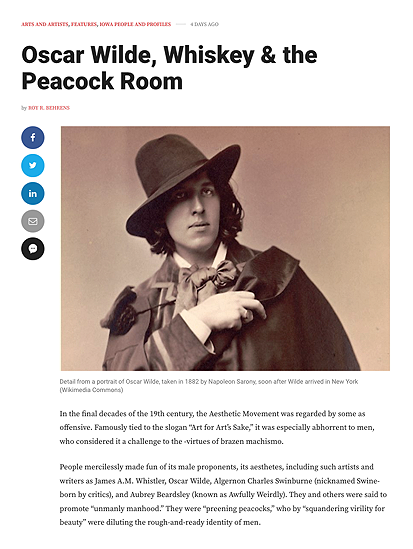
Just published is this essay on the 19th century Aesthetic Movement, and its chief proponents, the Irish playwright Oscar Wilde, and the American expatriate painter James A.M. Whistler. As "aesthetes," the two were satirized in an 1881 comic-opera by Gilbert and Sullivan, titled Patience. It became so popular in Europe that plans were made to tour it in the US and Canada. Wilde was commissioned to travel ahead to those locations to educate the audiences on the nature of aesthetics. He arrived in the US in January 1882, and departed in November, having lectured 141 times. This is an account of his tour, as well as the US acquisition of a masterpiece of the Aesthetic Movement, Whistler's co-called Peacock Room.

Thursday, April 22, 2021

a cart, a ball, and two boxes of wooden bricks

view larger
Above Roy R. Behrens, Cavern (© 2021). Digital montage.

•••

John Ruskin (Victorian-era writer and art critic), Prataerita [Of Past Things], 1899—

…I was never permitted for an instant [as a child] to hope, or even imagine, the possession of such things as one saw in toy shops. I had a bunch of keys to play with, as long as I was capable only of pleasure in which glittered and jingled; as I grew older, I had a cart, and a ball; and when I was five or six years old, two boxes of well-cut wooden bricks.

With these modest, but, I still think, entirely sufficient possessions, and being always summarily whipped if I cried, did not do as I was bid, or tumbled on the stairs, I soon attained serene and secure methods of life and motion; and could pass my days contently in tracing the squares and comparing the colors of my carpet; examining the knots in the wood of the floor, or counting the bricks in the opposite houses; with rapturous intervals of excitement during the fillling of the water cart, through its leathern pipe, from the dripping iron post at the pavement edge; or the still more admirable proceedings of the turncock, when he turned and turned until a fountain sprang up in the middle of the street. But the carpet, and what patterns I could find in the bed covers, dresses, or wallpapers to be examined, were my chief resources, and my attention to the particulars in these was soon so accurate that, when at three and a half I was taken to have my portrait painted by Mr. [James] Northcote, I had not been ten minutes alone with him before I asked him why there were holes in his carpet.

Tuesday, March 16, 2021

taxonomic rhyme and reason in esthetic forms

view larger
Above Roy R. Behrens, Suspended Animation (© 2021). Digital montage.

•••

Nicholas Humphrey, “The Illusion of Beauty” in his book of essays, Consciousness Regained: Chapters in the Development of Mind. UK: Oxford University Press, 1984, p. 126—

Here then we have the beginnings of an answer to what relations lie at the heart of beauty. “All beauty may by a metaphor be called rhyme.” What is rhyme like? Well, let us have an example: cat rhymes with mat; cat does not rhyme with table; cat does not rhyme with cat. Taking rhyme as the paradigm of beauty, let us turn at once to the fundamental question: Why do we like the relation that rhyme epitomizes? What is the biological advantage of seeking out rhyming elements in the environment? The answer I propose is this: Considered as a biological phenomenon, esthetic preferences stem from a predisposition among animals and men to seek out experiences through which they may learn to classify the objects in the world around them. Beautiful “structures” in nature or in art are those which facilitate the task of classification by presenting evidence of the “taxonomic” relations between things in a way which is informative and easy to grasp.

RELATED LINKS

Art, Design and Gestalt Theory

How Form Functions

Embedded Figures in Art, Design, and Architecture

Sunday, March 7, 2021

aesthetics / each species appears itself designed

Ogden
Above Roy R. Behrens, Ogden (© 2021). Digital montage.

•••

James Hillman, Cosmos, Life, Religion: Beyond Humanism, 1988—

Animal life is biologically aesthetic: each species presents itself in design, coats, tails, feathers, furs, curls, tusks, horns, hues, sheens, shells, scales, wings, songs, dances.

•••

Tom Driberg, Baron Bradwell, quoted in the Daily Express (1937)—

Sincerity is all that counts…Think again. Bolsheviks are sincere. Fascists are sincere. Lunatics are sincere. People who believe the earth is flat are sincere. They can’t all be right.

Saturday, February 27, 2021

if memory serves me right here are my origins

view larger
Above
Roy R. Behrens, In Point of Fact (© 2021). Digital montage.

•••

Henry Miller, quoted in Robert Snyder, ed., This is Henry, Henry Miller from Brooklyn (Los Angeles: Nash Publishing, 1974), pp. 119-121—

If my memory serves me right, here is my genealogical line, Boccaccio, Petronius, Rabelais, Whitman, Emerson, Thoreau, Maeterlinck, Romain Rolland, Plotinus, Heraclitus, Nietzsche, Dostoievski (and other Russian writers of the nineteenth century), the ancient Greek dramatists, the Elizabethan dramatists (excluding Shakespeare), Theodore Dreiser, Knut Hamsun, D.H. Lawrence, James Joyce, Thomas Mann, Elie Faure, Oswald Spengler, Marcel Proust, van Gogh, the Dadaists and Surrealists, Balzac, Lewis Carroll, Nijinsky, Rimbaud, Blaise Cendrars, Jean Giono, Céline, everything I read on Zen Buddhism, everything I read about China, India, Tibet, Arabia, Africa and of course the Bible, the men who wrote it and especially the men who made the King James version, for it was the language of the Bible rather than its "message" which I got first and which I will never shake off.


Wednesday, January 6, 2021

how structured and deliberate designers are

Above Streamlined-era magazine page layout for an Oldsmobile advertisement.

•••
Mirra Merriman in Wendy Deutelbaum and Carol de Saint Victor, “The Art of Teaching: Interviews with Three Masters” in The Iowa Review Vol 28 No I (1998), p. 13—

One of the illusions people have who don't know about the making of art is that it’s an activity that comes out of a creative surge, a genius or passion. What is missed most of the time is how deliberate and how structured the choices that artists [especially designers] make are, and how one can read in the works of art the intellectual process that was taking place in the mind of the artist.

Tuesday, November 24, 2020

be ruthless with opponents of modern painting

Cover of Hampton's Magazine (1910)

Stephen Potter
, "Notes on Exhibitionship"
in The Complete Upmanship (New York: New American Library, 1978), p. 202—

Be fairly ruthless, I think, with opponents of "modern" painting. If you are lucky enough to find a man who still says: "I don't know about pictures, but I know what I like," point out to him that because he does not know about pictures he does not know what he likes, and repeat this in a thundering voice. If he whimpers back something about it all being too advanced for him, point out exactly how many years Cézanne died before he was born, and the precise date of the exhibition of the first Modiglianis in London. Exaggerate both these dates and say, "After all, Matisse and your great-grandmother are exact contemporaries." If your man says of some picture, "Yes, but what does it mean?" ask him, and keep on asking him, what his carpet means, or the circular patterns on his rubber shoe-soles. Make him lift up his foot to look at them.

RELATED LINKS
How Form Functions
Other sources

Wednesday, November 11, 2020

standing straddle-legged, balancing as it rattled

from a plant photograph by Karl Blossfeldt
OIL PAINT AND GREASE PAINT: Autobiography of Laura Knight. New York: MacMillan, 1936. p. 173—

Sally Hicks the fish-buyer, Mrs. Porritt's friend, was big, red-faced and as strong as a man. She always drove her cart at a furious pace, standing straddle-legged and balancing it as it rattled and bumped over the cobbles. One night Sally was driving home along the cliff road with the money from the sale of her fish in her pocket. Suddenly two men sprang out of the hedge, one seizing the horse's head and one hanging on the tail of the cart. Sally had the whip in her hand and with it slashed the man off in front, then she dived back at the other with her fishgutting knife, and drove on as fast as she could lick.

When she went to clean her cart in the morning she found four fingers lying inside.

Sunday, June 7, 2020

Leacock Peacock | Entrapped by duplicity now

Montage / collage website
Stephen Leacock, Humor: Its Theory and Techniques, with Examples and Samples (New York: Dodd, Mead, 1935)—

He is the [jack]daw with a peacock's tail of his own painting. He is the ass who has been at pains to cultivate the convincing roar of a lion.

Tuesday, May 12, 2020

Privy aperture: Set right down I'll mark 'er 'round

Roy R. Behrens, front cover, Journal of Creative Behavior (1976)
Buck Johnson, quoted in Remar Sutton and Mary Abbott Waite, eds., The Common Ground Book: A Circle of Friends. Latham NY: British American Publishing, 1992, p. 272—

Cousin Sally wanted an air conditioner, so she went into Metter [Georgia] to buy one, and they said: "Miss Sally, what size you want?"

She said, "I don't know."

They said, "Well how many BTUs do you want?"

She said, "I don't know a thing in the world about BTUs. All I know is I want an air conditioner with enough BTUs to cool a b-u-t-t as big as a t-u-b." She was really large.


•••

Rockwell Kent in It’s Me O Lord: The Autobiography of Rockwell Kent. New York: Dodd, Mead and Company, 1955, p. 177—

…I laughed when he [Mr. Young, an old carpenter who worked with him in Maine] told me of “the big fat lady over on the main” for whom he was building a privy. “Now you be sure and make it big enough,” sez she. Said Mr. Young: “Lady, you set right down there and I’ll mark her ‘round.”

Roy R. Behrens, rear cover, Journal of Creative Behavior (1976)

Sunday, May 3, 2020

Entangled threesome | a walking Läocoon

Coles Phillips "fadeaway" magazine cover illustration (1916)
Above Magazine cover illustration for the October 1916 issue of Good Housekeeping by Coles Phillips (1880-1927). As shown in this example, he was especially known for paintings in which edges of the figure merge with the background. Tragically, he died of tuberculosis at the early age of 47. We reproduced another work of his in an earlier blog post.

•••

Ford Maddox Ford as quoted by Simon Nowell-Smith, compiler, The Legend of the Master (London, Constable, 1947), p. 44—

I was once walking with him [Henry James] and Mr. John Galsworthy…[whose] dachshund Maximilian ran sheep, so, not to curtail the animal’s exercise, the Master had provided it with a leash at least ten yards long. Mr. Galsworthy and I walked one on each side of James listening obediently while he talked. In order to round off an immense sentence the great man halted…He planted his [walking] stick firmly into the ground and went on and on and on. Maximilian passed between our six legs again and again, threading his leash behind him. Mr. Galsworthy and I stood silent. In any case we must have resembled the Laocöon, but when Maximilian had finished the resemblance must have been overwhelming. The Master finished his reflections, attempted to hurry on, found that impossible. Then we liberated ourselves with difficulty. He turned on me, his eyes fairly blazing, lifting his cane on high and slamming it into the ground: “H…” he exclaimed, “you are painfully young, but at no more than the age to which you have attained, the playing of such tricks is an imbecility! An im…be…cility!”