 |
| Thinking Outside the Box (2022) |
Showing posts with label inattentional blindness. Show all posts
Showing posts with label inattentional blindness. Show all posts
Sunday, November 13, 2022
Saturday, December 11, 2021
set off when we began to make nature serve us
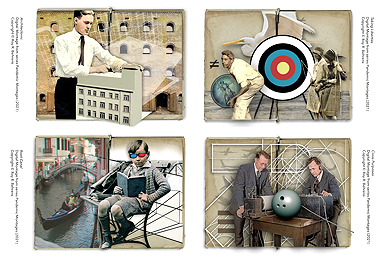 |
| Digital montages © Roy R. Behrens 2021 |
Edwin Muir, Autobiography. New York: William Sloane Associates, 1964, p. 194—
…the world has been divided into two hostile camps; and our concern has ceased to be the community or country we live in, and has become the single, disunited world: a vast abstraction, and at the same time a dilemma which, as it seems, we must all solve together or on which we must all be impaled together. This world was set going when we began to make nature serve us, hoping that we should eventually reach a stage where we would not have to adapt ourselves at all: machinery would save the trouble. We did not foresee that the machinery would grow into a great impersonal power, and that as it grew more perfect we should become more powerless and be forced at last into a position not chosen by us, or chosen in blindness before we knew where our desires were leading.
 |
| Pandemic Montage Exhibition (online) |

Tuesday, March 31, 2020
The blooming, buzzing confusion of daily life
 |
| Digital montage © Roy R. Behrens 2020 |
[Newspaper columnist] Walter Lippmann, in analyzing the creation of stereotypes that make public opinion, says: “For the most part we do not first see, and then define, we define first and then see. In the great blooming, buzzing confusion of the outer world we pick out what our culture has already defined for us, and we tend to perceive that which has been picked out in the form stereotyped for us by our culture.” And he goes on to demonstrate how largely our conclusions about the world we live in are based not on a fresh perception of experience, but on the stereotyped pictures of the world already in our heads.
Wednesday, December 25, 2013
George Carlin on Diminished Choices
 |
| Calendar page © Dana Potter (2013) |
•••
George Carlin, in an interview in David Jay Brown, Conversations on the Edge of the Apocalypse (NY: Palgrave Macmillan, 2005), p. 191—
We're given many choices to distract us from the fact that our real choices have been diminished in number. Two political parties. Maybe three or four large banks now. Credit card companies, just a couple, a handful. Newspapers, reduced. Ownership of media, reduced, down to five or six companies now. Big stock brokerage firms, reduced in number. In all of these important things we have less choice. Then we're distracted with these frivolous choices: 21 flavors of ice cream, 35 flavors of popcorn. You see specialty shops with 35 flavors of popcorn, like chocolate walnut popcorn. These are absurd distractions from what we are doing to ourselves…
Tuesday, March 29, 2011
Inattentional Blindness | Thoreau
From Henry Petroski, The Pencil: A History of Design and Circumstance. New York: Knopf, 1989, pp. 3-4—
Henry David Thoreau seemed to think of everything when he made a list of essential supplies for a twelve-day excursion into the Maine woods. He included pins, needles, and thread among the items to be carried in an India-rubber knapsack, and he even gave the dimensions of an ample tent: "six by seven feet, and four feet high in the middle, will do." He wanted to be doubly sure to be able to start a fire and to wash up, and so he listed: "matches (some also in a small vial in the waist-coat pocket); soap, two pieces." He specified the number of old newspapers (three or four, presumably to be used for cleaning chores), the length of strong cord (twenty feet), the size of his blanket (seven feet long), and the amount of "soft hardbread" (twenty-eight pounds!)…
But there is one object that Thoreau neglected to mention, one that he most certainly carried himself. For without this object Thoreau could not have sketched either the fleeting fauna he would not shoot or the larger flora he could not uproot. Without it he could not label his blotting paper pressing leaves or his insect boxes holding beetles; without it he could not record the measurements he made; without it he could not write home on the paper he brought; without it he could not make his list. [He had forgotten to mention the pencil that enabled him to make the list.]
Subscribe to:
Posts (Atom)