Showing posts with label Digital montage. Show all posts

Wednesday, January 14, 2026

slow art / deep-running skill and doggedness

Roy R. Behrens (©2011), Barbarian Seville. Digital book montage.
Robert Hughes
in "A Bastion Against Cultural Obscenity" [a speech delivered at Burlington House, London] in The Guardian, June 3, 2004—

What we need more of is slow art: art that holds time as a vase holds water: art that grows out of modes of perception and whose skill and doggedness make you think and feel; art that isn't merely sensational, that doesn't get its message across in ten seconds, that isn't falsely iconic, that hooks into something deep-running in our natures. In a word, art that is the very opposite of mass media.

Monday, March 6, 2023

Versluis and Behrens working out the Iowa bugs

Iowa Insect Series, David Versluis and Roy R. Behrens
More than ten years ago (if you can believe it), my good friend and fellow designer David Versluis (we have both since retired from university teaching) decided to collaborate. Actually, he came up with a plan, and asked if I were up to it.

Over the years, he had amassed an assortment of (kaput) Iowa insects. His proposal was to scan those, at high resolution, and to send me the scans by email, one at a time. I had free rein. After receiving the scanned image, I had to alter it someway—major or minor—for the purpose of making a digital montage, using Adobe Photoshop. I would then send it back to him, and he in turn would make a move—and pass it back to me again.

We did this fairly rapidly, and after five or six back-and-forth sessions, we soon mutually came to suspect that the work was finished. The ones that I especially recall are a beetle, a cicada, a dragon fly, and a hornet (above, in a cropped version) that was eventually found to be not a hornet but a yellow jacket wasp. In a few short weeks we ended up with a substantial, original cluster, titled the Iowa Insect Series.

After finishing the series, it was David’s initiative to print them at large scale, and to be watchful of competitions or exhibitions which they could be submitted to. For almost a decade, they were exhibited multiple times (through his efforts) at various galleries and museums around the country. The most recent one that I recall was an exhibition last year at the University of Wisconsin-Madison, called Evolving Graphic Design.

However, I have just now learned from David that two of the pieces have recently been accepted for an upcoming exhibition—called Awake! Printmaking in Action, at the Ann Arbor Art Center in Michigan, which will run from April 14 through May 28, 2023.

Friday, June 24, 2022

adrift in milan / never too late for the last supper

Wind Instrument [detail] © Roy R. Behrens
Abel Warshawsky, The memories of an American Impressionist. Kent OH: Kent State University Press, 1980, pp. 86-87—

In connection with the Last Supper, a friend of mine, Samuel Cahan, a well-known newspaper artist who had been with the New York World for thirty years, told me of an amusing incident which occured when he and his wife visited Milan a few years ago. Speaking no Italian, they had asked their hotel porter to procure an English-speaking cabby to take them about. To the latter my friend very carefully explained that they wished to see the Last Supper. "Last supper?" replied the cabby, "yes , yes. Me understand!" Whereupon he started driving them round the town and finally into the country.

After the drive had extended for several miles, my friend, fearing that there must be some mistake, repeated his instructions to the driver. "Last supper?" he yelled back, "Sure! Me understand!" and continued to drive. Late that evening the two Americans were finally brought back to the city in a state approaching nervous exhaustion. Drawing up his carriage in front of a brilliantly lit edifice, the vetturino opened the cab and ushered his fares into a fashionable restaurant, proudly giving them to understand that he had brought them back in good time for the desired "late supper."

Monday, June 13, 2022

Coming Soon / Graphic Design Symposium

Reproduced above is a sampling of on-site photographs (courtesy Taekyeom Lee) from an on-going exhibition at the University of Wisconsin-Madison, titled EVOLVING GRAPHIC DESIGN. The exhibition (which includes the work of twenty-three graphic design professionals and design educators from across the nation) continues for the next twelve days, ending on June 24. 

The concluding highlight of the exhibition will be a two-day symposium, to be held on June 23 and 24, in the Art Loft Conference Room, Art Lofts Building, in the Department of Art, University of Wisconsin-Madison at 111 North Frances Street, in Madison. Some participants are attending in-person, while others (worldwide) are registering online for free tickets, and, since it is a hybrid event, they will participate online as speakers, panelists and observers. 

Please note, although participation is free, you must register at this link in advance

Iowa Insect Series (stages animated)

Included in the exhibition is a series of ten large-scale digital montages, called the Iowa Insect Series, that were made in 2012-2013 in collaboration with design colleague and friend David M. Versluis. At the time, he was a Professor of Art and Design at Dordt College in Iowa, while I was then on the faculty at the University of Northern Iowa in Cedar Falls. 


Also on exhibit are thirteen design-related images that are part of my long-term, continuing research (as a design historian) of World War I Allied naval camouflage. The theme uniting these artifacts is high difference or disruptive ship camouflage, which was referred to at the time as dazzle painting or dazzle camouflage. Among the items exhibited are restored government photographs from the time period, full-color reproductions of diagrams of the camouflage patterns, and my own recent hypothetical camouflage schemes, derived from historical works of art.

Iowa Insect Series

Wednesday, May 4, 2022

National Parks at Jester Park Nature Center

National Park Poster © Roy R. Behrens 2019
Above I am absolutely pleased (ecstatic even) by the opportunity to exhibit at Jester Park Nature Center (in Polk County, near Granger IA) a series of 23 digital montage posters, the theme of which is US National Parks and Monuments. I actually designed these in 2019, with the thought that I would frame them and make the exhibit available to nature centers to exhibit without charge. It was a great pleasure to design them, and an even greater pleasure results when other people can enjoy them also.

The poster exhibit at Jester Park was installed earlier this week, and will remain on view at the Nature Center Galleries there through August 28. It will officially open with an in-person reception (free and open to the public), including wine and refreshments, on Thursday, May 12, from 6 to 8 pm. Sounds wonderful. 

Exhibition at Jester Nature Center

And of course it’s also an opportunity to see other on-going exhibits in the same building, including the work of glass artist Tilda Brown Swanson, as well as permanent features as well. There is additional information at this online link.

For those who live too far away, or who can’t attend in person for other reasons, the posters can easily be accessed online. For example, all the posters are the internet (click on each to enlarge it to view) at this link. But they can also be experienced in video form online at YouTube here.  

There also another online component that quite a few people have found of interest in understanding the significance of how color, shapes, and other pattern attributes contribute to animal camouflage. It’s a succinct 30-minute video talk on Nature, Art and Camouflage, also free on YouTube. A screen grab from the video is reproduced below, as is one of the National Park posters.

For the opportunity to share the posters at the Jester Park Nature Center, I am especially grateful to Missy Smith, Nature Center Coordinator, and Lewis Major, Naturalist.

video on Nature, Art and Camouflage


Monday, December 13, 2021

Phänomenal / Journal of Gestalt Psychotherapy

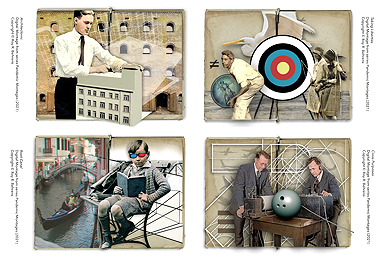
I could not be more pleased to find that four of my recent montages (above and below) have been published in the current issue of Phänomenal: The Journal of Gestalt Psychotherapy (2/2021), published in Vienna.


Saturday, December 11, 2021

set off when we began to make nature serve us

Digital montages © Roy R. Behrens 2021
Below is a passage by a Scottish poet, novelist and translator. It was written in 1964, when he was in his late 70s. As I read it, it occurred to me that the same passage could have been written today (in view of the storms that took place overnight), to describe the dilemma we find ourselves in.

Edwin Muir, Autobiography. New York: William Sloane Associates, 1964, p. 194—

…the world has been divided into two hostile camps; and our concern has ceased to be the community or country we live in, and has become the single, disunited world: a vast abstraction, and at the same time a dilemma which, as it seems, we must all solve together or on which we must all be impaled together. This world was set going when we began to make nature serve us, hoping that we should eventually reach a stage where we would not have to adapt ourselves at all: machinery would save the trouble. We did not foresee that the machinery would grow into a great impersonal power, and that as it grew more perfect we should become more powerless and be forced at last into a position not chosen by us, or chosen in blindness before we knew where our desires were leading.

Pandemic Montage Exhibition (online)

Saturday, December 4, 2021

my first choice would have been an albatross

digital montages © Roy R. Behrens

Paul Auster

What I try to do is to leave enough room in the prose for the reader to enter it fully. All the books I’ve most enjoyed, the writers I most admire, have given me the space in which to imagine the details for myself.

•••

J.B. Priestley, A Visit to New Zealand

What I couldn’t understand was why this wingless night-grubber [the kiwi] had ever been chosen as New Zealand’s national image. It was a bad move. New Zealanders should never have called themselves Kiwis. Perhaps it has been the Kiwi aspects of New Zealand life and character that encouraged visitors in the past to call them dull. Though not a unique native of the country, albatross would have been my first choice.

•••

George Ellis aka Gregory Gander [the twelve months of the year]—

Snowy, Flowy, Blowy,
Showery, Flowery, Bowery,
Hoppy, Croppy, Droppy,
Breezy, Sneezy, Freezy.

Afterthought: When I was in grade school, I remember that our teacher said that a sure way to spell geography correctly was to remember the following phrase: George Ellis' old grandmother rode a pig home yesterday. But it may be another George Ellis.

Friday, December 3, 2021

abandon your cat at Clifford's Inn in London

Pandemic montages © Roy R. Behrens 2021
At Harvard, poet Frank O’Hara’s roommate was artist and author Edward Gorey.

•••

In Lowell MA, Beat Generation novelist Jack Kerouac (author of On the Road) was in the same high school class as Ray Gouding, of the hilarious radio comedy team, Bob and Ray.

•••

Samuel Butler: “People when they want to get rid of their cats, and do not like killing them, bring them to the garden of Clifford’s Inn [in London], drop them there, and go away. In spite of all that is said about cats being able to find their way so wonderfully, they seldom do find it, and once in Clifford’s Inn the cat generally remains there.”

•••

E.L. Doctorow: “I have few vices, but one of them is moderation.”

Friday, October 29, 2021

that Lazarus was the original raised character

view larger
Above Roy R. Behrens, Wavelength. Digital montage (©2021). 

•••

Edward Robb Ellis, A Diary of the Century. New York: Kodansha, 1995, p. 222—

Tuesday, March 1, 1955: In the city room today some of us were discussing a report that the New Testament has been published in Braille. Frank [Kappler] said: “Yes—but did you know that Lazarus was the original raised character?”

•••

James Joyce, Ulysses (Chapter Six)—

“Come forth, Lazarus! And he came fifth and lost the job.”

Tuesday, October 19, 2021

living in a poky village in a backward county

view larger

Above
Roy R. Behrens, Beach Repair. Digital montage (©2021). 

•••

Maurice Browne, Too Late to Lament: An Autobiography. Bloomington: Indiana University Press, 1956, p. 30—

Mr. Pickford was one of the finest Sanskrit scholars of his day. He was very poor; he had sacrificed his life to Sanskrit and his sister. His sister kept house for him in a little village where he was rector, a few miles outside Ipswich; a dour, bitter, selfish woman whom no one liked. So, for his sister's sake, he had put aside marriage, advancement, happiness, and had taken that obscure living in a poky village in a backward county, to make her a home where were few to hate her.

One day a letter came addressed to Mr. Pickford. Through several weeks he had been hoping for it; if it came, it might offer him an academic position where he could carry to fruition his life's work in Sanskrit. Every morning his sister went downstairs to meet the postman and see whether the letter had come: "No, John, it has not come today; perhaps it will come tomorrow."

Long afterwards the Vice-Chancellor in whose gift that position lay, meeting Mr. Pickford accidentally in the streets of Ipswich, greeted him coldly: "I considered it discourteous of you not even to have acknowledged the offer which I made you." Mr. Pickford made no comment. But, when he got back to the ugly, lonely, village rectory, he spoke to his sister. "Yes," she said defiantly, "of course the letter came; I read and burned it. I'm very happy where I am, and you're much better off in a place suited to you."

A little later…[Mr.] Pickford killed himself. My father [an Anglican clergy] preached his funeral sermon. There was no mention of, no hint of reference to, that story in it; but the Stoic view of self-murder was upheld by the Anglican preacher [who years later did the same].

Sunday, October 17, 2021

rudimentary multiple nipples on a hydroplane

view larger
Above Roy R. Behrens, Horn of Plenty. Digital montage (©2021). 

•••

Maurice Browne, Too Late to Lament: An Autobiography. Bloomington: Indiana University Press, 1956, pp. 257-258—

[This is Browne’s account of time spent at the home of the parents of his friend and associate Robert Bell, whose] father, an eminent banker, terrified me, but I sat rapturously at his mother's feet; she had as many laughter-wrinkles round her eyes as there are waves in a field of corn.

One evening her famous brother-in-law, Alexander Graham Bell—Telephone Bell, as we younger folk inevitably nicknamed him—brought his charming deaf-mute wife [née Mabel Hubbard] to dinner as it was her disability which had first led him to the study of sound. During dinner he talked of a new hydroplane which he was building, the intensive breeding of sheep and rudimentary multiple nipples on human beings. Not one of us had an elementary acquaintance with one of his subjects, yet he held us all spellbound. After dinner his nephew and I steered him carefully into a corner: “How on earth did you keep us so interested in things of which we knew nothing?” For two memorable hours the old man thought aloud. Finally he reached a conclusion. “It is not primarily what a speaker says which interests his hearers—be he conversationalist, preacher, lecturer, actor or even writer—nor the words in which he says it, nor his manner of delivery, nor his personality; these things help or hinder but are secondary. The primary cause of sustained interest, I believe, is this. Each time that a speaker—or writer—pauses, for however infinitesimally brief a moment, he builds a bridge in his own mind over the silence between the word which he has last uttered and the word which he will utter next. If his hearers cross that bridge before him, he bores them; if they fail to cross it, or cross it too late, he loses them; if they cross it with him, he holds and keeps them.”

Wednesday, October 13, 2021

palmetto bugs / as large as mice and quicker still

larger view
Above Roy R. Behrens, Swan Lake. Digital montage (©2021).

•••
In reading the following passage from the autobiography of American artist Abel Warshawsky, I was reminded of those times in my life when I have lived in parts of the country (Hawaii and the Deep South) where apartments were inhabited by huge cockroaches, as large as mice and quicker still. 

I once climbed into the shower to find one on the curtain, and, on another occasion, I was typing in the living room on a Sunday morning when something fell from the ceiling and landed on my head—I knew immediately what it was. In the South, these are politely referred to as “pametto bugs,” but when we moved to Cincinnati, we had to pay admission to see the “live insect exhibit” at the zoo, to learn that in the North they're called the “American cockroach.” Not one of my favorite things to recall.

•••


Abel Warshawsky, The memories of an American Impressionist. Kent OH: Kent State University Press, 1980, p. 34— 

[In a Paris studio] Once accustomed to the creaking wire mattress, I slept more soundly there than I have since in many a luxurious bed—this, despite the nightly incursions of roaches, which infested our building. My horror of these beasts was insurmountable. One Sunday morning, while lying on the counch, I was discussing with my companions ways and means for ridding ourselves of this pest. Glancing up at the ceiling, I saw three of the loathsome vampires. With a cry of horror I seized my shoes and started bombarding the enemy. Roars of laughter broke from my companions, The roaches had been painted on the ceiling, while I slept, for my special benefit!

Tuesday, October 12, 2021

if you don't mind please i must leave i smell bad

view larger
Above Roy R. Behrens, Wind Instrument. Digital montage (©2021).

••• 

Abel Warshawsky, The memories of an American Impressionist. Kent OH: Kent State University Press, 1980, p. 60—

What the pitfalls of literal translation from one language to another can be, I also learned to my cost. Spending the evening with some French people I had met, I was attacked by a splitting headache and felt I must get back to my studo. Desiring to make explanation to my hosts for leaving so abruptly, I made the literal translation of “I must leave, I feel bad,” which I phrased “Il faut que je pars, je sens mauvas,” not realizing that I should have said, “Je me sens mal,” for “sentir mauvais” means “to smell bad.” This astounding avowal was too much for even French politeness, and the laughter that greeted it still rings in my ears. Such verbal faux pas were a speciality of mine in those days, and caused me often great embarrassment, for I never knew to what I might commit myself.

Tuesday, September 28, 2021

no pain yet fearful that something had happened

view larger
Above Roy R. Behrens, Egg Head. Digital montage © 2021.

•••

Fritz Heider, The life of a psychologist. Lawrence: University Press of Kansas, 1983, pp. 5 and 30—

My brother and I had little cap pistols [at around the age of ten]. These caps seemed to have remarkable properties, and I decided to experiment to find out more about them. The upshot was that something exploded in my face. Several small pieces of lead became embedded in my cheeks and forehead, and a few entered my left eye, injuring the retina. My father took me to our doctor right away. He was rather pessimistic about the outlook for the eye. I remember that I had to stay in bed for two weeks, with my eyes covered. I had no pain as I lay there, but I had a dim feeling that something of importance had happened which would influence my whole life. I could not judge whether this would be beneficial or harmful—I only knew that there was something serious about it, though I do not remember that I was unduly worried.…

[Ten years later, during World War I] I tried several times to enter the military service. I began to wonder whether I was rejected because the draft board considered the possibility that my injured eye might become infected and affect the healthy eye. So, on one bleak, wintry day in 1916 I went to the hospital, accompanied by my father, and had the damaged eye removed, to be replaced by an artificial one. But even after that change in my physical condition, I was not taken on.

Saturday, September 25, 2021

a girl from new york begged him to grow a beard

view larger

Carl Sandburg, Abraham Lincoln: The War Years. NY: Harcourt Brace, 1939—

Just why Lincoln took to whiskers at this time nobody seemed to know. A girl in New York had begged him to raise a beard. But something more than her random wish guided him. Herndon, Whitney, Lamon, Nicolay, Hay, heard no explanation from him as to why after fifty-two years with a smooth face he should now change.

Would whiskers imply responsibility, gravity, a more sober and serene outlook on the phantasmagoria of life? Perhaps he would seem more like a serious farmer with crops to look after, or perhaps a church sexton in charge of grave affairs. Or he might have the look of a sea-captain handling a ship in a storm on a starless sea. Anyhow, with whiskers or without, he would be about the same-sized target.

VIDEO LINKS

Nature, Art, and Camouflage  

Art, Women's Rights, and Camouflage

 Embedded Figures, Art, and Camouflage

 Art, Gestalt, and Camouflage


i was forced to suspect i was no longer young

view larger
Above Roy R. Behrens, Peerless. Digital montage © 2021.

•••

Samuel Johnson, in a letter to Joseph Baretti, July 20, 1762— 

Last winter I went down to my native town, where I found the streets much narrower and shorter than I thought I had left them, inhabited by a new race of people, to whom I was little known. My playfellows were grown old, and forced me to suspect that I was no longer young.

VIDEO LINKS

Nature, Art, and Camouflage  

Art, Women's Rights, and Camouflage

 Embedded Figures, Art, and Camouflage

 Art, Gestalt, and Camouflage