Showing posts with label Audubon. Show all posts

Sunday, January 13, 2019

Audubon's Birds of America Re-Interpreted

Waterloo Courier (Waterloo IA), January 13, 2019
Above Screen grab of the cover page of the Sunday Living Section of the Waterloo Courier, January 13, 2019, with an article, written by Melody Parker, about an exhibition of Audubon-themed student posters at the Hartman Reserve Nature Center, in Cedar Falls IA. Many of the same posters were posted earlier on this blog in 2017.

•••

The posters in this exhibit here were produced in the fall of 2017 by undergraduate students at the University of Northern Iowa. They resulted from a problem that was given in an introductory course in graphic design. When the course began, most of the students had little if any experience in designing, whether the process of layout (arranging parts within a page) or the use of appropriate software.

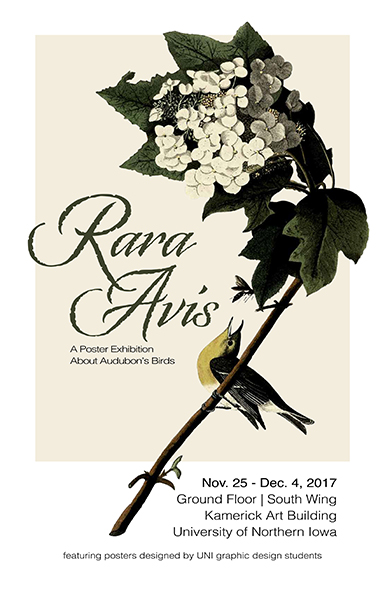
Each student was asked to design a suite of three posters that would be used to advertise an exhibition of the posters they themselves had made. Titles, dates, locations and other text components were provided, as was the agreed upon emphasis on the exhibition’s title, RARA AVIS: A Poster Exhibition About Audubon’s Birds.

All images used in the posters were extracted from online high resolution images from American naturalist John James Audubon’s famous book, The Birds of America, first published in 1827 and 1838. His paintings are now in public domain, out-of-copyright, and available freely for download at their large, original size.

The series of posters was given the name RARA AVIS to signal that these are not merely unaltered reproductions of Audubon’s original artwork. Instead, the problem required that each student reinterpret Audubon’s work. They were free to extract fragments from any of his paintings, to dissemble them, to remix and rearrange the parts. The Latin term rara avis (which translates literally as “rare bird”) is suitable for the eccentric results.

Some of the student designers whose work is represented have since graduated. The work of nine designers is shown, including Sophia Grover, Ross Hellman, Sydney Hughes, Lydia Madsen, Hanna Seggerman, Cheyenne Strelow-Varney, Mallory Thurm, Samantha White, and Charles Williams. The course instructor, UNI Professor Emeritus and Distinguished Scholar Roy R. Behrens, retired at the end of 2018 after 46 years of teaching.

Tuesday, November 21, 2017

Audubon's Birds of America | Samantha White

Audubon Poster © Samantha White 2017
Above and below Reinterpretations, in poster form, of John James Audubon's The Birds of America, designed by Samantha White, graphic design student at the University of Northern Iowa (2017).

•••

Louis MacNeice, The Strings are False: An Unfinished Autobiography. London: Faber and Faber, 1965. p. 127—

Dr. Johnson had said that the poet is not concerned with the minute particulars, with "the streaks on the tulip."  This, I thought, was just where he was wrong and just where I met Mariette on a common ground. Mariette was crazy for the streaks on the tulip. At the same time I felt she made much ado not about nothing but about the obvious or the trivial. Her conversation was like a barber's scissors when he is giving his last retouches to the back of your head, clicking away very fast, very deftly, but apparently not making contact.

Audubon Poster © Samantha White 2017

Louis MacNeice, The Strings are False: An Unfinished Autobiography. London: Faber and Faber, 1965. pp. 73-74—

At school I no longer assumed that the masters were all my superiors. Some of them were ninnies.  Mr. Cameron left us for a time and in his place we had a master from Galway—seedy, embittered, with a powerful brogue, a bad cough and always the same suit. He could not manage the chalk on the blackboard; the pieces of chalk from day to day, from month to month, harassed him with unending guerilla warfare, breaking in his hand, deploying to all corners of the room. "Damn the chark!" he would shout, hurling the remaining stub away from him. "The square on the hypotenuse is equal—Damn the chark!" And then, conscious of our grins, he would look ashamed, on the verge of tears, and surrender to a spasm of coughing.

Audubon Poster © Samantha White 2017

Saturday, October 21, 2017

Audubon's Birds of America | Mallory Thurm

Audubon Poster © Mallory Thurm 2017
Above and below Components from John James Audubon's magnificent Birds of America are reimagined in these commemorative posters by Mallory Thurm, a graphic design student at the University of Northern Iowa.

•••

Marvin Bell, A Marvin Bell Reader: Selected Poetry and Prose. Middlebury College Press, 1994—

[In Star Trek, Captain] Kirk is eating pizza in a joint in San Francisco with a woman whose help he will need, when he decides to fess up about who he is and where he has come from. The camera circles the room, then homes in on Kirk and his companion as she bursts out with, "You mean you're from outer space?" "No," says Kirk, "I'm from Iowa. I just work in outer space."

Audubon Poster © Mallory Thurm 2017


Norman Douglas, Siren Land: A Celebration of Life in Southern Italy. London: Penguin, 1948—

Bouillabaisse is only good because it is made by the French, who, if they cared to try, could produce an excellent and nutritious substitute out of cigar stumps and empty matchboxes.

Audubon Poster © Mallory Thurm 2017

Tuesday, October 10, 2017

Audubon's Birds of America | Ross Hellman

Audubon poster © Ross Hellman 2017
Above and below Components from John James Audubon's magnificent Birds of America are reimagined in these commemorative posters by Ross Hellman, a graphic design student at the University of Northern Iowa.

•••

Henry David Thoreau, Walden, or Life in the Woods, 1854—

I once had a sparrow alight upon my shoulder for a moment while I was hoeing in a village garden, and I felt that I was more distinguished by that circumstance than I should have been by any epaulette I could have worn.

Audubon poster © Ross Hellman 2017


Vaclav Havel, quoted in The New York Review of Books, January 15, 1998—

…America is an almost symbolic concentration of all the best and the worst of our civilization. On the one hand, there are its profound commitment to enhancing civil liberty and to maintaining the strength of its democratic institutions, and the fantastic developments in science and technology which have contributed so much to our well-being; on the other, there is the blind worship of perpetual economic growth and consumption, regardless of their destructive impact on the environment, or how subject they are to the dictates of materialism and consumerism, or how they, through the omnipresence of television [and the internet] and advertising, promote uniformity, and banality instead of a respect for human uniqueness.

Audubon poster © Ross Hellman 2017

Audubon's Birds of America | C. Strelow-Varney

Audubon poster © Cheyenne Strelow-Varney (2017)
Above and below Components from John James Audubon's magnificent Birds of America are reimagined in these commemorative posters by Cheyenne Strelow-Varney, a graphic design student at the University of Northern Iowa.

•••

Edmund Clerihew Bentley [inventor of the clerihew], Biography for Beginners. London" T.W. Laurie, 1905—

Sir Humphrey Davy
Abominated gravy.
He lived in the odium
Of having discovered sodium.

Audubon poster © Cheyenne Strelow-Varney (2017)


Edmund Clerihew Bentley in More Biography. London: Methuen, 1929—

George the Third
Ought never to have occurred
One can only wonder
At so grotesque a blunder.

Audubon poster © Cheyenne Strelow-Varney (2017)

Sunday, October 8, 2017

Audubon's Birds of America | Hanna Seggerman

Audubon Poster © Hanna Seggerman 2017
Above and below Components from John James Audubon's magnificent Birds of America are reimagined in these commemorative posters by Hanna Seggerman, a graphic design student at the University of Northern Iowa.

•••

Samuel Foote [nonsense text devised to test the claim of actor Charles Macklin that he could memorize anything] quoted in Maria Edgeworth, Harry and Lucy Concluded. New York: Harper and Borthers, 1842, p. 315—

So she went into the garden to cut a cabbage leaf; to make an apple pie; and at the same time a great she-bear, coming up the street, pops its head into the shop. What! no soap? So he died, and she very imprudently married the barber; and there were present the Picninnies, and the Joblillies, and the Garyalies, and the grand Panjandrum himself, with the little round button at top, and they all fell to playing the game of catch as catch can, till the gun powder ran out at the heels of their boots.

Audubon Poster © Hanna Seggerman 2017


 Melissa Meyer, quoted in Heresies (Winter 1977-78), Vol 1 No 4—

Published information about the origins of collage is misleading. Picasso and Braque are credited with inventing it. Many artists made collage before they did, Picasso's father for one and Sonia Delaunay for another.

Audubon Poster © Hanna Seggerman 2017


 Lawrence Perlman (American business executive)—

When you ask children what they want to be when they grow up, they don't say, "I want a boring job where the only thing I look forward to is Friday."

Audubon's Birds of America | Charles Williams

Audubon Poster © Charles Williams 2017
Above and below Components from John James Audubon's magnificent Birds of America are reimagined in these commemorative posters by Charles Williams, a graphic design student at the University of Northern Iowa.

•••

Camilo José Cela, Journey to the Alcarria: Travels Through the Spanish Countryside. New York: Atlantic Monthly Press, 1994—

Things are always best seen when they are a trifle mixed-up, a trifle disordered; the chilly administrative neatness of museums and filing cases, of statistics and cemeteries, is an inhuman and antinatural kind of order; it is, in a word, disorder. True order belongs to Nature, which never yet has produced two identical trees or mountains or horses.

Audubon Poster © Charles Williams 2017


Arthur Eddington, quoted in Nicolas Rose, ed. Mathematical Maxims and Minims. Raleigh NC: Rome Press, 1988—

We used to think that if we knew one, we knew two, because one and one are two. We are finding that we must learn a great deal more about "and."

Audubon Poster © Charles Williams 2017
 

Tuesday, October 3, 2017

Audubon's Birds of America | Sophia Grover

Audubon poster © Sophia Grover 2017
Above and below Components from John James Audubon's magnificent Birds of America are reimagined in these commemorative posters by Sophia Grover, a graphic design student at the University of Northern Iowa.

•••

Arthur Koestler, The Act of Creation. New York: Macmillan, 1964, p. 191—

"The great field for new discoveries," wrote William James, "is always the unclassified residuum. Round about the accredited and orderly facts of every science there ever flows a sort of dust-cloud of exceptional observations, of occurrences minute and irregular and seldom met with, which it always proves more easy to ignore than to attend to." The genius of Sherlock Holmes manifested itself in shifting his attention to minute clues which poor Watson found too obvious to be relevant, and so easy to ignore. The psychiatrist obtains his clues from the casual remark, the seemingly irrelevant drift of associations; and he has learned to shift the emphasis from the patient's meaningful statements to his meaningless slips of the tongue, from his rational experiences to his irrational dreams. [It is] the trick which [Edgar Allan] Poe's character empolyed when he let the secret document lie open on his desk—where it was too obvious to be seen. 

Audubon poster © Sophia Grover 2017

Sunday, October 1, 2017

Audubon's Birds of America | Colton Ellison

Audubon poster © Colton Ellison 2017
Above and below Reinterpretations, in poster form, of John James Audubon's The Birds of America, designed by Colton Ellison, graphic design student at the University of Northern Iowa (2017).

•••

Louis MacNeice, The Strings are False: An Unfinished Autobiography. London: Faber and Faber, 1965. p. 123—

Ireland was something new to Mariette and obliged her by appearing very Irish. A local peasant girl, who had been engaged to do the work, turned out delightfully incompetent and committed all the Irishisms beloved by English humorists. When told to clean a pair of shoes she asked "Do you mean both of them?" and when sent up to a bedroom with a hot-water bottle she would hang it on the knob of a chair. There were three itinerant butchers who visited the house in rotation and sold us whole sides of sheep. And when I walked along the road with my arm around Mariette, an old woman called out, "That's a grand way for a girl to be—linked to a boy."

…One day Mariette and I drove across the island to buy lobsters. The fishermen had only a dozen which they had contracted to send to the mainland, but Mariette's Mediterranean persuasiveness was too much for them and one of them gave us two lobsters, saying to his colleague who was in charge of the box for the mainland, "Throw in a couple of herring; they're all fish." The lobsters sat on the back seat and clacked their claws like castanets as we drove home.

Audubon poster © Colton Ellison 2017