Thursday, April 2, 2026
the sunset tree / tum, tum, tum, and tum again
•••
Samuel Butler The Way of All Flesh. London: Grant Richards, 1903, pp. 109-110—
In the course of the evening they came into the drawing room, and, as an especial treat, were to sing some of their hymns to me, instead of saying them, so that I might hear how nicely they sang. Ernest was to choose the first hymn, and he chose one about some people who were to come to the sunset tree. I am no botanist, and do not know what kind of tree a sunset tree is, but the words began, ‘‘Come, come, come; come to the sunset tree for the day is past and gone.” The tune was rather pretty and had taken Ernest’s fancy, for he was unusually fond of music and had a sweet little child’s voice which he liked using.
He was, however, very late in being able to sound a hard "c” or “k,” and, instead of saying “Come,” he said ‘Tum, tum, tum.”
"Ernest,” said Theobald, from the arm-chair in front of the fire, where he was sitting with his hands folded before him, “don’t you think it would be very nice if you were to say ‘come’ like other people, instead of ‘tum’?”
"I do say tum,” replied Ernest, meaning that he had said "come.”
Theobald was always in a bad temper on Sunday evening. Whether it is that they are as much bored with the day as their neighbors, or whether they are tired, or whatever the cause may be, clergymen are seldom at their best on Sunday evening; I had already seen signs that evening that my host was cross, and was a little nervous at hearing Ernest say so promptly “I do say tum,” when his papa had said he did not say it as he should.
Theobald noticed the fact that he was being contradicted in a moment. He got up from his armchair and went to the piano.
“No, Ernest, you don’t,” he said, “you say nothing of the kind, you say ‘tum,’ not ‘come.’ Now say ‘come’ after me, as I do.”
“Tum,” said Ernest, at once; “‘is that better?” I have no doubt he thought it was, but it was not.
“Now, Ernest, you are not taking pains: you are not trying as you ought to do. It is high time you learned to say ‘come,’ why, Joey can say ‘come,’ can’t you, Joey?”
“Yeth, I can,” replied Joey, and he said something which was not far off “come.”
“There, Ernest, do you hear that? There’s no difficulty about it, nor shadow of difficulty. Now, take your own time, think about it, and say ‘come’ after me.”
The boy remained silent a few seconds and then said “tum” again.
I laughed, but Theobald turned to me impatiently and said, ‘‘Please do not laugh, Overton; it will make the boy think it does not matter, and it matters a great deal;” then turning to Ernest, he said, “Now, Ernest. I will give you one more chance, and if you don’t say ‘come,’ I shall know that you are self-willed and naughty.”
He looked very angry, and a shade came over Ernest’s face, like that which comes upon the face of a puppy when it is being scolded without understanding why. The child saw well what was coming now, was frightened, and, of course, said ‘tum’ once more.
“Very well, Ernest,” said his father, catching him angrily by the shoulder, “I have done my best to save you, but if you will have it so, you will,” and he lugged the little wretch, crying by anticipation, out of the room. A few minutes more and we could hear screams coming from the dining room, across the hall which separated the drawing room from the dining room, and knew that poor Ernest was being beaten.
“I have sent him up to bed,” said Theobald, as he returned to the drawing room, "and now, Christina, I think we will have the servants in to prayers,” and he rang the bell for them, red-handed as he was.
Saturday, December 28, 2024
an ill-fated way to celebrate war's end in 1945
Above One of a series of in-process montages having to do with the Ballets Russes (the Russian Ballet). Copyright © Roy R. Behrens, 2024.
Digital Montage © Roy R. Behrens 2024
•••
ART BUCHWALD, Leaving Home (New York: G.P. Putnam ’s Sons, (I993) , pp. 188-189—
I was in New York City on VJ day [Victory Over Japan Day in 1945]. No one can imagine what it was like to be a Marine on VJ night in New York City. People hugged me, girls kissed me, my hand was sore from being shaken. Then I went and did something stupid. I bought a pint of very bad whiskey called “America the Brave." It was even worse than raisin jack [fermented raisin wine]. I drank the whole bottle in four minutes and proceeded to get sick on the curb at Broadway and 47th Street. I presented an awful picture, a disgrace to my uniform, my country, and to the Great White Way. Why, on this night of all nights, I chose to get drunk instead of enjoying the moment is something I have often asked myself, since I could have been dancing in the streets with a Rockette from Radio City in my arms, or a Smith girl like the ones I used to ogle at the Biltmore. I could have been taken to the Stork Club by a divorcee whose boyfriend was a lieutenant on a destroyer off the Philippines. I could have wound up seated on a couch in Frank Sinatra's dressing room at the Paramount Theater. Instead, I put a dagger in my stomach with a pint of the worst rotgut money could buy .
Friday, May 3, 2024
do portraits begin to resemble their subjects?
William Zorach, Art Is My Life: The autobiography of William Zorach. Cleveland OH: World Publishing, 1967, p 130—
There is a disconcerting thing about portraits. Someone does your portrait and you don't like it, your friends don't like it; everyone says it doesn't look like you. A few years go by and you look like that portrait and all your family and all your friends say, "What a good likeness." People, they say, begin to look like their dogs. Maybe this is somewhat the same thing.
Saturday, April 13, 2024
what traveling with a wagon train was really like
Above Fred Stone was a famous Vaudeville performer, one of the best. He was also the best friend of Will Rogers. Among his many achievements, he played the Scarecrow in the 1902 stage production of the Wizard of Oz. He is shown above with David Montgomery, who was cast as the Tin Woodman.
•••
Fred Stone (in his autobiography), Rolling Stone. New York: Whittlesey House, 1945, pp. 3 and 5—
The day they were married, my father and mother hitched their team to a prairie schooner and joined the procession that was trailing out across Illinois, Iowa, Missouri, Kansas, and Colorado…
We went into Garden City, Kansas—so called because there wasn’t a garden within a thousand miles—with a train of seventy-three prairie schooners. People were traveling together for protection from the Indians, for there were still Indian raids over the prairies, and buffalo, bear, and deer were plentiful. But though I saw lots of Indians at Garden City, they were all friendly, and the only marauders father had to contend with were the white men who tried to steal everything in those covered wagons, from the bedding to the wooden wheels. So when father stood on watch all night, with a shotgun in his hand, it was not because any redskin was going to bite the dust. It was because some of his fellow travelers were as apt as not to take his prairie schooner apart in the night if there was anything in it they fancied.
Friday, December 22, 2023
i believe in the imaginative life and love to talk
![]() |
| © Mary Snyder Behrens |
•••
These are the concluding words in Sherwood Anderson’s foreward to his autobiography, as published in Ray Lewis White, ed., Sherwood Anderson’s Memoirs: A Critical Edition, Chapel Hill: University of North Carolina Press, 1969, p.29—
I am an imaginative man. I believe in the imaginative life, its importance and would like to write of that. My readers, therefore, those who go long with me, will have to be patient…
…I shall tell the tale as though you, the reader, were a personal friend. We are walking together, let’s say, on a country road. The road follows a stream and the day is pleasant. We are unhurried. We stop at times to sit on a rock beside the stream. We arise and walk again and I talk.
I keep talking, love to talk. I am telling you that this thing happened to me, that that thing happened.
Do you wish I would stop talking, let you talk? Why then, dear reader, go write your own book.
Saturday, November 25, 2023
she spent half her life in a pink chenille robe
Above Image sequence from a talk I once presented on the history of chair design, called Sitting Down with Frank Lloyd Wright.
•••
Richard Critchfield, Those Days: An American Album. New York: Dell, 1986, pp. 376—
In one corner of the dining room, by the
hot-air register, was a big old Morris chair, where Betty, when she
still worked at the bakery, would sit and fall asleep, she was so tired.
Billy used to say, "Betty's spent half her waking life in a pink
chenille robe." The stairwell to the attic was always loaded with things
left there by somebody intending to take them up later: books, clothes,
tennis rackets, skates, Tinker Toys, little trucks that always seemed
to have a wheel missing. Like the road to hell, the stairs were paved
with good intentions.
Sunday, September 3, 2023
the family chair in which one customarily dies
Above Armchair designed by Charles Rennie Mackintosh, Glasgow (1898).
•••
Stark Young, The Pavilion: Of People and Times Remembered, of Stories and Places. NY: Charles Scribner’s Sons, 1951, p. 78—
…in another branch of [his father's] family, nine Douglass men had gone from a single household to [serve in] the [American] Revolution. It was in this Douglass family that they had what was known as the Douglass chair. The custom was for every man in the house, when the moment came for him to die, to rise from his bed and go, or else be carried, to meet his death sitting in this chair.
Wednesday, June 7, 2023
hoop and holler when little pig got under skirt
Stark Young, The Pavilion: Of People and Times Remembered, of Stories and Places. NY: Charles Scribner’s Sons, 1951, p. 106—
My father had a brother-in-law, Uncle Henry Hargis, who had married my Aunt Elizabeth. She had been long since dead and the only thing remembered about her was that she went on wearing hoopskirts years after they were given up, because her legs were too weak for skirts pressuring against them, and that a little pig had got under the hoop one day and the more she kicked and screamed the higher he jumped.
Wednesday, February 8, 2023
the timely accidental death of actor james dean
![]() |
| James Dean / publicity photo / public domain |
When we got there [at an Italian bistro in Los Angeles]…there was no table available. As we walked disconsolately away I said, “I don’t care where we eat or what. Just something, somewhere.” I became aware of running, sneakered feet behind us and turned to face a fair young man in sweat shirt and blue jeans. “You want a table?” he asked. “Join me. My name is James Dean.” We followed him gratefully, but on the way back to the restaurant he turned into a car park, saying, “I’d like to show you something.” Among the other cars there was what looked like a large, shiny, silver parcel wrapped in cellophane and tied with ribbon. “It’s just been delivered,” he said, with bursting pride. “I haven’t even driven it yet.” The sports car looked sinister to me, although it had a large bunch of red carnations resting on the bonnet. “How fast is it?” I asked. “She’ll do a hundred and fifty,” he replied. Exhausted, hungry, feeling a little ill-tempered in spite of Dean’s kindness, I heard myself saying in a voice I could hardly recognize as my own, “Please, never get in it.” I looked at my watch.”It is now ten o’clock, Friday the 23rd of September, 1955. If you get in that car you will be found dead in it by this time next week.” He laughed. “Oh, shucks! Don’t be so mean!” I apologized for what I had said, explaining it was lack of sleep and food. Thelma Moss and I joined him at his table and he proved an agreeable, generous host, and was very funny about Lee Strasberg, the Actors’ Studio and the Method. We parted an hour later, full of smiles. No further reference was made to the wrapped-up car. Thelma was relieved by the outcome of the evening and rather impressed. In my heart I was uneasy—with myself. At four o’clock in the afternoon of the following Friday James Dean was dead, killed while driving the car.
Friday, October 28, 2022
having a whale of a time on Nantucket Island
J. Hector St John de Crevecoeur, Letters from an American Farmer. UK: Davies and Davis, 1782—
A singular custom prevails here [on Nantucket Island] among the women, at which I was greatly surprised, and am really at a loss to account for the original cause that has introduced in this primitive society so remarkable a fashion, or so extraordinary a want. They have adopted these many years the Asiastic custom of taking a dose of opium every morning; and so deeply rooted is it, that they would be at a loss how to live without this indulgence; they would rather be derprived of any necessary than forego their favorite luxury. This is much more prevailing among the women than the men…though the sheriff…has for many years submitted to this custom. He takes three grains of it every day after breakfast, without the effects of which, he often told me, he was not able to transact any business.
Wednesday, September 28, 2022
El Lissitzky Loren Eiseley and S. Howard Bartley
Above I find this amazing. A composite multiple-exposure photograph by El Lissitzky, The Studio.
•••
S. Howard Bartley [his autobiography], A Bit of Human Transparency. Bryn Mawr PA: Dorrance, 1988—
…This is about a little boy who had no brother or sisters and only occasional playmates. He lived in a world of imagination. Imagination filled his life and he didn't learn much about people. It was his Aunt Clara and his grandmother who mainly made up the human circle for him. His mother had died when he was three weeks old. Although his father was part of the family, he didn't count. Later his [father's] stern discipline left its mark. So this story is also about the boy reaching manhood and a career as scientist and teacher, and about his impressions and outlook on life.
This boy was me, and from here on I'll tell my own story.
…
Another person who has enriched my life is Loren Eiseley, the noted anthropologist. First of all he reached me because he, like me, was a loner as a little boy. His description of his childhood [in All the Strange Hours] is one of the most fascinating and touching modern tales I ever read. It, with his career, is an example of what can develop when a child is left alone enough to think and wonder—as in constrast to what happens when a child jostles elbows all day long wth other children. From this comes politicians and the opposite of scholars.
Monday, April 11, 2022
blind prejudice / the thing to fear is fear itself
Jay Partridge, A Wonderful Experience: A Memoir. Independence IA: Privately published, no date, p. 29—
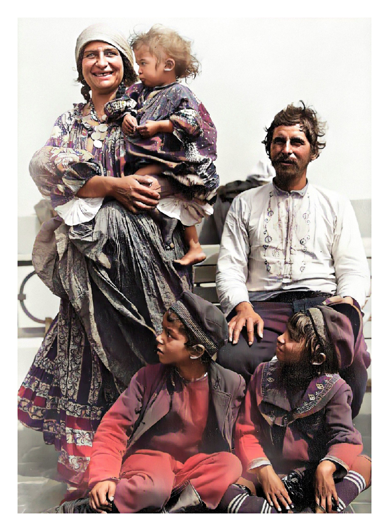
Gypsy family, public domain
[Growing up in southern Iowa] I remember only one fear I had when I was a child. It was a fear of Gypsies. Someone said Gypsies steal little boys to work for them. Every year Gypsies would camp over-night, sometimes stay a day or two, at the Mount Vernon school grounds on the corner west of the house.
Their dark skin, black hair and long dark dresses with capes or shawls all scared me. Mom thought their dress was better to hide things they stole. She always tried to keep them out of the house. They were always coming over to get something to eat and feed for their horses.
They traveled in little buildings on wagons pulled by horses. Sometimes there might be five or six loads of them. Seemed like next morning our cows never gave as much milk. The folks always though the Gypsies had come during the night and milked the cows. The folks also thought some chickens, eggs, feed, and maybe a pig were missing after the Gypsies were gone.
Anyway, I breathed easier when they left, because then I knew three little boys they hadn’t stolen.
•••
William L. Shirer, 20th Century Journey. New York: Simon and Schuster, 1976, p. 83—
[While growing up in Cedar Rapids IA] The fear of Indians by the acquisitive white settlers persisted for some time…Sometimes a stray and hungry Indian from the nearby Tama Reservation would come to the back door of our house to beg food and my worried mother would lock the doors and windows and, if the man persisted in knocking, call the police. We were brought up to believe that “the only good Indian was a dead Indian” and nothing was said to us in those days of the cruel and savage slaughter and the robbery of the Indians by the white Americans, one of the darkest sides of our history.
Monday, April 4, 2022
and a handkerchief used for dusting my shoes
Henry L. Mencken, quoted by Huntington Cairns in John Dorsey, ed., On Mencken. New York: Alfred A. Knopf, 1980, pp. 53-54—
[As a youngster in Baltimore, one day, Mencken was "held up by two tough boys and relieved of"] all: five keys, a horse chestnut, the snapper of a buggy whip, a dried cockroach in a pill box, a small shell, six agate marbles, a top, and a handkerchief used mainly for dusting my shoes. I also had two cents, but the bandits, after a long debate, decided not to take them, it would be stealing.
Friday, April 1, 2022
how be thine graminivorous tramcollicken now?
Edwin Muir, An Autobiography. New York: William Sloane, 1954—
Nature-Themed Poster © Roy R. Behrens 2019
My cousin Sutherland was the most original character in the [his parents’] house. I remember him as a little man in a blue jersey and trousers with a dashing fall. His body swung forward from his hips, as if he were always on the point of offering something with his hands. His head was like a battering-ram, and dusty brown hair like an animal’s fell stood stiffly up from it. His sparkling grey eyes were nautical, his bulbous nose ecclesiastical, his bushy brown moustache military. Before he made a joke he would pass the back of his hand under his moustache with a casual succulent sweep which left his arm negligently hanging in the air, as if he had forgotten it for the moment but would presently remember it again. All his movements melted into each other with the continuity of a tree. His skin was reptilian; his head sloped, like a tortoise’s, into his neck, his shoulders into his trunk. He was very strong and crafty, and in wrestling could bring down men much younger and heavier than himself His ordinary stance then was a lazy crouch; he would roll waggishly on his feet, as if he were keeping his balance in a slight swell; he was very light-footed. His appearance never changed while I knew him; he looked thirty-five all the time.…
Whenever Sutherland got drunk he began to invent language. I can’t remember now many of his feats in this way, but he liked words with a dashing Spanish sound, like ‘yickahooka’ and ‘navahonta.’ He was so pleased with the word ‘tramcollicken,’ which he invented himself, that he gave it a specific meaning which I had better not mention; but the word became so popular that it spread all over Wyre. From somewhere or other he had picked up ‘graminivorous,’ which struck him by its comic sound, and for a long time his usual greeting was, “Weel, boy, how’s thee graminivorous tramcollicken?” Macedonia, Arabia, Valparaiso, and Balaclava became parts of his ordinary vocabulary, giving him a sense of style and grandeur.
Thursday, March 31, 2022
Robert Frost / let what burrs will stick to them
Louis Untermeyer, FROM ANOTHER WORLD: The Autobiography of Louis Untermeyer. New York: Harcourt, Brace and Company, 1939—
Nature-Themed Poster © Roy R. Behrens 2019
…[the poet Robert Frost] was the friend of [British poet and critic Lascelles] Abercrombie whom [American poet Ezra] Pound had challenged to a duel, the weapons to be unsold copies of their books at thirty paces. (p. 208)
[Frost] wrote to me: “There are two types of realist—the one who offers a good deal of dirt with his potato to show that it is a real one, and the one who is satisfied with the potato brushed clean. I’m inclined to be the second kind. To me the thing that art does for life is to clean it, to strip it to form.” (p. 209)
[Quoting from Frost’s preface to his own Collected Poems:] “Scholars and artists thrown together are often annoyed at the puzzle of where they differ. Both work from knowledge; but I suspect they differ more importantly in the way their knowledge is come by. Scholars get theirs with conscientious thoroughness along projected lines of logic; poets theirs cavalierly and as it happens in and out of books. They stick to nothing deliberately, but let what will stick to them like burrs where they walk in the fields.” (p. 210)
Wednesday, February 23, 2022
her broken cuckoo clock hoots at a stranger
•••
William Butler Yeats, The Autobiography of William Butler Yeats: Consisting of reveries over childhood and youth, the trembling of the veil, and dramatic personae. New York: Macmillan, 1953, pp. 106ff—
I found Madame Blavatsky in a little house at Norwood, with but, as she said, three followers left…and as one of the three followers sat in an outer room to keep out undesirable visitors, I was kept a long time kicking my heels. Presently I was admitted and found an old woman in a plain lose dark dress: a sort of old Irish peasant woman with an air of humor and audacious power. I was still kept waiting, but she was deep in conversation with a woman visitor. I strayed through folding doors into the next room and stood, in sheer idleness of mind, looking at a cuckoo clock. It was certainly stopped, for the weights were off and lying upon the ground, and yet, as I stood there the cuckoo came out and cuckooed at me. I interrupted Madame Blavatsky to say, “Your clock has hooted at me.” “It often hoots at a stranger,” she replied. “Is there a spirit in it?” I asked. “I should have to be alone to know what is in it.” I went back to the clock and began examining it and heard her say: “Do not break my clock.” I wondered if there was some hidden mechanism and I should have been put out, I suppose, had I found any, though [a friend, William Ernest] Henley had said to me, “Of course she gets up fradulent miracles, but a person of genius has to do something: Sarah Bernhardt sleeps in her coffin.” Presently the visitor went away and Madame Blavatsky explained that she [the visitor] was a propagandist for women’s rights who had called to find out “why men were so bad.” “What explanation did you give her?” I said. “That men were born bad, but women made themselves so,” and then she explained that I had been kept waiting because she had mistaken me for some man, whose name resembled mine and who wanted to persuade her of the flatness of the earth.…
A great passionate nature, a sort of female Dr. Johnson, impressive I think to every man or woman who had themselves any richness, she seemed impatient of the formalism and the shrill abstract idealism of those about her, and this impatience broke out in railing and many nicknames: “oh, you are a flap-doodle, but then you are a theosophist and a brother.” The most devout and learned of all her followers said to me, “[She] has just told me that there is another globe stuck on to this at the north pole, so that the earth has really a shape something like a dumbbell.”…
One American said to me, “She has become the most famous woman in the world by sitting in a big chair and permitting us to talk.” They talked and she played patience, and totted up her score on the green baise, and generally seemed to listen, but sometimes she would listen no more. There was a women who talked perpetually of “the divine spark” within her, until Madame Blavatsky stopped her with—“Yes, my dear, you have a divine spark within you and if you are not very careful you will hear it snore.”…
Monday, February 21, 2022
imagine making your mother an arrangement
| Title Slide (2013) © Roy R. Behrens |
No, that's not a nose bleed. It's a perfectly purposeful devious use of his fantastic signature—WBYeats. And below, don't miss out on the chance to read his autobiography. There's nothing quite like it. And it doesn't let up for a minute.
•••
William Butler Yeats, The Autobiography of William Butler Yeats: Consisting of reveries over childhood and youth, the trembling of the veil, and dramatic personae. New York: Macmillan, 1953—
My two sisters and my brother and myself had dancing lessons in a low, red-brick and tiled house that drove away dreams, long cherished, of some day living in a house made exactly like a ship’s cabin. The dining-room table, where Sinbad the sailor might have sat, was painted peacock-blue, and the woodwork was all peacock-blue and upstairs a window niche was so big and high up that there was a flight of steps to go up and down by and a table in the niche. The two sisters of the master of the house, a well-known pre-Raphaelite painter, were our teachers, and they and their old mother were dressed in peacock-blue and in dresses so simply cut that they seemed a part of every story. Once when I had been looking with delight at the old woman, my father [Irish painter John Butler Yeats] who had begun to be influenced by French art, muttered, “Imagine dressing up your old mother like that” (pp. 16-17).
…I was happy when partly through my father’s planning some Whistlers were brought over and exhibited, and did not agree when my father said: “Imagine making your old mother an arrangement in gray!” (p. 50).
•••
Maurice Browne, Too Late to Lament: An autobiography. Bloomington: Indiana University Press, 1956, pp. 138-139—
One day [in Chicago] a Skyscraper [member of an elite arts society club] called to see me; his chains of office clanked about his neck. I bowed deeply. He regarded me with disfavor: “You are a friend of Nicholas Vachel Lindsay [the American poet]?” I pleaded guilty; the Skyscrapers mocked Lindsay for the way he read his rhymes and despised him because he traded them for bread, hawking his pamphlets from door to door through the farmlands of the Middle West.…
“Do you know Lindsay’s address?” the clubman asked. I did, “may I have it?” I replied that I had not Mr. Lindsay’s authority to disclose his present whereabouts but would forward a letter. “The matter is rather urgent; could you reach him by telephone?” I could but didn’t. The clubman hummed and hawed, then plunged like Doris Keane [a well-known American stage actress] but the splash was louder: “We are giving a luncheon in honor of Mr. William Butler Yeats tomorrow and would like you and your friend to be our guests.” I trust that I concealed my amazement and was courteous in conveying my regret that despite my admiration for Mr. Yeats I would be unable to attend; I could not of course answer for Mr. Lindsay. The clubman grew urgent: “Do you think that he will come?” My silence was duly interpreted: “But we must get him; we have to.” The conversation was growing interesting; I waited. “The fact is,”and this time the diver took a bellyflop which resounded through Chicago—“we announced that Yeats was coming, and now he says he won’t unless we get Lindsay.”
When the clubman had departed…I went into the hotel next door where Lindsay was staying and we laughed ourselves sick. But Lindsay had never met Yeats, and the latter’s demand moved him deeply; so he decided to attend the luncheon and insisted on my coming with him to hold his hand.
[In the concluding half-hour of the luncheon] as though no one else were present Yeats talked directly to Lindsay, and to Lindsay alone. He spoke of the poet’s task, the poet’s reward, the poet’s joy; poet to poet, equal to equal. Then he [Yeats] walked down the room, shook hands, turned again to his hosts, thanked them once more in a sentence, bowed, left. The mandarins were too flabberghasted to show their chagrin; besides, Yeats was a great poet; they themselves had said so.… [pp. 138-139].
[At the end of 1931, two years after the Wall Street Crash, distraught by poor health and financial concerns, Vachel Lindsay took his own life, at age 52, by drinking a bottle of lye.]
Tuesday, October 19, 2021
living in a poky village in a backward county

view larger
Above Roy R. Behrens, Beach Repair. Digital montage (©2021).
•••
Maurice Browne, Too Late to Lament: An Autobiography. Bloomington: Indiana University Press, 1956, p. 30—
Mr. Pickford was one of the finest Sanskrit scholars of his day. He was very poor; he had sacrificed his life to Sanskrit and his sister. His sister kept house for him in a little village where he was rector, a few miles outside Ipswich; a dour, bitter, selfish woman whom no one liked. So, for his sister's sake, he had put aside marriage, advancement, happiness, and had taken that obscure living in a poky village in a backward county, to make her a home where were few to hate her.
One day a letter came addressed to Mr. Pickford. Through several weeks he had been hoping for it; if it came, it might offer him an academic position where he could carry to fruition his life's work in Sanskrit. Every morning his sister went downstairs to meet the postman and see whether the letter had come: "No, John, it has not come today; perhaps it will come tomorrow."
Long afterwards the Vice-Chancellor in whose gift that position lay, meeting Mr. Pickford accidentally in the streets of Ipswich, greeted him coldly: "I considered it discourteous of you not even to have acknowledged the offer which I made you." Mr. Pickford made no comment. But, when he got back to the ugly, lonely, village rectory, he spoke to his sister. "Yes," she said defiantly, "of course the letter came; I read and burned it. I'm very happy where I am, and you're much better off in a place suited to you."
A little later…[Mr.] Pickford killed himself. My father [an Anglican clergy] preached his funeral sermon. There was no mention of, no hint of reference to, that story in it; but the Stoic view of self-murder was upheld by the Anglican preacher [who years later did the same].
Friday, April 9, 2021
Inez McAlister Faber / Out Here on Soap Creek
![]() |
•••
Inez McAlister Faber, Out Here on Soap Creek. Ames: Iowa State University Press, 1982, pp. 23-24—
Probably many people wiser than I dislike some of the things I like, such as hoeing, canning, cleaning house, cutting corn fodder, living in the country, being in my thirties, dahlias, roses, meals on time, empty houses with flowers still growing in the yards, old furniture, small boys, books, newspaper editorials, astronomy, chickens, dogs, cows, horses, meat or gravy cooked in a cast-iron skillet, waffles, carrots and spinach.
It is quite likely that others, and I have no quarrel with them, like many of the things I hate, including petunias, cats, children who have been taught that they are cute, grown-ups who try to act kiddish, male or female sissies, superiority complexes, machine hemstitching, tablecloths hemmed on the machine, cows with horns, weedy gardens, dwelling houses painted green, rain on washday, so-called living rooms that are only used for company, and overstuffed davenports. Large women in striped or checked dresses, bad table manners, being flatly contradicted, people who handle books roughly or who lay an open book face down upon a table, people who read over my shoulder, inquisitiveness, concrete walks in front of farm homes, fried parsnips, mashed potatoes, interruptions while ironing, washing milk pails, cleaning muddy overshoes, cooking for visitors who do not come, going to bed, getting up, washing yesterday’s dishes, and talking over the telephone.
Thursday, April 8, 2021
a cool clutch and four gears and even reverse
![]() |
| view larger |
•••
An unidentified aging British chaffeur and auto mechanic, recalling his youth as a worker on an estate, in Ronald Blythe, The View in Winter: Reflections on Old Age. New York: Penguin Books, 1980, p. 65—
I’ll tell you how I learned to drive. There was a shooting party and I had just got this car all washed and polished and clean, ready for the pick-up—the guns—when a boy came out of the house to put some dirt in the dustbin. I called out, “Come for a ride, Harry?” just as a joke, laughing, you know, but then in Harry jumps aside of me, looking pleased and excited. So what could I do? I was sixteen. I'd watched old Crossley [the estate chauffeur] with the gear-lever and the brake, and I told myself, “If he can do it, I can do it.” So I reached for the pedals and suddenly there we were, dashing down the front drive! That drive was a mile long and ended at the bottom lodge, where the village policeman lived. I was driving straight to prison, I told myself, for taking the motor. And could I turn it round and bring it back? But that lovely motor had a cool clutch and four gears and a reverse, and by luck I managed them all—brought it back safe, washed it all over again, and nothing was seen or said. That was the first time I had a drive and I’ve been driving ever since.