Showing posts with label zoology. Show all posts

Thursday, January 30, 2025

dinner scraps of great horned owls and others

Wikipedia article: A pellet, in ornithology, is the mass of undigested parts of a bird's food that some bird species occasionally regurgitate. The contents of a bird's pellet depend on its diet, but can include the exoskeletons of insects, indigestible plant matter, bones, fur, feathers, bills, claws, and teeth. 

Photograph copyright © Mary Snyder Behrens 2025.

Tuesday, November 19, 2024

who can you truss? i'd walk a mile for a camel

source
EDWARD MARSH and CHRISTOPHER HASSALL, Ambrosia and Small Beer. NY: Harcourt Brace. 1965—

A soldier up for medical exam proved to have been wearing a truss for the past 6 years, and was classified as P. E. or Permanently Exempt. On his way out he gave this news to his pal, who immediately asked for the loan of the truss, which was granted. The examiner asked how long he had been wearing it, and he said “Six years," whereupon he was classified as M.E. "What's that?” he asked. "Middle East." “How can I go to the Middle East when I've been wearing a truss for 6 years?" “If you can wear a truss for 6 years upside-down, you can jolly well ride a camel for 6 months."

Tuesday, January 22, 2019

Charles Henry Bennett / Shapeshifting Cat

C.H. Bennett, Poor Puss (1863)
Above One of a series of elaborate comic metamorphoses (aka shapeshifting) created by Victorian-era British illustrator Charles Henry Bennett (1863) in sardonic reference to Charles Darwin's theory of natural selection, this one titled "Poor Puss." Courtesy The Wellcome Library.

•••

The Reverend Benjamin Newton (Vicar of Landwit), Diary (September 1, 1816)—

An entertaining German dined here who teaches the girls music and plays delightfully and sings well with no voice having been shot through the lung. A Mr. Causer having been bit in a drunken frolic by a man of the name of Shipley in the leg last week is obliged to suffer amputation. During an armistice in which the Prussian and French officers were drinking together a son of [Prussian Field Marshall] Blücher gave for a toast the King of Prussia, which a French officer would not drink and soon after when it came to his turn gave [Napolean] Bonaparte which young Blücher would not drink, on which the officer went up to him and without saying anything struck him a smash in the face. Blücher said nothing but went out of the room and returned immediately with a pair of pistols, with one of which without uttering a word he shot the officer dead and then held up the other and said he had that ready for any man who would take up the quarrel. This came to his father's knowledge, who put him under arrest for six weeks.

Charles Henry Bennett / Shapeshifting Dog

C.H. Bennett, Good Dog (1863)
Above One of a series of elaborate comic metamorphoses (aka shapeshifting) created by Victorian-era British illustrator Charles Henry Bennett (1863) in sardonic reference to Charles Darwin's theory of natural selection, this one titled "Good dog." Courtesy The Wellcome Library.

•••

The Reverend Francis Kilvert, Diary (July 22, 1871)—

Mrs. Nott told me that Louie of the Cloggau was staying in Presteign with her aunt Miss Sylvester, the woman frog. This extraordinary being is partly a woman and partly a frog. Her head and face, her eyes and mouth are those of a frog, and she has a frog's legs and feet. She cannot walk but she hops. She wears very long dresses to cover and conceal her feet which are shod with something like a cow's hoof. She never goes out except to the Primitive Methodist Chapel. Mrs. Nott said she had seen this person's frog feet and had seen her in Presteign hopping to and from the Chapel exactly like a frog. She had never seen her hands. She is a very good person. The story about this unfortunate being is as follows. Shortly before she was born a woman came begging to her mother's door with two or three little children. Her mother was angry and ordered the woman away. "Get away with your young frogs," she said. And the child she was expecting was born partly in the form of a frog, as a punishment and a curse upon her.

Tuesday, November 21, 2017

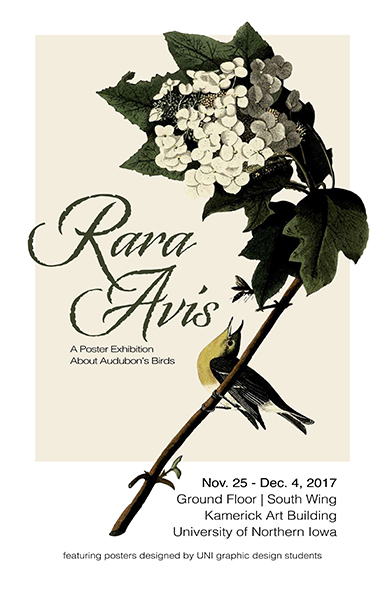
Audubon's Birds of America | Samantha White

Audubon Poster © Samantha White 2017
Above and below Reinterpretations, in poster form, of John James Audubon's The Birds of America, designed by Samantha White, graphic design student at the University of Northern Iowa (2017).

•••

Louis MacNeice, The Strings are False: An Unfinished Autobiography. London: Faber and Faber, 1965. p. 127—

Dr. Johnson had said that the poet is not concerned with the minute particulars, with "the streaks on the tulip."  This, I thought, was just where he was wrong and just where I met Mariette on a common ground. Mariette was crazy for the streaks on the tulip. At the same time I felt she made much ado not about nothing but about the obvious or the trivial. Her conversation was like a barber's scissors when he is giving his last retouches to the back of your head, clicking away very fast, very deftly, but apparently not making contact.

Audubon Poster © Samantha White 2017

Louis MacNeice, The Strings are False: An Unfinished Autobiography. London: Faber and Faber, 1965. pp. 73-74—

At school I no longer assumed that the masters were all my superiors. Some of them were ninnies.  Mr. Cameron left us for a time and in his place we had a master from Galway—seedy, embittered, with a powerful brogue, a bad cough and always the same suit. He could not manage the chalk on the blackboard; the pieces of chalk from day to day, from month to month, harassed him with unending guerilla warfare, breaking in his hand, deploying to all corners of the room. "Damn the chark!" he would shout, hurling the remaining stub away from him. "The square on the hypotenuse is equal—Damn the chark!" And then, conscious of our grins, he would look ashamed, on the verge of tears, and surrender to a spasm of coughing.

Audubon Poster © Samantha White 2017

Saturday, October 21, 2017

Audubon's Birds of America | Mallory Thurm

Audubon Poster © Mallory Thurm 2017
Above and below Components from John James Audubon's magnificent Birds of America are reimagined in these commemorative posters by Mallory Thurm, a graphic design student at the University of Northern Iowa.

•••

Marvin Bell, A Marvin Bell Reader: Selected Poetry and Prose. Middlebury College Press, 1994—

[In Star Trek, Captain] Kirk is eating pizza in a joint in San Francisco with a woman whose help he will need, when he decides to fess up about who he is and where he has come from. The camera circles the room, then homes in on Kirk and his companion as she bursts out with, "You mean you're from outer space?" "No," says Kirk, "I'm from Iowa. I just work in outer space."

Audubon Poster © Mallory Thurm 2017


Norman Douglas, Siren Land: A Celebration of Life in Southern Italy. London: Penguin, 1948—

Bouillabaisse is only good because it is made by the French, who, if they cared to try, could produce an excellent and nutritious substitute out of cigar stumps and empty matchboxes.

Audubon Poster © Mallory Thurm 2017

Tuesday, October 10, 2017

Audubon's Birds of America | Ross Hellman

Audubon poster © Ross Hellman 2017
Above and below Components from John James Audubon's magnificent Birds of America are reimagined in these commemorative posters by Ross Hellman, a graphic design student at the University of Northern Iowa.

•••

Henry David Thoreau, Walden, or Life in the Woods, 1854—

I once had a sparrow alight upon my shoulder for a moment while I was hoeing in a village garden, and I felt that I was more distinguished by that circumstance than I should have been by any epaulette I could have worn.

Audubon poster © Ross Hellman 2017


Vaclav Havel, quoted in The New York Review of Books, January 15, 1998—

…America is an almost symbolic concentration of all the best and the worst of our civilization. On the one hand, there are its profound commitment to enhancing civil liberty and to maintaining the strength of its democratic institutions, and the fantastic developments in science and technology which have contributed so much to our well-being; on the other, there is the blind worship of perpetual economic growth and consumption, regardless of their destructive impact on the environment, or how subject they are to the dictates of materialism and consumerism, or how they, through the omnipresence of television [and the internet] and advertising, promote uniformity, and banality instead of a respect for human uniqueness.

Audubon poster © Ross Hellman 2017

Audubon's Birds of America | C. Strelow-Varney

Audubon poster © Cheyenne Strelow-Varney (2017)
Above and below Components from John James Audubon's magnificent Birds of America are reimagined in these commemorative posters by Cheyenne Strelow-Varney, a graphic design student at the University of Northern Iowa.

•••

Edmund Clerihew Bentley [inventor of the clerihew], Biography for Beginners. London" T.W. Laurie, 1905—

Sir Humphrey Davy
Abominated gravy.
He lived in the odium
Of having discovered sodium.

Audubon poster © Cheyenne Strelow-Varney (2017)


Edmund Clerihew Bentley in More Biography. London: Methuen, 1929—

George the Third
Ought never to have occurred
One can only wonder
At so grotesque a blunder.

Audubon poster © Cheyenne Strelow-Varney (2017)

Sunday, October 8, 2017

Audubon's Birds of America | Hanna Seggerman

Audubon Poster © Hanna Seggerman 2017
Above and below Components from John James Audubon's magnificent Birds of America are reimagined in these commemorative posters by Hanna Seggerman, a graphic design student at the University of Northern Iowa.

•••

Samuel Foote [nonsense text devised to test the claim of actor Charles Macklin that he could memorize anything] quoted in Maria Edgeworth, Harry and Lucy Concluded. New York: Harper and Borthers, 1842, p. 315—

So she went into the garden to cut a cabbage leaf; to make an apple pie; and at the same time a great she-bear, coming up the street, pops its head into the shop. What! no soap? So he died, and she very imprudently married the barber; and there were present the Picninnies, and the Joblillies, and the Garyalies, and the grand Panjandrum himself, with the little round button at top, and they all fell to playing the game of catch as catch can, till the gun powder ran out at the heels of their boots.

Audubon Poster © Hanna Seggerman 2017


 Melissa Meyer, quoted in Heresies (Winter 1977-78), Vol 1 No 4—

Published information about the origins of collage is misleading. Picasso and Braque are credited with inventing it. Many artists made collage before they did, Picasso's father for one and Sonia Delaunay for another.

Audubon Poster © Hanna Seggerman 2017


 Lawrence Perlman (American business executive)—

When you ask children what they want to be when they grow up, they don't say, "I want a boring job where the only thing I look forward to is Friday."

Audubon's Birds of America | Charles Williams

Audubon Poster © Charles Williams 2017
Above and below Components from John James Audubon's magnificent Birds of America are reimagined in these commemorative posters by Charles Williams, a graphic design student at the University of Northern Iowa.

•••

Camilo José Cela, Journey to the Alcarria: Travels Through the Spanish Countryside. New York: Atlantic Monthly Press, 1994—

Things are always best seen when they are a trifle mixed-up, a trifle disordered; the chilly administrative neatness of museums and filing cases, of statistics and cemeteries, is an inhuman and antinatural kind of order; it is, in a word, disorder. True order belongs to Nature, which never yet has produced two identical trees or mountains or horses.

Audubon Poster © Charles Williams 2017


Arthur Eddington, quoted in Nicolas Rose, ed. Mathematical Maxims and Minims. Raleigh NC: Rome Press, 1988—

We used to think that if we knew one, we knew two, because one and one are two. We are finding that we must learn a great deal more about "and."

Audubon Poster © Charles Williams 2017
 

Tuesday, October 3, 2017

Audubon's Birds of America | Sophia Grover

Audubon poster © Sophia Grover 2017
Above and below Components from John James Audubon's magnificent Birds of America are reimagined in these commemorative posters by Sophia Grover, a graphic design student at the University of Northern Iowa.

•••

Arthur Koestler, The Act of Creation. New York: Macmillan, 1964, p. 191—

"The great field for new discoveries," wrote William James, "is always the unclassified residuum. Round about the accredited and orderly facts of every science there ever flows a sort of dust-cloud of exceptional observations, of occurrences minute and irregular and seldom met with, which it always proves more easy to ignore than to attend to." The genius of Sherlock Holmes manifested itself in shifting his attention to minute clues which poor Watson found too obvious to be relevant, and so easy to ignore. The psychiatrist obtains his clues from the casual remark, the seemingly irrelevant drift of associations; and he has learned to shift the emphasis from the patient's meaningful statements to his meaningless slips of the tongue, from his rational experiences to his irrational dreams. [It is] the trick which [Edgar Allan] Poe's character empolyed when he let the secret document lie open on his desk—where it was too obvious to be seen. 

Audubon poster © Sophia Grover 2017

Sunday, October 1, 2017

Audubon's Birds of America | Colton Ellison

Audubon poster © Colton Ellison 2017
Above and below Reinterpretations, in poster form, of John James Audubon's The Birds of America, designed by Colton Ellison, graphic design student at the University of Northern Iowa (2017).

•••

Louis MacNeice, The Strings are False: An Unfinished Autobiography. London: Faber and Faber, 1965. p. 123—

Ireland was something new to Mariette and obliged her by appearing very Irish. A local peasant girl, who had been engaged to do the work, turned out delightfully incompetent and committed all the Irishisms beloved by English humorists. When told to clean a pair of shoes she asked "Do you mean both of them?" and when sent up to a bedroom with a hot-water bottle she would hang it on the knob of a chair. There were three itinerant butchers who visited the house in rotation and sold us whole sides of sheep. And when I walked along the road with my arm around Mariette, an old woman called out, "That's a grand way for a girl to be—linked to a boy."

…One day Mariette and I drove across the island to buy lobsters. The fishermen had only a dozen which they had contracted to send to the mainland, but Mariette's Mediterranean persuasiveness was too much for them and one of them gave us two lobsters, saying to his colleague who was in charge of the box for the mainland, "Throw in a couple of herring; they're all fish." The lobsters sat on the back seat and clacked their claws like castanets as we drove home.

Audubon poster © Colton Ellison 2017


Saturday, September 30, 2017

Audubon's Birds of America | Sydney Hughes

Audubon Poster © Sydney Hughes (2017)
Above and below Reinterpretations, in poster form, of John James Audubon's The Birds of America, designed by Sydney Hughes, graphic design student at the University of Northern Iowa (2017).

•••

Andrew Nelson Lytle, A Wake for the Living: A Family Chronicle. New York: Crown Publishers, 1975—

Papa, my grandfather Nelson, rarely went to church. The evangelical sects seemed lacking in ritual and ceremony, and he had had the chance to know full well the hypocrites. I asked him once for a nickel to go to Sunday school. He enquired if a penny wouldn't make as much noise in the pan. [p. 31]

•••

Aunt Tene and I were very fond of each other. She was thin as a straw but with a clear eye that never mistook its object. She managed to outlive one of those old-fashioned "consumptions" which was a medical term of the day for death's affair with life. During the Great Depression I used to borrow her burial money to go courting. "You might as well have it," she said. "It looks like I can't die." [p. 20]

•••

I think I have already told you that I called my grandfather Nelson, Papa, as if I were a younger child…

I never heard Papa complain, but at times he was politely tart. Once, speaking out of a general silence, he said at large, "All old women ought to be shuck out every morning."

His intentions were not misunderstood. Aunt Tene without hesitation replied, "Well, every old man ought to be stood in a barrel of lye." [pp. 15-16]

•••

Cousin Mary set an extravagant table and, I understand, ruined her husband. She took on great weight and died at Grandma's one hot July day…The wagon carrying Cousin Mary's coffin to the funeral cracked a wheel, as it jolted through a creek. Before the matter could be mended, the hot July sun made her well and Cousin Mary split the coffin.

"She wants out," a mourner said, downwind. [p. 113] 

Audubon poster © Sydney Hughes (2017)


Friday, April 8, 2016

Iowa Insect Series Installed

Installation view © Sergio Gomez
Above An installation view (photo by Sergio Gomez) of an exhibition of collaborative montage images, called Iowa Insect Series, currently on view at the Dorothea Thiel Gallery at South Suburban College in Chicago. More>>>

Tuesday, March 29, 2016

Digital Montage | Gina Hamer

Digital montage © Gina Hamer 2016
Above Digital montage by Gina Hamer (2016), graphic design student, Department of Art, University of Northern Iowa.

•••

Liam Hudson, “Texts, Signs, Artefacts” in W.R. Crozier and A.J. Chapman, eds., Cognitive Processes in the Perception of Art. Elsevier 1984—

The arts in particular are seen [in our society] as peripheral, or—even worse—as “fun”; that is to say, as a simple emotional release that receives little professionally academic attention because it deserves none. Yet the briefest glance shows that poems, novels, paintings, photographs, plays, films of any quality are rarely fun, either for the artist or for the spectator; what is more, that they are at least as carefully poised, as subtly calculated in their effects, as any other genre of intellectual activity. Many take months, years, to put together, and at least as long to assimilate in any but a superficial way.

Iowa Insects | Roy Behrens and David Versluis

Iowa Insect Series © Roy Behrens and David Versluis c2012-13
South Suburban College’s Dorothea Thiel Gallery will host an exhibition of 10 large-scale digital montage images [see examples above and below] from the Iowa Insect Series, a collection of artworks created in collaboration between graphic design professors Roy R. Behrens and David M. Versluis.  The exhibit, Graphic Designers Collaborate: Attention to Detail, will be held in the Dorothea Thiel Gallery from April 1 to April 21, 2016.

The exhibit features digital montage collaborations created by Graphic Design professor Roy R. Behrens, University of Northern Iowa, and Art & Graphic Design professor David Versluis, Dordt College. Various artworks from the Iowa Insect Series have been exhibited in group shows at the Washington Pavilion Visual Art Center in Sioux Falls, South Dakota; Nemeth Art Center in Park Rapids, Minnesota; University of Northern Iowa Gallery of Art in Cedar Falls, Iowa; and the 27th McNeese National Works on Paper Exhibition at McNeese State University Grand Gallery in Lake Charles, Louisiana. This exhibit at South Suburban College is one of the first times that the collection Iowa Insect Series will be shown together.

Iowa Insect Series © Roy Behrens and David Versluis c2012-13


“The process of creating the collaborative images began in 2012 with me sending Roy scanned images of insects from my personal collection. One image at a time, we challenged each other to respond to each image, building a digital montage, using Adobe Photoshop®,” said Versluis. “We would then pass the image back and forth, responding to each other’s move.” The images were built with about five or six back and forth exchanges between Behrens & Versluis, until the two graphic designers mutually decided that the artwork was finished.

Professor Versluis will be at the college as visiting artist in the digital arts lab and Dorothea Thiel Gallery for a 1:00 p.m. reception on Thursday April 21st. The public is welcome to visit the art exhibition and reception at no charge. The Thiel Gallery is located on the 4th floor in the Art & Design hallway, Room 4333.  SSC Galleries are open at minimum Mondays through Thursdays from 9:00 am–6:00 pm, and Fridays from 9:00 am–4:00 pm. The galleries are closed on weekends and holidays. For more information, please call (708) 596-2000, ext. 2316, or visit www.ssc.edu/art. SSC is located at 15800 South State Street, South Holland, Illinois.

Iowa Insect Series © Roy Behrens and David Versluis c2012-13

Friday, May 30, 2014

Iowa Insect Series: Attention to Detail

Cicada © David Versluis and Roy R. Behrens
Above In the late 1980s, driving a U-Haul from the Deep South to Cincinnati, as we neared our destination, we began to hear a deafening buzz—and soon we ran into a boundless cloud of the seventeen-year locust, the cicada. They were everywhere—everywhere. What an indelible welcome.

Another batch of the seventeen-year cicada will soon arrive in Iowa (in another week or so, I think). Be not alarmed or overwhelmed. They're actually quite wonderful. Enjoy them while you can—they may soon go the way of the monarch, the hummingbird, the garter snake.

Long live corn and ethanol in the land of hulk and money.

And guns.

In the meantime, my good friend David Versluis has anticipated the emergence of the cicada by installing an exhibition of his and my collaborative digital montages (collages made on computer), called Insects of Iowa: Attention to Detail. See exhibit installation below.

•••

David Plowden, from "Conversation with David Plowden" in Christopher R. Rossi, ed., David Plowden's Iowa. Iowa City IA: Humanities Iowa, 2012—

When you get to Iowa, the land may be gentle and the land may be very subtle, but the sky isn't. You live out here under the weather and at your own risk, for god's sake. You may have all of the most up-to-date equipment, all the pesticides and chemicals you need—everything. But you have no control over the weather. And I think that's one of the most important things about living in this part of the world—that you could be wiped out by the weather, or you could be blessed by the weather, but you live by the weather.…

Sunday, February 17, 2013

Versluis | Behrens Beetle Montage

David Versluis & Roy R. Behrens, Beetle (©2012)

In two earlier posts, I talked about a recent collaboration with my friend and fellow designer David Versluis, in which (in early 2012) we worked together on a series of digital montages about Iowa insects. We did all this by email, by taking turns (as if we were playing chess) while passing files back and forth. One of my favorites is Yellow Jacket, and another is Cicada. But a third one that I like a lot is shown above, titled Beetle.

•••

Kenneth Williams, in R. Davies, ed., The Kenneth Williams Diaries (1993)—

How impossible it is for me to make regular entries in the diary. I suddenly remember how I used to puzzle over that word at school. Always wondering why diary was so like Dairy and what the connection was. Never found out.

•••

Anon (an old joke)—

Question: What do you call a Frenchman in sandals?
Answer: Philippe Philoppe.

Saturday, December 19, 2009

Ballast Reviews | Proteus

Proteus: A Nineteenth Century Vision. A film by David Lebrun. 61 mins. DVD, color and b&w, 2004. Available from Icarus Films

My favorite statement by German scientist Ernst Haeckel is not mentioned in this film. A zoologist, scientific illustrator, and advocate of pantheism ("God is everywhere"), he wrote in 1899, in The Riddle of the Universe, that the typical Christian description of God is that of "a gaseous vertebrate." More…