Showing posts with label Germany. Show all posts

Monday, April 24, 2023

the absurd continuing access to weapons of war

Without hesitation, I can say that one of my favorite artists is the German printmaker and sculptor Käthe Kollwitz (1867-1945). I became acquainted with her work in 1964, when I was 18 and a freshman art student in undergraduate school. In the university’s art collection was one of Kollwitz’s finest lithographs, titled Death and the Woman (1934), reproduced below. 

Many of her most powerful works are self-portraits. One reason that they are so powerful is that her own appearance was so dignified, yet strikingly sad and remorseful, a quality that is equally true of photographs of her. Reproduced above is the commemorative relief profile that was issued as a German coin in 1967. And at the bottom of this blog post is surely one of her most unforgettable self-portraits, an etching titled Self-Portrait with Hand on Forehead (1910). In 1914, her sadness was intensified when her youngest son Peter was killed in World War I, only two days after arriving at the battlefield. 

The awful grief of losing her son remained with her until her own death, a sorrow that she tried to assuage by designing a gravesite memorial to him (and other soldiers), now at the Vladslo German war cemetery in Belgium. At that gravesite, she installed two mourning figures, she and her husband, side by side, known as The Grieving Parents

I was reminded of this lately when my friend, the distinguished German psychologist and neuroscientist Lothar Spillman, brought up her name, and recalled what she said at the time of her loss: “Where do those women find the courage to send their dear ones to the front to face the guns when they watched over them all their lives with loving care?” Today, not only do those mothers face the “weapons of war” on the battlefields of Ukraine, Sudan and elsewhere—but, in our own country, on the formerly innocuous neighborhood streets.

In 1996, PBS broadcast an eight-part video series on The Great War. In the final episode is a brief but memorable section about Käthe Kollwitz, the death of Peter, and the gravesite memorial. It can be accessed free online on YouTube. The portion that pertains to Käthe Kollwitz begins around 21 minutes into the film. I strongly recommend it. Do take a look, at a time when we too face—increasingly and every day—the needless killing of people with war-grade weapons.


Tuesday, November 15, 2022

today I bought a dress that is made out of wood

Where is the fifth pig?
Ione Robinson, A Wall to Paint On. New York: E.P. Dutton, 1946, p. 373-374, while visiting Berlin, from a letter dated November 8, 1938 (less than a year in advance of the start of World War II) —

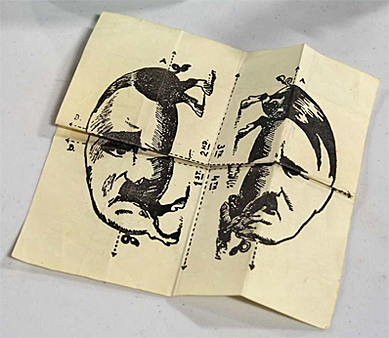
Today I bought a dress that is made out of wood. I still can't believe it. In fact, there was not one “natural” item in this department store; everything was synthetic. In an arcade on Unter den Linden, I spent a long time looking at photographs of Hitler and I bought a series of tiny "flap” [flip book] photos which, when you riffle them fast, make him come to life like a miniature movie. The one I have shows him making a speech and if you riffle the pages slowly the gestures are so calculated and ridiculous they make you laugh—although that is one thing I have not seen people do in this city. 

The people in the streets [of Berlin] look worn and tired. Life is completely regulated. There are signs every few feet, telling one what to eat and believe. Money is controlled. Four dollars a day is about all you can spend. In a certain sense, this makes life very simple—you know exactly what you can and cannot do. Even though certain things could be achieved through such a system, I don't see how anyone could be happy. I begin to feel as though I were living in a well-run jail. There is the same security of a bed at night, something to eat, and a few hours of “forced” recreation. But the realization that one must constantly yield to the will of a single man takes all the incentive and moral force from a human being.