Showing posts with label propaganda. Show all posts

Saturday, November 9, 2024

Henry Mayer's WWI Pasteboard Charlemagnes

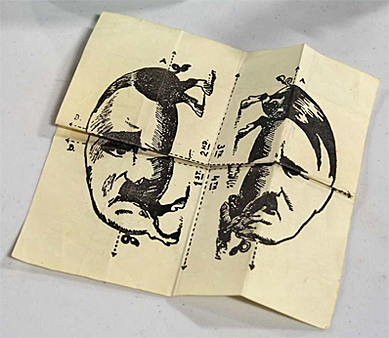
Here are two views of a single illustration, created by Hy Mayer (aka Henry Mayer) and published in Puck (19 September 1914), vol 76 no 1959, pp. 12-13. It was accompanied by a text about the outbreak of World War I, titled “The Pasteboard Charlemagnes by Benjamin De Casseres

Mayer’s illustration, titled “Militarism: From the Craddle to the Grave,” is an upsidedown double image. As shown here, it appears to be the image of a child when viewed upright, but turned upsidedown, it looks like a German helmet with a human skull inside.


Tuesday, May 23, 2023

Vladimir Tatlin's Tower of the Third International

Above Photograph of Russian Constructivist artist Vladimir Tatlin (second from left) and three of his associates in the process of constructing a model of his now famous Tower of the Third International (aka Tatlin's Tower).

•••

George Grosz, An Autobiography. Translated by Nora Hodges. Berkeley: University of California Press, 1998, pp. 178-180—

Constructivism had many followers in Russia. [Among the most prominent] was a certain [Vladimir] Tatlin, a peculiar Russian child of nature. Tatlin came from a wealthy family and had traveled in Germany before the First World War. At that time he had been a member of a famous balalaika band [in which he played the bandura] and choir [which sang in Ukrainian], which had played before Kaiser Wilhelm at court. He then became a painter and also studied at a school of technology. He got known when he exhibited his big project for a monument in Moscow [intended for construction near the Cathedral of Saints Peter and Paul] …he himself would never have called it a monument, that word was too old-fashioned and romantic, he called it the “Tower of the Third International” [at full scale, it would have been one third taller than the Eiffel Tower]. The [initial] model of this whole powerful construction was about ten feet high, consisting of all sorts of rods and bars put together at odd angles.…

…[Sometime later] I went to see Tatlin once more. He lived in a small, old, dilapidated apartment. Some of the chickens that he kept slept in his bed. They laid eggs in one corner. We drank tea, and Tatlin chatted about Berlin, Wertheim's department store, and his performance at court. There was a completely rusted wire mattress leaning on the wall behind him with a few sleeping chickens sitting on it, their heads tucked under their wings. They furnished the perfect frame to dear Tatlin as he started to play his homemade balalaika. Darkness appeared through the curtainless window; most panes had been replaced with little squares of wood. We suddenly seemed surrounded by the melancholy humor of a book by [Russian writer Nikolai] Gogol. Tatlin was no longer the ultramodern constructivist; he was a piece of genuine, old Russia. I never saw him again, nor did I ever hear of him or the formerly much discussed “Tatlinism.” He is said to have died alone, and forgotten [in 1953].•

 • According to a Wikipedia biographical text, “In 1948 he was heavily criticized for his allegedly anti-communist stance and lost his job, but was not repressed.”

•••

George Grosz, An Autobiography. Translated by Nora Hodges. Berkeley: University of California Press, 1998—

I remember [American literary critic] Edmund Wilson best coming down the steps in his beach coat; like all fat people, he looked most impressive viewed from below…Wilson is more a lobster person than a fish person: you have to use a nut cracker to get to the meat. (p. 305)

Below Vladimir Tatlin, Counter-relief (1916). Photo: Shakko, Wikimedia Commons.


Tuesday, November 15, 2022

today I bought a dress that is made out of wood

Where is the fifth pig?
Ione Robinson, A Wall to Paint On. New York: E.P. Dutton, 1946, p. 373-374, while visiting Berlin, from a letter dated November 8, 1938 (less than a year in advance of the start of World War II) —

Today I bought a dress that is made out of wood. I still can't believe it. In fact, there was not one “natural” item in this department store; everything was synthetic. In an arcade on Unter den Linden, I spent a long time looking at photographs of Hitler and I bought a series of tiny "flap” [flip book] photos which, when you riffle them fast, make him come to life like a miniature movie. The one I have shows him making a speech and if you riffle the pages slowly the gestures are so calculated and ridiculous they make you laugh—although that is one thing I have not seen people do in this city. 

The people in the streets [of Berlin] look worn and tired. Life is completely regulated. There are signs every few feet, telling one what to eat and believe. Money is controlled. Four dollars a day is about all you can spend. In a certain sense, this makes life very simple—you know exactly what you can and cannot do. Even though certain things could be achieved through such a system, I don't see how anyone could be happy. I begin to feel as though I were living in a well-run jail. There is the same security of a bed at night, something to eat, and a few hours of “forced” recreation. But the realization that one must constantly yield to the will of a single man takes all the incentive and moral force from a human being.

Tuesday, November 23, 2021

WWI American actions and attitudes at home

Above 19th century Victorian wood type catalog page, 1874. Public domain.

•••

Edward Robb Ellis, Life in the United States 1914-1918. New York: Coward, McCann and Geoghegan, 1975, p. 428, describing the actions and attitudes of Americans during World War I, after the US declared war against Germany—

Anything mindful of German culture became suspect. Vigilantes inspected public libraries and invaded private homes and burned books by Goethe and Heine and Kant, broke Victrola records that preserved the music of Beethoven and Bach and Wagner. School after school forbade the teaching of the German language, while in clubs and churches and halls there was a ban against speaking German. [In the Iowa home of my father's parents, whose parents had immigrated from Germany in the 1850s, German was guardedly only spoken at home.]

With trembling fingers people plucked their gardens free of bachelor buttons, which was Germany’s national flower. Sauerkraut was renamed Liberty cabbage, hamburger became Salisbury steak. German measles were called Liberty measles, German dishes disappeared from restaurants, seed catalogs referred to German clover as Liberty clover, and bartenders removed pretzels from their free lunch counters.