Showing posts with label caricature. Show all posts

Saturday, April 13, 2024

what traveling with a wagon train was really like

Above Fred Stone was a famous Vaudeville performer, one of the best. He was also the best friend of Will Rogers. Among his many achievements, he played the Scarecrow in the 1902 stage production of the Wizard of Oz. He is shown above with David Montgomery, who was cast as the Tin Woodman.

•••

Fred Stone (in his autobiography), Rolling Stone. New York: Whittlesey House, 1945, pp. 3 and 5—

The day they were married, my father and mother hitched their team to a prairie schooner and joined the procession that was trailing out across Illinois, Iowa, Missouri, Kansas, and Colorado…

We went into Garden City, Kansas—so called because there wasn’t a garden within a thousand miles—with a train of seventy-three prairie schooners. People were traveling together for protection from the Indians, for there were still Indian raids over the prairies, and buffalo, bear, and deer were plentiful. But though I saw lots of Indians at Garden City, they were all friendly, and the only marauders father had to contend with were the white men who tried to steal everything in those covered wagons, from the bedding to the wooden wheels. So when father stood on watch all night, with a shotgun in his hand, it was not because any redskin was going to bite the dust. It was because some of his fellow travelers were as apt as not to take his prairie schooner apart in the night if there was anything in it they fancied.

Sunday, May 21, 2023

impromptu gymnastics strengthens muscularity

flag waving / anon
A.A. Milne, Autobiography. New York: E.P. Dutton, 1939, pp. 52-53—

The only occasion on which I spoke in the Debating Society was at what was called an “Impromptu Debate.” The names of the members were put into one hat, the subjects for speech into another. In an agony of nervousness I waited for my name to be called. It came at last, “Milne Three.” Milne III tottered up and drew his fate; not that it mattered, for one subject was as fatal to him as another. He tottered back to his desk and opened the paper. The subject on which he had to speak was “Gymnastics.”

I stood there dumbly. I could think of nothing. The boy next to me, misapprehending the meaning of the word “impromptu,” whispered to me: “Gymnastics strengthens the muscles.” I swallowed and said, “Gymnasthicth thtrengthenth the muthelth.” Then I sat down. This is the shortest speech I have ever made, and possibly, for that reason, the best.

• See also this great story about the “shotgun seminars” at Princeton, as well as this video essay about the nature of humor.

Friday, May 12, 2023

social media acronyms as practiced by victorians

Above A three-panel caricature, The Pair of Skaters (1873), by one of history's finest comic illustrators (often featured in Simplicissimus), the Norwegian artist Olaf Gulbransson. His command of movement and gestural line has never been equaled.

•••

A.A. Milne, Autobiography. New York: E.P. Dutton, 1939, pp. 131-132—

One way and another we [the author and his brother Kenneth John Milne] got a good deal of happiness out of it [preparatory school], if not always in the way expected of us. We sat together now, never to be separated, in the Mathematical Sixth, which meant that we occupied one corner of a room in which some lowly mathmatical set was being taught. Since we could not talk wthout disturbing the master-in-charge we wrote letters to each other: long letters detailing our plans for the next holidays. Interest was added to these letters by our custom of omitting every other word, leaving blanks which the addressee had to fill in. Our minds were sufficiently in tune for this to be possible without being easy; one could get the general sense without being certain of the exact word. As in my old French set, we then changed papers and marked each other's mistakes. Sometimes our communications were in initial letters only. During “second school,” for instance, it was certain that one of us would ask the other “SWGUSIB?” This clearly meant “Shall we go up-Sutts in break?” a question which expected the answer “Yes” and got it. Ken would feel in his pockets and decide that, since we already owed Father 15/6, we might as well owe him sixteen shillings. We did.

Tuesday, November 15, 2022

today I bought a dress that is made out of wood

Where is the fifth pig?
Ione Robinson, A Wall to Paint On. New York: E.P. Dutton, 1946, p. 373-374, while visiting Berlin, from a letter dated November 8, 1938 (less than a year in advance of the start of World War II) —

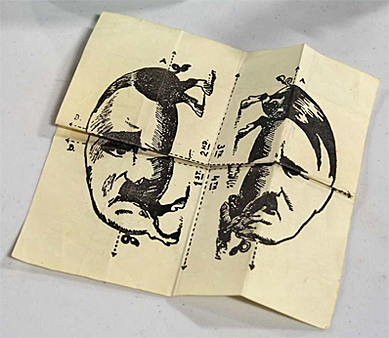
Today I bought a dress that is made out of wood. I still can't believe it. In fact, there was not one “natural” item in this department store; everything was synthetic. In an arcade on Unter den Linden, I spent a long time looking at photographs of Hitler and I bought a series of tiny "flap” [flip book] photos which, when you riffle them fast, make him come to life like a miniature movie. The one I have shows him making a speech and if you riffle the pages slowly the gestures are so calculated and ridiculous they make you laugh—although that is one thing I have not seen people do in this city. 

The people in the streets [of Berlin] look worn and tired. Life is completely regulated. There are signs every few feet, telling one what to eat and believe. Money is controlled. Four dollars a day is about all you can spend. In a certain sense, this makes life very simple—you know exactly what you can and cannot do. Even though certain things could be achieved through such a system, I don't see how anyone could be happy. I begin to feel as though I were living in a well-run jail. There is the same security of a bed at night, something to eat, and a few hours of “forced” recreation. But the realization that one must constantly yield to the will of a single man takes all the incentive and moral force from a human being.

Saturday, November 5, 2022

tobacco road / the story of a boy who smoked

EVOLUTION OF A BOY WHO SMOKED, in The Journal (Huntsville AL), February 28, 1907, p. 2. Reprinted from the Chicago Daily News. Artist unidentified—

Do you know any little boy that [sic] smokes cigarettes? If you do, just show him this picture. It is the sad story of Dick Sillypate. He saw another boy smoking a cigarette, and thought it looked so manly that he would try it himself. The picture shows what happened to him at the end of five months.

Saturday, December 18, 2021

Stendhal Meets Rossini / Who Crows for You?

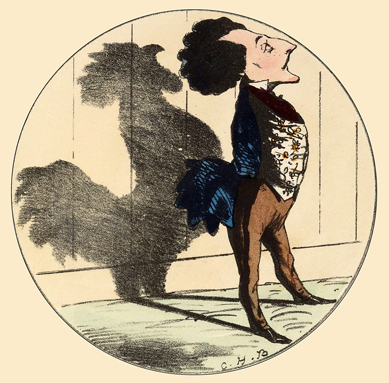
Above Bantam, comic shadow caricature by British artist Charles Henry Bennett, Victorian illustrator.

•••

Stendhal (Marie Henri Beyle), author of The Red and the Black, describing an incident in a visit to Italy in 1817—

We halted in Terracina, and there…we were invited to take supper with a party of travellers newly arrived out of Naples. Gathered about the table, I observed some seven or eight persons, amongst whom, in particular, my eyes lighted upon a fair-haired young man, of some five or six-and-twenty years of age, astonishingly handsome in spite of a slight touch of baldness. I pressed him for news of Naples, and in particular, of music in that city: he answered my curiosity with answers that were clear-cut, brilliant and humorous. I enquired of him whether, when I reach Naples, I might still hope to see [Gioachino] Rossinis Otello. I pursued the topic, asserting that, in my opinion, Rossini was the bright hope of the Italian school; that he was the only living composer who had true genius as his birthright. At this point I noticed that my man seemed faintly embarrassed, while his companions were grinning openly. To cut a long story short, this was Rossini.

Sunday, November 22, 2020

the stuff of my pleasures / flesh of my thoughts

Honoré Daumier (attr.)
Jean-Paul Sartre, The Words (New York: George Braziller, 1964), pp. 93-94—

I’m a dog. I yawn, the tears roll down my cheeks. I feel them. I'm a tree, the wind gets caught in my branches and shakes them vaguely. I'm a fly, I climb up a windowpane, I fall, I start climbing again. Now and then, I feel the caress of time as it goes by. At other times—most often—I feel it standing still. Trembling minutes drop me down, engulf me, and are a long time dying. Wallowing, but still alive, they're swept away. They are replaced by others which are fresher but equally futile. This disgust is called happiness. My mother keeps telling me that I'm the happiest of little boys. How could I not believe it since it's true? I never think about my forlornness. To begin with, there's no word for it. And secondly, I don't see it. I always have people around me. Their presence is the warp and woof of my life, the stuff of my pleasures, the flesh of my thoughts.

RELATED LINKS

Embedded Figures in Art, Architecture and Design

Other sources

Friday, April 3, 2020

Kenneth Gogel | Recalling a wonderful teacher

Above Kenneth Gogel, The Nervous System. Collage (1973). Permanent Collection of Art, University of Northern Iowa. Among his most memorable artworks is Gogel's portrayal of “the [very] nervous system” of US President Richard Nixon at the height of the Watergate scandal. Gift of Roy R. and Mary Snyder Behrens.

•••

In the late 1960s, when I was an undergraduate art student at the University of Northern Iowa, one of my favorite teachers was an art education professor named Kenneth Gogel. He had been a student of Victor Lowenfeld at Pennsylvania State University. He was particularly interested in children’s drawings, and what those might reveal about (in Lowenfeld’s words) their “creative and mental growth.”

Part of the reason I liked him so much was his eccentricity. He had "a mind of his own,” so his comments were often surprising. His artwork was equally unpredictable. He wasn’t committed to staying within a consistent approach to art-making, whether medium, style, or subject matter. In one of his experiments, he used photo booth self-portraits and xerox (innovative at the time). In another, he rigged up a kind of terrarium, the sides of which were covered with a card-like material punched with random circular holes; inside the terrarium were ladybugs, which changed the pattern of the holes (on-or-off, like digital punch cards) as they climbed up and down the interior walls.

Of the artworks he was making then, one I especially admire is a large mixed media work titled A Bride and Her Father Visit the World’s Largest Turtle, dated c1968 (below). It is now in the UNI Permanent Collection of Art. Gift of Roy R. and Mary Snyder Behrens. The original source for the turtle is the vintage print at the bottom of this post.

Kenneth Gogel (c1968), mixed media


Ken and I remained in contact now and then after I graduated, by exchanging cryptic notes. His were usually whimsical observations he made during lengthy faculty meetings or peculiar things he’d run across while nosing around in the library. One time, he sent me the patent diagram for a mechanical drawing device by Jean Tinguely. He was forever looking around at thrift shops and used bookstores, then sending me things that he thought I could use. He sent me my very first vintage World War I photograph of a dazzle-camouflaged ship, the USS Leviathan.

He even wrote to me when I was (miserably) in the US Marine Corps. When I answered candidly, he saved the letter (he saved nearly everything, repurposing the slightest scraps), then simply mailed it back to me fifteen years later.

Years later, when I was teaching temporarily at an awful art school in the South, I was surprised to hear his voice when I answered the phone one day at home. When I asked where he was calling from (I had heard that he was touring the country alone in a recreational vehicle), he replied, “Oh, I’m just a couple of blocks from your house. If you’re going to be there, I’d like to stop by briefly, just to say hello.” Moments later, he arrived, and, in spite of my insistence that he stay for a few days, we talked briefly and off he went. That time, I think he gave me a copy of Karl Gerstner’s A Compendium for Literates.

As an undergraduate, my major was Art Education, so that later, I would teach grades 7-12 for most of a school year, until the draft board broke my contract and sent me off to be a Marine. But in the last year before graduating with a BA degree, I was a student teacher for the first nine weeks of one semester. During the remaining half of that semester, Ken Gogel was my advisor for a full-time research project in which I proposed to read about the role of perception in visual art. I met with Ken only a few times, with the agreement that at the end of the term I would turn in a substantial paper about what I had discovered.

The paper I turned in was titled Perception in the Visual Arts. It anticipated many of the subjects that I would research and write about for the next fifty years. Although I was only an undergraduate, on a whim I submitted it to Art Education: The Journal of the National Art Education Association, the foremost journal in the field. It was published there in March 1969, just weeks in advance of being ejected from the classroom (not having a bone spur) and sent off to an unjust war. I am the same age as the man who now pretends to be the US President.

Public domain

Sunday, December 8, 2019

Arcimboldo portrait | Do you carrot all for me?

Above A reversible painting (view top side up or upside down) by the Italian master Giuseppe Arcimboldo (c1526-1593), especially known for his portrait heads comprised of visual pun arrangements of fruits, vegetables, flowers and so on. This one is referred to as Reversible Head with Basket of Fruit. c1590. Oil on panel.

•••

Anon
Do you carrot all for me?
My heart beets for you,
With your turnip nose
And your radish face.
You are a peach,
If we cantaloupe,
Lettuce marry;
Weed make a swell pear.

Thursday, August 29, 2019

Saying so much with so little | such a poster

Above An extraordinary poster (unfortunately, haven't found the graphic designer's name) that says so much so powerfully—with such unbelievable brevity. Thanks to former student Amanda Chan, who passed it on.

Tuesday, January 22, 2019

Charles Henry Bennett / Shapeshifting Cat

C.H. Bennett, Poor Puss (1863)
Above One of a series of elaborate comic metamorphoses (aka shapeshifting) created by Victorian-era British illustrator Charles Henry Bennett (1863) in sardonic reference to Charles Darwin's theory of natural selection, this one titled "Poor Puss." Courtesy The Wellcome Library.

•••

The Reverend Benjamin Newton (Vicar of Landwit), Diary (September 1, 1816)—

An entertaining German dined here who teaches the girls music and plays delightfully and sings well with no voice having been shot through the lung. A Mr. Causer having been bit in a drunken frolic by a man of the name of Shipley in the leg last week is obliged to suffer amputation. During an armistice in which the Prussian and French officers were drinking together a son of [Prussian Field Marshall] Blücher gave for a toast the King of Prussia, which a French officer would not drink and soon after when it came to his turn gave [Napolean] Bonaparte which young Blücher would not drink, on which the officer went up to him and without saying anything struck him a smash in the face. Blücher said nothing but went out of the room and returned immediately with a pair of pistols, with one of which without uttering a word he shot the officer dead and then held up the other and said he had that ready for any man who would take up the quarrel. This came to his father's knowledge, who put him under arrest for six weeks.

Charles Henry Bennett / Shapeshifting Dog

C.H. Bennett, Good Dog (1863)
Above One of a series of elaborate comic metamorphoses (aka shapeshifting) created by Victorian-era British illustrator Charles Henry Bennett (1863) in sardonic reference to Charles Darwin's theory of natural selection, this one titled "Good dog." Courtesy The Wellcome Library.

•••

The Reverend Francis Kilvert, Diary (July 22, 1871)—

Mrs. Nott told me that Louie of the Cloggau was staying in Presteign with her aunt Miss Sylvester, the woman frog. This extraordinary being is partly a woman and partly a frog. Her head and face, her eyes and mouth are those of a frog, and she has a frog's legs and feet. She cannot walk but she hops. She wears very long dresses to cover and conceal her feet which are shod with something like a cow's hoof. She never goes out except to the Primitive Methodist Chapel. Mrs. Nott said she had seen this person's frog feet and had seen her in Presteign hopping to and from the Chapel exactly like a frog. She had never seen her hands. She is a very good person. The story about this unfortunate being is as follows. Shortly before she was born a woman came begging to her mother's door with two or three little children. Her mother was angry and ordered the woman away. "Get away with your young frogs," she said. And the child she was expecting was born partly in the form of a frog, as a punishment and a curse upon her.

Thursday, March 24, 2016

Jared Rogness Exhibition at UNI Rod Library

Jared Rogness Exhibit Poster
From February 29 through April 4, 2016, selected works by an Iowa-born illustrator, and UNI Department of Art alum, Jared Rogness, will be on on display on the Learning Commons Exhibition Wall on the main floor in Rod Library at the University of Northern Iowa.

This exhibit both predates and coincides with RodCon 2016, the Rod Library’s annual mini comic con, which takes place on Saturday, April 2, from 10 am to 4 pm. Throughout the day, the various featured events include comics, crafts, games and a costume contest.

© Jared Rogness


Artist Jared Rogness is a storyboard artist and illustrator living in Los Angeles. He earned his Bachelors of Fine Arts degree at UNI in 2003. As a student he was a frequent contributor of outspoken political cartoons to The Northern Iowan (student newspaper) under the pen name e-Chicken.

He has illustrated short stories for magazines, produced motion picture storyboards, and created the graphic series "Green Street" for Little Village magazine. The works in the exhibition are a mix of selected components from a variety of his projects.

© Jared Rogness

Tuesday, April 16, 2013

UNI Art History Symposium | Roger Shimomura

Symposium Poster |  Desiree Dahl (2013)

About eight years ago, art historian William Lew (who was once my department head) produced an exhibition catalog about the artwork of Japanese-American artist Roger Shimomura. During World War II, simply because of their ethnicity, three generations of Shimomura's family (as a child, he was among them) were imprisoned in an American concentration camp, called Minidoka, in south central Idaho, about 20 miles from Twin Falls. That catalog, titled Minidoka Revisited: The Paintings of Roger Shimomura, was published by the Lee Gallery at Clemson University (2005), where Lew was teaching at the time. It was beautifully designed by one of our former students, Jessica Barness, who now teaches graphic design at Kent State University. I reviewed it for Leonardo Reviews, which I saw as an opportunity to remind myself and others of that deplorable episode in American history.

On Friday, April 19, on the campus of the University of Northern Iowa, there will be another chance to remember these injustices, in relation to the artwork of Roger Shimomura. Through the efforts of two UNI colleagues, art historians Charles Adelman and Elizabeth Sutton, William Lew is coming back to serve as the juror and guest lecturer at the UNI Department of Art's 3rd Annual Art History Symposium. The evening's events (to be held in the auditorium of the Kamerick Art Building) begin at 5:30 pm, with scholarly presentations by two current undergraduate art history students, Carlton James Miller ("Mauricio: For an Eye an Eye") and Brittany Deal ("Romare Bearden: The Great Migration as a Black Odyssey"). Following that, at 6:00 pm, will be the announcement of juror's awards, and the keynote address by William Lew, titled "Messages: An Asian American Perspective (The Art of Roger Shimomura)." This annual symposium, which is always interesting, is free and open to the public.

One final note: A hint of Shimomura's work can be seen on this web page, where I've posted two variations on the symposium poster, designed by Desiree Dahl, one of our current graphic design students who works as an intern in the publicity section (directed by Sarah Pauls) of the Dean's Office of the College of Humanities, Arts and Sciences. The second version (below) was the one that was actually published, but the first one is equally poignant, and, like King Solomon, I could not choose between the two.

Symposium Poster | Desiree Dahl (2013)


Friday, April 27, 2012

WPA Artist | Orr C. Fisher


Back in 1999, we published an essay (now online) about the painted murals that were made for US post offices in the 1930s and 40s as part of a government program called the Works Progress Administration (WPA). Among our favorites is an oil on canvas mural made in 1941 by Iowa-born artist Orr C(leveland) Fisher (1885-1974), titled The Corn Parade (reproduced above). It was commissioned to hang in the lobby of the new post office in Mount Ayr IA (and is apparently still there, assuming it hasn't closed), the seat of Ringgold Country in south central Iowa. (In an earlier post, we noted that Jackson Pollock's mother was born near Mount Ayr, and his father was also from Ringgold County.) As a WPA artist, Fisher also painted a mural for the post office in Forest City IA, titled Evening on the Farm (1942).

Fisher was originally from Ringgold County, having grown up near Delphos (originally named Borneo). According to online information (submitted by the artist's niece, Donna L. Howard) at a website on WPA murals, he studied art through correspondence schools, and (in 1913 and 1921) with Charles A. Cumming at the Cumming School of Art in Des Moines. While in Des Moines, he also studied at Drake University and worked with J.N. "Ding" Darling, the famous political cartoonist for the Des Moines Register

In an autobiographical article in 1930, as quoted in his niece's article, Fisher described his interest in art—

At an early age, yet in the primary department of a country school, I exhibited a talent for drawing by making pictures on my slate during the study period and on the blackboard at recesses and the noon hour. The barn doors, granary walls and every place on the old homestead where a smooth surface appeared was a temptation too strong to resist the markings of my pencil or chalk. Hence everything on the old farm was either decorated with comics or carved with knife in crude designs and initials. I use to draw with my finger in the plow furrow where the over-turned sod presented a smooth surface. On the way to school I would dig from the clay hills red and yellow soft rocks to color my pictures at school. This was before I knew what a crayola was.

He went on to say that "everywhere I have gone, I have drawn. I have drawn almost everything imaginable up to the modern art era, except a salary." Aside from being an artist, he worked for the railroad, drove a six-horse freight wagon, and produced articles, cartoons and illustrations for various publications. He was also an erstwhile inventor, and in 1904 (at age 19) he received a US Patent (No. 759,257) for an Automatic Whistle Operating Mechanism for locomotives (see patent diagram below). 


In later years, he lived in Woodstock NY, where he built a studio. In the 1960s, he moved to California, where he died in Fresno in 1974.

Wednesday, December 30, 2009

Darwin Smiling Broadly

While reading Diana Donald and Jane Munro, eds., Endless Forms: Charles Darwin, Natural Selection and  the Visual Arts (New Haven CT: Yale University Press, 2009), we were surprised to run across a caricature of Charles Darwin in which he is (to our surprise) smiling broadly. According to the caption (p. viii), it is a colored lithograph that initially appeared in Vanity Fair on September 30, 1871. You can also see it online here. In Endless Forms, it is described as showing "aspects of Darwin's characteristic appearance described by his son Francis, but seldom portrayed. He habitually raised his seat with cushions or footstools, and sat with 'his legs crossed, and from being so thin they could be crossed very far…When he was excited with pleasant talk,' his face and 'whole manner' were 'wonderfully bright and animated.'"