![]() |
| Roy R. Behrens (©2011), Barbarian Seville. Digital book montage. |
Wednesday, January 14, 2026
slow art / deep-running skill and doggedness
Sunday, January 11, 2026
bush whacked / rhymes with porky, no offense
"I just want to apologize to you for what I said," she [Barbara Bush] told me over the phone while I was in the middle of another debate rehearsal. "I certainly didn't mean anything by it."
"Don't worry about it," I said to her. "We all say things at times we don't mean. It's all right."
"Oh," she said breathlessly, "You're such a lady."
All I could think when I hung up was: Thank God for my convent school training.
Wednesday, September 18, 2024
the frustrations of small mistakes in video talks
One that always bothers me is a scene in which I provide an example of the simultaneous contrast of color, in which a single color appears to be two noticeably different colors, when placed in different settings. The still shot reproduced above is the slide that I intended to use. It is a persuasive example of simultaneous contrast, because the field of background gray (behind the name Bing Crosby) conspicuously appears to be two distinctively different grays. This is the image I should have used, and everything would have been perfectly fine. Unfortunately, as I was editing the final version, I slightly adjusted the overall color balance—with the result that the contrast effect is far too subtle in the film.
Friday, May 3, 2024
do portraits begin to resemble their subjects?
William Zorach, Art Is My Life: The autobiography of William Zorach. Cleveland OH: World Publishing, 1967, p 130—
There is a disconcerting thing about portraits. Someone does your portrait and you don't like it, your friends don't like it; everyone says it doesn't look like you. A few years go by and you look like that portrait and all your family and all your friends say, "What a good likeness." People, they say, begin to look like their dogs. Maybe this is somewhat the same thing.
Friday, November 3, 2023
a meeting of midwestern minds? one gets nasty
Wood was greatly interested in architecture, as is apparent in the subject matter of his paintings. But what did he think of Wright's architecture? And, in turn, what was Wright's opinion of the Regionalist paintings of Grant Wood and others? Based on evidence from the time, this essay surmises the answer.
Wednesday, October 25, 2023
John C. Lofton / his astonishing miniature rooms
John C. Lofton, Abandoned Nest in an Empty Room (1976). Wood and other materials. Interior 28h x 16w x 22d. Exterior (on sturdy mounted tripod stand) 90h. Lighted inside through window with shade.
I’m not sure when I purchased this. It must have been in the 1980s. I was teaching in Milwaukee, and became interested in a series of constructions that consisted of mysterious room interiors. They were miniaturized of course, but enclosed in a box and mounted on a wooden pole-like stand (including the stand, the height of this one is 90 inches).
Lofton was a local artist who was especially skilled at woodworking. I was drawn to this particular work, because it reminded me of the bleakness of an empty room in (let's say) an apartment at the moment one is moving in—or moving out.
There is a detailed hardwood floor, exactly proportioned moulding, and replicas of a wooden chair, a telephone, an ashtray, and a window on the facing wall. The detail which completes its persuasiveness is the simulated outdoor light that appears to flow in from beyond the window shade.
I can’t recall how much I paid for this. Not a terrible lot, I’m sure. But the amount was sufficient that the artist joked I’d “lost my shirt” in acquiring it. As a result, he graciously threw in a second miniature work of his (see below), a hand-carved balsa wood shirt, with appropriate metal buttons and a wire clothes hanger.
I remember another Lofton work, a second room interior, which I saw but, regrettably, did not buy. Fortunately, I still have a full-color photograph of it (also below). He titled it Bird Cage (1976), a name that surely does not “spoil” or give away its range of interpretative possibilities.
Is that a toucan on the pole?
These two artworks (the empty room and wooden shirt) have traveled with us everywhere in the years since 1985, as we repeatedly moved from state to state. They have survived unscathed, as have so many other wonderful works which remain in our collection. As we age, of course, we wonder what will become of them. It's not unlike finding a home for a cat. So many questions, so many concerns.
Thursday, June 29, 2023
Del Ames / David Chelsea's book on perspective
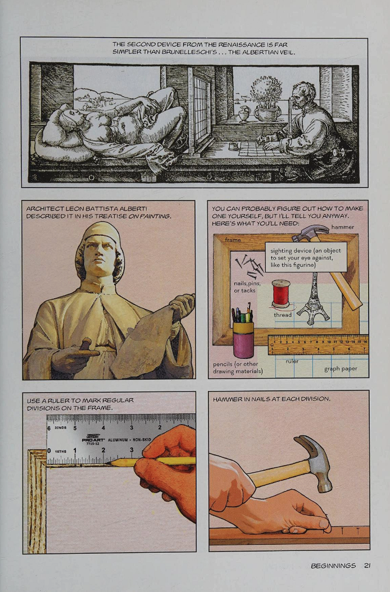
There are various reasons why I recommend this book (the cover isn’t one of them). The interior comic-style images are beautifully rendered and colorized, and the page layout is very smart. It interweaves a well-written and reliable text, both historical and technical, with clear and thoughtful instructions on how to make physical models of the demonstrations in the text.
That would be enough to recommend it. But I am also drawn to it because it covers so many of the vision-related topics that I myself have researched and written about since the 1960s, of which the history of perspective is one. But there is also the use of the camera obscura as a drawing aid. Anamorphoses or “forced perspective” imagery, including street art illusions. Dutch perspective cabinets. The Ames Demonstrations, devised by American optical physiologist Adelbert Ames II, including the Ames Distorted Room (there are instructions on how to make a model, in exacting detail). Six-Point Perspective. Various kinds of stereoscopic (3-D) imagery, and even stereo collage (which I thought I invented back in c1984). And zoetrope (flip book) animations. Wow! What more could you want.
So look for this book! It’s well worth it. And you might also take a look at my own recent video trilogy on the life and work of Ames, since it touches on many of the same subjects. The videos are found online at my YouTube Channel. They are completely free to view and to share with others. See two screen grabs below.
Tuesday, May 23, 2023
Vladimir Tatlin's Tower of the Third International
Above Photograph of Russian Constructivist artist Vladimir Tatlin (second from left) and three of his associates in the process of constructing a model of his now famous Tower of the Third International (aka Tatlin's Tower).
•••
George Grosz, An Autobiography. Translated by Nora Hodges. Berkeley: University of California Press, 1998, pp. 178-180—
Constructivism had many followers in Russia. [Among the most prominent] was a certain [Vladimir] Tatlin, a peculiar Russian child of nature. Tatlin came from a wealthy family and had traveled in Germany before the First World War. At that time he had been a member of a famous balalaika band [in which he played the bandura] and choir [which sang in Ukrainian], which had played before Kaiser Wilhelm at court. He then became a painter and also studied at a school of technology. He got known when he exhibited his big project for a monument in Moscow [intended for construction near the Cathedral of Saints Peter and Paul] …he himself would never have called it a monument, that word was too old-fashioned and romantic, he called it the “Tower of the Third International” [at full scale, it would have been one third taller than the Eiffel Tower]. The [initial] model of this whole powerful construction was about ten feet high, consisting of all sorts of rods and bars put together at odd angles.…
…[Sometime later] I went to see Tatlin once more. He lived in a small, old, dilapidated apartment. Some of the chickens that he kept slept in his bed. They laid eggs in one corner. We drank tea, and Tatlin chatted about Berlin, Wertheim's department store, and his performance at court. There was a completely rusted wire mattress leaning on the wall behind him with a few sleeping chickens sitting on it, their heads tucked under their wings. They furnished the perfect frame to dear Tatlin as he started to play his homemade balalaika. Darkness appeared through the curtainless window; most panes had been replaced with little squares of wood. We suddenly seemed surrounded by the melancholy humor of a book by [Russian writer Nikolai] Gogol. Tatlin was no longer the ultramodern constructivist; he was a piece of genuine, old Russia. I never saw him again, nor did I ever hear of him or the formerly much discussed “Tatlinism.” He is said to have died alone, and forgotten [in 1953].•
• According to a Wikipedia biographical text, “In 1948 he was heavily criticized for his allegedly anti-communist stance and lost his job, but was not repressed.”
•••
George Grosz, An Autobiography. Translated by Nora Hodges. Berkeley: University of California Press, 1998—
I remember [American literary critic] Edmund Wilson best coming down the steps in his beach coat; like all fat people, he looked most impressive viewed from below…Wilson is more a lobster person than a fish person: you have to use a nut cracker to get to the meat. (p. 305)
Below Vladimir Tatlin, Counter-relief (1916). Photo: Shakko, Wikimedia Commons.
Sunday, April 23, 2023
Herbert Simon / the fruits of being colorblind
![]() |
| Arcimboldo, Fruit Basket (c1590) |
Above Painting by Giuseppe Arcimboldo titled Fruit Basket. Oil on panel, c1590. It is a reversible still life of fruit. Turned upsidedown (as shown here), it resembles the head of a person.
•••
Herbert Simon, Models of my life. NYC: Basic Books, 1991, p. 5—
Whether during his fourth summer or on some later occasion, the boy [the author] was among a party picking wild strawberries. The others filled their pails in a few minutes; there were only a few strawberries in the bottom of his. How could the others see the berries so easily amid the closely matching leaves? That was how he learned that strawberries are red and leaves green, and that he was colorblind.
•••
Postscript As Simon comments in his autobiography, he would later marry a woman with red hair. In view of his being colorblind (he continues): “'How did you know her hair was red?' the perceptive reader might wonder. Well, I had early been told that there were no green-haired people, nor any red lawns. Ergo. . . ."
In relation to the use of ambiguous, pun-like images in art (such as this painting by Arcimboldo), it may also be of interest to view my recent video called EMBEDDED FIGURES, ART AND CAMOUFLAGE.
Wednesday, January 12, 2022
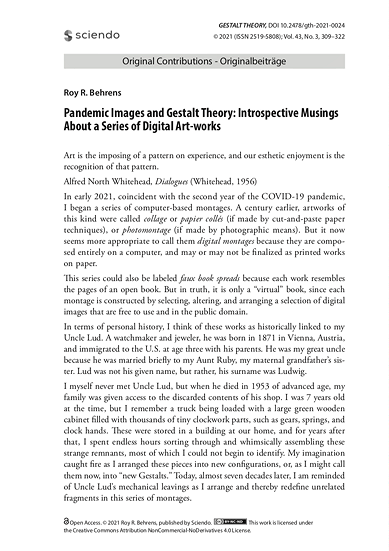
musings about digital art and gestalt theory
Saturday, July 10, 2021
Gertrude Käsebier's Portraits of Lakota Sioux
![]() |
| Article from The Iowa Source July 2021, p 10 |
Thaw had recently married a chorus girl and actress named Evelyn Nesbit. In an effort to be straightforward, she revealed to him that, several years earlier, as a teenager, she had been sedated and seduced by White. At the time of the shooting, the public was well-acquainted with Nesbit. She was a popular model for artists and photographers, and a “Gibson girl” celebrity.
The best-known portrait of Nesbit, made in 1903, is an iconic image in the history of photography. The woman who made it, Iowa native Gertrude Käsebier (1852-1934), is now widely considered to be one of the finest photographers of the Modernist era. That ranking is not only based on her portrait of Nesbit—indeed, she was far more accomplished than that.
Käsebier (née Gertrude Stanton) had a photographic studio on Fifth Avenue in New York at the time that she photographed Nesbit. Her photographic career had taken off late in the 1890s, when Alfred Stieglitz published and exhibited her photographs. She was, he asserted, “the leading artistic portrait photographer of the day.”
more>>>
Below Roy R. Behrens, Death Announced, 2021. Digital montage. Among the background components is a press photograph (not by Gertrude Käsebier) of the public appearance of Evelyn Nesbit (shrouded) after the assassination of Stanford White by her husband, Harry Thaw.
![]() |
| Roy R. Behrens, copyright © 2021 |
Thursday, January 14, 2021
artist Orr Fisher in process of painting his mural
Saturday, January 9, 2021
favorite feather in the cap of Ringgold County
Above Detail of Orr Fisher's WPA mural, The Corn Parade (1941), in the US Post Office in Mount Ayr IA.
•••
Roy R. Behrens, THE CORN PARADE: Orr Fisher's wacky WPA mural, in The Iowa Source (Fairfield IA), Vol 38 No 1 (January 2021), pp. 10-11—
American astronaut Peggy Whitson was born in south central Iowa, in Riggold County, and attended high school in Mount Ayr, the county seat. She is that region's claim to fame, although it should also be noted that the parents of Abstract Expressionist artist Jackson Pollock also grew up in that county. My favorite feather in the cap of Ringgold County is a Depression-era WPA mural that hangs in the US Post Office in Mount Ayr. Created in 1941 by local artist Orr Cleveland Fisher (1885-1974), it is titled The Corn Parade.…more>>>
Thursday, December 24, 2020
think life today is strange—just look at the future
Above Trompe l'oeil is an art historical term which translates literally from French as “fool the eye.” In this long-practiced tradition, artists create images that are so finely detailed that they might at first be mistaken for “the thing itself.” Until recently, I had not heard of Cornelius Norbertus Gijsbrechts, a seventeenth century Dutch painter. Not only was he an accomplished trompe l’oeil practitioner, he could also be terribly funny. Reproduced above, for example, is his The Reverse of a Framed painting (c1670), which is featured in an article on one of my favorite websites, The Public Domain Review, which includes an essay on Gijsbrechts and a selection of his paintings.
•••
Ring Lardner, TEETH AND HAIR TO DISAPPEAR, NOTES RING: Will Mean Radical Changes—Barbers and Magazine Proprietors to be Jobless—Highballs for Breakfast in the Davenport Democrat and Leader (Davenport IA), March 1, 1925, p. 3—
The future man, says [a Harvard University professor], “is certain to lose his teeth because he don’t need them no more. The ape man used them to tear sinews and break nuts and etc., but civilization has done away with these conditions. Hair was given us by nature to protect us vs. cold, but now we have got coats and artificial covering. Man used to half to have toes, to help climb trees to escape from animals, but now he don’t need toes no more and can get along with a whole lot less fingers. The shape of the human skull and man’s erect position is designed to promote an increase in the size and weight of the brain.”
Well, friends set down a wile and ponder what all this means. It ain’t no wonder people will be wearing longer faces as they will be thousands and thousands throwed out of work. Without no teeth and no reason for teeth they won’t be no dentists and without no dentists they won’t be no factories for making them weapons that nobody but a dentist would dast use. And without no hair they won’t be no excuse for barber shops which means that all the barbers will not only be out of a job but they won’t have no place to talk and nobody to talk to.
Without hair and whiskers and teeth, they won’t be nobody advertising shampoo cream or shaving powder or toothpaste which means closing up a lot more factories to say nothing about shutting down all the magazines, which is now supported by the boys that advertises these implements. Any ways you can see the finish of same magazines which I don’t need to mention their names but the only place you ever find them, is at barbers and dentists.
With the barbers out of business they won’t be no shelter for manicure girls and besides when people only has one finger they ain’t going to pay no 50 cents or 75 cents for a manicure to say nothing about how is the gals going to wield their scissors and file and etc. with only one finger. Along with manicurists will go chiropodists because our feet is going to have even less toes than our hands and they won’t be no parking space for a corn let alone a bunion.
There is a few facts to be faced but they ain’t by no means all. Like for instance: What is to become of all the folks now employed in comb and brush factories? And what will women talk about when they ain’t got no hair? And who is going to provide for the boys that makes their bread and butter playing a clarinet or a horn or a harp or a violin and etc. The only musical instrument a person can play with one finger is the piano and one finger piano music ain’t libel to overcrowd the dance halls. How can Babe Ruth swing a bat or how can Vanco pitch a curve ball with one finger? And what is the coacher at first and third base going to holler when they can’t say “Be on your toes?”
A person will get up in the morning and thank heavens that they don’t half to have or comb their hair but it will take them just as long to dress if not longer because it is some trick to button things up with one finger and if you ain’t got no hair—why they’s so much more surface to wash and specially when you have longer faces.
Without no teeth you can’t have nothing for breakfast except soup or a couple of high balls and by that time the high balls probably won’t have much nourishment in them because the professor says that it is going to be anywheres from 40,000 to 75,000 years before all these changes takes place. After breakfast you go to whatever work a person can do with one finger and no toes. At lunch you can have some more soup or scotch then back to work and a big dinner at night consisting of soup and liquor. They will still be theaters in the evening but people who prefers revues and gal shows will be up against it for entertainment as nobody wants to open their mouth and sing when they ain’t go no teeth and Gilda Gray is the only dancer in the world that can perform without using her hands and feet.
As I say [the good professor] don’t expect all these evolutions and revolutions for 40,000 or 75,000 years and the big majority of us won’t hardily live that long so we should worry, but it would be kind of interesting to look on from the outside and see how the world rolls along under the new conditions. Personally I haven’t no idear what it would be like to have no fingers or toes, but from the start I have got it ain’t going to take me no 40,000 years or nowheres near that long to appreciate what it means to live without teeth and hair.
Related Link
Roy R. Behrens and Paul D. Whitson, Mimicry, Metaphor and Mistake
Sunday, October 25, 2020
the chess piece could no longer be moved—
Man Ray, Self-Portrait (Boston: Llttle Brown, 1963), p. 237—
After dinner, [Marcel] Duchamp would take the bus to Nice to play at a chess circle and return late with Lydie [his first wife] lying awake waiting for him. Even so, he did not go up to bed immediately, but set up the chess pieces to study the position of a game he had been playing. First thing in the morning when he arose, he went to the chessboard to make a move he had thought out during the night. But the piece could not be moved—during the night Lydie had arisen and glued down all the pieces...A few days later Duchamp and Lydie divorced, and he returned to the States.

Artwork by Marcel Duchamp with Man Ray (1921)
Wednesday, April 22, 2020
a wreath of trefoiled shiny leaves—just like ivy
![]() |
| © Mary Snyder Behrens 2002 |
•••
Rockwell Kent, It's Me O Lord: The Autobiography of Rockwell Kent. New York: Dodd, Mead and Company, 1955, p. 21-22 [recalling his early childhood]—
…above all, and forever dear to my thoughts, there was Rosa, our young nurse from Austria. It was Rosa who dressed me in the morning and put me to bed at night. It was Rosa who taught me to say my prayers, and to believe in them…
It was always in German, of course, that with Rosa I prayed, and German—long before I spoke English—that I spoke. And it was Rosa who read us Struwwelpeter aloud, teaching us how wicked it was to kill birds and hunt hards, how sinful it was to make fun of little black boys, how disastrous it was to not watch your step and to tilt back in your chair at table, and how fatal it was to play with matches or not eat your supper every night. It was Rosa who walked with us in the fields and woods, who made us daisy chains and garlands of flowers, and who, sitting with us under the great oak tree—a veritable "charter oak"—wove me a wreath of trefoiled leaves, green shiny leaves just tinged with russet red, wove me the wreath and put it round my brow. Such pretty shiny leaves, like ivy! Ivy indeed it was: poison ivy. It was the doctor who prescribed the milky lotion, sugar of lead, for a swollen and disfigured child. And it was that child who got hold of it and drank it, and who almost died. It was Rosa who, more than any other, fills my memory of those years.
Monday, February 10, 2020
Salvador Dali's Dreams of Iowa Fields in 1952
Saturday, November 9, 2019
Humanities Iowa | Program opportunities 2019
![]() |
| WPA mural by Orr Fisher |
Over the years, the talks I've offered have usually been about Frank Lloyd Wright, Grant Wood, Buffalo Bill, World War I camouflage (which Iowans contributed to), and so on. A few days ago, I gave my presentation on Buffalo Bill (which includes an account of the plight of the Native Americans during the dreadful Indian Wars) at the Story County Conservation Center, just north of Ames IA. The large audience (around 100 people) was absolutely wonderful, and, as usual, I had a truly delightful time.
The downside is that it was probably the last time I'll present my talk about Buffalo Bill, which has easily had the most requests. With my retirement from teaching, I decided it was time to offer new topics. My new talks are listed on the HI website here. One of those talks is about the WPA (Works Progress Administration), one of the government programs set up by Franklin D. Roosevelt in the Depression Era, as I described in an essay I wrote years ago. One facet of that enabled unemployed artists to apply to create public murals for permanent installation in US post offices. It's surprising how many of these have survived. Reproduced above is one of my favorites, titled The Corn Parade, a painting by Orr Fisher in the US Post Office in Mount Ayr IA.
Saturday, April 13, 2019
A Sweet Disorder in the Dress / Robert Herrick
•••
Robert Herrick
Delight in Disorder (1648)
A sweet disorder in the dress
Kindles in clothes a wantonness;
A lawn about the shoulders thrown
Into a fine distraction;
An erring lace, which here and there
Enthralls the crimson stomacher;
A cuff neglectful, and thereby
Ribands to flow confusedly;
A winning wave, deserving note,
In the tempestuous petticoat;
A careless shoe-string, in whose tie
I see a wild civility:
Do more bewitch me, that when art
Is too precise in every part.
Monday, February 25, 2019
Long Lost Wedding Photograph Found
![]() |
| Mr. and Mrs. Arnold Finney (wedding photograph) |