Showing posts sorted by relevance for query John Dewey. Sort by date Show all posts

Tuesday, July 30, 2019

His students remember John Dewey

John Dewey
Will Durant, Transition: A Sentimental Story of One Mind and One Era. New York: Simon and Schuster, 1927, pp. 262-263—

Finally I came to Professor [John] Dewey. I smiled as I saw him cross the campus on a winter's day, hatless and overcoatless, collar turned up and hands in his pockets, hair unsubdued and neck-tie awry; none of us would have supposed, from his bearing or his appearance, that he was the leading figure in American philosophy. Nevertheless his lectures were almost the worst in his university. His voice was a monotone and his pace an even drawl,—except when he sought Flaubertianly for the fittest word, and stared out upon the lawn till it came. Some of us went to sleep; others of us copied his lecture in longhand word for word in order to remain awake. But he was slow because he did his own thinking, and ploughed virgin soil. Most lectures are compilations; and if they flow easily on it is because they follow a beaten path. But where Dewey thought there were no paths; he had to make them as he went; and like a frontiersman he had no time for ornamental delicacies. When, in the leisure of the evening, we read over what we had taken down during the day, we discovered gold in every second line. We found that without excitement, and without exaggeration, this man was laying a firm basis, in biological psychology, for the progress of his country and his race. Sometimes he spoke so radically that only the obscurity of his speech and the modesty of his manner saved him from the sensationalism of reporters or the hunters of heresy. And then at times, with a quiet sentence of irrefutable analysis, he annihilated a theory or a movement, and brought the eager ideals of youth within the circle of reality.

•••

Earl K. Peckham, quoted in Robert Bruce Williams, ed., John Dewey, Recollections (Washington DC: University Press of America, 1970), p. 12—

[American philosopher John] Dewey was speaking slowly and very carefully [in an evening class in 1935 at Columbia University], also in simply constructed sentences, which was typical of his style. I was listening intently to a point. Many of the class seemed to have left the area of thought. Dewey himself seemed to have left, to have gone into his own world. I felt that I was with him regardless of the seeming absence of the other members of the class. He hesitated after his point was made, and he looked at me through his thick bifocals. I said to him in a too loud, nervous voice, “Doesn’t emotion play a part in this thought process?” His stare fixed on me. I was embarrassed. He was silent—then he walked slowly over to the window and looked into the night, for the better part of two minutes. Then he looked back and fixed his stare at me (at least that is how I felt) and he said in a very slow and almost inaudible voice—but he knew I heard and he seemed to me not to care if anyone else heard or not—“Knowledge is a small cup of water floating on a sea of emotion.”

Thursday, November 19, 2015

Pencil Sharpener Poster | Amber Claus

Exhibition poster © Amber Claus 2015
Above Poster by graphic designer Amber Claus for an exhibition of student posters about historic pencil sharpeners from the P.D. Whitson Collection. Department of Art, University of Northern Iowa.

•••

J.J. Oppenheimer, quoted in Robert Bruce Williams, ed., John Dewey, Recollections (Washington DC: University Press of America, 1970), pp. 123-124—

At the dinner table one evening [in the 1920s at Stephens College in Columbia, Missouri, at the college president’s home], our famous guest [Count Hermann Keyserling] suddenly asked all of us who in the American scene would make a distinct contribution to culture in the next fifty to one hundred years. A number of nominations were made. When it came my turn, I said “John Dewey.” At that, the huge (rather tall than huge) Count said: “I met John Dewey last week at my lecture at Columbia University. Surely that ‘little shrimp’ couldn’t add anything to human knowledge.”…Later by several weeks, Time magazine had a short article on the Count’s departure in which a reporter asked him what three things had the United States [contributed] to civilization. The Count replied: “Jazz, skyscrapers and John Dewey.”  

Tuesday, November 17, 2015

Pencil Sharpener Poster | Joseph Burgus

Exhibiti0n poster © Joseph Burgus 2015
Above Poster by graphic designer Joseph Burgus for an exhibition of student posters about historic pencil sharpeners from the P.D. Whitson Collection. Department of Art, University of Northern Iowa.

•••

George A. Wolf, Jr., quoted in Robert Bruce Williams, ed., John Dewey, Recollections (Washington DC: University Press of America, 1970), pp. 172-173—

[In 1947 or 1948, George A. Wolf, Jr. was a young physician in New York. One weekend he was asked to take the emergency calls of one of his professors, who was John Dewey’s doctor. The American philosopher, who was in his late eighties] had gone for a walk on Fifth Avenue, slipped and hurt his shoulder. I was called to see him which I did in his apartment. The old gentleman was literally quivering in pain and his new wife was most apprehensive…I am an internalist but I remembered from medical school orthopedics a maneuver, somewhat old fashioned, said to reduce such dislocations occasionally.

The patient was in so much pain that I decided to try the maneuver. It consisted of taking off my shoe, sitting on the foot of Dr. Dewey’s bed, placing my sock covered foot in Dr. Dewey’s armpit, grasping his hand and forearm on the affected side and gently pulling…Suddenly, there was a feeling that the bone had slipped back into place. My memory tells me that it was a loud satisfying crack but my biological training tells me that both Dr. Dewey and I were so relieved, he of his pain and I of my apprehension, that the event was really very quiet. He stopped shaking, looked at me gratefully, and smiled a little smile. He said the appropriate thank you’s, as did his wife.

The amusing part was that as I put my foot in the suffering gentleman’s armpit (axilla), I said, “Pardon me, Dr. Dewey.”  

Pencil Sharpener Poster | Rachel Bartholomay

Exhibition poster © Rachel Bartholomay 2015
Above Poster by graphic designer Rachel Bartholomay for an exhibition of student posters about historic pencil sharpeners from the P.D. Whitson Collection. Department of Art, University of Northern Iowa.

•••

John C. Thirlwall, quoted in Robert Bruce Williams, ed., John Dewey, Recollections (Washington DC: University Press of America, 1970), p. 157.

In 1932 I was an English graduate student at Columbia [University]. Ashley Thorndike was then Chairman of the English Department, and every graduate student took his Shakespeare course, which [began] at 2:00 pm in a lecture room holding over one hundred [students], on the sixth floor of Philosophy Hall. One day, promptly at 2:00 pm, Professor [John] Dewey shambled in, sat down at the desk and proceeded to read a long list, marking absent each one, since there was no reply from a crowded room. At 2:10 [Professor] Thorndike strode into the room, gawped at Dewey at moment, then tapped him on the shoulder, saying: “John, you are one flight up.” None of us laughed as Thorndike proceeded to read the proof sheets of his Shakespearian Comedy.  

Sunday, December 6, 2015

Trammels | Gape | Mary Snyder Behrens

Gape © Mary Snyder Behrens, mixed media 2004
Earl K. Peckham, quoted in Robert Bruce Williams, ed., John Dewey, Recollections (Washington DC: University Press of America, 1970), p. 12—

[American philosopher John] Dewey was speaking slowly and very carefully [in an evening class in 1935 at Columbia University], also in simply constructed sentences, which was typical of his style. I was listening intently to a point. Many of the class seemed to have left the area of thought. Dewey himself seemed to have left, to have gone into his own world. I felt that I was with him regardless of the seeming absence of the other members of the class. He hesitated after his point was made, and he looked at me through his thick bifocals. I said to him in a too loud, nervous voice, “Doesn’t emotion play a part in this thought process?” His stare fixed on me. I was embarrassed. He was silent—then he walked slowly over to the window and looked into the night, for the better part of two minutes. Then he looked back and fixed his stare at me (at least that is how I felt) and he said in a very slow and almost inaudible voice—but he knew I heard and he seemed to me not to care if anyone else heard or not—“Knowledge is a small cup of water floating on a sea of emotion.”

Sunday, April 11, 2010

Bee Keeper


Above Photograph of American philosopher John Dewey. The following is a passage from the autobiography of Sidney Hook, Out of Step: An Unquiet Life in the 20th Century. New York: Harper and Row, 1987, p. 92—

When I was still a student at Columbia, he [John Dewey] invited me to his home for Sunday dinner. His daughters, son, and daughter-in-law were there, and it seemed to me a rather formal affair. It was my first visit, and I was naturally nervous. When I rang the bell, he himself came to the door. The first thing he did when I had shed my hat and overcoat was to point out the bathroom. I had no experience with dinners as elaborate as this seemed to me and don't remember whether I talked too much or too little. I wasn't sure what all the knives and forks were for, and my lack of ease must have been quite apparent. At the end of the meal, when the nuts were passed around, I took only one lest I be considered greedy. "Sidney," remarked Dewey, "you remind me of the man who kept a bee."

Tuesday, November 17, 2015

Pencil Sharpener Poster | Dallas Guffey

Exhibition poster © Dallas Guffey 2015
Above Poster by graphic designer Dallas Guffey for an exhibition of student posters about historic pencil sharpeners from the P.D. Whitson Collection. Department of Art, University of Northern Iowa.

•••

Violette de Mazia, quoted in Robert Bruce Williams, ed., John Dewey, Recollections (Washington DC: University Press of America, 1970), p. 9.

[American philosopher John] Dewey’s observations on art were sometimes characterized by a remarkable spontaneous insight. On one of his frequent visits to The Barnes Foundation during Dr. [Albert C.] Barnes and I were looking at the collection with him, he stopped in front of a [painting by Paul] Cézanne, The Bibemus Quarry, and said with the air of tossing off an incidental remark, “If you were to explode a bomb in the middle of this landscape you would have a [painting by Chaim] Soutine.”

Friday, June 7, 2024

Del Ames, Frank Lloyd Wright & Guggenheim

Guggenheim Museum under construction
The famous bungled robbery of the First National Bank in Northfield MN took place on September 7, 1876. The outlaw gang was headed by Jesse James and Cole Younger, who, as ardent Southerners, were infused with anger about the recent Civil War. 

They were especially resentful toward Union General Adelbert Ames (Reconstruction Governor of Mississippi), and his father-in-law, General Benjamin F. Butler (both greatly hated in the South). In postwar years, the James and Younger gang had learned that ex-Governor Ames had moved north to Minnesota, where he (and General Butler) had invested in a flour mill on the Cannon River, and were on the board of directors at the Northfield bank.

Nearly one hundred years later, in 1972, the Northfield Historical Society produced a publication about the city’s history, titled Nuggets from Rice County Southern Minnesota History, which featured articles about the bank robbery as well as the role the Ames family in the development of the town. That publication was edited by a Northfield architect and local historian named Robert Roy (Bob) Warn (1924-1977), who had been a student of Frank Lloyd Wright at Taliesen, near Spring Green WI, in the late 1940s or early 1950s.

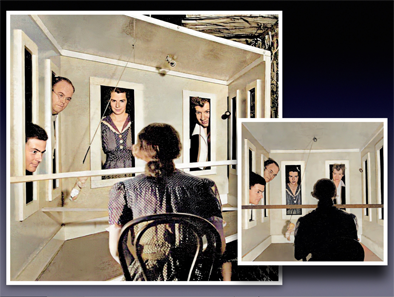
In that publication, Warn briefly mentions that a son of General Ames was Adelbert Ames Jr. (aka Adelbert Ames II) (1880-1955). Initially trained as a lawyer, the younger Ames switched professions from law to art, to psychology and optics. During the 1940s, he became especially known for having devised about twenty illusion-based laboratory set-ups called the Ames Demonstrations in Perception, notably the Ames Distorted Room and the Rotating Trapezoid Window.

laboratory-sized Ames Room
In March 1947, as part of its bicentennial, Princeton University hosted a three-day conference on “Planning Man’s Physical Environment.” Invited as participants were seventy prominent speakers, among them leading architects, philosophers, and social psychologists [see photo below]. Adelbert (Del) Ames Jr. (of whom most were probably unaware) was among those featured, as was the famous (and typically outspoken) Frank Lloyd Wright, who gave a controversial speech. The two men met, during which Wright spoke admiringly of the Ames Demonstrations, which had been on exhibit at Princeton for three months.

Ames (5 from left) and Wright (2 from right), front row
Following the conference, Wright recommended Ames’ demonstrations to others, including George Nelson, the well-known industrial designer. In a letter to artist / educator Hoyt Sherman at Ohio State University, Ames wrote that “I had the most interesting and stimulating time at Princeton. Practically all the attending members went through the demonstrations and got a great kick out of them, and all wanted copies of any literature that we had on the matter.”

Back at Wright’s Wisconsin studio-school (as recalled by Northfield historian Warn), the architect “told us, his apprentices, of his meeting with Ames at Princeton University…and how the SR Guggenheim Museum, then being designed, was to be an institute for the celebration of the eye—an optical museum.”

It was Wright’s idea that the Ames Demonstrations should be a permanent part of the Guggenheim Museum, but that decision could only be made by Baroness Hilla von Rebay, who was the museum’s co-founder and first director. Solomon Guggenheim was 88 years old (he died the following year), and the baroness (as Ames documents attest) was “in full control of his art expenditures.” As one of Ames’ associates (John Pearson) noted in a memo after the Princeton event, “She [the baroness] is one of the strangest persons in the world, a psychopathic case, a mystic, a very troublesome person, a hero worshiper.” Whatever Wright’s ambitions, the best that he could hope for was a meeting between Ames, Rebay, and himself. But that meeting never took place. Later, a separate proposal was made (without Wright’s involvement) to exhibit the Ames Demonstrations at the Museum of Modern Art, by appealing to Rene d’Harnoncourt, the museum’s director, but that too did not come about.

•••

As a young graphic design teacher (c1970) who believed that art, design, and architecture should be informed by vision, I replicated some of the Ames Demonstrations for use in exhibits and classroom teaching, and began to publish articles on such subjects as Gestalt theory, anamorphosis, stereo vision, and camouflage. Over the years, my interest in Ames has continued intermittently. I visited Northfield, spoke at Dartmouth, and corresponded now and then with his associates and relatives (among his nephews was the writer George Plimpton). I also published articles on his demonstrations, his early collaboration with his sister (artist and suffragist Blanche Ames Ames), and the indebtedness of his work to anamorphic distortion in art, to disruptively-patterned ship camouflage (called “dazzle camouflage”), to aspects of Gestalt theory, and to the early experiments in cinema by Dudley Murphy (who worked as Ames’ laboratory assistant), Fernand Leger, Man Ray, and others.

In 2022, having strayed into producing online documentary talks, I made a three-part series of films (30 minutes each) about Ames’ life and influence, titled Ames and Anamorphosis: THE MAN WHO MADE DISTORTED ROOMS. These are accessible online, and free to share with others.

•••

Since the 1930s (almost a century has passed), interest in Del Ames and his demonstrations has risen and fallen, time after time, as society’s concerns have changed. At Harvard, Ames had studied with William James. Eventually, he became associated with Transactionalism, a spin-off of Pragmatism (inspired by John Dewey), in which it was asserted that human experience is not direct objective witnessing, but consists of an amalgam of sensory input, past experience, desires and expectations.

Del Ames may be due for revival again, if (to quote Peter Godfrey-Smith in the June 2024 issue of The New York Review of Books) “we have nothing like the simple, direct contact with the world around us that we suppose. Instead…our brains actively synthesize a picture of the world, continually guessing, extrapolating, and projecting.” And while our sensory input may constrain what we experience, “the constraint can be tenuous, and ordinary perception may be akin to a ‘controlled hallucination’…”

As Ames himself once put it: “The things we see are the mind’s best bet as to what is out front.”

Tuesday, November 5, 2013

Game Parody | Kaitlyn Cuvelier

Game Parody © Kaitlyn Cuvelier (2012)
Above Design for a game parody by Kaitlyn Cuvelier, graphic design student, University of Northern Iowa (2013).
...

From Max Eastman, Great Companions (New York: Farrar Straus and Cudahy, 1942)—

[In his later life, American philosopher John Dewey] moved out on Long Island, and preserved his contact with reality by raising eggs and vegetables and selling them to the neighbors… [He received an urgent order one day] from a wealthy neighbor for a dozen eggs, and the children being in school, he himself took the eggs over in a basket. Going by force of habit to the front door, he was told brusquely that deliveries were made in the rear. He trotted obediently around to the back door, feeling both amused and happy. Some time later, he was giving a talk to the women's club of the neighborhood, and his wealthy customer, when he got up to speak, exclaimed in a loud whisper: "Why, he looks exactly like our egg man!" 

Saturday, November 25, 2023

we do not first see, we define first and then see

related online video talks
Walter Lippmann, Public Opinion. New York: Harcourt Brace, 1922, p. 81—

[In Art as Experience, John Dewey] gives an example of how differently an experienced layman and a chemist might define the word metal. "Smoothness, hardness, glossiness, and brilliancy, heavy weight for its size…the serviceable properties of capacity for being hammered and pulled without breaking, of being softened by heat and hardened by cold, of retaining the shape and form given, of resistance to pressure and decay, would be included" in the layman's definition. But the chemist would likely as not ignore these esthetic and utilitarian qualities, and define a metal as "any chemical element that enters into combination with oxygen so as to form a base."

For the most part we do not first see, and then define, we define first and then see. In the great blooming, buzzing confusion of the outer world we pick out what our culture has already defined for us, and we tend to perceive that which we have picked out in the form stereotyped for us by our culture.

regarding montages and vision