Showing posts with label vision. Show all posts

Tuesday, January 13, 2026

Indian eyes / the role of ocular culture in high art

© Mary Snyder Behrens
Above Mary Snyder Behrens, Title and current location unknown. Machine embroidered wall art / altered Brownie Scout uniform, ©1984.

•••

Ginu Kamani
, “Code Switching” in Meri Nana-Ama Danquah, ed., Becoming American: Personal Essays by First Generation Immigrant Women (New York: Hyperion, 2000), p. 99—

Indian lore is full of the magical power of the eyes—justified, in my view, as Indian eyes are truly incomparable. The cultural emphasis on implicit rather than explicit communication, on keeping emotions in check, on placing others before self, and observing duty-bound restrictions on words and action, transforms ocular communication into a high art. In the Vedas, the visual gaze is considered as potent as the transmission of semen between bodies. Westerners are often entranced by the eyes of Indian gurus and holy men, whose gaze casts an enticing spell. Many have felt hypnotized, submitting to a power they cannot fathom.

Saturday, August 3, 2024

Temple Grandin and the Ames Demonstrations

Good news travels slowly here. I recently ran across a book by Temple Grandin (widely-known authority on autism and animal science) published in 2018, titled Calling All Minds: How To Think and Create Like An Inventor (New York: Philomel Books). In other words, it has been in print for six years—but only now have I discovered that I am mentioned by name in its pages.

Grandin is world-famous, and I have long been interested in her work. Few people are as widely admired. Since 1984, she has been the recipient of 101 prestigious awards, including honorary doctorates from the leading universities, being chosen for Time Magazine’s 100 Most Influential People, inducted into the American Academy of Arts and Science, and named as one of the Top Best College Professors in the US.

That’s phenomenal. Given all that she’s achieved, how could she possibly even attend all those award ceremonies, and still remain productive? She is one year younger than I am. I cannot begin to imagine receiving so many awards—I would never have accomplished anything. Maybe I am fortunate that the less-than-prestigous awards I've received can be counted on one hand. And I don’t have extra digits.

My interest in Grandin reached its peak in 2010, with the release of a popular Hollywood film about her life, in which she was portrayed by actress Clare Danes. At the beginning of the film, we learn about a turn of events that occured while she was in high school. She saw an educational film about the then popular laboratory experiments of American artist and optical physiologist Adelbert (Del) Ames, Jr., usually referred to as the Ames Demonstrations. The best-known of these are the Ames Window (in which a rotating window-like cut-out appears not to rotate, but to sway back and forth), and the Ames Distorted Room (in which people’s sizes appear to change as they move around a cleverly misshapen room interior).

Since Grandin and I are nearly the same age, we were probably introduced to the Ames Demonstrations at around the same time. Her response was to try to figure out how to build an Ames Room. She succeeded. As an aspiring art student, with a familarity with perpective and anamorphosis, I too replicated an Ames Room, an Ames Window, and other demonstrations, then spent a substantial amount of my life researching and writing about his development as an artist. And indeed, today I continue to publish new findings.

Over the years, I published multiple articles on the Ames Demonstrations and their significance. In the text and bibliography of her book, Grandin refers to one of my articles, published in 1987, titled “The Life and Unusual Ideas of Adelbert Ames, Jr.” In the text, she even mentions me by name, for which I am grateful, because it is far more common for other authors to make blatant use of another author’s research, but neglect to credit it as a source.

In this case, there is a peripheral downside. While I have been credited, it was disappointing to find that I was also wrongly quoted. In my article, I had quoted a published statement by prominent Harvard psychologist Jerome Bruner, who had been married to Ames’s niece. Bruner and his wife’s uncle apparently had their quibbles, and, in his autobiography (1983), Bruner discounted the impact of Ames’s research with the following statement: “It was demonstration that he [Ames] was after, not experimental manipulation. And demonstration of a kind that, I think, speaks more to the artist’s wonder than to the scientist’s. In the end, he had little impact on psychology or philosophy, but he continues to facinate artists.”

In Grandin’s book, she doesn’t mention Bruner. She states instead that it was “Roy R. Behrens, Professor of Art at the University of Northern Iowa” who “concludes that much of Ames’s work has more appeal for the artist than for the scientist. As a visual thinker, I have to disagree.” But I myself did not disparage Ames’s work. I only quoted Bruner, as one view of a prominent scientist, which, in the original article, I then qualified with a lengthy footnote on writings by others who may or may not have agreed with Bruner’s dismissive assessment.

In the end it doesn’t especially matter of course. I continue to be greatly pleased to have been mentioned by someone whose achievements are exemplary, and whose work is so well known.

•••

NOTES
Temple Grandin has also written about her interest in the Ames Demonstrations in Temple Grandin and Margaret M. Scariano, Emergence: Labeled Autistic, New York: Warner Books, 1996.

More recently, I have produced a series of three online video talks (30 minutes each) which provide an overview of Del Ames, his life and his accomplishments. These to some extent are based on my published research articles, but they also include new, surprising information that I have found more recently. These can be accessed free online at <https://youtu.be/MAEjgatMkio>, <https://youtu.be/-8gaYm2FUI0>, and <https://youtu.be/mxOEx2JLQBA>. My articles on Ames include:

Roy R. Behrens, “The Life and Unusual Ideas of Adelbert Ames, Jr,” in Leonardo, vol 20 no 3 (1987), pp. 273-279.
______________, “Adelbert Ames and the Cockeyed Room,” in Print magazine, vol 48 no 2 (1994), pp. 92–97.
______________, “Eyed Awry: The Ingenuity of Del Ames,” in North American Review, vol 282 no 2 (1997), pp. 26-33.
______________, “The Artistic and Scientific Collaboration of Blanche Ames Ames and Adelbert Ames II,” in Leonardo, vol 31 (1998), pp. 47-54.
______________, “Adelbert Ames, Fritz Heider, and the Chair Demonstration,” in Gestalt Theory, vol 21 (1999),” pp. 184–190.
 

I have also provided Ames biographical articles for Encyclopedia of Perception, Grove Online Dictionary of Art, askArt, and Allgemeines Kunstlerlexikon.


Tuesday, July 16, 2024

Oops / John Sloan & Adelbert Ames, Jr. riposte

still image from online Ames video trilogy
Oops. Soon after posting that quote about the friendship of Adelbert Ames Jr. (born aristocrat) and artist and socialist John Sloan (born democrat), about how opposite they were, I ran across new information. Herbert Faulkner West’s account may have made it sound as if the social status of Ames, in comparison to Sloan, was completely one-sided. But soon after we found that Sloan had moved to Hanover NH in part because his cousin, John Sloan Dickey, was the president of Dartmouth College during the 1950s and 1960s. That may have tipped the scales a tad, although not completely.

Sunday, July 14, 2024

John Sloan / simple, modest & absolutely no airs

John Sloan, Cover illustration (1914)

Herbert Faulkner West, John Sloan's Last Summer. Iowa City IA: Prairie Press, 1952—

I was talking one day with Adelbert Ames, Jr., of the Hanover Institute, researcher, painter and experimenter in color, whose background was about as dissimilar to Sloan’s as could be imagined—Ames who went to Andover and Harvard; Sloan who went for a while to Philadelphia public schools and then graduated to newspaper offices in the same city. One the born aristocrat; the other the born democrat. Yet both got on wonderfully together, and Mr. Ames said to me one day about Sloan: “You can see what a really great man is like—simple, modest, and absolutely no airs whatever.”

John Sloan (1891)


Friday, June 7, 2024

Del Ames, Frank Lloyd Wright & Guggenheim

Guggenheim Museum under construction
The famous bungled robbery of the First National Bank in Northfield MN took place on September 7, 1876. The outlaw gang was headed by Jesse James and Cole Younger, who, as ardent Southerners, were infused with anger about the recent Civil War. 

They were especially resentful toward Union General Adelbert Ames (Reconstruction Governor of Mississippi), and his father-in-law, General Benjamin F. Butler (both greatly hated in the South). In postwar years, the James and Younger gang had learned that ex-Governor Ames had moved north to Minnesota, where he (and General Butler) had invested in a flour mill on the Cannon River, and were on the board of directors at the Northfield bank.

Nearly one hundred years later, in 1972, the Northfield Historical Society produced a publication about the city’s history, titled Nuggets from Rice County Southern Minnesota History, which featured articles about the bank robbery as well as the role the Ames family in the development of the town. That publication was edited by a Northfield architect and local historian named Robert Roy (Bob) Warn (1924-1977), who had been a student of Frank Lloyd Wright at Taliesen, near Spring Green WI, in the late 1940s or early 1950s.

In that publication, Warn briefly mentions that a son of General Ames was Adelbert Ames Jr. (aka Adelbert Ames II) (1880-1955). Initially trained as a lawyer, the younger Ames switched professions from law to art, to psychology and optics. During the 1940s, he became especially known for having devised about twenty illusion-based laboratory set-ups called the Ames Demonstrations in Perception, notably the Ames Distorted Room and the Rotating Trapezoid Window.

laboratory-sized Ames Room
In March 1947, as part of its bicentennial, Princeton University hosted a three-day conference on “Planning Man’s Physical Environment.” Invited as participants were seventy prominent speakers, among them leading architects, philosophers, and social psychologists [see photo below]. Adelbert (Del) Ames Jr. (of whom most were probably unaware) was among those featured, as was the famous (and typically outspoken) Frank Lloyd Wright, who gave a controversial speech. The two men met, during which Wright spoke admiringly of the Ames Demonstrations, which had been on exhibit at Princeton for three months.

Ames (5 from left) and Wright (2 from right), front row
Following the conference, Wright recommended Ames’ demonstrations to others, including George Nelson, the well-known industrial designer. In a letter to artist / educator Hoyt Sherman at Ohio State University, Ames wrote that “I had the most interesting and stimulating time at Princeton. Practically all the attending members went through the demonstrations and got a great kick out of them, and all wanted copies of any literature that we had on the matter.”

Back at Wright’s Wisconsin studio-school (as recalled by Northfield historian Warn), the architect “told us, his apprentices, of his meeting with Ames at Princeton University…and how the SR Guggenheim Museum, then being designed, was to be an institute for the celebration of the eye—an optical museum.”

It was Wright’s idea that the Ames Demonstrations should be a permanent part of the Guggenheim Museum, but that decision could only be made by Baroness Hilla von Rebay, who was the museum’s co-founder and first director. Solomon Guggenheim was 88 years old (he died the following year), and the baroness (as Ames documents attest) was “in full control of his art expenditures.” As one of Ames’ associates (John Pearson) noted in a memo after the Princeton event, “She [the baroness] is one of the strangest persons in the world, a psychopathic case, a mystic, a very troublesome person, a hero worshiper.” Whatever Wright’s ambitions, the best that he could hope for was a meeting between Ames, Rebay, and himself. But that meeting never took place. Later, a separate proposal was made (without Wright’s involvement) to exhibit the Ames Demonstrations at the Museum of Modern Art, by appealing to Rene d’Harnoncourt, the museum’s director, but that too did not come about.

•••

As a young graphic design teacher (c1970) who believed that art, design, and architecture should be informed by vision, I replicated some of the Ames Demonstrations for use in exhibits and classroom teaching, and began to publish articles on such subjects as Gestalt theory, anamorphosis, stereo vision, and camouflage. Over the years, my interest in Ames has continued intermittently. I visited Northfield, spoke at Dartmouth, and corresponded now and then with his associates and relatives (among his nephews was the writer George Plimpton). I also published articles on his demonstrations, his early collaboration with his sister (artist and suffragist Blanche Ames Ames), and the indebtedness of his work to anamorphic distortion in art, to disruptively-patterned ship camouflage (called “dazzle camouflage”), to aspects of Gestalt theory, and to the early experiments in cinema by Dudley Murphy (who worked as Ames’ laboratory assistant), Fernand Leger, Man Ray, and others.

In 2022, having strayed into producing online documentary talks, I made a three-part series of films (30 minutes each) about Ames’ life and influence, titled Ames and Anamorphosis: THE MAN WHO MADE DISTORTED ROOMS. These are accessible online, and free to share with others.

•••

Since the 1930s (almost a century has passed), interest in Del Ames and his demonstrations has risen and fallen, time after time, as society’s concerns have changed. At Harvard, Ames had studied with William James. Eventually, he became associated with Transactionalism, a spin-off of Pragmatism (inspired by John Dewey), in which it was asserted that human experience is not direct objective witnessing, but consists of an amalgam of sensory input, past experience, desires and expectations.

Del Ames may be due for revival again, if (to quote Peter Godfrey-Smith in the June 2024 issue of The New York Review of Books) “we have nothing like the simple, direct contact with the world around us that we suppose. Instead…our brains actively synthesize a picture of the world, continually guessing, extrapolating, and projecting.” And while our sensory input may constrain what we experience, “the constraint can be tenuous, and ordinary perception may be akin to a ‘controlled hallucination’…”

As Ames himself once put it: “The things we see are the mind’s best bet as to what is out front.”

Saturday, November 25, 2023

we do not first see, we define first and then see

related online video talks
Walter Lippmann, Public Opinion. New York: Harcourt Brace, 1922, p. 81—

[In Art as Experience, John Dewey] gives an example of how differently an experienced layman and a chemist might define the word metal. "Smoothness, hardness, glossiness, and brilliancy, heavy weight for its size…the serviceable properties of capacity for being hammered and pulled without breaking, of being softened by heat and hardened by cold, of retaining the shape and form given, of resistance to pressure and decay, would be included" in the layman's definition. But the chemist would likely as not ignore these esthetic and utilitarian qualities, and define a metal as "any chemical element that enters into combination with oxygen so as to form a base."

For the most part we do not first see, and then define, we define first and then see. In the great blooming, buzzing confusion of the outer world we pick out what our culture has already defined for us, and we tend to perceive that which we have picked out in the form stereotyped for us by our culture.

regarding montages and vision


the extraordinary visions of Joseph Podlesnik

Above The photographs of Joseph Podlesnik are simply astonishing. A large selection are on sale through December 8, 2023, online here.

Friday, October 27, 2023

newly published book on Blanche Ames Ames

Above I’ve been writing about the Ames family for more than 50 years. I myself don’t know of a family that is more colorful or complex. I refer to those descended from the marriage of Union General Adelbert Ames (Reconstruction governor of Mississippi) and Blanche Butler, who was the daughter of the notorious General Benjamin F. Butler.

One of their sons was Adelbert (Del) Ames, Jr., an artist and optical scientist who devised the well-known Ames Demonstrations in psychology (such as his Distorted Room). One of their daughters was an artist and equal rights proponent named Blanche Ames Ames. She has that double name because she married Harvard orchid expert Oakes Ames, whose ancestors had made their fortune providing shovels to those who went west to pan for gold or who worked on the Transcontinental Railroad.

Ames, Iowa, is named for a prominent family member. George Plimpton’s mother was an Ames, and it appears there is also a link to Aldrich Ames, the famous spy. My main interest has usually been the artist and scientist Del Ames, about whom I have published various essays over the years and, more recently, have produced a series of three short online videos.

But I’ve also always been intrigued by Del’s sister, Blanche, in part because he and she worked in tandem on art and science research in the years before the outbreak of World War I. In recent years, there have been various efforts to unearth and celebrate the achievements of Blanche Ames Ames, whose magnificent self-designed mansion is now Borderland State Park in Massachusetts, just south of Boston, a site that is well-worth the visit.

Last year, a 55-minute film was produced, titled Borderland: The Life and Times of Blanche Ames Ames. And now, most recently, a new book has just been published about the shared lives of Blanche Ames and her husband. Titled Blanche Ames Ames (1878-1969) and Oakes Ames (1874-1950): Cultivating That Mutual Ground (Eugene OR: Resource Publications), it was written by Elizabeth F. Fideler, a Harvard scholar who has published earlier books about aging, retirement and related concerns. Especially for those who are interested in the Ames family, women’s studies, and the chemistry of married life, it is a praiseworthy overview of the accomplishments of an amazing American woman. 

Thursday, June 29, 2023

Del Ames / David Chelsea's book on perspective

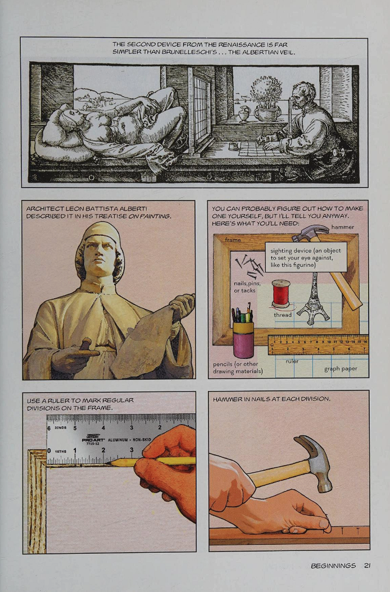
I recently ran across a book (a comic book) which I highly recommend. Titled Perspective in Action: Creative Exercises for Depicting Spatial Representation from the Renaissance to the Digital Age, it was both drawn and written by a Portland-based illustrator named David Chelsea. I regret not knowing about this earlier, since it was published back in 2017 (six years ago!) by New York: Watson-Guptill. ISBN 978-1-60774-946-2. Fortunately, it is still available online, and I now own a copy.

There are various reasons why I recommend this book (the cover isn’t one of them). The interior comic-style images are beautifully rendered and colorized, and the page layout is very smart. It interweaves a well-written and reliable text, both historical and technical, with clear and thoughtful instructions on how to make physical models of the demonstrations in the text.


That would be enough to recommend it. But I am also drawn to it because it covers so many of the vision-related topics that I myself have researched and written about since the 1960s, of which the history of perspective is one. But there is also the use of the camera obscura as a drawing aid. Anamorphoses or “forced perspective” imagery, including street art illusions. Dutch perspective cabinets. The Ames Demonstrations, devised by American optical physiologist Adelbert Ames II, including the Ames Distorted Room (there are instructions on how to make a model, in exacting detail). Six-Point Perspective. Various kinds of stereoscopic (3-D) imagery, and even stereo collage (which I thought I invented back in c1984). And zoetrope (flip book) animations. Wow! What more could you want.

So look for this book! It’s well worth it. And you might also take a look at my own recent video trilogy on the life and work of Ames, since it touches on many of the same subjects. The videos are found online at my YouTube Channel. They are completely free to view and to share with others. See two screen grabs below.


Monday, June 19, 2023

a new practical guide to art in relation to seeing

coming soon
There’s a new book in the works—it isn't out yet, but it's coming. Issued by the University of Chicago Press, it will soon be available in hardbound, paperback, and E-book formats. The title peaks my interest: STUDIO SEEING: A practical guide to drawing, painting, and perception. It is due out in September. The author is Michael Torlen, a painter, printmaker and writer who retired from teaching in 2012, and now resides in Maine. A graduate of Ohio State University and Cranbrook Academy, he taught courses in visual arts for many years at the University of Georgia at Athens, and at Purchase College in New York.

How do I know him? I don’t, or at least we've never met in person. But we are well-acquainted “online,” as they say, because about ten years ago, by chance we discovered that we have a common interest in, not just art and vision, but in the writings and teaching practices of an artist / teacher (in the 1940s and thereafter) named Hoyt Sherman. At OSU, Sherman was the teacher of Pop Artist Roy Lichtenstein. But he was also the teacher of one of my most influential teachers, a man named David Delafield. Torlen’s link to Sherman is far more direct: he earned an MFA at OSU and actually worked closely with Sherman.

My additional interest in Sherman is through his connection to artist and optical physiologist Adelbert Ames II, who invented the Ames Demonstrations, about whom I have written, and more recently made a three-part documentary video on.

At OSU, Sherman reconstructed many of the Ames Demonstrations. But the achievement for which he was famous (or, as his detractors would probably say, “infamous”) was his attempt to teach drawing in the dark. He devised a method of teaching drawing in a pitch dark studio (called a “flash lab”) in which his students drew from abstract images that he projected on a screen, using a tachistoscope, for a fraction of a second. His students included members of the OSU football team, who (it was claimed) improved their passing accuracy by wearing a hooded contraption called a “flash helmet.”

Judging from its table of contents (as well as the title), the key concern in Torlen’s book is perception in relation to art, from the view of a long-experienced teacher. You can learn much more about him as well as updates on his book at <https://www.michaeltorlenauthor.com/>.


Sunday, April 23, 2023

Herbert Simon / the fruits of being colorblind

Arcimboldo, Fruit Basket (c1590)

Above Painting by Giuseppe Arcimboldo titled Fruit Basket. Oil on panel, c1590. It is a reversible still life of fruit. Turned upsidedown (as shown here), it resembles the head of a person.

•••

Herbert Simon, Models of my life. NYC: Basic Books, 1991, p. 5—

Whether during his fourth summer or on some later occasion, the boy [the author] was among a party picking wild strawberries. The others filled their pails in a few minutes; there were only a few strawberries in the bottom of his. How could the others see the berries so easily amid the closely matching leaves? That was how he learned that strawberries are red and leaves green, and that he was colorblind. 

•••

Postscript As Simon comments in his autobiography, he would later marry a woman with red hair. In view of his being colorblind (he continues): “'How did you know her hair was red?' the perceptive reader might wonder. Well, I had early been told that there were no green-haired people, nor any red lawns. Ergo. . . ."

In relation to the use of ambiguous, pun-like images in art (such as this painting by Arcimboldo), it may also be of interest to view my recent video called EMBEDDED FIGURES, ART AND CAMOUFLAGE.

Sunday, February 26, 2023

graphic design / indispensable tools of the trade

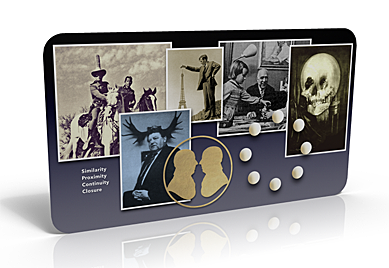
Above and below Still frame excerpts from a video talk, titled Art Design and Gestalt Theory: the film version (2023), about the organizing principles that are fundamental to human vision, including accents (above), unit-forming factors, and closure (below). Nothing is more indispensable to design-based organizing skills, including graphic design. 


Saturday, October 8, 2022

the man who made distorted rooms / a trilogy

All three of these have now been posted on YouTube here. It has been a challenge, and I am eager for others to see them. Share to your heart's delight.

Friday, September 23, 2022

film trilogy on artist / scientist Adelbert Ames II

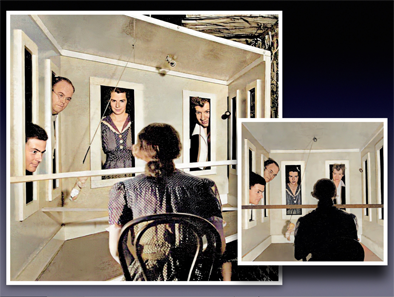
Colleagues Gary Gnade and John Volker in an Ames Room
Nearing completion is a film trilogy (a three-part series of online voice-over video talks) about the life and work of Adelbert (Del) Ames II (1880-1955), an American artist, lawyer, optical physiologist, and psychologist. He is best-known for having invented the Ames Demonstrations in Perception, a group of about twenty-five laboratory set-ups, of which perhaps the three most famous are the Distorted Room, the Chair Demonstration, and the Rotating Trapezoid Window.

I began to research and to write about Ames in the late 1960s, and, in the many years since, I’ve continued to collect a fairly substantial amount of material related to him, including unpublished correspondence. I have always hoped to write a book about his life and ideas, but it was delayed by various circumstances, and now, as I age—and books become less useful as ways to share ideas—that project is on the back burner. So I have turned instead to making a series of video talks. Not the same thing, obviously, but it will do for the moment.

The first video in the series, titled Ames and Anamorphosis: THE MAN WHO DISTORTED ROOMS / Part One, was completed earlier this month, and is accessible online. It provides an overview of Ames’ life and his accomplishments, as well as information about his interesting family (he was related to writer / editor George Plimpton).

Ames and Anamorphosis / Part One

Part Two is all but finished, and should be available on the same channel in a matter of days. It documents the use of anamorphic distortion (forced perspective) in the history of art and in the research of vision. Although the Ames Demonstrations were highly unusual when they gained popularity in the 1940s, the optical principles on which they were based had been anticipated by Leonardo da Vinci, Hans Holbein, various Dutch artists, and, in science, by Hermann von Helmholtz.

Part Three will consist of an overview of the connections between the Ames Demonstrations, and various artistic and scientific achievements that took place during and after his lifetime, such as avant garde filmmaking, perspective distortion in ship camouflage, Hoyt Sherman's vision laboratory at Ohio State University, comedian Ernie Kovacs, theatrical special effects, the reverspective artworks of British artist Patrick Hughes, and so on.

In the early 1970s, I reconstructed several of the Ames Demonstrations, and, collaborating with a friend and colleague, John Volker, I designed a multi-faceted hands-on exhibition, in which children could experience a full-sized distorted room, a straight-forward forced perspective room, an upsidedown room, and so on. Over the years, I went on to publish articles about various aspects of his work in research journals, the online links to some of which are listed below. 

•••

Behrens, R. R. (1987). The Life and Unusual Ideas of Adelbert Ames Jr. Leonardo: Journal of the International Society of Arts, Sciences and Technology, 20, 273–279.

Behrens, R. R. (1994). Adelbert Ames and the Cockeyed Room. Print magazine, 48:2, 92–97.

Behrens, R. R. (1997). Eyed Awry: The Ingenuity of Del Ames. North American Review, 282:2, 26–33.

Behrens, R. R. (1998). The Artistic and Scientific Collaboration of Blanche Ames Ames and Adelbert Ames II. Leonardo, 31, 47–54.

Behrens, R. R. (1999). Adelbert Ames, Fritz Heider, and the Chair Demonstration. Gestalt Theory, 21, 184–190.

Saturday, September 10, 2022

a remote radio drawing course taught in 1932

There is a legend, true or not, that Hungarian-born Bauhaus designer and photographer Laszlo Moholy-Nagy once created an artwork over the phone. Henceforth, as Rainer K. Wick said in Teaching at the Bauhaus (Germany: Hatje Cantz, 2000), it might be the conclusion of some that “art in the industrial age could consist of an anonymous machine process of high precision and exist independently of the personal intervention of the artist’s hand; thus the act of artistic creation should be seen in the intellectual aspect and not in the manual one.”
Moholy’s experiment comes to mind whenever I see this vintage magazine article on so-called “Radio Comics” [shown above], as published in an issue of Popular Mechanics in 1932. The instructor is a radio broadcaster, who makes a drawing on a grid-based page, consisting of 144 numbered squares. His pupils, who are listening remotely to the broadcast, have been given an indentical page of numbered squares—but without a drawing.

“As the instructor draws a figure, he calls out the squares touched by his pencil or crayon. Pupils sitting at the radio with duplicate charts trace lines from one number of another as they are announced in efforts to ‘copy’ the work of the instructor.”

Actually, the only thing innovative about this (at the time) was the use of the radio. The practice of “squaring off” a drawing (called mise au careau) in order to copy, enlarge or reduce the image onto a second squared-off surface, was practiced as early as the Ancient Egyptians. Here is an example of that by the artist Sassoferrato.

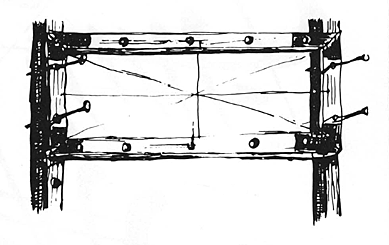
Later artists (among them Leonardo da Vinci, Albrecht Dürer, and Vincent Van Gogh) not only relied on that same approach, but also used “drawing frames” (of which Dürer's and Van Gogh's are shown below) by which they looked at the model through a network of suspended threads, arranged to match a pattern of squares on their drawing paper. Leonardo highly recommended this—

“If you wish to learn correct and good positions for your figures [he wrote], make a frame that is divided into squares by threads and put it between your eyes and the nude you are drawing, and you will trace the same squares lightly onto your paper on which you intend to draw your nude.”


After the invention of photography, artists began to square off photographs of their models, as a gridwork guide for drawing. Still other artists (among them Blanche Ames Ames and Adelbert Ames II) make efficient use of large-scale grid-based frames which the model stood behind as the photograph was made. Below is a photograph of that in her Borderland studio. 


Saturday, June 25, 2022

a report of naiveté in assessing works of art

Cavern [detail] © Roy R. Behrens 2021
Abel Warshawsky, The memories of an American Impressionist. Kent OH: Kent State University Press, 1980, p. 62—

[In Paris] The "cult of the naive" at all costs became a rage…

A group of painters in Montmartre decided to exploit this hysteria and have some fun with the critics. Procuring a donkey, they tied a large paintbrush to his tail, first dipping the brush into an assortment of colors. Then a canvas was set up within striking distance of the donkey's tail, which in its gyrations soon covered the canvas with a weird conglomeration of colors—quite a stunning study in the new style, as the spectators all agreed. Witnesses and a notary, who had been invited to attend, attested to the manner in which the work had been done. This canvas was framed and sent to the Salon des Independants. It bore as title, if I remember rightly, Sunset on the Red Sea. After several well-known critics had remarked it and written about it as a work of extraordinary interest, the story with the signatures of the witnesses was published, and the laugh was on the "new art" critics.

Also see Art by Animals video, Desmond Morris, and pandemic montages.

Monday, February 14, 2022

i can always remember the place on a page…

Max Eastman, Enjoyment of Living. New York: Harper and Brothers, 1948, pp. 54-55—

I never remember anything without remembering its position. I can always predict the place on a page where I will find a missing quotation, even when I cannot remember the book that contained it. I can recall now the exact position in which I sat, and the position in which another person sat in relation to me, when he or she threw a cigarette stub and burned a hole in my sweater, but I cannot remember who it was, or where it was, or when it was, or what color the sweater was, or how I felt about it. This keen sense of spatial relation has something to do, I suppose, with my pleasure in putting things in order whether in a room, an essay, or an argument. I am not overconfident of my taste in colors or sounds, but I am always ready to state categorically whether a composition is good. Sometimes in a hotel room I feel so crisscross that I move the bed and bureau into their places before I can go happily to sleep.