Showing posts with label Borderland. Show all posts

Friday, October 27, 2023

newly published book on Blanche Ames Ames

Above I’ve been writing about the Ames family for more than 50 years. I myself don’t know of a family that is more colorful or complex. I refer to those descended from the marriage of Union General Adelbert Ames (Reconstruction governor of Mississippi) and Blanche Butler, who was the daughter of the notorious General Benjamin F. Butler.

One of their sons was Adelbert (Del) Ames, Jr., an artist and optical scientist who devised the well-known Ames Demonstrations in psychology (such as his Distorted Room). One of their daughters was an artist and equal rights proponent named Blanche Ames Ames. She has that double name because she married Harvard orchid expert Oakes Ames, whose ancestors had made their fortune providing shovels to those who went west to pan for gold or who worked on the Transcontinental Railroad.

Ames, Iowa, is named for a prominent family member. George Plimpton’s mother was an Ames, and it appears there is also a link to Aldrich Ames, the famous spy. My main interest has usually been the artist and scientist Del Ames, about whom I have published various essays over the years and, more recently, have produced a series of three short online videos.

But I’ve also always been intrigued by Del’s sister, Blanche, in part because he and she worked in tandem on art and science research in the years before the outbreak of World War I. In recent years, there have been various efforts to unearth and celebrate the achievements of Blanche Ames Ames, whose magnificent self-designed mansion is now Borderland State Park in Massachusetts, just south of Boston, a site that is well-worth the visit.

Last year, a 55-minute film was produced, titled Borderland: The Life and Times of Blanche Ames Ames. And now, most recently, a new book has just been published about the shared lives of Blanche Ames and her husband. Titled Blanche Ames Ames (1878-1969) and Oakes Ames (1874-1950): Cultivating That Mutual Ground (Eugene OR: Resource Publications), it was written by Elizabeth F. Fideler, a Harvard scholar who has published earlier books about aging, retirement and related concerns. Especially for those who are interested in the Ames family, women’s studies, and the chemistry of married life, it is a praiseworthy overview of the accomplishments of an amazing American woman. 

Saturday, September 10, 2022

a remote radio drawing course taught in 1932

There is a legend, true or not, that Hungarian-born Bauhaus designer and photographer Laszlo Moholy-Nagy once created an artwork over the phone. Henceforth, as Rainer K. Wick said in Teaching at the Bauhaus (Germany: Hatje Cantz, 2000), it might be the conclusion of some that “art in the industrial age could consist of an anonymous machine process of high precision and exist independently of the personal intervention of the artist’s hand; thus the act of artistic creation should be seen in the intellectual aspect and not in the manual one.”

Moholy’s experiment comes to mind whenever I see this vintage magazine article on so-called “Radio Comics” [shown above], as published in an issue of Popular Mechanics in 1932. The instructor is a radio broadcaster, who makes a drawing on a grid-based page, consisting of 144 numbered squares. His pupils, who are listening remotely to the broadcast, have been given an indentical page of numbered squares—but without a drawing.

“As the instructor draws a figure, he calls out the squares touched by his pencil or crayon. Pupils sitting at the radio with duplicate charts trace lines from one number of another as they are announced in efforts to ‘copy’ the work of the instructor.”

Actually, the only thing innovative about this (at the time) was the use of the radio. The practice of “squaring off” a drawing (called mise au careau) in order to copy, enlarge or reduce the image onto a second squared-off surface, was practiced as early as the Ancient Egyptians. Here is an example of that by the artist Sassoferrato.

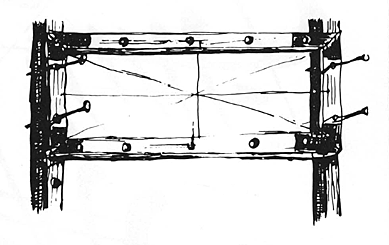
Later artists (among them Leonardo da Vinci, Albrecht Dürer, and Vincent Van Gogh) not only relied on that same approach, but also used “drawing frames” (of which Dürer's and Van Gogh's are shown below) by which they looked at the model through a network of suspended threads, arranged to match a pattern of squares on their drawing paper. Leonardo highly recommended this—

“If you wish to learn correct and good positions for your figures [he wrote], make a frame that is divided into squares by threads and put it between your eyes and the nude you are drawing, and you will trace the same squares lightly onto your paper on which you intend to draw your nude.”


After the invention of photography, artists began to square off photographs of their models, as a gridwork guide for drawing. Still other artists (among them Blanche Ames Ames and Adelbert Ames II) make efficient use of large-scale grid-based frames which the model stood behind as the photograph was made. Below is a photograph of that in her Borderland studio.