In 1948 when I was six years old, I was selected to appear on Art Linkletter's radio program People Are Funny. The night before the show, my mother worked feverishly getting me ready. On the show I was the first child to be announced. Art Linkletter asked me "Debby, do you know what happened last night?" In my cutest little voice, I responded, "No, what?" There was hysterical laughter. Without saying another word to me, Art Linkletter turned to the next child and asked him the same question. He answered, "President Truman was elected." I have spent the rest of my life trying to figure out what happened.
Sunday, January 11, 2026
not funny adults / do you know what happened
In 1948 when I was six years old, I was selected to appear on Art Linkletter's radio program People Are Funny. The night before the show, my mother worked feverishly getting me ready. On the show I was the first child to be announced. Art Linkletter asked me "Debby, do you know what happened last night?" In my cutest little voice, I responded, "No, what?" There was hysterical laughter. Without saying another word to me, Art Linkletter turned to the next child and asked him the same question. He answered, "President Truman was elected." I have spent the rest of my life trying to figure out what happened.
Saturday, September 10, 2022
a remote radio drawing course taught in 1932
There is a legend, true or not, that Hungarian-born Bauhaus designer and photographer Laszlo Moholy-Nagy once created an artwork over the phone. Henceforth, as Rainer K. Wick said in Teaching at the Bauhaus (Germany: Hatje Cantz, 2000), it might be the conclusion of some that “art in the industrial age could consist of an anonymous machine process of high precision and exist independently of the personal intervention of the artist’s hand; thus the act of artistic creation should be seen in the intellectual aspect and not in the manual one.”
Moholy’s experiment comes to mind whenever I see this vintage magazine article on so-called “Radio Comics” [shown above], as published in an issue of Popular Mechanics in 1932. The instructor is a radio broadcaster, who makes a drawing on a grid-based page, consisting of 144 numbered squares. His pupils, who are listening remotely to the broadcast, have been given an indentical page of numbered squares—but without a drawing.
“As the instructor draws a figure, he calls out the squares touched by his pencil or crayon. Pupils sitting at the radio with duplicate charts trace lines from one number of another as they are announced in efforts to ‘copy’ the work of the instructor.”
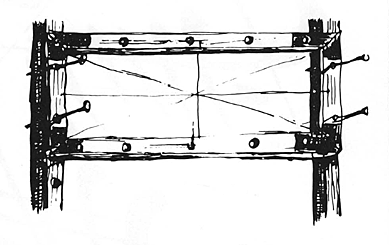
Actually, the only thing innovative about this (at the time) was the use of the radio. The practice of “squaring off” a drawing (called mise au careau) in order to copy, enlarge or reduce the image onto a second squared-off surface, was practiced as early as the Ancient Egyptians. Here is an example of that by the artist Sassoferrato.Later artists (among them Leonardo da Vinci, Albrecht Dürer, and Vincent Van Gogh) not only relied on that same approach, but also used “drawing frames” (of which Dürer's and Van Gogh's are shown below) by which they looked at the model through a network of suspended threads, arranged to match a pattern of squares on their drawing paper. Leonardo highly recommended this—
“If you wish to learn correct and good positions for your figures [he wrote], make a frame that is divided into squares by threads and put it between your eyes and the nude you are drawing, and you will trace the same squares lightly onto your paper on which you intend to draw your nude.”
After the invention of photography, artists began to square off photographs of their models, as a gridwork guide for drawing. Still other artists (among them Blanche Ames Ames and Adelbert Ames II) make efficient use of large-scale grid-based frames which the model stood behind as the photograph was made. Below is a photograph of that in her Borderland studio.
Friday, December 3, 2021
abandon your cat at Clifford's Inn in London
![]() |
| Pandemic montages © Roy R. Behrens 2021 |
•••
In Lowell MA, Beat Generation novelist Jack Kerouac (author of On the Road) was in the same high school class as Ray Gouding, of the hilarious radio comedy team, Bob and Ray.
•••
Samuel Butler: “People when they want to get rid of their cats, and do not like killing them, bring them to the garden of Clifford’s Inn [in London], drop them there, and go away. In spite of all that is said about cats being able to find their way so wonderfully, they seldom do find it, and once in Clifford’s Inn the cat generally remains there.”
•••
E.L. Doctorow: “I have few vices, but one of them is moderation.”
Monday, June 21, 2021
Jonathan Miller on humor as classification errors
![]() |
| view larger |
Above Roy R. Behrens, Border Crossing. Digital montage, © 2021.
•••
Excerpts from Jonathan Miller and Eric Korn, Under-Twenty Parade, a BBC radio panel, 1953—
Er, er, that was “Lift Up Your Socks”…Next week, “A Short Gap” recorded anonymously…the South of England is going to move in a westerly direction…Now here is a police message, published Methuen at twenty-one shillings. There was an accident last night on the Great North Circular Road, when an elderly chrysanthemum was knocked down by a steamroller and received injuries from which the Chief Constable of Hertfordshire has since died…The police are anxious to interview a man with long blue hair—they have never seen a man with long blue hair.
•••
Kate Bassett [in reference to the above radio script] In Two Minds: A biography of Jonathan Miller. London: Oberon Books, 2012, p. 55—
What is remarkable, more immediately, is this extract’s sheer craziness. It is garbled, elided and dreamlike, with slivers of the everyday made strange by being miscategorized, everything playfully grafted into the wrong slots. Miller’s own theory of comedy, expounded in later life, would home in on precisely that: laughter aroused by errors of classification.
Tuesday, December 4, 2018
Let's Pretend | A Radio Series from the 1950s
![]() |
| Poster by Roy R. Behrens (2018) |
Recently, I've been reading the autobiography of Terry Gilliam, the only American member of the Monty Python troupe, titled Gilliamesque (New York: HarperCollins, 2015). On page 9, he recalls his own American childhood, and the experience of reading books, in which a child may often engage in "translating that mental picture from two dimensional into three." How clearly I remember that in my early years of reading books. But then he goes on—
It's the same with the radio, which was all-powerful in America at that time [the early 1950s]. There was a children's radio show called Let's Pretend, which was one of my very first gateways to the fantastical.
Mine too, for which I will always be grateful.
Saturday, December 20, 2014
Infographic | Brandi Weis
![]() |
| Infographic © by Brandi Weis (2014) |
•••
Robert Craft, An Improbable Life (Vanderbilt University Press, 2002), p. 184—
Dorothy [Christopher Isherwood's maid] had never heard of [Russian-born composer Igor] Stravinsky. She thought she recognized Igor as a Jewish comic on the Molly Goldberg show.
![]() |
| Igor Stravinsky autograph |
Ibid, p. 147—
In 1953, he [Stravinsky] broke off his connection with Hollywood's two Russian [Orthodox] churches, for the reason that the priest-confessor had asked him for an autograph.
Titanic Infographic | Bradley Kennedy
![]() |
| Infographic © Bradley Kennedy (2014) |
•••
Henry Adams, in Victor Schreckengost and 20th-Century Design (Cleveland OH: Cleveland Museum of Art / University of Washington Press, 2001), p. 10.—
Another of [drawing instructor Frank N.] Wilcox’s exercises [at the Cleveland Institute of Art in the 1920s] was to go down to the Five and Ten on 105th Street and look at the objects in the window for 45 minutes. Back at the school, the students would make drawings of precisely what they had seen—the objects, the prices, and every other detail. After completing the drawings, they went back to the store window to make sure that everything was accurate.
•••
Robert Craft, An Improbable Life (Vanderbilt University Press, 2002), p. 33—
On Sunday afternoon, December 7, 1941, my father and I were watching a football game in Rockville Center, Long Island, when a loudspeaker announced the bombing of Pearl Harbor. The game went on as though the statement had not been understood, or taken for another Orson Welles radio hoax, but when twice repeated, the stunned, disbelieving crowd in the bleachers began to drift away. As we drove back to Manhattan, the automobile radio sputtered news bulletins, one of which said that the Museum of Fine Arts in Boston had been cordoned off by police because of concern that its great collection of Japanese Art might be endangered by reprisals.
Sunday, January 31, 2010
On Air Romance
In one [an adult radio drama in 1950] I had to play a series of love scenes with a pretty actress called Miriam Newman, who was enough older, say twenty-nine to my nineteen, to make me feel a very raw youth. The sound of kissing was achieved by kissing one's own hand. We stood, man and woman, facing each other, a few inches apart, with a large microphone between us, each holding the script to one side of the mike, in order to get our mouths very close for the intimate, breathy parts. Miriam was extremely realistic, sighing and kissing the soft part of her right hand above the thumb until it was smeared with lipstick and, I thought, as a mere thumb, getting far too much attention.