Showing posts with label distortion. Show all posts

Saturday, August 3, 2024

Temple Grandin and the Ames Demonstrations

Good news travels slowly here. I recently ran across a book by Temple Grandin (widely-known authority on autism and animal science) published in 2018, titled Calling All Minds: How To Think and Create Like An Inventor (New York: Philomel Books). In other words, it has been in print for six years—but only now have I discovered that I am mentioned by name in its pages.

Grandin is world-famous, and I have long been interested in her work. Few people are as widely admired. Since 1984, she has been the recipient of 101 prestigious awards, including honorary doctorates from the leading universities, being chosen for Time Magazine’s 100 Most Influential People, inducted into the American Academy of Arts and Science, and named as one of the Top Best College Professors in the US.

That’s phenomenal. Given all that she’s achieved, how could she possibly even attend all those award ceremonies, and still remain productive? She is one year younger than I am. I cannot begin to imagine receiving so many awards—I would never have accomplished anything. Maybe I am fortunate that the less-than-prestigous awards I've received can be counted on one hand. And I don’t have extra digits.

My interest in Grandin reached its peak in 2010, with the release of a popular Hollywood film about her life, in which she was portrayed by actress Clare Danes. At the beginning of the film, we learn about a turn of events that occured while she was in high school. She saw an educational film about the then popular laboratory experiments of American artist and optical physiologist Adelbert (Del) Ames, Jr., usually referred to as the Ames Demonstrations. The best-known of these are the Ames Window (in which a rotating window-like cut-out appears not to rotate, but to sway back and forth), and the Ames Distorted Room (in which people’s sizes appear to change as they move around a cleverly misshapen room interior).

Since Grandin and I are nearly the same age, we were probably introduced to the Ames Demonstrations at around the same time. Her response was to try to figure out how to build an Ames Room. She succeeded. As an aspiring art student, with a familarity with perpective and anamorphosis, I too replicated an Ames Room, an Ames Window, and other demonstrations, then spent a substantial amount of my life researching and writing about his development as an artist. And indeed, today I continue to publish new findings.

Over the years, I published multiple articles on the Ames Demonstrations and their significance. In the text and bibliography of her book, Grandin refers to one of my articles, published in 1987, titled “The Life and Unusual Ideas of Adelbert Ames, Jr.” In the text, she even mentions me by name, for which I am grateful, because it is far more common for other authors to make blatant use of another author’s research, but neglect to credit it as a source.

In this case, there is a peripheral downside. While I have been credited, it was disappointing to find that I was also wrongly quoted. In my article, I had quoted a published statement by prominent Harvard psychologist Jerome Bruner, who had been married to Ames’s niece. Bruner and his wife’s uncle apparently had their quibbles, and, in his autobiography (1983), Bruner discounted the impact of Ames’s research with the following statement: “It was demonstration that he [Ames] was after, not experimental manipulation. And demonstration of a kind that, I think, speaks more to the artist’s wonder than to the scientist’s. In the end, he had little impact on psychology or philosophy, but he continues to facinate artists.”

In Grandin’s book, she doesn’t mention Bruner. She states instead that it was “Roy R. Behrens, Professor of Art at the University of Northern Iowa” who “concludes that much of Ames’s work has more appeal for the artist than for the scientist. As a visual thinker, I have to disagree.” But I myself did not disparage Ames’s work. I only quoted Bruner, as one view of a prominent scientist, which, in the original article, I then qualified with a lengthy footnote on writings by others who may or may not have agreed with Bruner’s dismissive assessment.

In the end it doesn’t especially matter of course. I continue to be greatly pleased to have been mentioned by someone whose achievements are exemplary, and whose work is so well known.

•••

NOTES
Temple Grandin has also written about her interest in the Ames Demonstrations in Temple Grandin and Margaret M. Scariano, Emergence: Labeled Autistic, New York: Warner Books, 1996.

More recently, I have produced a series of three online video talks (30 minutes each) which provide an overview of Del Ames, his life and his accomplishments. These to some extent are based on my published research articles, but they also include new, surprising information that I have found more recently. These can be accessed free online at <https://youtu.be/MAEjgatMkio>, <https://youtu.be/-8gaYm2FUI0>, and <https://youtu.be/mxOEx2JLQBA>. My articles on Ames include:

Roy R. Behrens, “The Life and Unusual Ideas of Adelbert Ames, Jr,” in Leonardo, vol 20 no 3 (1987), pp. 273-279.
______________, “Adelbert Ames and the Cockeyed Room,” in Print magazine, vol 48 no 2 (1994), pp. 92–97.
______________, “Eyed Awry: The Ingenuity of Del Ames,” in North American Review, vol 282 no 2 (1997), pp. 26-33.
______________, “The Artistic and Scientific Collaboration of Blanche Ames Ames and Adelbert Ames II,” in Leonardo, vol 31 (1998), pp. 47-54.
______________, “Adelbert Ames, Fritz Heider, and the Chair Demonstration,” in Gestalt Theory, vol 21 (1999),” pp. 184–190.
 

I have also provided Ames biographical articles for Encyclopedia of Perception, Grove Online Dictionary of Art, askArt, and Allgemeines Kunstlerlexikon.


Tuesday, July 16, 2024

Oops / John Sloan & Adelbert Ames, Jr. riposte

still image from online Ames video trilogy
Oops. Soon after posting that quote about the friendship of Adelbert Ames Jr. (born aristocrat) and artist and socialist John Sloan (born democrat), about how opposite they were, I ran across new information. Herbert Faulkner West’s account may have made it sound as if the social status of Ames, in comparison to Sloan, was completely one-sided. But soon after we found that Sloan had moved to Hanover NH in part because his cousin, John Sloan Dickey, was the president of Dartmouth College during the 1950s and 1960s. That may have tipped the scales a tad, although not completely.

Friday, October 27, 2023

newly published book on Blanche Ames Ames

Above I’ve been writing about the Ames family for more than 50 years. I myself don’t know of a family that is more colorful or complex. I refer to those descended from the marriage of Union General Adelbert Ames (Reconstruction governor of Mississippi) and Blanche Butler, who was the daughter of the notorious General Benjamin F. Butler.

One of their sons was Adelbert (Del) Ames, Jr., an artist and optical scientist who devised the well-known Ames Demonstrations in psychology (such as his Distorted Room). One of their daughters was an artist and equal rights proponent named Blanche Ames Ames. She has that double name because she married Harvard orchid expert Oakes Ames, whose ancestors had made their fortune providing shovels to those who went west to pan for gold or who worked on the Transcontinental Railroad.

Ames, Iowa, is named for a prominent family member. George Plimpton’s mother was an Ames, and it appears there is also a link to Aldrich Ames, the famous spy. My main interest has usually been the artist and scientist Del Ames, about whom I have published various essays over the years and, more recently, have produced a series of three short online videos.

But I’ve also always been intrigued by Del’s sister, Blanche, in part because he and she worked in tandem on art and science research in the years before the outbreak of World War I. In recent years, there have been various efforts to unearth and celebrate the achievements of Blanche Ames Ames, whose magnificent self-designed mansion is now Borderland State Park in Massachusetts, just south of Boston, a site that is well-worth the visit.

Last year, a 55-minute film was produced, titled Borderland: The Life and Times of Blanche Ames Ames. And now, most recently, a new book has just been published about the shared lives of Blanche Ames and her husband. Titled Blanche Ames Ames (1878-1969) and Oakes Ames (1874-1950): Cultivating That Mutual Ground (Eugene OR: Resource Publications), it was written by Elizabeth F. Fideler, a Harvard scholar who has published earlier books about aging, retirement and related concerns. Especially for those who are interested in the Ames family, women’s studies, and the chemistry of married life, it is a praiseworthy overview of the accomplishments of an amazing American woman. 

Thursday, June 29, 2023

Del Ames / David Chelsea's book on perspective

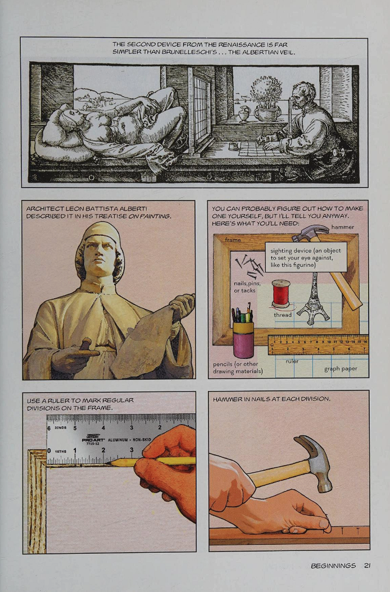
I recently ran across a book (a comic book) which I highly recommend. Titled Perspective in Action: Creative Exercises for Depicting Spatial Representation from the Renaissance to the Digital Age, it was both drawn and written by a Portland-based illustrator named David Chelsea. I regret not knowing about this earlier, since it was published back in 2017 (six years ago!) by New York: Watson-Guptill. ISBN 978-1-60774-946-2. Fortunately, it is still available online, and I now own a copy.

There are various reasons why I recommend this book (the cover isn’t one of them). The interior comic-style images are beautifully rendered and colorized, and the page layout is very smart. It interweaves a well-written and reliable text, both historical and technical, with clear and thoughtful instructions on how to make physical models of the demonstrations in the text.


That would be enough to recommend it. But I am also drawn to it because it covers so many of the vision-related topics that I myself have researched and written about since the 1960s, of which the history of perspective is one. But there is also the use of the camera obscura as a drawing aid. Anamorphoses or “forced perspective” imagery, including street art illusions. Dutch perspective cabinets. The Ames Demonstrations, devised by American optical physiologist Adelbert Ames II, including the Ames Distorted Room (there are instructions on how to make a model, in exacting detail). Six-Point Perspective. Various kinds of stereoscopic (3-D) imagery, and even stereo collage (which I thought I invented back in c1984). And zoetrope (flip book) animations. Wow! What more could you want.

So look for this book! It’s well worth it. And you might also take a look at my own recent video trilogy on the life and work of Ames, since it touches on many of the same subjects. The videos are found online at my YouTube Channel. They are completely free to view and to share with others. See two screen grabs below.


Friday, June 9, 2023

reality lacks solidity when compared to illusions

Del Ames, The Man Who Made Distorted Rooms, Part 1
Stark Young, The Pavilion: Of People and Times Remembered, of Stories and Places. NY: Charles Scribner’s Sons, 1951, p. 187—

Art’s function is to extend life into dream; since reality, for all its being so close at hand, is beyond us; it is actually far more incapable of definition than the maddest vision. For us the actuality of real things has no solidity as compared to the reality of our illusions and the precision of our emotions. We know only too well the truth of that line in French that man who can create countless gods cannot create even a flea.

See also

Adelbert Ames, Fritz Heider, and the Chair Demonstration

The Artistic and Scientific Collaboration of Blanche Ames Ames and Adelbert Ames II

Adelbert Ames and the Cockeyed Room

Saturday, October 8, 2022

the man who made distorted rooms / a trilogy

All three of these have now been posted on YouTube here. It has been a challenge, and I am eager for others to see them. Share to your heart's delight.

Friday, September 23, 2022

film trilogy on artist / scientist Adelbert Ames II

Colleagues Gary Gnade and John Volker in an Ames Room
Nearing completion is a film trilogy (a three-part series of online voice-over video talks) about the life and work of Adelbert (Del) Ames II (1880-1955), an American artist, lawyer, optical physiologist, and psychologist. He is best-known for having invented the Ames Demonstrations in Perception, a group of about twenty-five laboratory set-ups, of which perhaps the three most famous are the Distorted Room, the Chair Demonstration, and the Rotating Trapezoid Window.

I began to research and to write about Ames in the late 1960s, and, in the many years since, I’ve continued to collect a fairly substantial amount of material related to him, including unpublished correspondence. I have always hoped to write a book about his life and ideas, but it was delayed by various circumstances, and now, as I age—and books become less useful as ways to share ideas—that project is on the back burner. So I have turned instead to making a series of video talks. Not the same thing, obviously, but it will do for the moment.

The first video in the series, titled Ames and Anamorphosis: THE MAN WHO DISTORTED ROOMS / Part One, was completed earlier this month, and is accessible online. It provides an overview of Ames’ life and his accomplishments, as well as information about his interesting family (he was related to writer / editor George Plimpton).

Ames and Anamorphosis / Part One

Part Two is all but finished, and should be available on the same channel in a matter of days. It documents the use of anamorphic distortion (forced perspective) in the history of art and in the research of vision. Although the Ames Demonstrations were highly unusual when they gained popularity in the 1940s, the optical principles on which they were based had been anticipated by Leonardo da Vinci, Hans Holbein, various Dutch artists, and, in science, by Hermann von Helmholtz.

Part Three will consist of an overview of the connections between the Ames Demonstrations, and various artistic and scientific achievements that took place during and after his lifetime, such as avant garde filmmaking, perspective distortion in ship camouflage, Hoyt Sherman's vision laboratory at Ohio State University, comedian Ernie Kovacs, theatrical special effects, the reverspective artworks of British artist Patrick Hughes, and so on.

In the early 1970s, I reconstructed several of the Ames Demonstrations, and, collaborating with a friend and colleague, John Volker, I designed a multi-faceted hands-on exhibition, in which children could experience a full-sized distorted room, a straight-forward forced perspective room, an upsidedown room, and so on. Over the years, I went on to publish articles about various aspects of his work in research journals, the online links to some of which are listed below. 

•••

Behrens, R. R. (1987). The Life and Unusual Ideas of Adelbert Ames Jr. Leonardo: Journal of the International Society of Arts, Sciences and Technology, 20, 273–279.

Behrens, R. R. (1994). Adelbert Ames and the Cockeyed Room. Print magazine, 48:2, 92–97.

Behrens, R. R. (1997). Eyed Awry: The Ingenuity of Del Ames. North American Review, 282:2, 26–33.

Behrens, R. R. (1998). The Artistic and Scientific Collaboration of Blanche Ames Ames and Adelbert Ames II. Leonardo, 31, 47–54.

Behrens, R. R. (1999). Adelbert Ames, Fritz Heider, and the Chair Demonstration. Gestalt Theory, 21, 184–190.