Showing posts with label Guy Davenport. Show all posts

Friday, March 10, 2023

familiar american icons / artifacts made strange

Above Dust jacket for Brooke L. Blower and Mark Philip Bradley, eds., The Familiar Made Strange: American Icons and Artifacts After the Transnational Turn. Ithaca NY: Cornell University Press, 2015.  Available online at Internet Archive.

•••

In browsing, I was struck by the power and appropriateness of this book cover (annoyingly, the cover designer goes unmentioned). The contents of the book are equally interesting, such as “William Howard Taft’s Drawers” by Andrew J. Rotter, and “Josephine Baker’s Banana Skirt” by Matthew Pratt Guterl. As noted in an earlier blog post, it was a Nebraska expatriate playwright named Virgil Geddes whose job it was to assist Josephine Baker in donning her famous scanty banana attire at the Folies Bergere.

The often-quoted phrase “to make the familiar strange” can be traced to an essay titled “Art as Technique" by Russian formalist critic Victor Shklovsky, first published in 1917. His term for the process was defamilarization or ostranenie. I myself prefer this translation of what he wrote—

Habitualization devours works, clothes, furniture, ones wife, and the fear of war…And art exists that one may recover the sensation of life; it exists to make one feel things, to make the stone stony. The purpose of art is to impart the sensation of things as they are perceived and not as they are known. The technique of art is to make objects “unfamiliar,” to make forms difficult, to increase the difficulty and length of perception because the process of perception is an esthetic end in itself and must be prolonged. Art is a way of experiencing the artfulness of an object, the object is not important.

In The Novel of the Future (1968), the writer Anaïs Nin rephrased Shklovsky’s concept in a brief (and perhaps too familiar) form as follows—

It is the function of art to renew our perception. What we are familiar with we cease to see. The writer shakes up the familiar scene, and as if by magic, we see a new meaning in it.

As I have written elsewhere, I became acquainted with Victor Shklosky’s ideas during years of corresponding with American writer Guy Davenport. It eventually occurred to me that there is a reciprocal process, of equal value in the innovation process, which might be called “making the strange familiar.”

Thursday, February 25, 2016

Letters to Guy Davenport | Roy R. Behrens

Blog post from Paris Review (2016)
We were recently delighted to learn that my twenty-plus years of  letters to American scholar, essayist and fiction writer Guy Davenport have been added to the archives of the Harry Ransom Center at the University of Texas at Austin. They are part of Davenport's papers, acquired in 2005. They will soon be supplemented by my own gift of 231 letters from Guy Davenport to me. A post on the Ransom Center's blog featured one of my letters (with, as I often did back then, an illustrated envelope). It was also featured in a post on the blog of the Paris Review.

Blog post Harry Ransom Center (2016)

Thursday, October 3, 2013

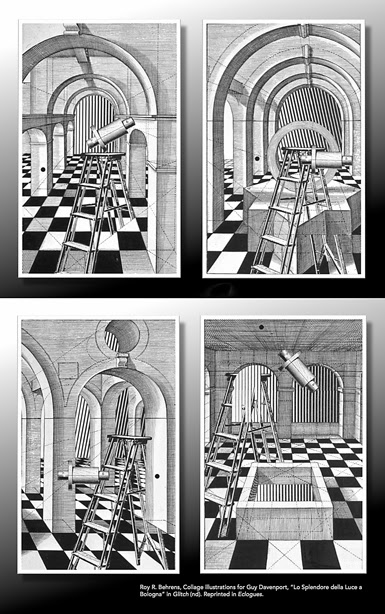
Guy Davenport | Lo Splendore

Short story illustrations (1981) © Roy R. Behrens
Above Roy R. Behrens, collage illustrations for Guy Davenport short story, "Lo Splendore della Luce a Bologna' (1981).

...

Ernest Hemingway, Death in the Afternoon

If a writer of prose knows enough about what he is writing about he may omit things that he knows and the reader, if the writer is writing truly enough, will have a feeling of those things as strongly as though the writer had stated them. The dignity of the movement of an iceberg is due to only one-eighth of it being above water.

...

William Strunk, Jr., The Elements of Style

Vigorous writing is concise. A sentence should contain no unnecessary words, a paragraph no unnecessary sentences, for the same reason that a drawing should have no unnecessary lines and a machine no unnecessary parts. This requires that the writer make all his sentences short, or that he avoid all detail and treat his subjects only in outline, but that every word tell.

...

Osbert Sitwell—

Freud Madox Fraud.

...

Guy Davenport

Max Ernst Ernst Mach.

Sunday, January 31, 2010

Guy Davenport: Take Back Your Life

From "What Are Revolutions?" in Guy Davenport, The Hunter Gracchus and Other Papers on Literature and Art (Washington DC: Counterpoint, 1997), pp. 247-248—

Take back your body from its possession by the automobile; take back your imagination from the TV set; take back your wealth from Congress's bottomless pit and maniac spending; take back your skills as homemakers from the manufacturers; take back your minds from the arguments from necessity and the merchants of fear and prejudice. Take back peace from perpetual war. Take back your lives; they are yours.