Showing posts with label embedded figures. Show all posts

Sunday, March 12, 2023

the offense of telling the same thing twice

Alan Fletcher
Above Alan Fletcher [British designer], model of one of twelve proposals for outdoor drinking fountains (made in stone, one meter high), in which each fountain is shaped to form the silhouette of a famous cultural figure, through reversible figure-ground. This one is the silhouette of Albert Einstein. As reproduced in Fletcher, Picturing and Poeting. London: Phaidon, 2006, p. 103.

•••

Vyvyan Beresford Holland [the second son of Oscar Wilde], An Evergreen Garland. London: Cassell 1968, Page 156-157—

My next case [of how to deal with boring people] is that of the horrible habit of repetition, often known as "twicing." This is the offense of telling the same person the same thing twice. Unfortunately, everyone over the age of forty is to some extent a "twicer," because he refuses to remember to whom he has told his stock stories, and he is apt to forget any new stories he has heard. He is also apt to be much too interested in his past life to care very much whether his victim has heard his stories, so long as he can get someone to listen to them once more, particularly if they happen to be true, or were true before they were embroidered out of all recognition. And it is almost worse if he says, "Do stop me if I’ve told you this before," because one should never run the slightest risk of repeating oneself to other people. On the whole, it is far better not to tell stories at all unless either you invited them yourself or they are very short.

The remedy for "twicing" is contained in: 

Rule VI.—As soon as one is certain that a case of "twicing" is about to occur, one should interrupt the "twicer" roughly by telling him that his story reminds you of another one, and then proceed to tell him his own story, with added detail. That is, if he will let you.

Thursday, August 29, 2019

Saying so much with so little | such a poster

Above An extraordinary poster (unfortunately, haven't found the graphic designer's name) that says so much so powerfully—with such unbelievable brevity. Thanks to former student Amanda Chan, who passed it on.

Thursday, June 28, 2018

Kevin Nute on Frank Lloyd Wright and Japan

If I named a single book from which, more than any other, I learned about the architecture and beliefs of Frank Lloyd Wright (and the source of his influences), my first choice would easily be Frank Lloyd Wright and Japan: The Role of Traditional Japanese Art and Architecture in the Work of Frank Lloyd Wright by Kevin Nute, who teaches architecture at the University of Oregon. I was fortunate to buy a copy when it was published in 1994, nearly twenty-five years ago.

Only yesterday, I was delighted to find that Professor Nute will soon be talking about Wright in Japan at the Architectural Interpretive Center in Mason City IA. The lecture begins at 7:00 pm on Tuesday, July 10, 2018. It is free and open to the public.

Thursday, December 8, 2016

Joseph Podlesnik Poster | Jordan Goldbeck

Joseph Podlesnik Poster © Jordan Goldbeck •
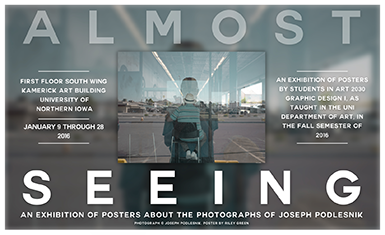
Above Poster by Jordan Goldbeck, graphic design student, Department of Art, University of Northern Iowa, in celebration of the photographs of Joseph Podlesnik. An artist, photographer, and filmmaker (BFA University of Wisconsin-Milwaukee, MFA Cornell University), he is associate professor and lead faculty for foundations at the Art Institute of Pittsburgh. In 2016, he received the Inez Hall Outstanding Faculty Award. He lives in Phoenix AZ.

Podlesnik's photographs (reproduced with his permission from Almost Seeing) are of particular interest because (despite appearances) they were not constructed in Adobe Photoshop by sandwiching multiple layers. Nor are they double exposures. They are simply single frame, through the lens camera shots, by which he makes astonishing use of light, shadow and reflections.

•••

John Aubrey, in Ruth Scurr (ed.), John Aubrey: My Own Life. London: Vintage, 2015, pp. 327-328—

 Sir Henry Blount, who is over eighty years of age, his mind still strong, has been taken very ill in London: his feet extremely swollen… He is fond of saying that he does not care to have his servants go to church lest they socialize with other servants and become corrupted into visiting the alehouse and debauchery. Instead he encourages them to go and see the [public] executions at Tyburn, which, he claims, have more influence over them than all the oratory in the sermons.

• Photograph used in poster copyright © Joseph Podlesnik. All rights reserved.

Joseph Podlesnik Poster | Emily Brown 2016

Joseph Podlesnik Poster © Emily Brown •
Above Poster by Emily Brown, graphic design student, Department of Art, University of Northern Iowa, in celebration of the photographs of Joseph Podlesnik. An artist, photographer, and filmmaker (BFA University of Wisconsin-Milwaukee, MFA Cornell University), he is associate professor and lead faculty for foundations at the Art Institute of Pittsburgh. In 2016, he received the Inez Hall Outstanding Faculty Award. He lives in Phoenix AZ.

Podlesnik's photographs (reproduced with his permission from Almost Seeing) are of particular interest because (despite appearances) they were not constructed in Adobe Photoshop by sandwiching multiple layers. Nor are they double exposures. They are simply single frame, through the lens camera shots, by which he makes astonishing use of light, shadow and reflections.

•••

John Aubrey, in Ruth Scurr (ed.), John Aubrey: My Own Life. London: Vintage, 2015, pp. 376-377 and 379—

July 1690
Mr. Wood [British antiquarian Anthony à Wood] sends me so many queries. I trouble myself to find the answers for him, despite the troubles that press upon me. I desire to give Mr. Wood my watch, which was a gift from the Earl of Pembroke, to remember me by. I will be my own executor and send it to him as soon as the watchmaker has finished mending it.

•••

April 1691
Mr. Wood has complained that the watch I gave him does not work well, but it kept time indifferently when I had it. The days of the month were always faulty but that isn't worth a chip. I have told him that if he has it mended he should do so in London rather than Oxford. I believe it cost at least 10 li. [pounds] when the Earl of Pembroke bought it for me.

• Photograph used in poster copyright ©Joseph Podlesnik. All rights reserved.

Thursday, December 1, 2016

Joseph Podlesnik Poster | Riley Green 2016

Joseph Podlesnik Poster © Riley Green *
Above Poster by Riley Green, graphic design student, Department of Art, University of Northern Iowa, in celebration of the photographs of Joseph Podlesnik. An artist, photographer, and filmmaker (BFA University of Wisconsin-Milwaukee, MFA Cornell University), he is associate professor and lead faculty for foundations at the Art Institute of Pittsburgh. In 2016, he received the Inez Hall Outstanding Faculty Award. He lives in Phoenix AZ.

Podlesnik's photographs (reproduced with his permission from Almost Seeing) are of particular interest because (despite appearances) they were not constructed in Adobe Photoshop by sandwiching multiple layers. Nor are they double exposures. They are simply single frame, through the lens camera shots, by which he makes astonishing use of light, shadow and reflections.

•••

John Aubrey, in Ruth Scurr (ed.), John Aubrey: My Own Life. London: Vintage, 2015, p. 179—

Mr. [James] Harrington [British political theorist] suffers from the strangest sort of madness I have ever found in anyone. He imagines his perspiration turns to flies, or sometimes to bees. He has had a movable timber house built in Mr. Hart's garden (opposite to St. James Park), to try an experiment to prove this delusion. He turns the timber structure to face the sun, chases all the flies and bees out of it, or kills them, then shuts the windows right. But inevitably he misses some concealed in crannies of the cloth hangings and when they show themselves he cries out, "Do you not see that these come from me?" Aside from this, his discourse is rational.

• Photograph used in poster © Joseph Podlesnik. All rights reserved.

Joseph Podlesnik Poster | Chris Hall 2016

Joseph Podlesnik Poster © Chris Hall •
Above Poster by Chris Hall, graphic design student, Department of Art, University of Northern Iowa, in celebration of the photographs of Joseph Podlesnik. An artist, photographer, and filmmaker (BFA University of Wisconsin-Milwaukee, MFA Cornell University), he is associate professor and lead faculty for foundations at the Art Institute of Pittsburgh. In 2016, he received the Inez Hall Outstanding Faculty Award. He lives in Phoenix AZ.

Podlesnik's photographs (reproduced with his permission from Almost Seeing) are of particular interest because (despite appearances) they were not constructed in Adobe Photoshop by sandwiching multiple layers. Nor are they double exposures. They are simply single frame, through the lens camera shots, by which he makes astonishing use of light, shadow and reflections.

•••

John Aubrey, in Ruth Scurr (ed.), John Aubrey: My Own Life. London: Vintage, 2015, p. 256—

Mr. [Robert] Hooke [prominent British philosopher, scientist and architect] believes all vegetables are females. He told us about his principle of flying and we drank port. Mr. Hooke claims that when he was a schoolboy at Westminster School he devised thirty different ways of flying. He imagines flying by some mechanical means: a chariot pulled by horses; or powered by vanes; or bending springs by gunpowder. I consider Mr. Hooke the greatest mechanic alive in the world today.

• Photograph used in poster © Joseph Podlesnik. All rights reserved.

Joseph Podlesnik Poster | Abi Watson 2016

Joseph Podlesnik Poster © Abi Watson (2016) •
Above Poster by Abi Watson, graphic design student, Department of Art, University of Northern Iowa, in celebration of the photographs of Joseph Podlesnik. An artist, photographer, and filmmaker (BFA University of Wisconsin-Milwaukee, MFA Cornell University), he is associate professor and lead faculty for foundations at the Art Institute of Pittsburgh. In 2016, he received the Inez Hall Outstanding Faculty Award. He lives in Phoenix AZ.

Podlesnik's photographs (reproduced with his permission from Almost Seeing) are of particular interest because (despite appearances) they were not constructed in Adobe Photoshop by sandwiching multiple layers. Nor are they double exposures. They are simply single frame, through the lens camera shots, by which he makes astonishing use of light, shadow and reflections.

•••

Augusta, Lady Gregory, in Lennox Robinson, ed., Lady Gregory's Journals 1916-1930. New York: MacMillan, 1947, p. 205—

He [George Bernard Shaw] talked afterwards of what Wilfred Blunt had written of William Morris and of his being without love for anyone (except his invalid daughter), and said it is so often with men immersed in their work, they have no room for another strong affection. The first time he saw Mrs. Morris [Jane Burden Morris] it was a shock. She was lying full-length on a sofa, her long limbs covered, and looked death-like—like clay. He was trying the other day if he could remember anything she ever said and could not, except that one day when he had taken a second helping of some pudding, she said, "You seem to like that pudding," and when he answered "Yes," she said, "There is suet in it." That word, aimed at his vegetarianism, is all he can remember.

• Photograph used in poster copyright © Joseph Podlesnilk. All rights reserved.

Tuesday, November 8, 2016

Joseph Podlesnik Poster | Nick Baumann 2016

Joseph Podlesnik Poster © Nicholas Baumann (2016) •
Above Poster by Nicholas Baumann, graphic design student, Department of Art, University of Northern Iowa, in celebration of the photographs of Joseph Podlesnik. An artist, photographer, and filmmaker (BFA University of Wisconsin-Milwaukee, MFA Cornell University), he is associate professor and lead faculty for foundations at the Art Institute of Pittsburgh. In 2016, he received the Inez Hall Outstanding Faculty Award. He lives in Phoenix AZ.

Podlesnik's photographs (reproduced with his permission from Almost Seeing) are of particular interest because (despite appearances) they were not constructed in Adobe Photoshop by sandwiching multiple layers. Nor are they double exposures. They are simply single frame, through the lens camera shots, by which he makes astonishing use of light, shadow and reflections.

•••
 
Frank Luther Mott in "The SPCS" [Society for the Prevention of Cruelty to Speakers] in The Palimpest (State Historical Society of Iowa). Vol 43 No 3 (March 1962), pp. 114-115—

I think the best speech I ever made was one to a Rotary Club which had asked me to discuss "Freedom of the Press" during Newspaper Week. I shall favor my readers with the entire speech herewith: "Mr. President. Gentlemen of the Rotary Club: There is no such thing as freedom of the press. I thank you." Then I sat down, to the consternation of the program chairman. Of course, I spoiled it all later by yielding to the urging of the president to go on and say something about it anyway, and I talked for a while about the nature of freedom and the controls to which the press is subject. It would have served right and served me well for my smart aleck "hamming" if the Rotarians had all walked out immediately after I had sat down, but they were so intrigued by the spectacle of a man who actually appeared not to want to make a speech that they stayed it out.

• Photograph used in the poster copyright © Joseph Podlesnik. All rights reserved.

Joseph Podlesnik Poster | Kaycee Miller 2016

Joseph Podlesnik Poster © Kaycee Miller (2016) •
Above Poster by Kaycee Miller, graphic design student, Department of Art, University of Northern Iowa, in celebration of the photographs of Joseph Podlesnik. An artist, photographer, and filmmaker (BFA University of Wisconsin-Milwaukee, MFA Cornell University), he is associate professor and lead faculty for foundations at the Art Institute of Pittsburgh. In 2016, he received the Inez Hall Outstanding Faculty Award. He lives in Phoenix AZ.

Podlesnik's photographs (reproduced with his permission from Almost Seeing) are of particular interest because (despite appearances) they were not constructed in Adobe Photoshop by sandwiching multiple layers. Nor are they double exposures. They are simply single frame, through the lens camera shots, by which he makes astonishing use of light, shadow and reflections.

•••
Jack Pritchard, View From a Long Chair. London: Routledge and Kegan Paul, 1984, p. 124—

{Bauhaus designer Laszlo] Moholy-Nagy had a wonderful way of using words as if in error or through not understanding—sometimes, I suspect, on purpose. On one occasion John Betjeman had taken him to a party. As Moholy left he said to the hostess in his strange pronunciation, "Thank you for your hostilities." She was a little taken aback, and when Moholy told John Betjeman what had happened, Betjeman said: "Oh I don't worry—she is hostile to everyone."

• Photograph used in poster copyright © Joseph Podlesnik. All rights reserved.

Joseph Podlesnik Poster | Megan Wellik 2016

Joseph Podlesnik Poster © Megan Wellik (2016) •
Above Poster by Megan Wellik, graphic design student, Department of Art, University of Northern Iowa, in celebration of the photographs of Joseph Podlesnik. An artist, photographer, and filmmaker (BFA University of Wisconsin-Milwaukee, MFA Cornell University), he is associate professor and lead faculty for foundations at the Art Institute of Pittsburgh. In 2016, he received the Inez Hall Outstanding Faculty Award. He lives in Phoenix AZ.

Podlesnik's photographs (reproduced with his permission from Almost Seeing) are of particular interest because (despite appearances) they were not constructed in Adobe Photoshop by sandwiching multiple layers. Nor are they double exposures. They are simply single frame, through the lens camera shots, by which he makes astonishing use of light, shadow and reflections.

•••

Evelyn Waugh, A Little Learning (Boston: Little Brown, 1964), p. 29——

I remember a small sharp disappointment on the death of a pet rabbit. It developed a growth in the jaw and was sent to the vet to be killed. This was explained to me and I was reconciled to its loss. But the vet on his own initiative decided to operate. He sent the animal back a week later pronouncing it cured. I greeted it ecstatically and it died that night.

• Photograph used in poster copyright © Joseph Podlesnik. All rights reserved.

Sunday, November 6, 2016

Joseph Podesnik Poster | Lauren Garnes 2016

Joseph Podlesnik Poster © Lauren Garnes (2016) •
Above Poster by Lauren Garnes, graphic design student, Department of Art, University of Northern Iowa, in celebration of the photographs of Joseph Podlesnik. An artist, photographer, and filmmaker (BFA University of Wisconsin-Milwaukee, MFA Cornell University), he is associate professor and lead faculty for foundations at the Art Institute of Pittsburgh. In 2016, he received the Inez Hall Outstanding Faculty Award. He lives in Phoenix AZ.

Podlesnik's photographs (reproduced with his permission from Almost Seeing) are of particular interest because (despite appearances) they were not constructed in Adobe Photoshop by sandwiching multiple layers. Nor are they double exposures. They are simply single frame, through the lens camera shots, by which he makes astonishing use of light, shadow and reflections.

•••

Leonard Woolf [British writer, husband of Virginia Woolf] in Sowing: An Autobiography of the Years 1880 to 1904. New York: Harcourt Brace, 1960, p. 151—

And [British philosopher] Bertrand Russell has described the pleasure with which one used to watch philosopher [G.E.] Moore trying unsuccessfully to light his pipe when he was arguing an important point. He would light a match, hold it over the bowl of his pipe until it burnt his fingers and he had to throw it away, and go on doing this—talking the whole time or listening intently to the other man's argument—until the whole box of matches was exhausted.

• Photograph used in poster copyright © Joseph Podlesnik. All rights reserved.

Joseph Podlesnik Poster | Eldina Siljkovic 2016

Joseph Podlesnik Poster © Eldina Siljkovic (2016)
Above Poster by Eldina Siljkovic, graphic design student, Department of Art, University of Northern Iowa, in celebration of the photographs of Joseph Podlesnik. An artist, photographer, and filmmaker (BFA University of Wisconsin-Milwaukee, MFA Cornell University), he is associate professor and lead faculty for foundations at the Art Institute of Pittsburgh. In 2016, he received the Inez Hall Outstanding Faculty Award. He lives in Phoenix AZ.

Podlesnik's photographs (reproduced with his permission from Almost Seeing) are of particular interest because (despite appearances) they were not constructed in Adobe Photoshop by sandwiching multiple layers. Nor are they double exposures. They are simply single frame, through the lens camera shots, by which he makes astonishing use of light, shadow and reflections.

•••

Morse Peckham, Man's Rage for Chaos: Biology, Behavior and the Arts. New York: Chilton Books, 1965—

Our lives are bathed in a continuous flow of signs which we interpret to catch the world in an ever-shifting network of categories. The condition of human life is continuous categorical metamorphosis. We are forever engaged in constructing around us an architecture of categories as fluid and yielding to our interests as the air. There is nothing man has not sacrificed, including millions of his fellow human beings, in the vain effort to fix that architecture, to stabilize his categories. But all knowledge, all science, all learning, all history, all thought are unstable, cannot be made static, even by the majesty of the law armed with the power of brute force.

• Photograph used in poster copyright © Joseph Podlesnik. All rights reserved.

Saturday, November 5, 2016

Joseph Podlesnik Poster | Kaycee Miller

Joseph Podlesnik poster © Kaycee Miller (2016) •
Above Poster by Kaycee Miller, graphic design student, Department of Art, University of Northern Iowa, in celebration of the photographs of Joseph Podlesnik. An artist, photographer, and filmmaker (BFA University of Wisconsin-Milwaukee, MFA Cornell University), he is associate professor and lead faculty for foundations at the Art Institute of Pittsburgh. In 2016, he received the Inez Hall Outstanding Faculty Award. He lives in Phoenix AZ.

Podlesnik's photographs (reproduced with his permission from Almost Seeing) are of particular interest because (despite appearances) they were not constructed in Adobe Photoshop by sandwiching multiple layers. Nor are they double exposures. They are simply single frame, through the lens camera shots, by which he makes astonishing use of light, shadow and reflections.

•••

Ralph Waldo Emerson—
Weed—a plant whose virtues have not yet been discovered. 

• Photograph used in poster copyright © Joseph Podlesnik. All right reserved.

Joseph Podlesnik Poster | Jordan Goldbeck

Joseph Podlesnik Poster © Jordan Goldbeck (2016)
Above Poster by Jordan Goldbeck, graphic design student, Department of Art, University of Northern Iowa, in celebration of the photographs of Joseph Podlesnik. An artist, photographer, and filmmaker (BFA University of Wisconsin-Milwaukee, MFA Cornell University), he is associate professor and lead faculty for foundations at the Art Institute of Pittsburgh. In 2016, he received the Inez Hall Outstanding Faculty Award. He lives in Phoenix AZ.

Podlesnik's photographs (reproduced with his permission from Almost Seeing) are of particular interest because (despite appearances) they were not constructed in Adobe Photoshop by sandwiching multiple layers. Nor are they double exposures. They are simply single frame, through the lens camera shots, by which he makes astonishing use of light, shadow and reflections.

•••

Norwood R. Hanson in Patterns of Discovery. Cambridge University Press, 1958—

Seeing is an experience. A retinal reaction is only a physical state… People, not their eyes, see. Cameras, and eyeballs, are blind…there is more to seeing than meets the eyeball.

• Photograph used in poster copyright © Joseph Podlesnik. All rights reserved.

Joseph Podlesnik Poster | Ellen Holt 2016

Joseph Podlesnik Poster © Ellen Holt (2016) •
Above Poster by Ellen Holt, graphic design student, Department of Art, University of Northern Iowa, in celebration of the photographs of Joseph Podlesnik. An artist, photographer, and filmmaker (BFA University of Wisconsin-Milwaukee, MFA Cornell University), he is associate professor and lead faculty for foundations at the Art Institute of Pittsburgh. In 2016, he received the Inez Hall Outstanding Faculty Award. He lives in Phoenix AZ.

Podlesnik's photographs (reproduced with his permission from Almost Seeing) are of particular interest because (despite appearances) they were not constructed in Adobe Photoshop by sandwiching multiple layers. Nor are they double exposures. They are simply single frame, through the lens camera shots, by which he makes astonishing use of light, shadow and reflections.

•••

Saki in The Chronicles of Clovis. New York: Penguin Classics, 1989—

"Is your maid called Florence?" "Her name is Florinda." "What an extraordinary name to give a maid!" "I did not give it to her; she arrived in my service already christened." "What I mean is," said Mrs. Riversedge, "that when I get maids with unsuitable names I call them Jane; they soon get used to it." "An excellent plan," said the aunt of Clovis coldly; "unfortunately I have got used to being called Jane myself. It happens to be my name."

•••

H.G. Wells in Tales of Life and Adventure and Tales of Wonder. London: Heron Books, 1968—

"It's giving girls names like that [Euphemia]," said Buggins, "that nine times out of ten makes 'em go wrong. It unsettles 'em. If ever I was to have a girl, if ever I was to have a dozen girls, I'd call 'em all Jane."

• Photograph used in poster copyright © Joseph Podlesnik. All rights reserved.

Joseph Podlesnik Poster | Brandon Fagle 2016

Joseph Podlesnik Poster © Brandon Fagle (2016) •
Above Poster by Brandon Fagle, graphic design student, Department of Art, University of Northern Iowa, in celebration of the photographs of Joseph Podlesnik. An artist, photographer, and filmmaker (BFA University of Wisconsin-Milwaukee, MFA Cornell University), he is associate professor and lead faculty for foundations at the Art Institute of Pittsburgh. In 2016, he received the Inez Hall Outstanding Faculty Award. He lives in Phoenix AZ.

Podlesnik's photographs (reproduced with his permission from Almost Seeing) are of particular interest because (despite appearances) they were not constructed in Adobe Photoshop by sandwiching multiple layers. Nor are they double exposures. They are simply single frame, through the lens camera shots, by which he makes astonishing use of light, shadow and reflections.

•••

Jeanette Winterson, Sexing the Cherry. New York: Grove Press, 1998—

I call him Jordan and it will do. He has no other name before or after. What was there to call him, fished as he was from the stinking Thames? A child can't be called Thames, no and not Nile either, for all his likeness to Moses. But I wanted to give him a river name, a name not bound to anything, just as the waters aren't bound to anything.

• Photograph used in poster copyright © Joseph Podlesnik. All rights reserved.

Joseph Podlesnik Poster | Kate O'Dell 2016

Joseph Podlesnik Poster © Kate O'Dell (2016) •
Above Poster by Kate O'Dell, graphic design student, Department of Art, University of Northern Iowa, in celebration of the photographs of Joseph Podlesnik. An artist, photographer, and filmmaker (BFA University of Wisconsin-Milwaukee, MFA Cornell University), he is associate professor and lead faculty for foundations at the Art Institute of Pittsburgh. In 2016, he received the Inez Hall Outstanding Faculty Award. He lives in Phoenix AZ.

Podlesnik's photographs (reproduced with his permission from Almost Seeing) are of particular interest because (despite appearances) they were not constructed in Adobe Photoshop, by sandwiching multiple layers. Nor are they double exposures. They are simply single frame, through the lens camera shots, by which he makes astonishing use of light, shadow and reflections.

•••

Helen Barbour, quoted in Remar Sutton and Mary Abbott Waite, eds., The Common Ground Book: A Circle of Friends. Latham NY: British American Publishing, 1992, p. 237-238—

A group of us were driving up to a place in northwest Scotland. There were three of us in the backseat, Alastair, me, someone else. And we went past a house on the left side of the road which had turf on the roof with crocuses growing. It was March or April. And I turned to Alastair and said, "One day, when we have a house like that, we'll have crocuses and daffodils on the roof." Then I was immediately quiet because I realized what I'd said.

Alastair was very quiet for the next day or two…then he proposed.

• Photograph used in poster copyright © Joseph Podlesnik. All rights reserved.

Saturday, February 1, 2014

Fillm Poster | Kenny Meisner

Film poster © Kenny Meisner
Above Proposed film poster by Kenny Meisner, completed as an undergraduate graphic design student at the University of Northern Iowa.

•••

Charles Dickens (Nicholas Nickleby)—

"What's the water in French, sir?" "L'eau," replied Nicholas. "Ah!" said Mr. Lillyvick, shaking his head mournfully, "I thought as much. Lo, eh? I don't think anything of that language—nothing at all."

•••

Billy Wilder (Avanti)—

I don't object to foreigners speaking a foreign language: I just wish they'd all speak the same foreign language.

•••

G.K. Chesterton—

I regard golf as an expensive way of playing marbles.

Thursday, October 3, 2013

Guy Davenport | Lo Splendore

Short story illustrations (1981) © Roy R. Behrens
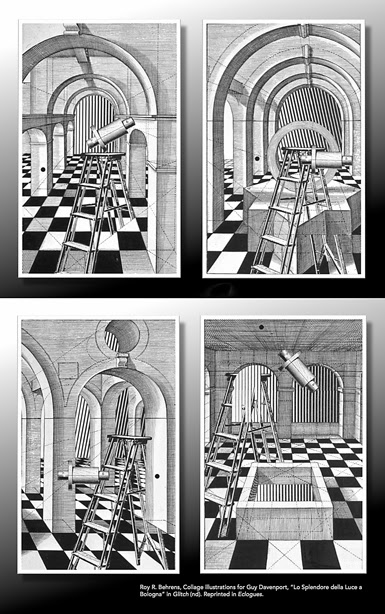
Above Roy R. Behrens, collage illustrations for Guy Davenport short story, "Lo Splendore della Luce a Bologna' (1981).

...

Ernest Hemingway, Death in the Afternoon—

If a writer of prose knows enough about what he is writing about he may omit things that he knows and the reader, if the writer is writing truly enough, will have a feeling of those things as strongly as though the writer had stated them. The dignity of the movement of an iceberg is due to only one-eighth of it being above water.

...

William Strunk, Jr., The Elements of Style—

Vigorous writing is concise. A sentence should contain no unnecessary words, a paragraph no unnecessary sentences, for the same reason that a drawing should have no unnecessary lines and a machine no unnecessary parts. This requires that the writer make all his sentences short, or that he avoid all detail and treat his subjects only in outline, but that every word tell.

...

Osbert Sitwell—

Freud Madox Fraud.

...

Guy Davenport—

Max Ernst Ernst Mach.