Showing posts sorted by relevance for query guy davenport. Sort by date Show all posts

Saturday, October 17, 2015

Guy Davenport's Mushrooms


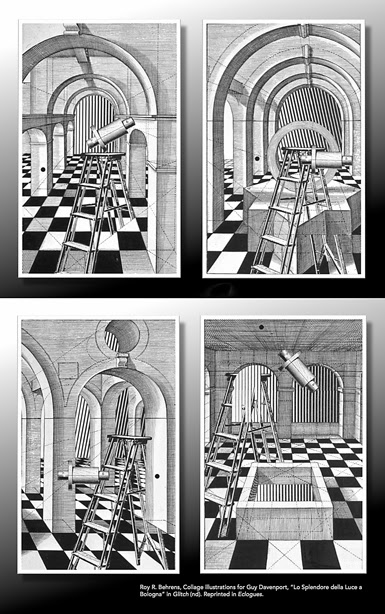
Roy R. Behrens © illustrations for Guy Davenport (1979)
In speaking with students, I am increasingly puzzled by how quickly and completely society's past has been effaced by popular culture. They've all read Harry Potter of course, but are totally unfamiliar with Charles Dickens or H.L. Mencken ("old white guys," as one explained). They are thoroughly acquainted with the Mario Brothers, but have never heard of the James brothers, William (the writer) and Henry (the psychologist). Not even the Marx Brothers.

Above are stages in illustrations I designed in 1979 (full-color cover and six interior collages) to complement a short story by American fiction writer, essayist and scholar Guy Davenport, with whom I was then corresponding. Each day, increasingly few can understand what the imagery refers to, since education now rarely includes such peripheral gems of history as Paolo Ucello, Albrecht Dürer, Thomas Eakins, William Hogarth's line of beauty, Stanley Spencer—and Guy Davenport.

•••

Guy Davenport, in "Pleasant Hill," an interview by Bernard Hoepffner—

I am a minor writer because I deal in mere frissons and adventitious insights, and with things peripheral.…

•••

I'm not a novelist. Paul Klee was not a muralist. My ambition is to write as little as possible, in the smallest possible space.
     All my discrete paragraphing is to force the reader to read. Most narrative prose can be read by running one's eye down the page. If I've worked one hour on a sentence, I want the reader to pay attention to it. I hope there's a web of symbols and themes running through all the stories.


•••

The major writers in whose shadows I grow my mushrooms are Osip Mandelstam, Donald Barthelme, Robert Walser, and Walter Savage Landor.

See also this.

Thursday, February 25, 2016

Letters to Guy Davenport | Roy R. Behrens

Blog post from Paris Review (2016)
We were recently delighted to learn that my twenty-plus years of  letters to American scholar, essayist and fiction writer Guy Davenport have been added to the archives of the Harry Ransom Center at the University of Texas at Austin. They are part of Davenport's papers, acquired in 2005. They will soon be supplemented by my own gift of 231 letters from Guy Davenport to me. A post on the Ransom Center's blog featured one of my letters (with, as I often did back then, an illustrated envelope). It was also featured in a post on the blog of the Paris Review.

Blog post Harry Ransom Center (2016)

Thursday, October 3, 2013

Guy Davenport | Lo Splendore

Short story illustrations (1981) © Roy R. Behrens
Above Roy R. Behrens, collage illustrations for Guy Davenport short story, "Lo Splendore della Luce a Bologna' (1981).

...

Ernest Hemingway, Death in the Afternoon

If a writer of prose knows enough about what he is writing about he may omit things that he knows and the reader, if the writer is writing truly enough, will have a feeling of those things as strongly as though the writer had stated them. The dignity of the movement of an iceberg is due to only one-eighth of it being above water.

...

William Strunk, Jr., The Elements of Style

Vigorous writing is concise. A sentence should contain no unnecessary words, a paragraph no unnecessary sentences, for the same reason that a drawing should have no unnecessary lines and a machine no unnecessary parts. This requires that the writer make all his sentences short, or that he avoid all detail and treat his subjects only in outline, but that every word tell.

...

Osbert Sitwell—

Freud Madox Fraud.

...

Guy Davenport

Max Ernst Ernst Mach.

Thursday, March 12, 2020

A designer remembers the writer Guy Davenport

Remembering Guy Davenport
Guy Davenport was an American essayist, fiction writer, poet, translator, painter, illustrator, university scholar and professor, and a recipient in 1992 of a "genius award" from the MacArthur Foundation. For more than a decade, he and I exchanged letters of a length of one or two pages, sometimes as often as weekly. I saved all his letters, with copies of nearly all of mine. To correspond with him for so many years was among the wisest things I’ve done. Yet in truth, it was always exhausting since the intensity of his letters was forever a woeful reminder that I was writing not simply to an ordinary person but to a remarkably talented man whose powers of observation were astonishing at very least. more>>>

Sunday, January 31, 2010

Guy Davenport: Take Back Your Life

From "What Are Revolutions?" in Guy Davenport, The Hunter Gracchus and Other Papers on Literature and Art (Washington DC: Counterpoint, 1997), pp. 247-248—

Take back your body from its possession by the automobile; take back your imagination from the TV set; take back your wealth from Congress's bottomless pit and maniac spending; take back your skills as homemakers from the manufacturers; take back your minds from the arguments from necessity and the merchants of fear and prejudice. Take back peace from perpetual war. Take back your lives; they are yours.

Friday, March 10, 2023

familiar american icons / artifacts made strange

Above Dust jacket for Brooke L. Blower and Mark Philip Bradley, eds., The Familiar Made Strange: American Icons and Artifacts After the Transnational Turn. Ithaca NY: Cornell University Press, 2015.  Available online at Internet Archive.

•••

In browsing, I was struck by the power and appropriateness of this book cover (annoyingly, the cover designer goes unmentioned). The contents of the book are equally interesting, such as “William Howard Taft’s Drawers” by Andrew J. Rotter, and “Josephine Baker’s Banana Skirt” by Matthew Pratt Guterl. As noted in an earlier blog post, it was a Nebraska expatriate playwright named Virgil Geddes whose job it was to assist Josephine Baker in donning her famous scanty banana attire at the Folies Bergere.

The often-quoted phrase “to make the familiar strange” can be traced to an essay titled “Art as Technique" by Russian formalist critic Victor Shklovsky, first published in 1917. His term for the process was defamilarization or ostranenie. I myself prefer this translation of what he wrote—

Habitualization devours works, clothes, furniture, ones wife, and the fear of war…And art exists that one may recover the sensation of life; it exists to make one feel things, to make the stone stony. The purpose of art is to impart the sensation of things as they are perceived and not as they are known. The technique of art is to make objects “unfamiliar,” to make forms difficult, to increase the difficulty and length of perception because the process of perception is an esthetic end in itself and must be prolonged. Art is a way of experiencing the artfulness of an object, the object is not important.

In The Novel of the Future (1968), the writer Anaïs Nin rephrased Shklovsky’s concept in a brief (and perhaps too familiar) form as follows—

It is the function of art to renew our perception. What we are familiar with we cease to see. The writer shakes up the familiar scene, and as if by magic, we see a new meaning in it.

As I have written elsewhere, I became acquainted with Victor Shklosky’s ideas during years of corresponding with American writer Guy Davenport. It eventually occurred to me that there is a reciprocal process, of equal value in the innovation process, which might be called “making the strange familiar.”

Thursday, September 26, 2013

Luther College Writers Festival 2013

Intersections Between Word and Image
University of Northern Iowa graphic design professor Roy R. Behrens will be among the presenters at the 2013 Luther College Writers Festival in Decorah IA on Saturday, September 28. He will appear on a panel on New Writing, New Media (3:00-5:00 pm), and will talk about "Intersections Between Word and Image." Beginning in the 1970s, as a designer/illustrator, he collaborated with various American writers, including Jerzy Kosinski, Guy Davenport, Marvin Bell and others.

Thursday, February 3, 2022

new documentary about Gertrude Stein 2022

I am pleased (albeit exhausted) to say that, as of yesterday, I completed what may be my most ambitious undertaking in recent years. It is a sixty-minute documentary voice-over film biography of the life of William Edwards Cook (1881-1959), an American expatriate artist, who grew up in Iowa, but spent his adult life in Europe, living in Paris, Rome, and Mallorca.

Titled COOK: The Man Who Taught Gertrude Stein to Drive, the film is freely available to everyone here online. More specifically, it is a detailed account of the life-long friendship of Cook with the American writer Gertrude Stein. It is based on her frequent adulation of him in her writings, as well as on the contents of 250 pages of their unpublished correspondence.

Cook was never a well-known artist, but he did acquire some renown for two other reasons: In 1907, he was the first American artist to be allowed to paint a portrait of Pope Pius X. Later, in 1926, he used his inheritance to commission the then-unknown Swiss-French architect Le Corbusier to design an early Modernist home (the "first true cubist house") in Boulogne-sur-Seine, which is still intact, and widely known as Maison Cook or Villa Cook.

The friendship of Gertrude Stein and William Edwards Cook (including the roles of their partners, Alice B. Toklas and Jeanne Moallic Cook) was first documented in (my earlier book)  COOK BOOK: Gertrude Stein, William Cook and Le Corbusier (Bobolink Books, 2005). This new documentary film corrects, updates, and adds to the information in that book.

This film project (as well as the earlier book) was made possible by the earlier work of such Stein scholars as Ulla Dydo, Bruce Kellner, and Rosalind Moad, as well as the Stein / Cook correspondence in the collection of the Beinecke Library at Yale University.

In 2005, when COOK BOOK was released, Ulla Dydo (the pre-eminent expert on Stein, and author of The Language that Rises) praised it in the following way: "This book jumps out at my eyes, my ears. It comes from everywhere, never drags those even blocks of print that dull the mind. Look at it, read it, let it tease you: It's researched with all the care that keeps its sense of humor and its visual and voice delights. Travel with it, leave home, go and explore the many ways for a book to be a house for living."

The distinguished critic Guy Davenport wrote: "This is as good as topnotch Behrens gets!"

This film is not without humor, and at times it shares surprises. It may prove of particular value to viewers (both scholars and the rest of us) who are particularly interested in American literature, Modernism, Gertrude Stein, art, architecture, horse racing, Harvard, William James, art collectors, expatriates, Paris, Mallorca, the American Midwest, Iowa, art history, the training of artists, Cézanne, Cubism, Picasso, Le Corbusier, LGBT, and gender identity issues. 

Maison Cook