Showing posts with label Musicians. Show all posts

Friday, June 24, 2022

adrift in milan / never too late for the last supper

Wind Instrument [detail] © Roy R. Behrens
Abel Warshawsky, The memories of an American Impressionist. Kent OH: Kent State University Press, 1980, pp. 86-87—

In connection with the Last Supper, a friend of mine, Samuel Cahan, a well-known newspaper artist who had been with the New York World for thirty years, told me of an amusing incident which occured when he and his wife visited Milan a few years ago. Speaking no Italian, they had asked their hotel porter to procure an English-speaking cabby to take them about. To the latter my friend very carefully explained that they wished to see the Last Supper. "Last supper?" replied the cabby, "yes , yes. Me understand!" Whereupon he started driving them round the town and finally into the country.

After the drive had extended for several miles, my friend, fearing that there must be some mistake, repeated his instructions to the driver. "Last supper?" he yelled back, "Sure! Me understand!" and continued to drive. Late that evening the two Americans were finally brought back to the city in a state approaching nervous exhaustion. Drawing up his carriage in front of a brilliantly lit edifice, the vetturino opened the cab and ushered his fares into a fashionable restaurant, proudly giving them to understand that he had brought them back in good time for the desired "late supper."

Saturday, December 18, 2021

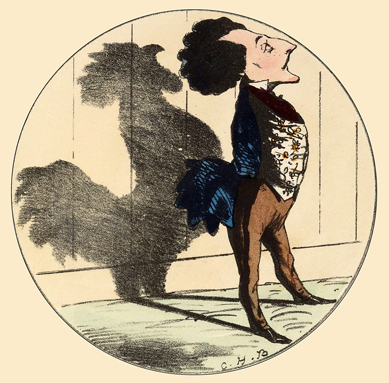
Stendhal Meets Rossini / Who Crows for You?

Above Bantam, comic shadow caricature by British artist Charles Henry Bennett, Victorian illustrator.

•••

Stendhal (Marie Henri Beyle), author of The Red and the Black, describing an incident in a visit to Italy in 1817—

We halted in Terracina, and there…we were invited to take supper with a party of travellers newly arrived out of Naples. Gathered about the table, I observed some seven or eight persons, amongst whom, in particular, my eyes lighted upon a fair-haired young man, of some five or six-and-twenty years of age, astonishingly handsome in spite of a slight touch of baldness. I pressed him for news of Naples, and in particular, of music in that city: he answered my curiosity with answers that were clear-cut, brilliant and humorous. I enquired of him whether, when I reach Naples, I might still hope to see [Gioachino] Rossinis Otello. I pursued the topic, asserting that, in my opinion, Rossini was the bright hope of the Italian school; that he was the only living composer who had true genius as his birthright. At this point I noticed that my man seemed faintly embarrassed, while his companions were grinning openly. To cut a long story short, this was Rossini.

Sunday, September 26, 2021

the elephant has a wrinkled moth-proof hide

Above A construction pattern for making a two-person elephant costume, from Albert Neely Hall, The Boy Craftsman: Practical and Profitable Ideas for a Boy's Leisure Hours. Boston: Lothrop, Lee and Shepard, 1905.

•••

Ogden Nash, "The Elephant," one of a series of comical animal poems written to accompany Camille Saint-Saëns' Carnival of the Animals . NY: Columbia Masterworks, 1949—

Elephants are useful friends,

Equipped with handles at both ends.

They have a wrinkled moth-proof hide.

Their teeth are upside down, outside. 

If you think the elephant preposterous,

You've probably never seen a rhinosterous.

•••

VIDEO LINKS

Nature, Art, and Camouflage  

Art, Women's Rights, and Camouflage

 Embedded Figures, Art, and Camouflage

 Art, Gestalt, and Camouflage

Friday, August 6, 2021

one bad clip / and a pheasant becomes a duck

view larger
Above Roy R. Behrens, La Scala. Digital montage, © 2021.

•••

Christopher Falconer, British gardener, as quoted in Ronald Blythe, Akenfield: Portrait of an English Village (New York: Dell Publishing, 1969), p. 113—

The garden was huge. The pleasure grounds alone, and not including the park, covered seven acres. The kind of gardening we did there is not seen nowadays. It was a perfect art. Topiary, there was a lot of that. It was a very responsible job. You had only to make one bad clip and a pheasant became a duck. The gardeners usually made up these creatures themselves. We were tempted to cut out something terrible sometimes, so that it grew and grew…but of course we never did.

Wednesday, December 25, 2013

Blind Leading the Blonde

Calendar page (2013) ©Rob Bauer
Above Layout for a calendar page (its theme determined by a quote) by Rob Bauer, graphic design student in the Department of Art, University of Northern Iowa.

•••

Dr. Peter H. Gott, "Health Q&A" in The Fresno Bee (Fresno CA), 4 May 2000, p. E-6—

After my father's bypass surgery, he felt so dreadful that he insisted his doctor stop most of his medication. Thereafter, he felt fine. While such a drastic action is not everyone's cup of tea, you would have to know my father to appreciate how relentlessly stubborn he was. He claimed to have "accurately misunderstood" his doctors, didn't want them to put [all] his "aches in one basket," was fearful of "dying for nothing," and wished as an adult to be "the blind leading the blonde."

Robert Craft in Stravinsky: Chronicle of a Friendship (Nashville: Vanderbilt University Press, 1994), p. 344—

[The poet W.H. Auden] says that in the train club car on his way to lecture at Yale, some students sent him a note: "We can't stand it a minute longer: are you Carl Sandburg?" He wrote back: "You have spoiled mother's day."

Saturday, February 4, 2012

Stravinsky on the Telephone


Above Separated at birth? (Left to right) German architect Peter Behrens (in a portrait by Max Liebermann, 1911), and designer Roy R. Behrens.

Below From Robert Craft, Stravinsky: Chronicle of a Friendship. Nashville TN: Vanderbilt University (1994), p. 188—

I.S [Stravinsky], telephoning the G. Wittenberg Surgical Appliances Company: "This is Mr. Stravinsky, S-T-R-A-" He spells it out loudly and deliberately, as he does when dictating a telegram. "Two years ago you fitted me with a truss. I want an appointment to have it repaired." He has dialed a wrong number, however, and the other party has apparently had to hear the entire speech without finding an opportunity to interrupt. I.S. ill-humoredly cradles the receiver, then carefully dials again. "This is Mr. Stravinsky, S-T-…" You made a …" The same party answers, very annoyed. Annoyed now himself, I.S. double-checks the number in his address book, finds it correct, still believes he has misdialed, tries again. "This is Mr.…" This time the man on the other end, no doubt believing himself the victim of a raving lunatic, slams down the receiver. At this point V. [Stravinsky's wife] discovers from the telephone directory that I.S. has miscopied the number.

Thursday, September 16, 2010

Mister Meshugge

From George Grosz, An Autobiography (Berkeley: University of California Press, 1998), pp. 90-91—

It was in a café [in Berlin] that I first heard a jazz band. People called it a noise band. It was not a jazz band in the American sense, but more of a café orchestra gone crazy. Two or three musicians with saws and cow bells would parody the general melody with rhythmic interruptions. The conductor called himself Mister Meshugge [Yiddish for Mister Crazy] and acted like a madman. He would pretend he had lost control, would break his baton to pieces and smash his violin over the head of a musician. At the end he would grab the bass and use it as a weapon in the ensuing battle, finally throwing the splinters into the audience that screamed with delight and threw them back. Throughout the performance waiters kept on serving the musicians more beer and drinks, increasing the general gaiety. Meschugee would grab instruments from the hands of the musicians, and sing and dance. Suddenly he would jump onto the piano, pretend he was a monkey, scratch himself, grab a large glass of beer to toast the audience, but then, quick as a flash, pour it down one of the trumpets. The audience was convulsed with laughter.

Wednesday, January 6, 2010

In Gawd We Truss

From Robert Craft's (often hilarious) journals about the aging Russian-born composer Igor Stravinsky, in Stravinsky: Chronicle of a Friendship (Nashville TN: Vanderbilt University Press, 1994), p. 188—

I.S., telephoning the G. Wittenberg Surgical Appliances Company: "This is Mr. Stravinsky, S-T-R-A-…" He spells it loudly and deliberately, as he does when dictating a telegram. "Two years ago you fitted me with a truss. I want an appointment to have it repaired." He has dialed a wrong number, however, and the other party has apparently had to hear the entire speech without finding an opportunity to interrupt. I.S., ill-humoredly cradles the receiver, then carefully dials again. "This is Mr. Stravinsky, S-T-… You made a…" The same party answers, very annoyed. Annoyed now himself, I.S. double-checks the number in his address book, finds it correct, still believes he has misdialed, tries again. "This is Mr…" This time the man on the other end,no doubt believing himself the victim of a raving lunatic, slams down the receiver. At this point V. [Vera, Stravinsky's wife] discovers from the telephone directory that I.S. has miscopied the number.