Showing posts with label comics. Show all posts

Tuesday, February 11, 2025

metamorphosis / shape-shifting and animation

Of late we’ve been exploring the workings of metamorphosis, the transition of a single form from one shape to another. A phenomenon not unrelated to shape-shifting, evolution diagrams, and animation sequences.

Among the best inventors of metamorphic sequences was a Victorian artist named Charles H. Bennett (1828-1867). He was more generally known for comic illustrations, such as those for children’s books. He's worth looking into.

Above and below are examples from a series of metamorphic images that were initially published weekly in The Illustrated Times (c1863) as Studies in Darwinesque Development, which was later republished posthumously in a book titled Character Sketches, Development Drawings and Original Pictures of Wit and Humor (1872).


Thursday, June 29, 2023

Del Ames / David Chelsea's book on perspective

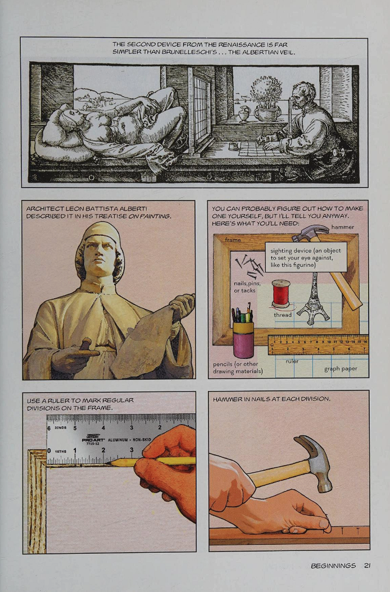
I recently ran across a book (a comic book) which I highly recommend. Titled Perspective in Action: Creative Exercises for Depicting Spatial Representation from the Renaissance to the Digital Age, it was both drawn and written by a Portland-based illustrator named David Chelsea. I regret not knowing about this earlier, since it was published back in 2017 (six years ago!) by New York: Watson-Guptill. ISBN 978-1-60774-946-2. Fortunately, it is still available online, and I now own a copy.

There are various reasons why I recommend this book (the cover isn’t one of them). The interior comic-style images are beautifully rendered and colorized, and the page layout is very smart. It interweaves a well-written and reliable text, both historical and technical, with clear and thoughtful instructions on how to make physical models of the demonstrations in the text.


That would be enough to recommend it. But I am also drawn to it because it covers so many of the vision-related topics that I myself have researched and written about since the 1960s, of which the history of perspective is one. But there is also the use of the camera obscura as a drawing aid. Anamorphoses or “forced perspective” imagery, including street art illusions. Dutch perspective cabinets. The Ames Demonstrations, devised by American optical physiologist Adelbert Ames II, including the Ames Distorted Room (there are instructions on how to make a model, in exacting detail). Six-Point Perspective. Various kinds of stereoscopic (3-D) imagery, and even stereo collage (which I thought I invented back in c1984). And zoetrope (flip book) animations. Wow! What more could you want.

So look for this book! It’s well worth it. And you might also take a look at my own recent video trilogy on the life and work of Ames, since it touches on many of the same subjects. The videos are found online at my YouTube Channel. They are completely free to view and to share with others. See two screen grabs below.


Friday, May 12, 2023

social media acronyms as practiced by victorians

Above A three-panel caricature, The Pair of Skaters (1873), by one of history's finest comic illustrators (often featured in Simplicissimus), the Norwegian artist Olaf Gulbransson. His command of movement and gestural line has never been equaled.

•••

A.A. Milne, Autobiography. New York: E.P. Dutton, 1939, pp. 131-132—

One way and another we [the author and his brother Kenneth John Milne] got a good deal of happiness out of it [preparatory school], if not always in the way expected of us. We sat together now, never to be separated, in the Mathematical Sixth, which meant that we occupied one corner of a room in which some lowly mathmatical set was being taught. Since we could not talk wthout disturbing the master-in-charge we wrote letters to each other: long letters detailing our plans for the next holidays. Interest was added to these letters by our custom of omitting every other word, leaving blanks which the addressee had to fill in. Our minds were sufficiently in tune for this to be possible without being easy; one could get the general sense without being certain of the exact word. As in my old French set, we then changed papers and marked each other's mistakes. Sometimes our communications were in initial letters only. During “second school,” for instance, it was certain that one of us would ask the other “SWGUSIB?” This clearly meant “Shall we go up-Sutts in break?” a question which expected the answer “Yes” and got it. Ken would feel in his pockets and decide that, since we already owed Father 15/6, we might as well owe him sixteen shillings. We did.

Saturday, December 18, 2021

Stendhal Meets Rossini / Who Crows for You?

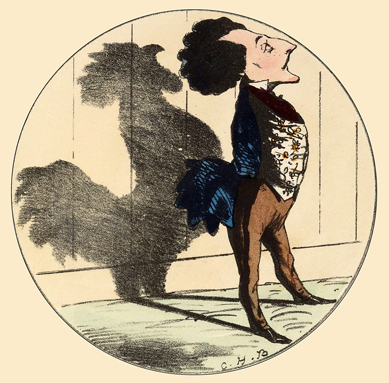
Above Bantam, comic shadow caricature by British artist Charles Henry Bennett, Victorian illustrator.

•••

Stendhal (Marie Henri Beyle), author of The Red and the Black, describing an incident in a visit to Italy in 1817—

We halted in Terracina, and there…we were invited to take supper with a party of travellers newly arrived out of Naples. Gathered about the table, I observed some seven or eight persons, amongst whom, in particular, my eyes lighted upon a fair-haired young man, of some five or six-and-twenty years of age, astonishingly handsome in spite of a slight touch of baldness. I pressed him for news of Naples, and in particular, of music in that city: he answered my curiosity with answers that were clear-cut, brilliant and humorous. I enquired of him whether, when I reach Naples, I might still hope to see [Gioachino] Rossinis Otello. I pursued the topic, asserting that, in my opinion, Rossini was the bright hope of the Italian school; that he was the only living composer who had true genius as his birthright. At this point I noticed that my man seemed faintly embarrassed, while his companions were grinning openly. To cut a long story short, this was Rossini.

Tuesday, December 14, 2021

new works by california artist jared rogness

Copyright © Jared Rogness
For decades, I have been in awe of the drawings of Jared Rogness, a California-based artist, who grew up in Iowa. Here (above and below) are two of his latest drawings. using only a blue-ink ballpoint pen. Such amazing facility, and such a gift to be able to so persuasively depict figures in motion from such complex points of view.

Bravo! 

Here is an online essay in which he talks about his work and provides more examples. In addition, we’ve blogged about him in the past, since I had the pleasure of working with him in the late 1990s and early 200os, when he was a university student in Iowa. 

Copyright © Jared Rogness


Tuesday, October 5, 2021

Ripley's ghost illustrator / Believe It or Not!

Above Article in the current issue (October 2021) of The Iowa Source about American illustrator Clemens Gretter. Until recently, I had never heard his name, but (although I didn't realize it) I was familiar with his work. Why? Because in the 1940s, he was the "ghost illustrator" (not unlike a "ghost writer") for Robert Ripley's syndicated newspaper cartoon panel, famously known as Believe It or Not! As part of his contract, he was not allowed to sign his name, since the credit was given to Ripley instead. But Gretter was also responsible for a wide range of other cartoons, illustrations, and book designs, for which he did receive credit. Here's the whole story more>>>

Thursday, February 18, 2021

Harold Lloyd's walking wooden hobby horse

Above World Cinema poster depicting American film star Harold Lloyd (designer and date unknown).

•••

S. Howard Bartley, A Bit of Human Transparency. Bryn Mawr PA: Dorrance and Company, 1988, p. 73—

[Hollywood film star Harold Lloyd designed a wooden] walking hobby horse large enough for adults to ride…[It] looked much like a regular hobby horse except it was not on rockers. As the rider would lean forward the horse would tilt forward, pivoting (or rocking) on its front legs. This would lift the rear end of the horse and lift the hind legs off the floor. They would swing forward to reach what would now be the perpendicular. As the rider would then lean back, the front end of the horse would lift off the ground and in tilting back the front legs would swing to a new position. The pivot for this second phase of action (tilt) would be the hind legs. So as the rider would alternately tilt forward and backward the animal would carry its rider across the floor. 

Harold Lloyd in Safety Last (1923)


Saturday, October 17, 2020

rabbi: so here's the butter but where's the cat

Eric Morecambe

Would you like to hear how I asked for his daughter's hand in marriage?...I said, "I would like your daughter for my wife." He said, "But I've never even seen your wife. Bring her round and we'll talk about it."

Roy R. Behrens, altered book collage [detail]


•••

Viktor Frankl, “Reduction and Nihilism” in Arthur Koestler and J . R. Smythies, eds., Beyond Reductionism (Boston: Beacon Press, 1969), p. 403—

There were two neighbors; one of them contended that the other's cat had stolen and eaten five pounds of his butter; there was a bitter argument and finally they agreed to seek the advice of the rabbi. They went to the rabbi and the owner of the cat said: “It cannot be, my cat doesn' t care for butter at all” but the other insisted that it was his cat and the rabbi said: “Bring me the scales.” And they brought the scales and he asked: “How many pounds of butter?” “Five pounds.” And believe it or not, the weight of the cat was exactly five pounds. So the rabbi said: “Now I have the butter, but where is the cat?”

Saturday, December 29, 2018

Charles Henry Bennett | Shapeshifting Fox

C.H. Bennett, Metamorphosis (1863)
Above One of a series of elaborate comic metamorphoses (aka shapeshifting) created by Victorian-era British illustrator Charles Henry Bennett (1863) in sardonic reference to Charles Darwin's theory of natural selection, this one titled "Beware of the goose when the fox preaches." Courtesy The Wellcome Library.

•••

Vincent Starrett (Chicago Tribune book columnist Charles Vincent Emerson Starrett), Born in a Bookshop: Chapters from the Chicago Renascence. Norman: University of Oklahoma Press, 1965, pp. 295-296—

It is curious how the faces of acquaintances repeat themselves in foreign lands. Uncanny, too, for what could be more disconcerting than to encounter an old friend jogging past dressed like a mandarin or selling chestnuts in coolie cloth? No sooner had I reached the Orient than this began to happen. Friends and associates I thought I had left behind in America, sometimes fellows I hadn't seen in years, popped up in Yokohama, Tokyo, Shanghai, and Peking, looking very much as I had seen them last, yet subtly altered by the native costumes they were wearing. It was as if one met them coming from a masquerade. In Yokohama it was an old school friend who had been dead for years. He was running a cigarette kiosk near the docks and I knew better than to speak to him. In Tokyo it was a genial barber who used to shave me in Chicago. And in Peking [Beijing] here were so many that my blood ran cold.

Among the friends I met in Chinese garb (and with Chinese faces) were some pretty distinguished fellows…I saw Alex Woollcott many times: once he was chirping seductively at a bird he was carrying through the streets in a bamboo cage. Once my dead mother turned out of a side street and gave me a turn that almost bowled me over. Once I met Bob Casey driving a small donkey attached to a two-wheeled cart: he was selling vegetables. After a time it became an amusing game to look for absent friends and sometimes to hail them genially, and no harm came of it for the Chinese were a friendly people, always ready to hail one in return.

But one day I really did get a shock. Rolling down one of the main thoroughfares of Peking in my rickshaw, I came suddenly abreast of another rickshaw rider headed in the opposite direction. He was bundled up in a fur coat and wore a fur hat, rather like a turban, at a rakish angle. He looked exactly like J. P. McEvoy and for a moment we looked hard at each other. Then I said, “Hello, Mac,” and he stopped his boy and said, “Why, hullo, Vince! What are you doing in Peking?”

Thursday, December 27, 2018

George Herriman | Are Cubists From Cuba?

George Herriman (1914)
Above A syndicated cartoon panel (repositioned vertically to read while scrolling) by the American master cartoonist, George Herriman, well-known because of Krazy Kat. This was one of his responses to the controversy surrounding the infamous Armory Show, the first US exhibition of Modern styles of art, Cubism among them.

Friday, September 7, 2018

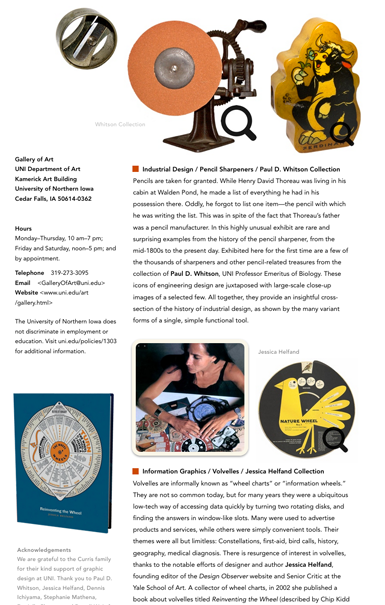
Elena Diane Curris Design Exhibition | 2018

Opening on October 8, 2018, at the Gallery of Art at the University of Northern Iowa is the first of an on-going series of biennial design-themed exhibitions. Titled The Reach and Richness of Design: The Elena Diane Curris Biennial Design Exhibition, it consists of five components representing architectural design, editorial illustration, industrial design, information graphics, and wood type and typography. Included are works by Frank Lloyd Wright, Dennis Ichiyama, Ad Reinhardt and others, as well as historical artifacts from the collections of Jessica Helfand, and Paul D. Whitson. The exhibition is one part of The Elena Diane Curris Endowment, which also provides for the return to campus annually of past graduates of the UNI Graphic Design program, which is housed within the Department of Art. more>>>


Thursday, September 22, 2016

Game Design and Poster | Sawyer Phillips

Poster © Sawyer Phillips 2015
Above Poster by graphic design student Sawyer Phillips. Its purpose was to advertise the annual Rod Library Comic Conference (RodCon), which took place in April 2016 on the University of Northern Iowa campus. In the judging, it was not selected for actual use. At the bottom of this page is another design by the same student for the hypothetical redesign of the game Mastermind, with the addition of a narrative theme.

•••

Juliet M. Soskice (granddaughter of British Pre-Raphaelite painter Ford Madox Brown), Chapters From Childhood: Reminiscences of an Artist's Granddaughter. New York: Harcourt Brace and Company, 1922, pp. 100-101—

[As a young girl, while living in a convent, some of her sins] were bad ones, such as being unbelieving. That's one of the worst sins. I didn't believe about the devil's climbing over the fence into the Garden of Eden, and disguising himself as a serpent and making all the trouble about the apple. I thought it more likely that Eve wanted the apple from the very beginning and invented the story about the serpent in order to put the blame on the devil. He had such a bad character already that anything would have been believed against him. I didn't believe either about the whale's being seasick and casting up Jonah on to dry land all tidily dressed as though nothing had happened as he appears in Bible pictures. I didn't believe that all the animals walked into the ark two and two, and behaved properly when Noah explained to them about the flood. I was sure some of them would have quarreled.
 
Game Design © Sawyer Phillips

Thursday, March 24, 2016

Jared Rogness Exhibition at UNI Rod Library

Jared Rogness Exhibit Poster
From February 29 through April 4, 2016, selected works by an Iowa-born illustrator, and UNI Department of Art alum, Jared Rogness, will be on on display on the Learning Commons Exhibition Wall on the main floor in Rod Library at the University of Northern Iowa.

This exhibit both predates and coincides with RodCon 2016, the Rod Library’s annual mini comic con, which takes place on Saturday, April 2, from 10 am to 4 pm. Throughout the day, the various featured events include comics, crafts, games and a costume contest.

© Jared Rogness


Artist Jared Rogness is a storyboard artist and illustrator living in Los Angeles. He earned his Bachelors of Fine Arts degree at UNI in 2003. As a student he was a frequent contributor of outspoken political cartoons to The Northern Iowan (student newspaper) under the pen name e-Chicken.

He has illustrated short stories for magazines, produced motion picture storyboards, and created the graphic series "Green Street" for Little Village magazine. The works in the exhibition are a mix of selected components from a variety of his projects.

© Jared Rogness

Saturday, August 22, 2015

Comic Art Exhibit | Jared Rogness

Poster for Jared Rogness exhibit (2015)
Above Beginning tomorrow and continuing for two weeks (August 23 through September 5, 2015) is an exhibition of about twenty large-sized pages of exquisitely drawn and constructed comic art by Jared Rogness, an Iowa-born (and now California-based) illustrator.

We've blogged about him once before in reference to his magazine short story illustrations. For a better sense of the quality of his current work, see the detail posted below. We've known about and admired Jared's work for a long time, and in fact had the pleasure to work with him in the late 1990s and later, when he was a student in the Department of Art, University of Northern Iowa.

In his student days, he was known on campus as e-Chicken, by which pseudonym he published in the student newspaper some of the most biting (and hilarious) captioned cartoons about the ills of American life. Our nation being more sickly now than perhaps ever before (recall the recent Republican Presidential Primary Debate), we wonder what e-Chicken's insights would be.

Drawing detail © Jared Rogness (2015)
Postscript: Below also are photos of some of the students who came to look at Jared's work. One indication of  the popularity of an exhibit is the number of exhibit posters that disappear from the hallways, and end up on students' walls. This one set a record.

Saturday, January 26, 2013

A Farewell to Artist Les Coleman

Les Coleman / RIP

Our friend of many years has died.

British artist Les Coleman liked to say that he was born "one day before peace broke out," making him one of the last World War II "war babies." He died peacefully on January 17, 2013, at Trinity Hospice in Clapham. I recall that we were introduced by another friend, Patrick Hughes. We never met, but for many years he sent me a torrent of "unthunks." In one of them, for example, he simply printed up a card (blank on the verso) that on the recto reads like this: THIS CARD IS TEMPORARILY OUT OF STOCK.

At the conclusion of one of his books, titled Meet the Art Students (1997), he added a brilliantly absurd author's note. Here it is—

Les Coleman moved to Clapham Junction in 1967. During the summer of that year, The Summer of Love, he lost his wallet on Dartmoor containing two pound notes. A doctor found the wallet and handed it in to the police. It took until the autumn to trace Coleman to his new address. He collected the wallet from the Lavender Hill Police Station to discover the money was still inside. In the autumn of 1996 he painted the walls of his front room Sunbeam with Moonshine on the woodwork. In keeping with this color scheme the room has a blue fitted carpet (80% wool) and yellow venetian blinds (made to measure). Among his possessions Coleman owns a small African sculpture which stands on his mantelpiece despite having one leg shorter than the other. 

Over the years, I republished many of his unthunks and his drawings, some in Ballast Quarterly Review, and more recently on this blog. I "thunk" he would have chuckled at the gravestone that I've made for him (see above). His humor lives on—

The three letters of the alphabet I most dislike are D, I and Y.

One day America will turn into one big gun.

Why do rabbit droppings look like currants and taste like shit?

Once dead the artist falls into a rut.

He put on his dark glasses and rode off into the sunset.

Is turvy-topsy the same as topsy-turvy?

Tuesday, May 8, 2012

Jared Rogness | E-Chicken Extraordinaire

Copyright © Jared Rogness. All rights reserved.

Whatever else may be said of teaching, it passes like a high speed train and carries ones life along with it.

My first college-level teaching position began 40 years ago, which means that I've just concluded my eightieth semester. In each of those years, I've worked with about 150 students, sometimes more. There was a time, I like to think, when I could recognize the names of all of them, usually because I remembered their work. Despite moving from school to school, many I can still recall, and there are some I continue to hear from.

Beginning in the late 1990s, for example, I had the memorable opportunity to work with a talented young illustrator named Jared Rogness (BFA 2003). Most likely, I doubt if I taught him a thing. He was one of those "driven" enthusiasts for pen-and-ink drawing who had probably been drawing nonstop since early childhood (a species now close to extinction). As an undergraduate, he was an editorial cartoonist for the student newspaper (he called himself "e-chicken"), for which he was doing professional work that was amazingly original, intelligent and of course well-drawn.

Years later, after somehow surviving the ordeal of making a living while continuing to do things of quality, he settled in California, working as a storyboard illustrator for Hollywood, while making imaginative comics. Reproduced above is a black-and-white drawing he made recently, in advance of his current major project, the first installment of a new creator-owned comic, titled The Knightmare of Nabokov.

I still recall so many drawings he made over the years. There was a period of time, for example, when I was the art director of what was then a small but widely-known magazine (a National Magazine Award winner), admired in those days for the quality of its artwork as well as for its writing. It was my good luck (and that of the magazine) to be able on occasion to hire Jared Rogness to illustrate some of the short fiction. He produced the most astonishing illustrations, some of which can still be seen on his current web portfolio. Two of those pieces are shown below.

Copyright © Jared Rogness. All rights reserved.