Showing posts with label racism. Show all posts

Monday, April 11, 2022

blind prejudice / the thing to fear is fear itself

Gypsy family, public domain
Jay Partridge, A Wonderful Experience: A Memoir. Independence IA: Privately published, no date, p. 29—
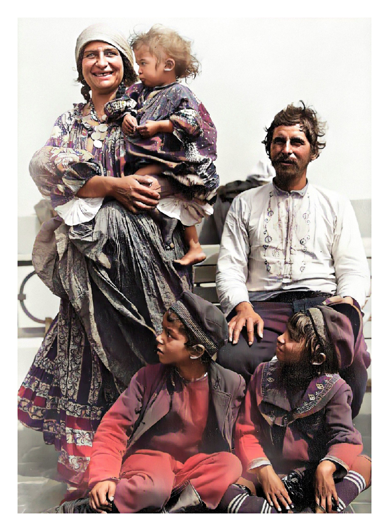
[Growing up in southern Iowa] I remember only one fear I had when I was a child. It was a fear of Gypsies. Someone said Gypsies steal little boys to work for them. Every year Gypsies would camp over-night, sometimes stay a day or two, at the Mount Vernon school grounds on the corner west of the house.

Their dark skin, black hair and long dark dresses with capes or shawls all scared me. Mom thought their dress was better to hide things they stole. She always tried to keep them out of the house. They were always coming over to get something to eat and feed for their horses.

They traveled in little buildings on wagons pulled by horses. Sometimes there might be five or six loads of them. Seemed like next morning our cows never gave as much milk. The folks always though the Gypsies had come during the night and milked the cows. The folks also thought some chickens, eggs, feed, and maybe a pig were missing after the Gypsies were gone.

Anyway, I breathed easier when they left, because then I knew three little boys they hadn’t stolen.

 ••• 

William L. Shirer, 20th Century Journey. New York: Simon and Schuster, 1976, p. 83—

[While growing up in Cedar Rapids IA] The fear of Indians by the acquisitive white settlers persisted for some time…Sometimes a stray and hungry Indian from the nearby Tama Reservation would come to the back door of our house to beg food and my worried mother would lock the doors and windows and, if the man persisted in knocking, call the police. We were brought up to believe that “the only good Indian was a dead Indian” and nothing was said to us in those days of the cruel and savage slaughter and the robbery of the Indians by the white Americans, one of the darkest sides of our history.

Monday, March 21, 2022

too late / sick, dried up, and have no strength

Vachel Lindsay album cover
Eleanor Ruggles, The West-Going Heart: A Life of Vachel Lindsay. New York: W.W. Norton, 1959—

From Cambridge, Massachusetts, the psychologist and philosopher William James acknowledged receipt of The Tramp’s Excuse and War Bulletin Number Three [which the poet Vachel Lindsay had sent him without asking]. Lindsay had read James’ The Varieties of Religious Experience, pondering it in the light of his [own] visions, and James was touched that this unknown youth should turn for “comradeship” to an academic personage like himself.

Only it was, he said, “too late, too late!”

He [James] was writing in October 1909, ten months before his death. “I am sick, dried up, have no strength to read aught but the barely needful for my own tasks, have grown, moreover, positively to hate poetry in these last years. I can only stand old poems learned by heart in my childhood and adolescence. How then should I shoot the rapids and ride the whirlwind and tramp the wilderness with you?”

James was not at all sure that he understood the “Map of the Universe.” “I do think Bulletin No. 3 anarchistic; I do think it incoherent; but I do think it may represent an excellent personal religion. Don’t enter the Catholic priesthood, whatever you do! Your semi-automatic inspirations are very interesting, in conjunction with your free attitude toward them…

“Go in peace and God be with you, brilliant being that you are, and leave me to my decrepitude.” [pp. 160-161].


•••

[Sixteen years later] In Washington [DC], in the dining room of the Wardman Park Hotel, a brown-skinned bus boy in a white jacket ignored senators and oil magnates, sidled shyly up to the wall table at which the only poet in the crowded room sat opposite his wife and laid a slim manuscript by [Vachel] Lindsay’s plate, That evening Lindsay opened his recital in the little theater of the hotel by reading the poems the boy had given him. It was the beginning of fame for the young Negro poet Langston Hughes” [p. 353].

Wednesday, March 10, 2021

alphabestiary / the moose found in his pajamas

view larger
Above Roy R. Behrens, Alphabestiary (© 2021). Digital montage.

•••

H.L. Mencken, in The American Mercury, March 1925—

The [Ku Klux] Klan is actually as thoroughly American as Rotary or the Moose. Its childish mummery is American, its highfalutin bombast is American, and its fundamental philosophy is American. The very essence of Americanism is the doctrine that the other fellow, if he happens to be a minority, has absolutely no rights—that enough is done for him when he is allowed to live at all.

Monday, October 19, 2020

How will the good people of Germany vote?

 Agnes Elizabeth Benedict, Progress to Freedom: The Story of American Education, 1942—

Whenever someone speaks with prejudice against a group—Catholics, Jews, Italians, Negroes—someone else usually comes up with a classic line of defense: “Look at Einstein!” “Look at Carver!” “Look at Toscanini!” So of course, Catholics (or Jews, or Italians, or Negroes) must be all right.


They mean well, these defenders. But their approach is wrong. It is even bad. What a minority group wants is not the right to have geniuses among them but the right to have fools and scoundrels without being condemned as a group.