Showing posts with label imagination. Show all posts

Saturday, November 25, 2023

she spent half her life in a pink chenille robe

Above Image sequence from a talk I once presented on the history of chair design, called Sitting Down with Frank Lloyd Wright.

•••

Richard Critchfield, Those Days: An American Album. New York: Dell, 1986, pp. 376—

In one corner of the dining room, by the hot-air register, was a big old Morris chair, where Betty, when she still worked at the bakery, would sit and fall asleep, she was so tired. Billy used to say, "Betty's spent half her waking life in a pink chenille robe." The stairwell to the attic was always loaded with things left there by somebody intending to take them up later: books, clothes, tennis rackets, skates, Tinker Toys, little trucks that always seemed to have a wheel missing. Like the road to hell, the stairs were paved with good intentions. 

Monday, June 19, 2023

if Vincent Van Gogh had been a dentist instead

Woody Allen, “If the Impressionists Had Been Dentists” in Without Feathers. New York: Random House, 1975, p. 199— 

Dear Theo—

Will life never treat me decently? I am wracked by despair! My head is pounding! Mrs. Sol Schwimmer is suing me because I made her bridge as I felt it and not to fit her ridiculous mouth! That’s right!… I decided her bridge should be enormous and billowing, with wild, explosive teeth flaring up in every direction like fire! Now she is upset because it won’t fit in her mouth! She is so bourgeois and stupid, I want to smash her! I tried forcing the false plate in but it sticks out like a star burst chandelier. Still, I find it beautiful. She claims she can’t chew! What do I care whether she can chew or not! Theo, I can’t go on like this much longer! . . .

Vincent

Thursday, November 24, 2022

Don Quixote / lunatics, lovers, and poets alike

Don Quixote
Above William Lake Price, Don Quixote in his Study (Photograph, 1857), National Gallery of Art.

•••

Roy R. Behrens, “Lunatics, Lovers, and Poets: On madness and creativity" in Journal of Creative Behavior Vol 8 No 4 (1975), pp 228ff—

Don Quixote has tunnel vision, by which he sees through the tunnel of love. Everything he sees relates to chivalry. It is as if he wore blinders, like Rocinante his “steed.”

He calls his neighbor a “squire.” He dons armored armour, with a cardboard visor top. He sees prostitutes as ladies. His unbridled imagination has left us with phantoms of windmills, whch are in turn synonymous with Quixote and quixotic. When he hears the “neighing of steeds, the sound of trumpets, and the rattling of drums,” his sidekick  Sancho Panza sees “nothing but the bleating of sheep and lambs.” 

Sancho Panza is conventional, while the knight-errant is errant. The “visionary gentleman” is either poetic or crazy. He confuses similarity with identity, whether by purpose or fault. A is not not-A, but inside Quixote’s mind, A and not-A merge as one. His five-and-dime descendant is the nearsighted cartoon character Mister Magoo, who (in Magoo Goes Shopping) sees and treats a rib cage (A) as if it were a xylophone (not-A), implying that musical pitch is related to the length of the ribs.…

In Magoo cartoons, Sancho Panza is Waldo. He is Watson in Sherlock Holmes. Sancho, Waldo and Watson represent unexceptional views. They know that A is A, that A is not not-A. “Look, sir,” Sancho calls out to the knight-errant, “those which appear yonder are not giants, but windmills; and what seem to be arms are sails…” more>>  

•••

Below An interpretation of Don Quixote by José Guadalupe Posada, c1908.

Monday, April 11, 2022

blind prejudice / the thing to fear is fear itself

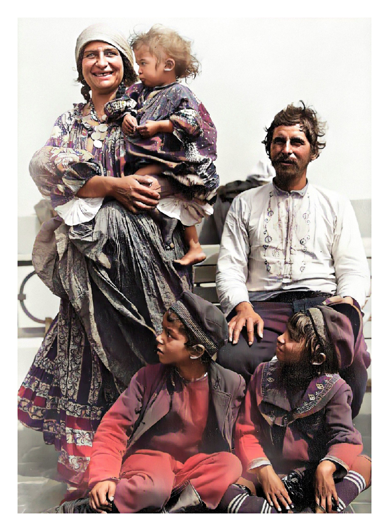
Gypsy family, public domain
Jay Partridge, A Wonderful Experience: A Memoir. Independence IA: Privately published, no date, p. 29—

[Growing up in southern Iowa] I remember only one fear I had when I was a child. It was a fear of Gypsies. Someone said Gypsies steal little boys to work for them. Every year Gypsies would camp over-night, sometimes stay a day or two, at the Mount Vernon school grounds on the corner west of the house.

Their dark skin, black hair and long dark dresses with capes or shawls all scared me. Mom thought their dress was better to hide things they stole. She always tried to keep them out of the house. They were always coming over to get something to eat and feed for their horses.

They traveled in little buildings on wagons pulled by horses. Sometimes there might be five or six loads of them. Seemed like next morning our cows never gave as much milk. The folks always though the Gypsies had come during the night and milked the cows. The folks also thought some chickens, eggs, feed, and maybe a pig were missing after the Gypsies were gone.

Anyway, I breathed easier when they left, because then I knew three little boys they hadn’t stolen.

 ••• 

William L. Shirer, 20th Century Journey. New York: Simon and Schuster, 1976, p. 83—

[While growing up in Cedar Rapids IA] The fear of Indians by the acquisitive white settlers persisted for some time…Sometimes a stray and hungry Indian from the nearby Tama Reservation would come to the back door of our house to beg food and my worried mother would lock the doors and windows and, if the man persisted in knocking, call the police. We were brought up to believe that “the only good Indian was a dead Indian” and nothing was said to us in those days of the cruel and savage slaughter and the robbery of the Indians by the white Americans, one of the darkest sides of our history.

Wednesday, October 13, 2021

palmetto bugs / as large as mice and quicker still

larger view
Above Roy R. Behrens, Swan Lake. Digital montage (©2021).

•••
In reading the following passage from the autobiography of American artist Abel Warshawsky, I was reminded of those times in my life when I have lived in parts of the country (Hawaii and the Deep South) where apartments were inhabited by huge cockroaches, as large as mice and quicker still. 

I once climbed into the shower to find one on the curtain, and, on another occasion, I was typing in the living room on a Sunday morning when something fell from the ceiling and landed on my head—I knew immediately what it was. In the South, these are politely referred to as “pametto bugs,” but when we moved to Cincinnati, we had to pay admission to see the “live insect exhibit” at the zoo, to learn that in the North they're called the “American cockroach.” Not one of my favorite things to recall.

•••


Abel Warshawsky, The memories of an American Impressionist. Kent OH: Kent State University Press, 1980, p. 34— 

[In a Paris studio] Once accustomed to the creaking wire mattress, I slept more soundly there than I have since in many a luxurious bed—this, despite the nightly incursions of roaches, which infested our building. My horror of these beasts was insurmountable. One Sunday morning, while lying on the counch, I was discussing with my companions ways and means for ridding ourselves of this pest. Glancing up at the ceiling, I saw three of the loathsome vampires. With a cry of horror I seized my shoes and started bombarding the enemy. Roars of laughter broke from my companions, The roaches had been painted on the ceiling, while I slept, for my special benefit!

Thursday, April 22, 2021

a cart, a ball, and two boxes of wooden bricks

view larger
Above Roy R. Behrens, Cavern (© 2021). Digital montage.

•••

John Ruskin (Victorian-era writer and art critic), Prataerita [Of Past Things], 1899—

…I was never permitted for an instant [as a child] to hope, or even imagine, the possession of such things as one saw in toy shops. I had a bunch of keys to play with, as long as I was capable only of pleasure in which glittered and jingled; as I grew older, I had a cart, and a ball; and when I was five or six years old, two boxes of well-cut wooden bricks.

With these modest, but, I still think, entirely sufficient possessions, and being always summarily whipped if I cried, did not do as I was bid, or tumbled on the stairs, I soon attained serene and secure methods of life and motion; and could pass my days contently in tracing the squares and comparing the colors of my carpet; examining the knots in the wood of the floor, or counting the bricks in the opposite houses; with rapturous intervals of excitement during the fillling of the water cart, through its leathern pipe, from the dripping iron post at the pavement edge; or the still more admirable proceedings of the turncock, when he turned and turned until a fountain sprang up in the middle of the street. But the carpet, and what patterns I could find in the bed covers, dresses, or wallpapers to be examined, were my chief resources, and my attention to the particulars in these was soon so accurate that, when at three and a half I was taken to have my portrait painted by Mr. [James] Northcote, I had not been ten minutes alone with him before I asked him why there were holes in his carpet.

Saturday, April 17, 2021

song, carols, hymn, chants or even a drone

view larger
Above Roy R. Behrens, Paul's New Acquisition (© 2021). Digital montage.

•••

Joseph Langland (Poetry! What in the World are You Saying?)—

I wanted to sing to you to say, not to be forgotten, that poetry is among other things, song, varied carols, hymns, chants, or even a drone. But it is verbal music; the word is its god, and the poet its worshipper. I never was much interested in helping anyone into poetry because he had exciting ideas, but the moment I find someone who is enchanted by a phrase I think that he might be trained to lift whatever he thinks into a whole holy city of the imagination.

Thursday, March 18, 2021

bereft of wonder we never know anything ever

view larger
Above
Roy R. Behrens, Wondering Eye (© 2021). Digital montage.

•••

Raphael Soyer (American painter, referring to his identical twin brother, the painter Moses Soyer) in Kathryn McLaughlin Abbe and Frances McLaughlin Gill, Twins on Twins (New York: Clarkson N. Potter, 1980), p. 53—

We looked exactly alike. People would greet me and say, “Hello, Moses,” and Moses would be greeted with “Hello, Raphael.” And I remember, a long time ago, I was walking along Fifth Avenue very briskly, and then I see Moses walking along too, and I was astounded. I mean, I didn't expect Moses to be there at that time. But it turned out to be myself, my reflection in the mirror, from far away.

•••

Ernest G. Schachtel, Metamorphosis (New York: Basic Books, 1959)—

Education and learning, while on the one hand furthering this process of discovery, on the other hand gradually brake and finally stop it completely. There are relatively few adults who are fortunate enough to have retained something of the child’s curiosity, his capacity for questioning and wondering. The average adult “knows all the answers,” which is exactly why he will never know even a single answer. He has ceased to wonder, to discover. He knows his way around, and it is indeed a way around and around the same conventional pattern, in which everything is familiar and nothing cause for wonder. It is this adult who answers the child’s questions and, in answering, fails to answer them but instead acquaints the child with the conventional patterns of his civilization, which effectively close up the asking mouth and shut the wondering eye.

Wednesday, March 10, 2021

the embalming of a suckling pig and broken vase

view larger
Above Roy R. Behrens, Confinement (© 2021). Digital montage.

•••

Jorge Luis Borges, in “The Analytical Language of John Wilkins,” Ruth L.C. Simms, translator (1942)—

[On the pages of “a certain Chinese encyclopedia,” the Celestial Emporium of Benevolent Knowledge] it is written that animals are divided into (a) those that belong to the Emperor, (b) embalmed ones, (c) those that are trained, (d) suckling pigs, (e) mermaids, (f) fabulous ones, (g) stray dogs, (h) those that are included in this classification, (i) those that tremble as if they were mad, (j) innumerable ones, (k) those drawn with a very fine camel’s hair brush, (l) others, (m) those that have just broken a flower vase, (n) those that resemble flies from a distance.

•••

Rennie Ellis (Reynolds Mark Ellis), Australian Graffiti Revisited. Melbourne AU: Sun Books, 1979—

If voting could change things, it would be illegal.

Saturday, December 12, 2020

a woman's lone journey around the world / 1890

LIFE magazine cover (August 26, 1909)
Lilian Leland, Traveling Alone: A Woman’s Journey Round the World. New York: American News Company, 1890—

Darjeeling [India] is an exceedingly pretty place, unlike anything I have seen before. It is laid in terraces on the side of the mountain. Looking down from the hotel, the streets form an interlaced and zigzag pattern. I should never know how to get to any given house in the place. It  is like one of those labyrinth puzzles that you try to get to the center of without crossing a line. The safest way is to do as Alice did in the “Looking-Glass House,” turn your back to a place, and presently you find yourself walking in at the front door.

Saturday, November 7, 2020

the notebooks of D'Arcy Wentworth Thompson

Image based on the plant photography of Karl Blossfeldt
D'Arcy Wentworth Thompson, quoted in Ruth D'Arcy Thompson, D'Arcy Wentworth Thompson, The Scholar-Naturalist (London: Oxford University Press, 1958), p . 175—

You choose some subject or other which takes your fancy, you buy a notebook and label it with the title of your theme; and you keep jotting down therein whatsoever bears upon your subject, as it comes your way, in all your reading, observation and reflection. I have had many such notebooks and some I have soon grown tired of but others have lasted and served me well ... Your subject opens out wonderfully as time goes on, it tempts you into byways, it carries you far afield; if you play the game aright it never comes to an end. It grows in interest continually, for things are interesting only in so far as they relate themselves to other things; only then can you put two and two together, and see them make four or even five, and hear them tell stories about each other. Such is science itself and such is all the knowledge that interests mankind.

Friday, June 12, 2020

the prairie as a lookalike of oceanic vastness

Full online article (1998)
Basil Hall, Travels in North America in the Years 1827 and 1828. UK: Edinburgh, Cadell and Co (1829)—

The resemblance to the sea, which some of the [American Midwestern] Prairies exhibited, was really most singular. I had heard of this before, but always supposed the account exaggerated. There is one spot in particular, near the middle of the Grand Prairie, if I recollect rightly, where the ground happened to be of the rolling character above alluded to, and where, excepting in the article of color—and that was not widely different from the tinge of some seas—the similarity was so very striking, that I almost forgot where I was. 


This deception was heightened by a circumstance which I had often heard mentioned, but the force of which, perhaps, none but a seaman could fully estimate; I mean the appearance of the distant insulated trees, as they gradually rose above the horizon, or receded from our view. They were so exactly like strange sails heaving in sight, that I am sure, if two or three sailors had been present, they would almost have agreed as to what canvas these magical vessels were carrying.

Henri Matisse, Portrait of Madame Matisse (The Green Line), 1905


Sunday, June 7, 2020

Leacock Peacock | Entrapped by duplicity now

Montage / collage website
Stephen Leacock, Humor: Its Theory and Techniques, with Examples and Samples (New York: Dodd, Mead, 1935)—

He is the [jack]daw with a peacock's tail of his own painting. He is the ass who has been at pains to cultivate the convincing roar of a lion.

Saturday, March 28, 2020

A thud of consonants | an upholstery of tears

Roy R. Behrens © altered book collage (1992)
Above Roy R. Behrens, collage, mixed media, altered book. Private collection.

•••

Anatole Broyard, Aroused by Books [his dismissal of the poetry of Dylan Thomas]—

Such a fatigue of adjectives, a drone of alliterations, a huffing of hyphenated words hurdling the meter like tired horses. Such a faded upholstery of tears, stars, bells, bones, flood and blood…a thud of consonants in tongue, night, dark, see, wound and wind.

Thursday, March 12, 2020

A designer remembers the writer Guy Davenport

Remembering Guy Davenport
Guy Davenport was an American essayist, fiction writer, poet, translator, painter, illustrator, university scholar and professor, and a recipient in 1992 of a "genius award" from the MacArthur Foundation. For more than a decade, he and I exchanged letters of a length of one or two pages, sometimes as often as weekly. I saved all his letters, with copies of nearly all of mine. To correspond with him for so many years was among the wisest things I’ve done. Yet in truth, it was always exhausting since the intensity of his letters was forever a woeful reminder that I was writing not simply to an ordinary person but to a remarkably talented man whose powers of observation were astonishing at very least. more>>>

Saturday, June 8, 2019

Henry Miller | As blind drunk as Mister Magoo

Henry Miller, as photographed by Carl Van Vechten (1940)
Dan Davin, Closing Times. London: Oxford University Press, 19175, p. 131—

[Welsh poet Dylan Thomas] told me a burlesque story of meeting [American novelist] Henry Miller in London. After a prolonged session in the pubs they went to a little dairy in Rathbone Place which served sandwiches and which I well remember as being a very simple, clean, unpretentious place. But Miller was drunk and also extremely short-sighted. He was convinced that Dylan had taken him to a brothel and that the plain uniforms and innocent bearing of the waitresses were the last word in lubricious sophistication. Dylan had great difficulty in averting calamity and never succeeded at all in convincing Miller that he was mistaken. We speculated on how many similar misunderstandings might underlie the exploits so boringly recounted in [Miller’s] Tropic of Capricorn and Dylan went on to improvise a new work of Miller’s of which the dairy was the transmuted center and in which Miller played a grotesquely comical role, rather like Mr. Magoo.

Also, see an earlier post about Anthony Burgess’ comparison of himself to Mr. Magoo. I am also reminded of Buckminster Fuller’s account of his impaired vision as a child—

I was born cross-eyed. Not until I was four years old was it discovered that this was caused by my being abnormally farsighted. My vision was thereafter fully corrected with lenses. Until four I could see only large patterns, houses, trees, outlines of people with blurred coloring. While I saw two dark areas on human faces, I did not see a human eye or a teardrop or a human hair until I was four. Despite my new ability to apprehend details, my childhood's spontaneous dependence only upon big pattern clues has persisted.…

Monday, April 15, 2019

I Could Be Bounded in a Nutshell

© Roy R. Behrens
William Shakespeare, Hamlet—

I could be bounded in a nutshell, and count myself a king of infinite space, were it not that I have bad dreams.

Tuesday, January 22, 2019

Charles Henry Bennett / Shapeshifting Cat

C.H. Bennett, Poor Puss (1863)
Above One of a series of elaborate comic metamorphoses (aka shapeshifting) created by Victorian-era British illustrator Charles Henry Bennett (1863) in sardonic reference to Charles Darwin's theory of natural selection, this one titled "Poor Puss." Courtesy The Wellcome Library.

•••

The Reverend Benjamin Newton (Vicar of Landwit), Diary (September 1, 1816)—

An entertaining German dined here who teaches the girls music and plays delightfully and sings well with no voice having been shot through the lung. A Mr. Causer having been bit in a drunken frolic by a man of the name of Shipley in the leg last week is obliged to suffer amputation. During an armistice in which the Prussian and French officers were drinking together a son of [Prussian Field Marshall] Blücher gave for a toast the King of Prussia, which a French officer would not drink and soon after when it came to his turn gave [Napolean] Bonaparte which young Blücher would not drink, on which the officer went up to him and without saying anything struck him a smash in the face. Blücher said nothing but went out of the room and returned immediately with a pair of pistols, with one of which without uttering a word he shot the officer dead and then held up the other and said he had that ready for any man who would take up the quarrel. This came to his father's knowledge, who put him under arrest for six weeks.

Charles Henry Bennett / Shapeshifting Dog

C.H. Bennett, Good Dog (1863)
Above One of a series of elaborate comic metamorphoses (aka shapeshifting) created by Victorian-era British illustrator Charles Henry Bennett (1863) in sardonic reference to Charles Darwin's theory of natural selection, this one titled "Good dog." Courtesy The Wellcome Library.

•••

The Reverend Francis Kilvert, Diary (July 22, 1871)—

Mrs. Nott told me that Louie of the Cloggau was staying in Presteign with her aunt Miss Sylvester, the woman frog. This extraordinary being is partly a woman and partly a frog. Her head and face, her eyes and mouth are those of a frog, and she has a frog's legs and feet. She cannot walk but she hops. She wears very long dresses to cover and conceal her feet which are shod with something like a cow's hoof. She never goes out except to the Primitive Methodist Chapel. Mrs. Nott said she had seen this person's frog feet and had seen her in Presteign hopping to and from the Chapel exactly like a frog. She had never seen her hands. She is a very good person. The story about this unfortunate being is as follows. Shortly before she was born a woman came begging to her mother's door with two or three little children. Her mother was angry and ordered the woman away. "Get away with your young frogs," she said. And the child she was expecting was born partly in the form of a frog, as a punishment and a curse upon her.