Showing posts with label surrealism. Show all posts

Monday, August 10, 2026

lingering memory traces of artist Salvador Dali

Dreams of Fields
Above
Book cover for Dreams of Fields: Memory Traces of Iowa's Past, essays by Roy R. Behrens. Ice Cube Press, 2025. The portrait on the cover is that of surrealist artist Salvador Dali, who spoke at the University of Northern Iowa in 1952, as described in one of the essays.

•••

James Thurber

The naked truth about me is to the naked truth about Salvador Dali as an old ukulele in the attic is to a piano in a tree, and I mean a piano with breasts.

Sunday, March 29, 2026

dream-like substitutions / Guiseppe Arcimboldo

Arcimboldo, Fruit Basket (upsidedown reversible)
During all the years I taught university-level art and design (about 45 years), among the most pleasurable aspects was the process of inventing hands-on studio exercises which I presented to students to solve. 

Everyone was given the same problem, but the solutions that resulted were invariably different, often surprisingly. Each problem was presented to the assembled group, but each student worked alone on his / her answer. No one knew what the other would do until the day of the critique, at which time everyone's work was revealed.

The problems were sometimes derivative of certain kinds of imagery, which often as not were indebted to historical styles of art. In one of those problems for example (of which five responses are reproduced below), which I presented to freshmen, I gave a prefatory talk about the portrait paintings of the Italian Mannerist artist Giuseppe Arcimboldo (1527-1593), one of which is shown in the reproduction above.

In the Modern era, it was often claimed that Arcimboldo had anticipated the dream-like qualities of Surrealism, since the bulk of his paintings consist of surprising portraits that were made by combining bits and pieces of non-portraits, such as plants, animals, flowers, fish, and so on. Using cut-out fragments of magazine photographs (this predates the use of computers), the students were instructed to devise comparable portraits.

Five of those are shown below. I regret that so many years have passed that I no longer have a record of the names of the students who made these.


Wednesday, November 16, 2022

Willi Baumeister cartoon / Hitler in electric chair

Schlemmer (left) and Baumeister
Above Margrit Baumeister, Oskar Schlemmer and Willi Baumeister 1929 in Frankfurt am Main.

Willi Baumeister, in Hellmut Lehmann-Haupt, Art under a dictatorship. New York: Octagon Books, 1973, page 87—

My friends in Wuppertal, Oskar Schlemmer among them, sent me humorous letters and postcards from time to time, with paste-up pictures and surrealist texts. I sent them, rather naively, a cartoon, cut from a US newspaper, of an electric chair with Hitler on it. Suddenly I was summoned to Gestapo Headquarters. I was confronted by the Gestapo censor with my entire correspondence for the last year and a half. Thank God, Hitler in the electric chair was not among the intercepted letters. I extricated myself by writing a long report to the Gestapo, explaining that these were plans for a book dealing with color modulation and patina, in connection with an especially resistant paint for the camouflaging of tanks and pill boxes.

Wednesday, February 3, 2021

a modern art museum, telephone and a martini

Donald Barthelme
(in “Brain Damage” in City Life, 1976)—

The Wapituil are like us to an extraordinary degree. They have a kinship system which is very similar to our kinship system. They address each other as “Mister,” “Mistress,” and “Miss.” They wear clothes which look very much like our clothes. They have a Fifth Avenue which divides their territory into east and west. They have a Chock Full o’ Nuts and a Chevrolet, one of each. They have a Museum of Modern Art and a telephone and a martini, one of each. The martini and the telephone are kept in the Museum of Modern Art. In fact they have everything that we have, but only one of each thing... They can conceptualize but they don't follow through. For instance, their week has seven days—Monday, Monday, Monday, Monday, Monday, Monday, and Monday. They have one disease, mononucleosis. The sex life of a Wapituil consists of a single experience, which he thinks about for a long time.

Sunday, October 25, 2020

the chess piece could no longer be moved—

Man Ray, Self-Portrait (Boston: Llttle Brown, 1963), p. 237—

After dinner, [Marcel] Duchamp would take the bus to Nice to play at a chess circle and return late with Lydie [his first wife] lying awake waiting for him. Even so, he did not go up to bed immediately, but set up the chess pieces to study the position of a game he had been playing. First thing in the morning when he arose, he went to the chessboard to make a move he had thought out during the night. But the piece could not be moved—during the night Lydie had arisen and glued down all the pieces...A few days later Duchamp and Lydie divorced, and he returned to the States.

Artwork by Marcel Duchamp with Man Ray (1921)


Thursday, July 30, 2020

Catacombs of the Capuchins in Palermo, Italy

Patrick Brydone
, A Tour through Sicily and Malta: in a series of letters to William Beckford, Esq., of Somerly in Suffolk, from P. Brydone, F.R.S., 1773. English Edition: New York: Evert Duyckink, 1813—

This morning we went to see a celebrated convent of Capuchins, about a mile without the city; it contains nothing very remarkable but the burial place, which indeed is a great curiosity. This is a vast subterraneous apartment, divided into large commodious galleries, the walls on each side of which are hollowed into a variety of niches, as if intended for a great collection of statues; these niches, instead of statues, are all filled with dead bodies, set upright upon their legs, and fixed by the back to the inside of the niche: their number is about three hundred: they are all dressed in the clothes they usually wore, and form a most respectable and venerable assembly. The skin and muscles, by a certain preparation, become as dry and hard as a piece of stock-fish; and although many of them have been here upwards of two hundred and fifty years, yet none are reduced to skeletons; the muscles, indeed, in some appear to be a good deal more shrunk than in others; probably because these persons had been more extenuated at the time of their death.

Here the people of Palermo pay daily visits to their deceased friends, and recall with pleasure and regret the scenes of their past life: here they familiarize themselves with their future state, and choose the company they would wish to keep in the other world. It is a common thing to make choice of their niche, and to try if their body fits it, that no alterations may be necessary after they are dead; and sometimes, by way of a voluntary penance, they accustom themselves to stand for hours in these niches…


I am not sure if this is not a better method of disposing of the dead than ours. These visits must prove admirable lessons of humility; and I assure you, they are not such objects of horror as you would imagine: they are said, even for ages after death, to retain a strong likeness to what they were when alive; so that, as soon as you have conquered the first feeling excited by these venerable figures, you only consider this as a vast gallery of original portraits, drawn after the life, by the most just and unprejudiced hand. It must be owned that the colors are rather faded; and the pencil does not appear to have been the most flattering in the world; but no matter, it is the pencil of truth, and not of a mercenary, who only wants to please.


Monday, February 10, 2020

Salvador Dali's Dreams of Iowa Fields in 1952

Few people know the story about the visit of surrealist artist Salvador Dali to the University of Northern Iowa campus (Iowa State Teachers College at the time) in February 1952. Not surprisingly, it has moments of hilarity. An updated version (enlarged and redesigned) is now available online at this link.

Sunday, December 8, 2019

Arcimboldo portrait | Do you carrot all for me?

Above A reversible painting (view top side up or upside down) by the Italian master Giuseppe Arcimboldo (c1526-1593), especially known for his portrait heads comprised of visual pun arrangements of fruits, vegetables, flowers and so on. This one is referred to as Reversible Head with Basket of Fruit. c1590. Oil on panel.

•••

Anon
Do you carrot all for me?
My heart beets for you,
With your turnip nose
And your radish face.
You are a peach,
If we cantaloupe,
Lettuce marry;
Weed make a swell pear.

Tuesday, December 4, 2018

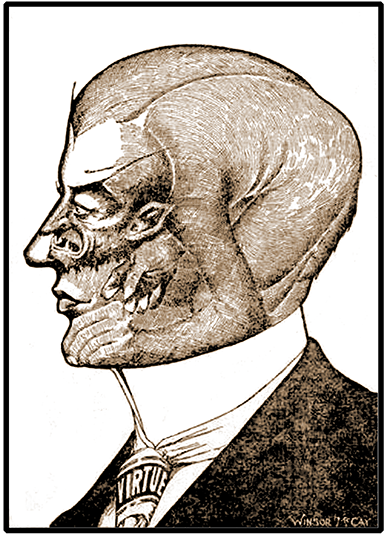
Winsor McCay | Brute in the Brain Illustration

The Brute in the Brain by Winsor McCay
Above An early uncharacteristic illustration by legendary comic page illustrator Winsor McCay, titled "The Brute in the Brain" (date and source unknown).

•••

Cornelius Weygandt, On the Edge of Evening: The Autobiography of a Teacher and Writer Who Holds to the Old Ways (New York: G.P. Putnam's Sons, 1946), p. 107—

In 1902 we went to Ireland…As we got off the ship there were women selling gooseberries on the quay. I had often heard of the proficiency in bad language of alewives. I was now to hear it. It was the time of the Boer War. A Tommy came by with a hat about the size of a teacup on one side of his head and the strap from it around under his chin to hold it in place. He said to the woman with the gooseberries, "Mother, how much the gooseberries?"

"You blank blank bastard of a blankety blank blank. I'm not your mother, and you may be very sure that I wouldn't have been. I'd have no child by a man that would get the like of you." And more of the same. And more of the same. I had been told by numerous kindly Irish people that the gooseberries in Ireland were as big as English walnuts in America. It is true they were. I was waiting for the old woman to show her dexterity by driving them at the offending Tommy, but she didn't. They were, I suppose, too previous. I had been intending to buy some, but she lost the sale. I was too afraid of what she might say to me to offer to buy any of them.

Sunday, March 22, 2015

Art History Poster | Olivia Jaschen

Art History Poster © Olivia Jaschen (2015)
Above Poster by Olivia Jaschen, graphic design student, Department of Art, University of Northern Iowa (2015), announcing a Call for Papers for the 5th Annual Art History Symposium at the same school on April 10, 2015.

•••

Lady Dorothy Nevill—

Guinea pig, there's a tasty dish for you, but it was always a job to make your cook do it. They want bakin' same as the gypsies serve the hedgehogs. I tried eatin' donkey too, but I had to stop that, for it made me stink.

•••

Charles Dickens, The Pickwick Papers—

Miss Bolo rose from the table considerably agitated, and went straight home, in a flood of tears and a sedan chair.

•••

Anon—

I'm not an actor. I just play one on tv.

Sunday, December 27, 2009

When Dali Came To Iowa

In 1952, Salvador Dali gave ten presentations at schools and museums in the US, beginning with a lecture on "Revolution and Tradition in Modern Painting" at the Iowa State Teachers College (now the University of Northern Iowa) in Cedar Falls, on the evening of Wednesday, February 6. His visit had been arranged by Herbert V. Hake, chairman of the college's Lecture-Concert Series Committee, who had chosen Dali as a replacement for Edward R. Murrow, the celebrated CBS new analyst, who was unable to appear. More…

Friday, December 25, 2009

Ballast Reviews | Leonora Carrington

Leonora Carrington: Surrealism, Alchemy and Art by Susan L. Aberth. Burlington VT: Lund Humphries, 2004. 160 pp., with 115 illus., color and b&w. Clothbound. ISBN 0-85331-908-1.

Reproduced in this book is a famous photograph, taken in New York in 1942, of a group of mostly European artists, in "exile" in the US. They are arranged in three rows, in a quietly comical manner: Everyone in the back row faces left, those in the center face right (with one exception), and those in the front row face whatever direction they like. Of the fourteen artists in the photograph, eleven are men, but, as if to anticipate recent concerns about gender inequality, each row contains one woman, including Peggy Guggenheim (of Guggenheim Museum fame), Berenice Abbott (the famous photographer), and a largely obscure painter named Leonora Carrington. More…