To be truthful, not all the midwestern engagements of Buffalo Bill’s Wild West were free of controversy. The most egregious example occurred in Prairie du Chien, Wisconsin, on the night of August 20, 1900.…
The full story is told in a new book by Roy R. Behrens, titled DREAMS OF FIELDS: Memory Traces of Iowa’s Past (Ice Cube Press 2025).
Saturday, August 23, 2025
Buffalo Bill's riotous night in Prairie du Chien
Monday, February 3, 2025
Buffalo Bill look-alike becomes an airborne hero
The wannabe impersonator, who ended up adopting the name of Colonel Samuel Franklin Cody, eventually moved to Europe, where he became the British equivalent of the Wright Brothers—that is, he invented some of the first powered aircraft, and piloted what is considered to be the first airplane flight in England. You can find the entire story in the February 2025 issue of The Iowa Source (Fairfield IA), but it’s also online here.
Monday, January 10, 2022
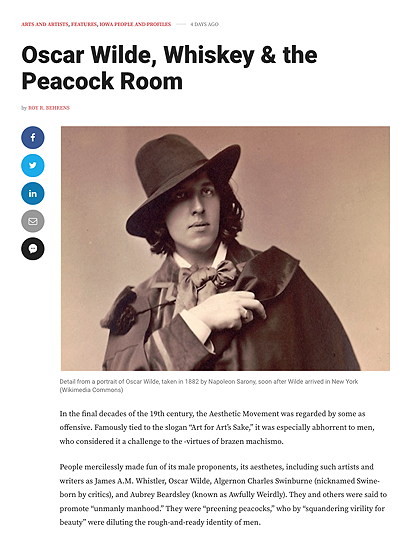
Oscar Wilde, Aestheticism, Whiskey & Peacocks
Monday, February 22, 2021
his pistol shot caused the weather vane to clang
![]() |
•••
Robert Conot (recalling an incident in the life of Thomas A. Edison), A Streak of Luck. New York: Seaview Books, 1979, p. 118—
It was a case of the famous ogling the famous. One evening after he [Edison] and Fox, who roomed together, had gone to bed, a thunderous knock on the door shook them upright. In strode "Texas Jack" [John Wilson Vermillion, aka "Shoot-Your-Eye-Out" Vermillion], the top of his head brushing the door frame, his eyes bloodshot, and his hands on his gunbelt. Which one, he wanted to know, was Edison? When Edison manfully identified himself in a quavering voice, Texas Jack said it was a pleasure: he himself was the boss pistol shot of the West, and he wanted to meet the great inventor of the phonograph. Whereupon he pulled out his six-shooter and, firing through the window, caused the weather vane across the street to clang into a dizzy spin.
Thursday, September 10, 2020
Ways to remain engaged during a pandemic
The feature article below was published earlier today in the Waterloo and Cedar Falls Courier (Waterloo IA). The full text and photos can be accessed online here.
Friday, August 21, 2020
The Iowa Exploits of Buffalo Bill Cody
Iowa-born Wild West showman William Frederick Cody, famously known as Buffalo Bill, was fortunate not to have witnessed the final years of the Great War. He died on January 10, 1917, in Denver, Colorado, at age 70. His funeral was a major news event, as admirers worldwide mourned his passing. Ironically, despite the on-going conflict, condolences for his death were sent by both England’s King George V and Germany’s Kaiser Wilhelm II.
Cody’s death was undoubtedly fresh in American minds on March 6, 1917, less than two months after the funeral. On that day, according to an article in the Marshalltown (Iowa) Times-Republican, a group of Iowa youngsters, who were walking down the street in Cedar Falls…more>>>
Tuesday, June 27, 2017
Mary Snyder Behrens | White Wish
![]() |
| White Wish (2005) © Mary Snyder Behrens |
•••
Owen Wister (author of The Virginian) as quoted in Fanny Kemble Wister, ed., Owen Wister Out West: His Journals and Letters. University of Chicago Press, 1958—
They had a dance somewhere [in Texas]—one of the regulation dances where the babies are all brought and piled in a corner while their parents jump about to music. After the thing had got going full swing, some unknown person got the babies and changed all their clothes—putting the linen of Mrs. Jone's little boy upon Mrs. Smith's little girl, and so on. In the dim light nobody noticed, and all went home with the wrong baby. Next morning there was the devil to pay, and for a week the whole countryside was busy exchanging and identifying babies [p. 158].
•••
Texas life breeds sayings and doings enough to fill a volume. For instance, on the road to Brownwood there used to be a sign: "See Cross-eyed Jim before you sell your hides." The gentleman himself put it up, as that was the name he was known by; but today he would not care to have you call him by it, for he has become civilized. It is Texas fashion if any man has a deformity to name him accordingly. One Ace Brown had a hump back and was known as "Camel." A man lame from being shot in the leg is "Crip" Jones [p. 153].
Tuesday, February 28, 2017
Buffalo Bill: Never Missed and He Never Will
![]() |
| Montage © Roy R. Behrens 2017 |
•••
William F. Cody (1846-1917), better known as “Buffalo Bill,” was born near Le Claire, Iowa, in Scott County, just north of Davenport. By the end of his life, he had become what some have called “the most famous American in the world.”
He had been a Pony Express rider, an Army scout, a buffalo hunter for the railroad, and the founder and central attraction of Buffalo Bill’s Wild West show, which traveled throughout the US and in Europe for thirty years. This talk is an overview of Cody’s life, both tragic and heroic. It was tragic because of the role he played in the near extinction of the American Bison (he himself is said to have killed nearly 3000 buffalo in eight months), and, more deplorable, in the subjugation of Native Americans.
If his life was heroic, it was because of his later support of the rights of Native Americans, his friendship with many of them (most notably with Sitting Bull), and his link with such colorful characters as Annie Oakley and Wild Bill Hickok. As a Wild West performer, it is thought that Cody probably played to a collective audience of more than 50 million, including at various Iowa towns. This is a face-paced and entertaining 60-minute talk, illustrated by projected vintage photographs, film clips and animated graphics.
Thursday, July 23, 2015
Buffalo Bill Cody in Cedar Falls IA in 1912
![]() |
| Greetings from Buffalo Bill |
Claud R. Wynegar, The Century and I: Memories of Cedar Falls and Beyond. Pacific Palisades CA: Seamount Publications, 1999, p. 51—
I do not remember the year [it was 1912], but I was a small boy when the Buffalo Bill and Pawnee Bill Circus came to town. They put up their tents out West First Street in Mularkey's pasture [sic, Mullarky's pasture, now called Riverview Park, at Ellen Street and South Park Road]. It was in the summer. I was alone and I got to the grounds early. I had a seat in the open air tent to watch the "battles" between the white men and the Indians, and a lot of fancy riding and roping of horses.
Buffalo Bill was on a horse with a shotgun. Someone ahead of him would throw a glass ball into the air and he would shoot at it and break it into small pieces. There was number of tents. I looked into all of them. It was a show a bit difficult to describe. There were a few wild bison, quite a few cowboys, Indians in native costumes, a few concessions where souvenirs were sold and food stands. It was the first circus I ever saw.
Later in the afternoon my mother drove out in our buggy to get me. While looking for me she met Buffalo Bill and had a nice visit with him. No doubt that was the beginning of my interest in the American West, and it has always stayed with me. I own some Remington bronzes, some western pictures and books about the people who were part of that era.
Tuesday, June 9, 2015
Buffalo Bill in Cedar Falls IA | 1917 Double Bill
![]() |
| William F. Cody shaking hands |
•••
My father was born in northeastern Iowa in 1901. Buffalo Bill was still touring the country in those years, appearing with his traveling show. He performed in Cresco and Decorah, one time each, which may account for my father's memory of having actually attended a Wild West performance. Cody died in January 1917, two months before the following news article appeared in an Iowa newspaper—
Anon, BILL CODY'S DOUBLE: Col. Curt L. Alexander, of Nebraska, Startles Cedar Falls Lads in the Marshalltown Times-Republican (Marshalltown IA), March 6, 1917—
"Gee! Buffalo Bill ain't dead! Look, fellers!"
That's the way a small boy directed a bunch of his fellows to Col. Curt L. Alexander, of Hastings, Neb., walking the streets of Cedar Falls (IA) today. And a small army of boys greeted him every time he appeared.
Colonel Alexander is an exact "double" of the late Col. W.F. Cody, from his flowing hair, moustache, goatee and big sombrero to the tips of his cowboy boots. He is here visiting his nephew, Lloyd Alexander, a prominent clothing merchant, while en route home from Chicago.
Besides looking enough like the famous "Buffalo Bill" to have been his twin brother, Colonel Alexander is an old plainsman and scout and as much like Colonel Cody in his habits. In fact, he was a lifelong intimate friend of "Buffalo Bill," working with him as a freighter across the plains when the west was young and in later years traveling for weeks at a time with Colonel Cody's great wild west show, where his remarkable likeness to his friend caused many amusing situations to arise.
•••
Since first posting the above news excerpt, we have also found an article by David Whitsett, titled A CEDAR FALLS STOP: Four US Presidents, MLK Among Famous Visitors to Town, in the Cedar Falls Times (May 1, 2013), which is online here. It tells the story of the one occasion in which Buffalo Bill performed with the Wild West in Cedar Falls on August 31, 1912. Here is the excerpt pertaining to that—
[Cedar Falls resident] Stella Wynegar recalled that his [Cody's] crew set up their tents in “Mullarkey’s pasture,” which was on the northwest corner of Cedar Falls. She says that she and her son, Claude, did not attend the show but that they “were wandering around the grounds after his show, and Buffalo Bill came up and talked with us. He asked about our family and told us about his life and where he’d been. He was very interesting and very nice.”
Another Cedar Falls resident, Marie Cook, also recalled Buffalo Bill’s visit. She remembered that she and her family were living on West First Street near where his show was set up, “He came walking along and saw the chickens in our yard. He offered my grandma $1.50 to cook a chicken dinner for his troupe and she did it!”
Both Marie and Stella also remembered that Annie Oakley was one of the stars of the Wild West Show when it was here. She was, perhaps, America’s first female superstar. She was a true sharp shooter who could split a playing card edge-on with her .22 rifle and put several holes in it before it hit the ground.
NOTE: There is a Wynegar Oral History Collection (Manuscript Record Series MsC-18) in the Special Collections and University Archives holdings at the Rod Library, University of Northern Iowa.
Friday, October 3, 2014
Saturday, June 23, 2012
Ping Pong and Indian Haircuts
Above Illustrations of Native American boys' haircuts, according to designated clan, from Francis La Flesche, "The Osage Tribe: Child Naming Rite" in 45th Annual Report, Bureau of American Ethnology (1925-26), Washington DC, 1928. Top row (left to right): Head and tail of elk; head, horns and tail of bison; tuft of hair on bison's back. Second row: Head, body and tail of small birds; head, wings and tail of eagle; turtle shell, with head, feet and tail. Third row: Reptile teeth; a compass, showing four directional points; shaggy side of the wolf. Bottom row: Horns and tail of bison; head and tail of deer; and head, tail and immature horns of a young bison.
...
Until recently, I had no idea that the Lakota Indians who performed in Buffalo Bill's Wild West show enjoyed playing ping pong. For more about this, check out the online photos of one of their games at the Denver Public Library's website. The spectators are other Wild West performers, including Mexican vaqueros, Russian Cossacks, US cavalrymen, cowboys, a Rough Rider, and other Native Americans. Seated in the center behind the table is a man in a suit who is holding up paper money, so presumably there was some gambling involved.
...
In 1893, concurrent with the Columbian Exposition or the Chicago World's Fair (but not officially part of it), the Wild West played in Chicago from May through October. There is a detailed account of what happened during the show's single most profitable season in L.C. Moses, Wild West Shows and the Images of American Indians 1883-1933 (Albuquerque NM: University of New Mexico Press, 1996). Here's an excerpt (p. 140)—
That season, Cody's Show Indians made good money, toured Chicago, took boat rides on Lake Michigan, ate peanuts and popcorn until they could eat no more, bought boutonnieres and funny coconut-fiber hats and wore them proudly, and on one occasion rode the merry-go-round [a carousel with wooden horses] by the hour. One evening in the high summer of Chicago's White City, fifteen Lakota led by Rocky Bear and No Neck mounted the painted ponies. As the carousel picked up speed, No Neck, holding the reins in both hands, gave a full-throated yell. Others in his party joined him. The News-Record placed the scene in its proper context. The Show Indians, observed the Record, "seem to like being jerked around on a carousel. They prefer it to the art galleries, and some people who are not Indians feel the same way." In all, about twenty-seven million people, a few hundred Indians among them, visited the fair. Most, Indians and non-Indians alike, probably had a glorious time.
Saturday, June 16, 2012
Why Sitting Bull Wore Goggles
| O.S. Goff, Sitting Bull (1881). Courtesy Library of Congress. |
Wednesday, June 13, 2012
Wild West, Hot Dogs and Gertrude Kasebier
![]() |
| Gertrude Kasebier, Portrait of Charging Thunder (1898) |
Above A studio portrait of a Native American (Lakota) named Charging Thunder, as photographed by Gertrude Kasebier (1852-1934) at her Fifth Avenue Studio in New York.
Kasebier had studied with Arthur Wesley Dow (whose theory of composition also influenced Georgia O'Keeffe), and was associated with O'Keeffe's partner Alfred Stieglitz and the Photo-Secession. After attending the Wild West show in Brooklyn, she secured permission from Buffalo Bill to photograph a group of the Wild West show Indians in her studio.
The photography session took place on Sunday, April 24, 1898. It lasted for three hours, during which the guests were served with tea and hot dogs ("hot frankfurters between unbuttered bread"). It isn't certain, but apparently one of Kasebier's guests was Charging Thunder (shown in the Kasebier portrait above). Details about the session and a selection of the portraits can be found in Michelle Delaney, Buffalo Bill's Wild West Warriors: A Photographic History by Gertrude Kasebier (New York: Harper Collins, 2007).
There seems some confusion about whether there might have been two performers named Charging Thunder. The person in this photograph appears in another photograph (also taken by Kasebier) with his Native American wife. However, elsewhere online, we have found a story (with photos) of another Lakota Indian named Charging Thunder (they certainly don't look like the same person), who was part of the Wild West troupe when they performed in Salford, England, in 1903. This second Charging Thunder, who was 26 years old at the time, had fallen in love with one of the show's horse trainers, a woman named Josephine, and when the Wild West left town, the two of them remained in the UK, married and raised a family. For the rest of their lives, they lived in the vicinity of Manchester. Charging Thunder changed his name to George Edward Williams, registered as an immigrant, and worked for many years at the Belle Vue Zoological Gardens, where he took care of the elephants. According to BBC Manchester, two of his grandchildren have recently been located in the UK.
It's nice to see the Kasebier photo of the first Charging Thunder with his dog. Back then, it was commonly rumored that some of the Native Americans considered dog meat a delicacy. Here for example is a paragraph from the New York Times (Thursday, June 28, 1888, p. 2)—
WHERE DOGS ARE DISAPPEARING: The refining influence of civilization has not lessened the strong taste that Buffalo Bill's Wild West Indians have for dog flesh, and the canine population of Staten Island is rapidly diminishing. New Shirt yesterday devoured with apparent relish an expensive poodle that had been used to much better treatment than it received at the hands of the fighting warrior. The show is still drawing large crowds.