 |
| Exhibition catalog design © 2005 by Roy R. Behrens [entire catalog online] |
Friday, December 31, 2010
Artist Mary Snyder Behrens | Exhibition Catalog


Thursday, December 30, 2010
Donfé Ca-Choo | Book Collage
 |
| Roy R. Behrens©, Donfé Ca-Choo (1997). Book collage. Collection of Luther College. |
Native Tongue | Digital Montage
 |
| Roy R. Behrens ©, Native Tongue (c2008). Digital montage. Collection M&J McLaughlin. |

Wednesday, December 29, 2010


Saturday, December 25, 2010
William James | Collage Portrait
 |
| Roy R. Behrens, Portrait of William James (1981). Collage w/colored pencil.© |
Mon Dieu | Book Collage
 | |
| Roy R. Behrens, Mon Dieu (1993)©. Book collage, 6.5 x 9 in. Walter Hamady Collection. |
Thursday, November 25, 2010
Henny Youngman in Alaska
Here's an old Henny Youngman joke—
A priest is assigned to Alaska. A year later, the bishop goes up to visit him. The bishop asks, "So how do you like it up here?" The priest answers, "I tell you, if it wasn't for my Rosary, and two martinis a day, I'd be in pretty sad shape. Speaking of which, would you yourself like a martini, Father?" "Ah, but of course," the bishop replies. And the priest yells out to the kitchen, "Rosary, bring the bishop a martini!"
A priest is assigned to Alaska. A year later, the bishop goes up to visit him. The bishop asks, "So how do you like it up here?" The priest answers, "I tell you, if it wasn't for my Rosary, and two martinis a day, I'd be in pretty sad shape. Speaking of which, would you yourself like a martini, Father?" "Ah, but of course," the bishop replies. And the priest yells out to the kitchen, "Rosary, bring the bishop a martini!"
Making Books
From Ned Rorem, Lies: A Diary (Cambridge MA: Da Capo Press, 2002), p. 29—
Nice anecdote about Peter Benchley and the not-too-bright brother of Mr. Glidden who sometimes sits behind the cash register at the Glidden's Fish Store.
The brother: "Hear you make books."
Peter B: "Well, I write the words. Other people set the type, bind the pages, design the cover."
Glidden's brother (losing interest): "Oh, you have help."
Monday, November 22, 2010
Ruari McLean's Landlady
Here is a wonderful story by British typographer Ruari McLean from his "typographical autobiography" True to Type (New Castle DE: Oak Knoll Press, 2000)—
When I returned, the room was exactly as it had been before my ministrations, except that Mrs. Buchsieb was standing in the middle of it looking like a dive-bomber about to strike.
When I got back to Bradford [England, after visiting the austere Modernist apartment of typographer Jan Tschichold] from Basel, I found that the room I rented from Mrs. Buchsieb contained too many ornaments. I began counting them, and found that the room itself contained one hundred and thirty-six objets d'art and eighty-nine pictures, prints, calendars, plates, mirrors, and texts on the walls. I decided I could stand it no longer. I placed all the vases in queue on the piano beside the door as a sign for their removal, and put a lot of other stuff out of sight, leaving the mantel shelf quite bare. I stood back to admire the effect, thought enviously of Tschichold's room in Basel, left a box of my own matches looking rather like a night watchman's hut on a slum clearance site, and went out to post a letter and have a drink.
Henry Moore on Shut-Eye Golf
 |
| Eric Ravilious, May. Woodcut, 1925. Public domain image. |
British sculptor Henry Moore, in a conversation about his friend Ben Nicholson (who was very good at shut-eye golf) in Maurice de Sausmarez, ed., Ben Nicholson: A Studio International Special (London: Studio International, 1969), p. 24—
Ah yes, shut-eye golf. That was introduced and I think invented by [British artist] Eric Ravilious. On this large sheet of paper you drew an imaginary golf course with a variety of obstacles—e.g., a dog, a tree, a cow, a bandstand, a duck pond and so on—and then you'd put a few extra bunkers in; it was a golf course in plan. Then you put the point of pencil in hole 1, had a good look at the course and where hole 2 was, and what obstacles lay between, then you had to close your eyes and attempt to draw a line to hole 2, without the line touching any drawn obstacle. Sometimes you did it in one, but more often at ones first shot ones line touched a tree, or bunker, or ended up far away from the hole—one had to play a second, a third and so on until the pencil rested plumb in the hole. You could play a nine-hole course, or eighteen holes, and as in real golf the least score was the winner.
James Watson: Avoid Dumb People
 |
| Dust jacket of Mastery, designed by Bill Stanton |
From an interview with Nobel Prize-winning molecular biologist James D. Watson (co-discoverer of the structure of DNA) in Joan Evelyn Ames, Mastery: Interviews with Thirty Remarkable People (Portland OR: Rudra Press, 1997), p. 69—
My chief piece of advice to a young person is go to a place where people are bright. That is, avoid dumb people—those people who can't give anything to you—and turn to people who are brighter than yourself.
Friday, November 19, 2010
Alec Guinness, Hiccups and the Pope
In an autobiography, British actor Alec Guinness (aka Obi-Wan Kenobi in Star Wars) recalled a very odd audience with the Pope in Blessings in Disguise (Pleasantville NY: Akadine Press, 2001), p. 46—
[In 1958, four days before the death of Pope Pius XII, British actor Alec Guinness was allowed to join an audience with the Holy Father, in a group that consisted primarily of plastic surgeons. Guinness stood “near the end of the line next to a middle-aged American couple,” where] I didn’t grasp what the Pope said to me...but I assumed it was about surgical alterations to the face and not about theatrical make-up; but I did catch every word said by the Americans. They both kneeled to kiss the Fisherman’s Ring, and then the man burst into loud sobs, the tears coursing down his face. The Pope [who was suffering from hiccups] patted him, took his hand, saying the Italian equivalent of “There! There!” and the man grasped his white cassock. The wife explained her husband away with a motherly smile. I imagined her to be a woman who would not have permitted him to buy his own shirts, socks or underpants. “He’s so moved, Your Holiness,” she said. “It is such an honor to meet you. Isn’t it, dear? He’s always like this on great occasions. Aren’t you, dear? Oh, he’s very moved! And just think, Your Holiness—we’ve come all the way from Michigan!” The Pope mastered a hiccup. “Michigan?” “Sure, Michigan.” “I know Michigan,” the Pope said, and managing to free himself from the plastic surgeon’s grip he raised a hand in blessing: “A special blessing on Michigan!” Those were probably the last words of English he spoke. The entourage sped him away from the audience chamber. His private doctor followed, glowering at each of us in turn as he passed.
[In 1958, four days before the death of Pope Pius XII, British actor Alec Guinness was allowed to join an audience with the Holy Father, in a group that consisted primarily of plastic surgeons. Guinness stood “near the end of the line next to a middle-aged American couple,” where] I didn’t grasp what the Pope said to me...but I assumed it was about surgical alterations to the face and not about theatrical make-up; but I did catch every word said by the Americans. They both kneeled to kiss the Fisherman’s Ring, and then the man burst into loud sobs, the tears coursing down his face. The Pope [who was suffering from hiccups] patted him, took his hand, saying the Italian equivalent of “There! There!” and the man grasped his white cassock. The wife explained her husband away with a motherly smile. I imagined her to be a woman who would not have permitted him to buy his own shirts, socks or underpants. “He’s so moved, Your Holiness,” she said. “It is such an honor to meet you. Isn’t it, dear? He’s always like this on great occasions. Aren’t you, dear? Oh, he’s very moved! And just think, Your Holiness—we’ve come all the way from Michigan!” The Pope mastered a hiccup. “Michigan?” “Sure, Michigan.” “I know Michigan,” the Pope said, and managing to free himself from the plastic surgeon’s grip he raised a hand in blessing: “A special blessing on Michigan!” Those were probably the last words of English he spoke. The entourage sped him away from the audience chamber. His private doctor followed, glowering at each of us in turn as he passed.
Heather McHugh: Do You Eat English?
Here's a great passage from American poet Heather McHugh (in Gregory Orr and Ellen Bryants Voigt, eds., Poets Teaching Poets), who was deservedly given this year the MacArthur Award—
[Her essay "Moving Means, Meaning Moves: Notes on Lyric Destination"] first took form as a lecture given in Bergen, Norway (a place where, as no tourist agency likes to tell you, it rains 305 days a year; in some senses, every destination is unexpected). I was there for one academic quarter, without the benefit of any knowledge of Norwegian, and it reminded me of the general truth that poets bear a naive or estranged relation to language. For example, it kept striking me as concretely evocative that the word for speak was snakker: "Snakker du engelsk?" smacked of "Do you eat English?" (not the fast food of choice, in America). And every time I saw that perfectly innocent Norwegian phrase meaning "Very good," I was subject to a sudden sense of titillating oxymoron: the Norwegian reads bare bra and cannot help packing, in an American eye, considerable wallop.
[Her essay "Moving Means, Meaning Moves: Notes on Lyric Destination"] first took form as a lecture given in Bergen, Norway (a place where, as no tourist agency likes to tell you, it rains 305 days a year; in some senses, every destination is unexpected). I was there for one academic quarter, without the benefit of any knowledge of Norwegian, and it reminded me of the general truth that poets bear a naive or estranged relation to language. For example, it kept striking me as concretely evocative that the word for speak was snakker: "Snakker du engelsk?" smacked of "Do you eat English?" (not the fast food of choice, in America). And every time I saw that perfectly innocent Norwegian phrase meaning "Very good," I was subject to a sudden sense of titillating oxymoron: the Norwegian reads bare bra and cannot help packing, in an American eye, considerable wallop.
Mediocre Emulations
A thought-provoking comment by American art historian James Elkins in Why Art Cannot Be Taught (Urbana and Chicago: University of Illinois Press, 2001), p. 68—
Art school catalogs from the turn of the century are filled with reproductions of student paintings that look like slavish copies of John Singer Sargent or Henri Toulouse-Lautrec, and exhibitions catalogs from the 1950s show hundreds of students works that emulate abstract expressionism. The lesson I draw from looking at older art school catalogs and graduation exhibitions is that fifty years from now even the most diverse-looking work will begin to seem quite homogeneous. Works that seemed new or promising will fade into what they really are: average works, mediocre attempts to emulate the styles of the day. That's depressing, I know: but it's what history teaches us.
Art school catalogs from the turn of the century are filled with reproductions of student paintings that look like slavish copies of John Singer Sargent or Henri Toulouse-Lautrec, and exhibitions catalogs from the 1950s show hundreds of students works that emulate abstract expressionism. The lesson I draw from looking at older art school catalogs and graduation exhibitions is that fifty years from now even the most diverse-looking work will begin to seem quite homogeneous. Works that seemed new or promising will fade into what they really are: average works, mediocre attempts to emulate the styles of the day. That's depressing, I know: but it's what history teaches us.
Thursday, November 18, 2010
No One Is A Continent, Not Even Queen Victoria
This is from Scottish author Muriel Spark in her Momento Mori (New York: Macmillan, 1959)—
The real rise of democracy in the British Isles occurred in Scotland by means of Queen Victoria's [weakness of the] bladder… When she went to stay at Balmoral in her latter years a number of privies were caused to be built at the back of little cottages which had not previously possessed privies. This was to enable the Queen to go on her morning drive round the countryside in comfort, and to descend from her carriage from time to time, ostensibly to visit the humble cottagers in their dwellings. Eventually, word went round that Queen Victoria was exceedingly democratic. Of course it was all due to her little weakness. But everyone copied the Queen and the idea spread, and now you see we have a great democracy.
The real rise of democracy in the British Isles occurred in Scotland by means of Queen Victoria's [weakness of the] bladder… When she went to stay at Balmoral in her latter years a number of privies were caused to be built at the back of little cottages which had not previously possessed privies. This was to enable the Queen to go on her morning drive round the countryside in comfort, and to descend from her carriage from time to time, ostensibly to visit the humble cottagers in their dwellings. Eventually, word went round that Queen Victoria was exceedingly democratic. Of course it was all due to her little weakness. But everyone copied the Queen and the idea spread, and now you see we have a great democracy.
Saturday, November 6, 2010
Jack Kerouac Meets Buffalo Bill
Edward Zane Carroll Judson, better known by his pseudonym Ned Buntline, was a 19th-century author of dime novels. It is he who is usually credited with establishing the legend of William F. Cody as Buffalo Bill. Buntline could write as many as six dime novels in a week. His writing method, as it turns out, seems to have anticipated that of Beat Generation novelist Jack Kerouac (a method called spontaneous prose, about which Truman Capote once said, "That's not writing, it's typing"), who is said to have typed his novel On the Road on one long role of paper, with no revisions. Here's how Buntline described his way of working, as quoted in Robert A. Carter, Buffalo Bill Cody: The Man Behind the Legend (Edison NJ: Castle Books, 2000), p. 139—
I take a bound book of blank paper, set my title at the head of it, and begin to write about the fictitious character who is to be the hero of it. I push ahead as fast as I can write, never blotting out anything I have once written, and never making a correction or modification. If you will examine the leaves of my manuscript you will see that the pages are clean with no erasures—no interlineations. If a book does not suit me when I have finished it, or at any stage of its progress, I simply throw it in the fire and begin again, without any reference to the discarded text.
I take a bound book of blank paper, set my title at the head of it, and begin to write about the fictitious character who is to be the hero of it. I push ahead as fast as I can write, never blotting out anything I have once written, and never making a correction or modification. If you will examine the leaves of my manuscript you will see that the pages are clean with no erasures—no interlineations. If a book does not suit me when I have finished it, or at any stage of its progress, I simply throw it in the fire and begin again, without any reference to the discarded text.
Josef Albers on Frank Lloyd Wright
A note by Bauhaus artist Josef Albers (who later taught at Black Mountain College and Yale) in which he recalls an encounter with Frank Lloyd Wright in 1938, as quoted by Nicholas Fox Weber in Achim Borcardt-Hume, ed., Albers and Moholy-Nagy: From the Bauhaus to the New World (New Haven CT: Yale University Press, 2006), p. 109—
I remember when the Bauhaus exhibition at the Museum of Modern Art in New York opened: very late. 11 or 12 when all were gone except a few from the Bauhaus. [Walter] Gropius, [Herbert] Bayer, Anni [Albers], me. Appeared Frank Lloyd Wright. In a Havelock [a cloth attached to the back of the hat, to protect ones neck from sunburn] and Wagnerian velvet cap (with a challenging older lady) telling us very loud, "You are all wrong." And who was it later saying: "Frank Lloyd Wright?—he is always frank, and not always right."
See also: Roy R. Behrens, FRANK LLOYD WRIGHT and Mason City: Architectural Heart of the Prairie (2016).

I remember when the Bauhaus exhibition at the Museum of Modern Art in New York opened: very late. 11 or 12 when all were gone except a few from the Bauhaus. [Walter] Gropius, [Herbert] Bayer, Anni [Albers], me. Appeared Frank Lloyd Wright. In a Havelock [a cloth attached to the back of the hat, to protect ones neck from sunburn] and Wagnerian velvet cap (with a challenging older lady) telling us very loud, "You are all wrong." And who was it later saying: "Frank Lloyd Wright?—he is always frank, and not always right."
See also: Roy R. Behrens, FRANK LLOYD WRIGHT and Mason City: Architectural Heart of the Prairie (2016).
Thursday, September 16, 2010
Mister Meshugge
From George Grosz, An Autobiography (Berkeley: University of California Press, 1998), pp. 90-91—
It was in a café [in Berlin] that I first heard a jazz band. People called it a noise band. It was not a jazz band in the American sense, but more of a café orchestra gone crazy. Two or three musicians with saws and cow bells would parody the general melody with rhythmic interruptions. The conductor called himself Mister Meshugge [Yiddish for Mister Crazy] and acted like a madman. He would pretend he had lost control, would break his baton to pieces and smash his violin over the head of a musician. At the end he would grab the bass and use it as a weapon in the ensuing battle, finally throwing the splinters into the audience that screamed with delight and threw them back. Throughout the performance waiters kept on serving the musicians more beer and drinks, increasing the general gaiety. Meschugee would grab instruments from the hands of the musicians, and sing and dance. Suddenly he would jump onto the piano, pretend he was a monkey, scratch himself, grab a large glass of beer to toast the audience, but then, quick as a flash, pour it down one of the trumpets. The audience was convulsed with laughter.
It was in a café [in Berlin] that I first heard a jazz band. People called it a noise band. It was not a jazz band in the American sense, but more of a café orchestra gone crazy. Two or three musicians with saws and cow bells would parody the general melody with rhythmic interruptions. The conductor called himself Mister Meshugge [Yiddish for Mister Crazy] and acted like a madman. He would pretend he had lost control, would break his baton to pieces and smash his violin over the head of a musician. At the end he would grab the bass and use it as a weapon in the ensuing battle, finally throwing the splinters into the audience that screamed with delight and threw them back. Throughout the performance waiters kept on serving the musicians more beer and drinks, increasing the general gaiety. Meschugee would grab instruments from the hands of the musicians, and sing and dance. Suddenly he would jump onto the piano, pretend he was a monkey, scratch himself, grab a large glass of beer to toast the audience, but then, quick as a flash, pour it down one of the trumpets. The audience was convulsed with laughter.
Fish to Fish
From Magda Bogin, Natalya, God’s Messenger (NY: Scribner, 1994)—
We slip through our lives like water, says my aunt. What we know is a blur. But history does not repeat itself. Little by little, knowledge is passed on. Fish to fish, we press small morsels of the truth into each other’s mouths as we swim past.
We slip through our lives like water, says my aunt. What we know is a blur. But history does not repeat itself. Little by little, knowledge is passed on. Fish to fish, we press small morsels of the truth into each other’s mouths as we swim past.
An Artist's Loyalty to Form
From William H. Gass, Finding a Form (Ithaca NY: Cornell University Press, 1996), p. 35—
I believe that the artist’s fundamental loyalty must be to form, and his energy employed in the activity of making. Every other diddly desire can find expression; every crackpot idea or local obsession, every bias and graciousness and mark of malice, may have an hour; but it must never be allowed to carry the day. If, of course, one wants to be a publicist for something; if you believe you are a philosopher first and Nietzsche second; if you think the gift of prophecy has been given you; then, by all means, write your bad poems, your insufferable fictions, enjoy the fame that easy ideas often offer, ride the flatulent winds of change, fly like the latest fad to the nearest dead tree, but do not count the seasons of your oblivion.
I believe that the artist’s fundamental loyalty must be to form, and his energy employed in the activity of making. Every other diddly desire can find expression; every crackpot idea or local obsession, every bias and graciousness and mark of malice, may have an hour; but it must never be allowed to carry the day. If, of course, one wants to be a publicist for something; if you believe you are a philosopher first and Nietzsche second; if you think the gift of prophecy has been given you; then, by all means, write your bad poems, your insufferable fictions, enjoy the fame that easy ideas often offer, ride the flatulent winds of change, fly like the latest fad to the nearest dead tree, but do not count the seasons of your oblivion.
Walker Evans Recalled
Photographer Dorothea Lange (when asked her opinion of American photographer Walker Evans, who, like her, had been employed by the Farm Security Administration during the Depression) in an Archives of American Art oral history interview, conducted by Richard K. Doud, on May 22, 1964—
A problem child. But I don’t know whether he’s a problem child to himself. But when anyone asks me what I know about someone who’s an artist, I can only answer, “Please, look at his work.” Because if you want to know anything about a person, doesn’t his work tell you? I mean, how can you know more? Walker Evans is, in my opinion, an extraordinary man. He had extraordinary eyesight. There is always a little twist in it somewhere, there is a bitterness, not always, I take that word out, and there is an edge, a bitter edge to Walker. That I sensed; and it’s pleasurable to me. I like that bitter edge. He seemed very straight and very true. I don’t care if he’s a son-of- a-gun.
A problem child. But I don’t know whether he’s a problem child to himself. But when anyone asks me what I know about someone who’s an artist, I can only answer, “Please, look at his work.” Because if you want to know anything about a person, doesn’t his work tell you? I mean, how can you know more? Walker Evans is, in my opinion, an extraordinary man. He had extraordinary eyesight. There is always a little twist in it somewhere, there is a bitterness, not always, I take that word out, and there is an edge, a bitter edge to Walker. That I sensed; and it’s pleasurable to me. I like that bitter edge. He seemed very straight and very true. I don’t care if he’s a son-of- a-gun.
Esthetics and Ecopoetics
From Frederick Turner, “An Ecopoetics of Beauty and Meaning” in Biopoetics: Evolutionary Explorations in the Arts (Lexington KY: Icus Books, 1999), p. 125—
Perception constructs a precise, individuated world of solid objects “out there,” endowed with color, shape, smell, and acoustic and tactile properties. It is generous to the outside world, giving it properties it did not necessarily possess until some advanced vertebrate was able, through its marvelously parsimonious cortical world-construction system, to provide them. Perception is both more global, more holistic, than sensation—because it takes into account an entire outside world—and more exact, more particular, because it recognizes individual objects and parts of objects...What is this awareness that is to perception what perception is to sensation, and sensation to reaction? The answer is: aesthetic experience. Aesthetic experience is as much more constructive, as much more generous to the outside world, as much more holistic, and as much more exact and particularizing than ordinary perception, as ordinary perception is than mere sensation. Thus by ratios we may ascend from the known to the very essence of the knower. Aesthetic perception is not vague and “touchy-feely” relative to ordinary perception; quite the reverse. This is why, given an infinite number of theories that will logically explain the facts, scientists will sensibly always choose the most beautiful theory. For good reason: this is the way the world works.
Tuesday, June 22, 2010
Fence Standing

Above Recently we ran across these separate but similar images. The top photograph is from a 1908 issue of the Strand Magazine, and was taken in Madison WI on November 2, 1907, on the occasion of a football game between Wisconsin and Indiana. These spectators are outside the bounds of the football stadium, and are standing on fence posts in order to see over the fence. The photo below that was probably made during the same time decade, and shows Republican socialite Eugenie Mary "May" Ladenberg Davie in attendance at a horse race. In this case, the news reporters are standing on the fence. This is in the Bain Collection at the Library of Congress, Prints and Photographs Division.
Sunday, June 6, 2010
I Think That I Shall Never See
From Richard Critchfield, Those Days: An American Album (New York: Laurel 1987), p. 391. The narrator's voice is that of Critchfield's mother, Anne (Williams) Critchfield, who is recalling what happened after she applied for the position of policewoman at the Police Department in Fargo, North Dakota (c1939)—
Almost two months later, the Police Department phoned one day and asked me to come in. I reported to the station downtown and they gave me some clerical work to do. Soon a tourist-park policeman brought in two boys. One was carrying a brand-new Boy Scout ax. They'd been caught chopping down trees in a park south of town. He left it up to me what to do. That first day and from then on, I was given pretty much of a free hand. I thought: let the punishment fit the crime. I told the boys they must memorize Joyce Kilmer's "Trees." They did. I was to work as a policewoman eight years. Just in my last months, a big husky policeman came up to me, grinned, and began, "I think I shall never see…"
Almost two months later, the Police Department phoned one day and asked me to come in. I reported to the station downtown and they gave me some clerical work to do. Soon a tourist-park policeman brought in two boys. One was carrying a brand-new Boy Scout ax. They'd been caught chopping down trees in a park south of town. He left it up to me what to do. That first day and from then on, I was given pretty much of a free hand. I thought: let the punishment fit the crime. I told the boys they must memorize Joyce Kilmer's "Trees." They did. I was to work as a policewoman eight years. Just in my last months, a big husky policeman came up to me, grinned, and began, "I think I shall never see…"
Thursday, May 20, 2010
Victorian Split Personality

Somewhere I have a delightful book of photographs by Mark Sloan, titled Dear Mr. Ripley: A Compendium of Curiosities from the Believe It or Not! Archives (NY: Bullfinch Press, 1993)—unfortunately, I can't find it at the moment. It includes such oddities as women with baby faces on their knee caps, animals with meaningful shapes on their sides, and other examples of "spurious images." One I especially remember is a photograph of a tavern owner from Cresco, Iowa (hometown of Norman Borlaug), in which he is both dressed and shaven to be two radically different persons, one on each half of his body, e.g., bearded on one half, clean-shaven on the other; dressed in white clothing on one half, in black on the other. I remembered this a few weeks ago when I ran across the set of three photographs shown here, which appeared initially in a Victorian-era British magazine around the turn of the century. It consists of course of three photographs of the same person in the same outfit, but seen from three different directions (there is some cheating going on in the photograph on the right, because the top hat has been omitted), which the result that the same person is both a Victorian "gentleman" and a "hobo," or migrating vagrant.
Thursday, April 29, 2010
Where Something or Someone Is From
From Michael Martone, Flatness and Other Landscapes: Essays by Michael Martone. Athens: University of Georgia Press, 2000, a book in which he also notes that "If the rest of Americans know anything about this region [the Midwest] they know it as the place where something or someone is from" (p. 105)—
Circleville, Ohio, is known for its pumpkins. Blue Earth, Minnesota, is known for the Jolly Green Giant. Wausau, Wisconsin, is known for its insurance. Warsaw, Indiana, is the world capital of artificial knees and replacement hips. In Bryan, the Ohio Art Company follows the ancient craft of constructing Etch-A-Sketches. Battle Creek builds cereals; Muncie builds mason jars; and Oshkosh builds jeans. In Auburn they built Auburns and Cords and Dusenbergs, the survivors of the species returning to the Indiana village each Labor Day like swallows to Capistrano. There are glass cities and seats of furniture. Homes of flags and birthplaces of cheeses. Lima gave its name to the best steam engines in the history of the world. There are town famous for bikes, canal boats, lentils, Bing cherries, mint, jams, jellies, preserves, spark plugs, band instruments, copper wire, mobile homes, motorcycles, the Dum-Dum sucker, and even the kitchen sink. These town are like diminutive solar systems; the life of each town orbits the bright center of its product, produce, or past, its identity caught up in the gravity of the plant or the plant. Even the larger cities participate in this reduction to a simple common denominator, the brewers of Milwaukee for example. And what do they do in Detroit?
Sunday, April 25, 2010
Looking Out Our Eye Hoals
From Russel Hoban, Riddley Walker. Indiana University Press, 1998—
You know Riddley theres some thing in us it dont have no name…Its some kynd of thing it aint us but yet its in us. Its looking out thru our eye hoals…It aint you nor it dont even know your name. Its in us lorn and loan and sheltering how it can…Its all 1 girt thing bigger nor the worl and lorn and loan and oansome. Temmering it is and feart. It puts on like we put our cloes. Some times we dont fit. Sometimes it cant fynd the arm hoals and it tears us apart…Now Im old I noatis it mor. It dont realy like to put me on no mor. Every morning I can feal how its tiret of me and readying to throw me away. Iwl tel you something Riddley and keap this in memberment. What ever it is we dont come naturel to it.
Saturday, April 24, 2010
Spot Check
Here, an especially curious note from Henry Miller, To Paint Is To Love Again. New York: Grossman, 1968, p. 7. See also Miller's thoughts about book design at A Tribute to Merle Armitage—
What is more intriguing than a spot on the bathroom floor which, as you sit emptying your bowels, assumes a hundred different forms, figures, shapes? Often I found myself on my knees studying a stain on the floor—studying it to detect all that was hidden at first sight.
A Bearded Virgin Mary

Above Engraving of a young, bearded John Singer Sargent, published in Harper's New Monthly Magazine Vol LXXV No 447 (October 1887), p. 68. Compare that with this statement by Pablo Picasso about beards and the generation of ideas, as quoted in Brassai, Picasso and Company. New York: Doubleday, 1966, p. 55—
Ideas are just points of departure. It's rare for me to be able to pinpoint them, just as they came to my mind. As soon as I set to work, others seem to flow from the pen. To know what you want to draw, you have to begin drawing it. If it turns out to be a man, I draw a man—if it's a woman, I draw a woman. There's an old Spanish proverb: "If it has a beard, it's a man; if it doesn't have a beard, it's a woman." Or, in another version, "If it has a beard, it's Saint Joseph; if it doesn't have a beard, it's the Virgin Mary."
Rope Trick
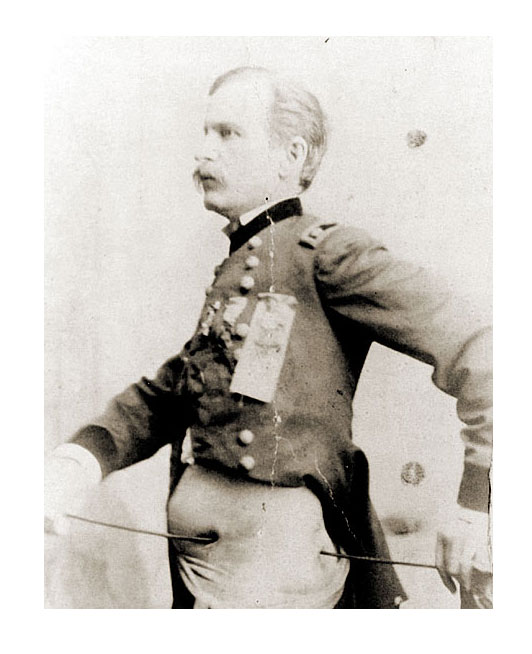
Above Historical photograph of US Civil War General Henry A. Barnum (1833-1892), who received what should have been a mortal gunshot wound through the left hip at the Battle of Malvern Hill in 1862. Although he survived, the wound became infected and required that an oakum cord (shown here) be passed through the bullet hole several times daily, to enable it to drain. There is an account of this in the autobiography of S.J. Woolf, Here Am I. New York: Random House, 1941, p. 13—
Among his [father's] friends were many Civil War veterans. The one with whom he was most intimate was General Henry Barnum, who had been on Sherman's staff during the war. Barnum had been wounded at Malvern Hill. With a bullet through his hip, he had been left for dead on the battlefield. Someone noticed him moving and he was carried to the hospital. He eventually recovered, but the wound was not permitted to close and all his life he carried a rope through it, which he had to pull back and forth a certain number of times every day.
Saturday, April 17, 2010
Frank Lloyd Wright Indentured

On exhibit at the North Carolina Museum of History in Raleigh, from September 10, 2010, through January 21, 2011, will be a traveling exhibition called Discover the Real George Washington: New Views from Mount Vernon. It includes about 100 artifacts pertaining to the first US President, including (shown here) the only surviving complete set of his dentures.

This reminds us of a story about architect Frank Lloyd Wright, as told by Edgar Tafel in his About Wright: An Album of Recollections By Those Who Knew Frank Lloyd Wright. New York: John Wiley, 1993, pp. 189-190—
[Frank Lloyd] Wright wanted every tooth in his mouth pulled, which could compare to storming the Great Wall of China single-handed, and in one sitting, and then to be fitted for false. This greatly impressed my dad [a dentist in Grand Rapids MI], as this was never done; it was too hard on the patient. Usually one or two were pulled at a time, four at the most, but Mr. Wright insisted, and so my dad pulled them as if he were plucking corn off a cob. Mr. Wright never flinched, but treated it as casually as if he'd come to have a hair trim.
See also: Roy R. Behrens, FRANK LLOYD WRIGHT and Mason City: Architectural Heart of the Prairie (2016).
Sunday, April 11, 2010
Bee Keeper

Above Photograph of American philosopher John Dewey. The following is a passage from the autobiography of Sidney Hook, Out of Step: An Unquiet Life in the 20th Century. New York: Harper and Row, 1987, p. 92—
When I was still a student at Columbia, he [John Dewey] invited me to his home for Sunday dinner. His daughters, son, and daughter-in-law were there, and it seemed to me a rather formal affair. It was my first visit, and I was naturally nervous. When I rang the bell, he himself came to the door. The first thing he did when I had shed my hat and overcoat was to point out the bathroom. I had no experience with dinners as elaborate as this seemed to me and don't remember whether I talked too much or too little. I wasn't sure what all the knives and forks were for, and my lack of ease must have been quite apparent. At the end of the meal, when the nuts were passed around, I took only one lest I be considered greedy. "Sidney," remarked Dewey, "you remind me of the man who kept a bee."
Tolstoy's Childhood

Above Photograph (n.d.) of Count Leo Tolstoy, from the George Grantham Bain Collection in the Library of Congress Prints and Photographs Division. Public domain. The following is an excerpt from Tolstoy's autobiography, Childhood, Boyhood, Youth. New York: Charles Scribner's Sons, 1929—
One day during dinner—I was six years old at the time—they [his parents] were discussing my looks and Mamma, trying to discover something nice about my face, said that I had intelligent eyes, and I pleasant smile, and then, yield to Papa's arguments and to the obvious, had been forced to admit that I was plain; and afterwards, when I was thanking her for the dinner, she patted my cheek and said: "Remember, my little Nikolai, that no one will love you for your face so you must try to be a sensible good boy."
Sunday, March 28, 2010
Apertures

Above A WPA-era government poster in favor of sanitary outhouses. Poster design by John Buczak, c1940. The brief passage that follows is from a memoir by American psychologist Roger G. Barker, recalling his childhood in Pover, Iowa, in Gardner Lindzey, ed., A History of Psychology in Autobiography. Vol VIII. Stanford CA: Stanford University Press, 1989, p. 4—
We had a horse and buggy, cow, chickens, apple trees, a walnut grove, a superior privy with three seats of different heights and sizes of apertures.
Saturday, March 27, 2010
Do Not Climb Mount Fuji

Above Katsushika Hokusai, Red Fuji (Southern Wind Clear Morning). Ukiyo-e woodblock print, c1830. The following passage is from John Morris, Traveler from Tokyo. New York: Sheridan House, 1944—
I wish, however, that I had not climbed Mount Fuji; never again was I able to quite capture the feeling of pristine beauty that it undoubtedly gives until such time as one actually sets foot upon its slopes. But then, as one of my Japanese friends was fond of saying, Fuji is only a "seeing" mountain; it was never meant to be climbed. The Japanese, however, have a saying that there are two kinds of fool: those who have never climbed Mount Fuji, and those who have climbed it more than once.
Eisenstein's Signature Upside Down

Above Alexander Rodchenko's poster for Sergei Eisenstein's famous film, The Battleship Potemkin (1926). Public domain. The following is a passage from Raphael Soyer, Diary of an Artist. Washington DC: New Republic Books, 1977, p. 127—
[An exhibition] which marked the fifteenth anniversary of [Russian filmmaker Sergei] Eisenstein's death, also contained his photos, letters, and old clippings, and books about him. One poignant item was a page from a notebook upon which Eisenstein wrote in Russian: "Today I am fifty years old," signed and dated. This is exhibited upside down to show how his unique signature in this position resembles the battleship Potemkin. The day after Eisenstein wrote this, he died.
Jacky Tar Creed
From James Joyce, Ulysses. New York: Random House, 1946, p. 323—
They believe in rod, the scourger almighty, creator of hell upon earth and in Jacky Tar, the son of a gun, who was conceived of unholy boast, born of the fighting navy, suffered under rump and dozen, was sacrificed flayed and curried, yelled like bloody hell, the third day he rose again from the bed, steered into haven, sitteth on his beamend till further orders whence he shall come to drudge for a living and be paid.
They believe in rod, the scourger almighty, creator of hell upon earth and in Jacky Tar, the son of a gun, who was conceived of unholy boast, born of the fighting navy, suffered under rump and dozen, was sacrificed flayed and curried, yelled like bloody hell, the third day he rose again from the bed, steered into haven, sitteth on his beamend till further orders whence he shall come to drudge for a living and be paid.
Fleming Grounded
From Edward Marsh, Ambrosia and Small Beer. NewYork: Harcourt, Brace and World, 1965, p. 342—
Sir Alexander Fleming, inventor of penicillin, was to fly to Belfast and give a lecture on it, but when he got to the aerodome he was told it was quite impossible for him to go, as all the berths were taken for Ministerial personages of the Highest Priority—so the aeroplane started without him. It turned out that the passengers were all officials from the Ministry of Health who had been sent to hear the lecture.
Sir Alexander Fleming, inventor of penicillin, was to fly to Belfast and give a lecture on it, but when he got to the aerodome he was told it was quite impossible for him to go, as all the berths were taken for Ministerial personages of the Highest Priority—so the aeroplane started without him. It turned out that the passengers were all officials from the Ministry of Health who had been sent to hear the lecture.
Sunday, March 21, 2010
Lackluster
From Cyril Connolly, Enemies of Promise. New York: Persea Books, 1938—
The shock, for an intelligent writer, of discovering for the first time that there are people younger than himself who think him stupid is severe. Especially if he is at an age (thirty-five to forty-two) when his self-confidence is easily shattered. The seventh luster is such a period, a menopause for artists, a serious change of life. It is the transition from a being a young writer, from being potentially Byron, Shelley, Keats, to becoming a stayer, a Wordsworth, a Coleridge, a Landor. It would seem that genius is of two kinds, one of which blazes up in youth and dies down, while the other matures, like Milton or Goethe's, through long choosing, putting out new branches every seven years.
The shock, for an intelligent writer, of discovering for the first time that there are people younger than himself who think him stupid is severe. Especially if he is at an age (thirty-five to forty-two) when his self-confidence is easily shattered. The seventh luster is such a period, a menopause for artists, a serious change of life. It is the transition from a being a young writer, from being potentially Byron, Shelley, Keats, to becoming a stayer, a Wordsworth, a Coleridge, a Landor. It would seem that genius is of two kinds, one of which blazes up in youth and dies down, while the other matures, like Milton or Goethe's, through long choosing, putting out new branches every seven years.
Upending Robert Frost
American poet Robert Frost, quoted in George Plimpton, ed., The Writer's Chapbook: A Compendium of Fact, Opinion, Wit, and Advice from the 20th Century's Preeminent Writers. New York: Viking, 1989, pp. 339-340—
Among other things, what [poet Ezra] Pound did was show me Bohemia. He'd take me to restaurants and things. Showed me ju jitsu in a restaurant. Threw me over his head. Wasn't ready for him at all. I was just as strong as he was. He said, "I'll show you, I'll show you. Stand up." So I stood up, gave him my hand. He grabbed my wrist, tipped over backwards and threw me over his head. Everybody in the restaurant stood up.
Among other things, what [poet Ezra] Pound did was show me Bohemia. He'd take me to restaurants and things. Showed me ju jitsu in a restaurant. Threw me over his head. Wasn't ready for him at all. I was just as strong as he was. He said, "I'll show you, I'll show you. Stand up." So I stood up, gave him my hand. He grabbed my wrist, tipped over backwards and threw me over his head. Everybody in the restaurant stood up.
Leonardo the Mischief
From Giorgio Vasari, Lives of the Most Eminent Painters, Sculptors and Architects (1568)—
He [Leonardo da Vinci] would often dry and purge the guts of a wether [a gelded male sheep] and make them so small that they might be held in the palm of the hand. In another room he kept a pair of [black]smith's bellows, and with these he would blow out one of the guts until it filled the room, which was a large one, forcing anyone there to take refuge in a corner.
He [Leonardo da Vinci] would often dry and purge the guts of a wether [a gelded male sheep] and make them so small that they might be held in the palm of the hand. In another room he kept a pair of [black]smith's bellows, and with these he would blow out one of the guts until it filled the room, which was a large one, forcing anyone there to take refuge in a corner.
Tuesday, March 9, 2010
Henry Moore's Secret
From Donald Hall, Life Work. Boston MA: Beacon Press, 1993, pp. 53-54—
[The last time American poet Donald Hall saw British sculptor Henry Moore, the latter] talked about his new grandson and showed us drawings in a studio he had just built to extend his workday. We sat with a drink in the sunny living room he had added to the house which, when he moved to it during the war, had been a broken-down farmworker's cottage. I knew my man, and I asked him, "Now that you're eighty, you must know the secret of life. What is the secret of life?" With anyone else the answer would have begun with an ironic laugh, but Henry Moore answered me straight: "The secret of life is to have a task, something you devote your entire life to, something you bring everything to, every minute of the day for your whole life. And the most important thing is—it must be something you cannot possibly do!"
Saturday, March 6, 2010
Dog's Nose and Man's Eyes
From Charley Waterman, Gun Dogs and Bird Guns: A Charley Waterman Reader. GSJ Press, 1986—
A man can sit in his living room and tell you he smells nothing at all; at least he is conscious of no odors. Give him a whiff of frying ham, and he thinks he smells that and nothing else. So if his nose is selective, it is crudely so, and he records nothing but the exceptional odors. But visually he is highly selective, and he'll find a small object of interest in a vast scene containing a thousand larger things. The dog's nose is as selective as the man's eyes.
A man can sit in his living room and tell you he smells nothing at all; at least he is conscious of no odors. Give him a whiff of frying ham, and he thinks he smells that and nothing else. So if his nose is selective, it is crudely so, and he records nothing but the exceptional odors. But visually he is highly selective, and he'll find a small object of interest in a vast scene containing a thousand larger things. The dog's nose is as selective as the man's eyes.
Friday, March 5, 2010
10,000 Days of Grass
From James Elkins, How to Use Your Eyes. London: Routledge, 2000—
A normal lifetime, for a person who lives in a developed nation, is about 30,000 days. Grass is in bloom for about 10,000 of those days, and certainly I could take one of them to sit down and get to know grass. But it is frightening how quickly life passes. I am a little over forty years old, and that means I have used up more than half of those 10,000 days that I have been given for viewing grass. If I'm lucky, I have about 30 summers left. Each summer has about 60 days of good weather, and maybe 20 days when I actually get outside and have some time to spare. That adds up to a little over 600 chances to see grass. They can easily slip away.
A normal lifetime, for a person who lives in a developed nation, is about 30,000 days. Grass is in bloom for about 10,000 of those days, and certainly I could take one of them to sit down and get to know grass. But it is frightening how quickly life passes. I am a little over forty years old, and that means I have used up more than half of those 10,000 days that I have been given for viewing grass. If I'm lucky, I have about 30 summers left. Each summer has about 60 days of good weather, and maybe 20 days when I actually get outside and have some time to spare. That adds up to a little over 600 chances to see grass. They can easily slip away.
Thursday, March 4, 2010
Never Twain Shall Meet
Mark Twain, as interviewed in Rudyard Kipling, From Sea to Sea: Letters of Travel. Cambridge MA: Harvard University Press, 1889—
Your conscience is a nuisance. A conscience is like a child. If you pet it and play with it and let it have everything that it wants, it becomes spoiled and intrudes on all your amusements and most of your griefs. Treat your conscience as you would anything else. When it is rebellious, spank it—be severe with it, argue with it, prevent it from coming to play with you at all hours, and you will secure a good conscience; one that is to say, a properly trained one. A spoiled one simply destroys all the pleasure in life. I think I have reduced mine to order. At least, I haven't heard from it for some time. Perhaps I have killed it from over-severity.
Your conscience is a nuisance. A conscience is like a child. If you pet it and play with it and let it have everything that it wants, it becomes spoiled and intrudes on all your amusements and most of your griefs. Treat your conscience as you would anything else. When it is rebellious, spank it—be severe with it, argue with it, prevent it from coming to play with you at all hours, and you will secure a good conscience; one that is to say, a properly trained one. A spoiled one simply destroys all the pleasure in life. I think I have reduced mine to order. At least, I haven't heard from it for some time. Perhaps I have killed it from over-severity.
Cerebral Secretions
From Ambrose Bierce, The Devil's Dictionary—
Understanding n. A cerebral secretion that enables one having it to know a house from a horse by the roof of the house. Its nature and laws have been exhaustively expounded by Locke, who rode a house, and Kant, who lived in a horse.
Understanding n. A cerebral secretion that enables one having it to know a house from a horse by the roof of the house. Its nature and laws have been exhaustively expounded by Locke, who rode a house, and Kant, who lived in a horse.
Tuesday, March 2, 2010
What Company Is For
From Mark Van Doren (recalling his friendship with Joseph Wood Krutch), The Autobiography of Mark Van Doren. New York: Greenwood Press, 1968—
The important thing was that we had a great deal to say to each other, and that each was really interested in what the other said; also, that each was eager to speak when it came to his turn, and was confident that what he said would be worth hearing. We like those who inspire us to talk well, to talk indeed our best, which in their presence becomes something better than it ever was before, so that it surprises and delights us too. We like least those persons in whose presence we are dull. For we can be either, and company brings it out; this is what company is for.
The important thing was that we had a great deal to say to each other, and that each was really interested in what the other said; also, that each was eager to speak when it came to his turn, and was confident that what he said would be worth hearing. We like those who inspire us to talk well, to talk indeed our best, which in their presence becomes something better than it ever was before, so that it surprises and delights us too. We like least those persons in whose presence we are dull. For we can be either, and company brings it out; this is what company is for.
Subscribe to:
Posts (Atom)