Showing posts with label metamorphosis. Show all posts

Friday, May 22, 2026

screwed / the vital necessity of engaging in war

Anon, Evolution of the Screw 1871
Simone Weil
 What a country calls its vital economic interests are not the things which enable its citizens to live, but the things which enable it to make war.

•••

Wilbert Snow, Codline's Child (Middletown, CT: Wesleyan University Press, 1974), pp. 37-38—

There were no septic tanks and no sewers in our village. Each home had a backhouse that had to be cleaned out once a year. For three years, when I was between ten and thirteen, I did this chore for [a woman neighbor named] Fronie. Each time she gave me five dollars, and five dollars to me then was far more than five hundred would be to me now. In those days no lime was thrown over the dung to make the task easier for the shoveler. Each time I became deathly sick, but I needed the five dollars so desperately that I saw the job through. I have no words to express the horror of those two or three hours each year. I would lie on my stomach and throw up when there was little or nothing to yield. After the job was over, I would go to the Mill Cove for a swim and to Patten Point to smell the fragrance of fir trees and bayberry bushes.

Tuesday, May 19, 2026

Agassiz's hands-on science teaching innovation

Anon, Grasshopper becomes human, Finland 1885
Louis Agassiz
, in Lane Cooper, editor, Louis Agassiz as a Teacher: Illustrative Extracts on His Method of Instruction (Ithaca, NY: Comstock Publishing, 1945), p. 82—

In 1847 I gave an address at Newton, Massachusetts, before a Teachers' Institute conducted by Horace Mann. My subject was grasshoppers. I passed around a large jar of these insects, and made every teacher take one and hold it while I was speaking. If any one dropped the insect, I stopped till he picked it up. This was at that time a great innovation, and excited much laughter and derision. There can be no true progress in the teaching of natural science until such methods become general.

writer Henry Miller shares his genealogical line

Anon, Birth of a Woman 1907
Henry Miller
, in Robert Snyder, This is Henry, Henry Miller from Brooklyn. Los Angeles: Nash Publishing, 1974—

And so, if my memory serves me right, here is my genealogical line: Boccaccio, Petronius, Rabelais, Whitman, Emerson, Thoreau, Maeterlinck, Romain Rolland, Plotinus, Heraclitus, Nietzsche, Dostoyevsky (and other Russian writers of the nineteenth century), the ancient Greek dramatists, the Elizabethan dramatists (excluding Shakespeare), Theodore Dreiser, Knut Hamsun, D.H. Lawrence, James Joyce, Thomas Mann, Élie Faure, Oswald Spengler, Marcel Proust, van Gogh, the Dadaists and Surrealists, Balzac, Lewis Carroll, Nijinsky, Rimbaud, Blaise Cendrars, Jean Giono, Céline, everything read on Zen Buddhism, everything I read about China, India, Tibet, Arabia, Africa and of course the Bible, the men who wrote it and especially the men who made the King James version, for it was the language of the Bible rather than its “message” which I got first and which I will never shake off.

Tuesday, February 11, 2025

metamorphosis / shape-shifting and animation

Of late we’ve been exploring the workings of metamorphosis, the transition of a single form from one shape to another. A phenomenon not unrelated to shape-shifting, evolution diagrams, and animation sequences.

Among the best inventors of metamorphic sequences was a Victorian artist named Charles H. Bennett (1828-1867). He was more generally known for comic illustrations, such as those for children’s books. He's worth looking into.

Above and below are examples from a series of metamorphic images that were initially published weekly in The Illustrated Times (c1863) as Studies in Darwinesque Development, which was later republished posthumously in a book titled Character Sketches, Development Drawings and Original Pictures of Wit and Humor (1872).


Thursday, November 2, 2023

the process by which creativity works / koestler

Roy R. Behrens, from the film narration in HOW TO WIN KINGS AND INFLUENCE CABBAGES: The Process by Which Creativity Works (2022), free to watch online on YouTube here—

As a college student, I was required to read for a humanities class Arthur Koestler’s Darkness at Noon, Albert Camus’ The Stranger, and Jean-Paul Sartre’s No Exit. Years later, I found out that, amusingly, all three of these literary titans had been drinking companions in postwar Paris, and that on one unforgettable evening in 1949 a greatly intoxicated Koestler (who was small and reputedly scrappy) had thrown a glass at Sartre and given Camus a black eye.

My favorite photograph of Koestler was made in the same year as that famous brawl by Dmitri Kessel for Life magazine [see above]. A double portrait of the Hungarian-born British writer and his magnificent boxer Sabby, it is memorable in part because of the uncanny resemblance between dog and master—boxer meets boxer, they seem deliberately to be imitating one another.

It is also, as might be said, a “self-exemplifying” image because that portrait is a superb example of what Koestler identified as the key ingredient throughout all creative activity: “The discovery of hidden similarities” or bisociation (perceiving things “in two self-consistent but incompatible frames of reference at the same time”).

Sunday, May 21, 2023

impromptu gymnastics strengthens muscularity

flag waving / anon
A.A. Milne, Autobiography. New York: E.P. Dutton, 1939, pp. 52-53—

The only occasion on which I spoke in the Debating Society was at what was called an “Impromptu Debate.” The names of the members were put into one hat, the subjects for speech into another. In an agony of nervousness I waited for my name to be called. It came at last, “Milne Three.” Milne III tottered up and drew his fate; not that it mattered, for one subject was as fatal to him as another. He tottered back to his desk and opened the paper. The subject on which he had to speak was “Gymnastics.”

I stood there dumbly. I could think of nothing. The boy next to me, misapprehending the meaning of the word “impromptu,” whispered to me: “Gymnastics strengthens the muscles.” I swallowed and said, “Gymnasthicth thtrengthenth the muthelth.” Then I sat down. This is the shortest speech I have ever made, and possibly, for that reason, the best.

• See also this great story about the “shotgun seminars” at Princeton, as well as this video essay about the nature of humor.

Saturday, November 5, 2022

tobacco road / the story of a boy who smoked

EVOLUTION OF A BOY WHO SMOKED, in The Journal (Huntsville AL), February 28, 1907, p. 2. Reprinted from the Chicago Daily News. Artist unidentified—

Do you know any little boy that [sic] smokes cigarettes? If you do, just show him this picture. It is the sad story of Dick Sillypate. He saw another boy smoking a cigarette, and thought it looked so manly that he would try it himself. The picture shows what happened to him at the end of five months.

Tuesday, March 16, 2021

dust to dust as we totter toward the end of time

view larger
 Above Roy R. Behrens, Architectonic (© 2021). Digital montage.

•••

Wiliam Hazlitt, “On the Fear of Death” in Table Talk (1822)—

Perhaps the best cure for the fear of death is to reflect that life has a beginning as well as an end. There was a time when we were not: this gives us no concern—why then should it trouble us that a time will come when we shall cease to be?

•••

Roy R. Behrens, “Khaki to Khaki (Dust to Dust): The Ubiquity of Camouflage in Human Experience” in Ann Elias, et al., eds., Camouflage cultures: beyond the art of disappearance (Sydney AU: Sydney University Press, 2015)—

…“I am I” and, to follow, I am not “not-I.” Or, I am “self” as distinguished from “others.” We typically regard our “selves” as permeable identities in a bouillabaisse of ubiquitous “stuff,” a surrounding that seems to a newborn, in the famous words of William James, like “a blooming, buzzing confusion.”  One wonders if this might also explain, as Ernst Schachtel suggested, why we are all afflicted by “childhood amnesia,” leaving us with little or no memory of the first years of our lives, because we lacked the “handles” then—the linguistic categories—that enable us to “grasp” events. In recent years, increased attention has been paid to the various forms of “amnesia” at the opposite end of life, including gradual memory loss, senility, dementia, and the horrifying ordeal of Alzheimer’s. If the boundaries of our figural “self” are blurred when we are newborns, perhaps we should not be surprised that the limits of our “self” grow thin—once again—as we totter toward the end of time.

As adults, we use hackneyed phrases like “dust to dust” to imply that at birth we somehow spring from naught; that we metamorphically evolve through infancy and childhood; live out our ritualistic lives as corporeal upright adults; then slowly—or, just as often, catastrophically—“deconstruct”; and (at last) are literally “disembodied” in the process that we dread as death. Instead of saying “dust to dust,” it may be more in tune to say “khaki to khaki,” since it seems as if our lives consist of time-based re-enactments of a spectrum of nuanced relations between figure and ground, some or all of which pertain to varieties of camouflage. 

online access

Saturday, August 24, 2019

Joseph Podlesnik's Phenomenal Photography

Photograph © Joseph Podlesnik 2019
An Arizona-based friend and artist Joseph Podlesnik recently sent me a visual metamorphosis, the stages in the development of chair design. I thought it was appropriate because Joe himself is a metamorphosis, albeit not one you should sit on.

This fall he is teaching an online course in photography for Cornell University, his graduate alma mater. When I first met him forty-plus years ago, he was an undergraduate in painting and drawing at the University of Wisconsin-Milwaukee, and admired for his skillfulness at drawing from life. His drawings were astonishing because they were so “true” to immediate sight, and yet they appeared to have happened effortlessly.

Here is a favorite self-portrait I’ve posted before. He does look squiggly in real life—but not that much.

Some years later, he began to make short films about his family, that relied on those same virtues of looseness entwined with precision. In recent years, he has evolved into photography. But not just photography, but Joe Podlesnik photographs.

A recent one (for which he received a prize in a nationwide competition) is shown above. But I am also reminded that in 2016, two years before my retirement, my students designed a series of posters, called Almost Seeing, about the photographs he was making then.

For more, see his website here.

Tuesday, January 22, 2019

Charles Henry Bennett / Shapeshifting Cat

C.H. Bennett, Poor Puss (1863)
Above One of a series of elaborate comic metamorphoses (aka shapeshifting) created by Victorian-era British illustrator Charles Henry Bennett (1863) in sardonic reference to Charles Darwin's theory of natural selection, this one titled "Poor Puss." Courtesy The Wellcome Library.

•••

The Reverend Benjamin Newton (Vicar of Landwit), Diary (September 1, 1816)—

An entertaining German dined here who teaches the girls music and plays delightfully and sings well with no voice having been shot through the lung. A Mr. Causer having been bit in a drunken frolic by a man of the name of Shipley in the leg last week is obliged to suffer amputation. During an armistice in which the Prussian and French officers were drinking together a son of [Prussian Field Marshall] Blücher gave for a toast the King of Prussia, which a French officer would not drink and soon after when it came to his turn gave [Napolean] Bonaparte which young Blücher would not drink, on which the officer went up to him and without saying anything struck him a smash in the face. Blücher said nothing but went out of the room and returned immediately with a pair of pistols, with one of which without uttering a word he shot the officer dead and then held up the other and said he had that ready for any man who would take up the quarrel. This came to his father's knowledge, who put him under arrest for six weeks.

Charles Henry Bennett / Shapeshifting Dog

C.H. Bennett, Good Dog (1863)
Above One of a series of elaborate comic metamorphoses (aka shapeshifting) created by Victorian-era British illustrator Charles Henry Bennett (1863) in sardonic reference to Charles Darwin's theory of natural selection, this one titled "Good dog." Courtesy The Wellcome Library.

•••

The Reverend Francis Kilvert, Diary (July 22, 1871)—

Mrs. Nott told me that Louie of the Cloggau was staying in Presteign with her aunt Miss Sylvester, the woman frog. This extraordinary being is partly a woman and partly a frog. Her head and face, her eyes and mouth are those of a frog, and she has a frog's legs and feet. She cannot walk but she hops. She wears very long dresses to cover and conceal her feet which are shod with something like a cow's hoof. She never goes out except to the Primitive Methodist Chapel. Mrs. Nott said she had seen this person's frog feet and had seen her in Presteign hopping to and from the Chapel exactly like a frog. She had never seen her hands. She is a very good person. The story about this unfortunate being is as follows. Shortly before she was born a woman came begging to her mother's door with two or three little children. Her mother was angry and ordered the woman away. "Get away with your young frogs," she said. And the child she was expecting was born partly in the form of a frog, as a punishment and a curse upon her.

Saturday, December 29, 2018

Charles Henry Bennett | Shapeshifting Fox

C.H. Bennett, Metamorphosis (1863)
Above One of a series of elaborate comic metamorphoses (aka shapeshifting) created by Victorian-era British illustrator Charles Henry Bennett (1863) in sardonic reference to Charles Darwin's theory of natural selection, this one titled "Beware of the goose when the fox preaches." Courtesy The Wellcome Library.

•••

Vincent Starrett (Chicago Tribune book columnist Charles Vincent Emerson Starrett), Born in a Bookshop: Chapters from the Chicago Renascence. Norman: University of Oklahoma Press, 1965, pp. 295-296—

It is curious how the faces of acquaintances repeat themselves in foreign lands. Uncanny, too, for what could be more disconcerting than to encounter an old friend jogging past dressed like a mandarin or selling chestnuts in coolie cloth? No sooner had I reached the Orient than this began to happen. Friends and associates I thought I had left behind in America, sometimes fellows I hadn't seen in years, popped up in Yokohama, Tokyo, Shanghai, and Peking, looking very much as I had seen them last, yet subtly altered by the native costumes they were wearing. It was as if one met them coming from a masquerade. In Yokohama it was an old school friend who had been dead for years. He was running a cigarette kiosk near the docks and I knew better than to speak to him. In Tokyo it was a genial barber who used to shave me in Chicago. And in Peking [Beijing] here were so many that my blood ran cold.

Among the friends I met in Chinese garb (and with Chinese faces) were some pretty distinguished fellows…I saw Alex Woollcott many times: once he was chirping seductively at a bird he was carrying through the streets in a bamboo cage. Once my dead mother turned out of a side street and gave me a turn that almost bowled me over. Once I met Bob Casey driving a small donkey attached to a two-wheeled cart: he was selling vegetables. After a time it became an amusing game to look for absent friends and sometimes to hail them genially, and no harm came of it for the Chinese were a friendly people, always ready to hail one in return.

But one day I really did get a shock. Rolling down one of the main thoroughfares of Peking in my rickshaw, I came suddenly abreast of another rickshaw rider headed in the opposite direction. He was bundled up in a fur coat and wore a fur hat, rather like a turban, at a rakish angle. He looked exactly like J. P. McEvoy and for a moment we looked hard at each other. Then I said, “Hello, Mac,” and he stopped his boy and said, “Why, hullo, Vince! What are you doing in Peking?”

Monday, January 16, 2017

The Man Who Mistook Someone's Hat For His

see larger
Frank Swinnerton, Swinnerton: An Autobiography. Garden City NY: Doubleday, Doran and Company, 1936, p. 28-29 [recalling an incident at a London publishing firm where he worked]—

He [a co-worker named Martin, who was the company cashier] had a very large round head, upon which he wore a great dusty bowler hat; and one Saturday, when everybody but myself had gone home, I was dismayed to find that he had taken my hat and left this monster [his hat] behind. Despair grew when it dawned upon me that the hat came down to my chin. But at last I recollected that Martin was most likely to be found in a local pub, and set out in search of him as Cockney wives sometimes go on Saturday nights in search of their husbands, opening swing doors and quickly scanning the faces in the bar.

My search was brief. He was sitting on a tall stool in the center of the saloon bar of the Essex Serpent, in King Street. In his outstretched arms was a newspaper; a pipe was held firmly in his front teeth; and high upon his big white head, looking in its inadequacy like a thimble, was perched my little hat. I removed it firmly; and Martin was very annoyed, first with me for entering a pub at all, second with himself for having taken my hat, and finally again with me for knowing where he was to be found. Poor man, his life was a misery.

•••

Note We will add this to our ever expanding collection of stories about those who have mistaken someone else's hat (or other item of clothing) for their own. Go here, for example, for another hat confusion tale by British philosopher Alfred North Whitehead, or here for Mircea Eliade's story about walking off with Claude Lévi-Strauss' raincoat.

Friday, February 22, 2013

Animated Currency | Randy Timm

Self-Portrait Currency (2012) © Randy Timm

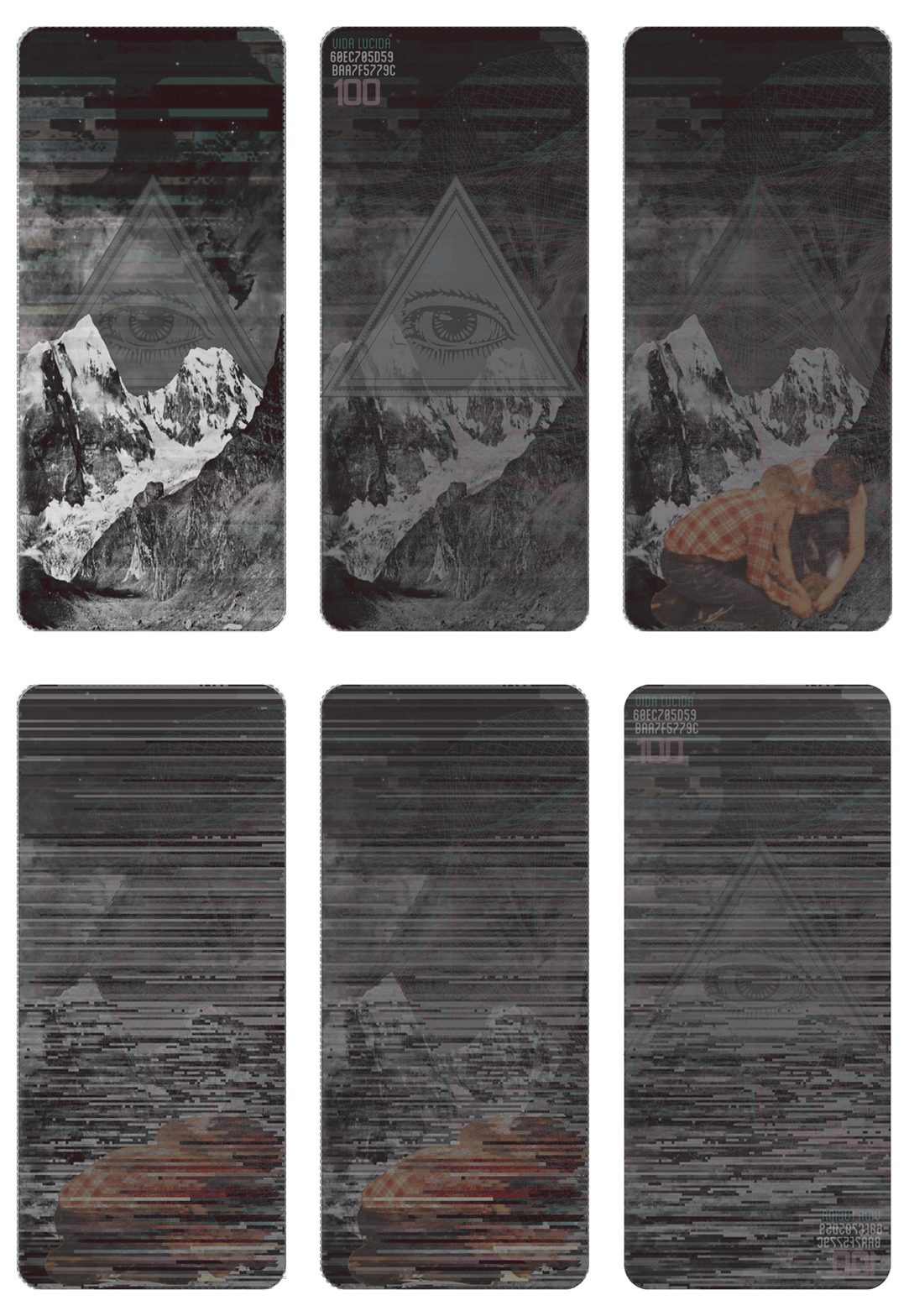
In the fall semester of 2012, I asked my beginning graphic design students at the University of Northern Iowa to design paper currency, for a fictitious country whose name was somehow related to theirs. It had to be self-portrait currency (in one way or another), with proposals for both front and back (as shown above). And then to make it more challenging, they were also asked to design an animated gif, based on the same banknote (below).

Animated Self-Portrait Currency (2012) © Randy Timm

Tuesday, February 19, 2013

Animated Currency | Kimber Bates

Animated Self-Portrait Currency (2012) © Kimber Bates

In the fall semester of 2012, I asked my beginning graphic design students at the University of Northern Iowa to design paper currency, for a fictitious country whose name was somehow related to theirs. It had to be self-portrait currency (in one way or another). And then to make it more challenging, they were also asked to design an animated gif, based on the same banknote.

Sunday, February 10, 2013

Animated Currency | Christian Gargano

Animated Self-Portrait Currency (2012) © Christian Gargano
In the fall semester of 2012, I asked my beginning graphic design students at the University of Northern Iowa to design paper currency, for a fictitious country whose name was somehow related to them. It had to be self-portrait currency (in one way or another). And then to make it more challenging, they were also asked to design an animated gif, based on the same banknote.

Animated Currency | Kellie Heath

Animated Self-Portrait Currency (2012) © Kellie Heath


In the fall semester of 2012, I asked my beginning graphic design students at the University of Northern Iowa to design paper currency, for a fictitious country whose name was somehow related to them. It had to be self-portrait currency (in one way or another). And then to make it more challenging, they were also asked to design an animated gif, based on the same banknote.

Sunday, November 18, 2012

Versluis | Behrens Collaborative Bugs

Yellow Jacket Digital Collage (2012) © David Versluis & Roy R. Behrens
Many months ago, coincident with the New Year 2012, my fine friend David Versluis (a Dutch Master) and I decided to try something. He has a collection of Iowa bugs (dead ones) of which he made exquisite scans at high resolution. He began to send me the scan files, one at a time, with the challenge that I should respond to them by beginning to build a digital montage, using Adobe Photoshop. I could do whatever I liked. Then I would pass that back to him, in response to which he'd make a move—and pass it back to me again. And so on, usually with five or six back-and-forth turns, until we mutually came to suspect that the work was finished. So that's how we proceeded—with a beetle, a cicada, a dragon fly, and other creatures, including (here) a hornet (which, in the end, was discovered to be not a hornet but a yellow jacket wasp). I can't recall how many of these montages we made, but in a few short weeks we ended up with a substantial and interesting series. Posted above is a gif (pronounced jiff) animation of the stages in our process for the collaborative yellow jacket (the stages are not in the order, I think, in which the piece evolved). The final stage for this montage (which was recently selected for a national juried exhibition) is posted here.

Thursday, November 15, 2012

Animated Currency | Dusty Kriegel

Animated Self-Portrait Currency (2012) © Dusty Kriegel


Above Teaching is so unbelievably difficult. I suppose it doesn't have to be, if you only pretend to do it (an ever present temptation), if you don't put your heart into it. If you do, there is nothing quite as devastating emotionally (when it fails) nor any greater source of joy (when it succeeds). This semester, I've been working with two groups of especially wonderful students in a beginning course in graphic design in the Department of Art at the University of Northern Iowa. When the semester started in late August, many of them had little or no experience with Adobe Photoshop or other bewildering software (increasingly bewildering with each, more frequent, update). There were some who could only do email. Now they are soaring at perilous heights that I can barely imagine at times. Most recently, for example, I asked them to design the front and back of a hypothetical banknote (paper money). To complicate the problem, I told them that it had to be "self-portrait currency." I also threw in a subsequent stage: Having designed the banknote as such, they were then required to animate the face side of it (which they did in Photoshop, using the gif animation technique). We critiqued the initial results yesterday, and a number of their pieces were utterly amazing. I was especially taken aback by this extraordinary solution (above) by Dusty Kreigel. Delights like this restore my faith in a world that I find so disturbing, in education—and in a baffling human race.

Wednesday, December 23, 2009

Bridging Lexicographical Gaps

Transformations. Metamorphoses. Evolutions. There are lots of great visual examples of course. But in E.J. Kahn, Jr.'s Year of Change: More About The New Yorker and Me (NY: Viking, 1988), he talks about his preoccupation with "bridging the lexicographical gap" between two (preferably antonymous) words, for example, love and hate (love-lave-have-hate); cock and crow (cock-cook-cool-fool-foul-soul-sour-slur-slum-glum-glim-grim-gram-cram-craw-crow); and frown and smile (frown-grown-grows-glows-slows-stows-stops-stope-stole-stile-smile).