Friday, April 29, 2011

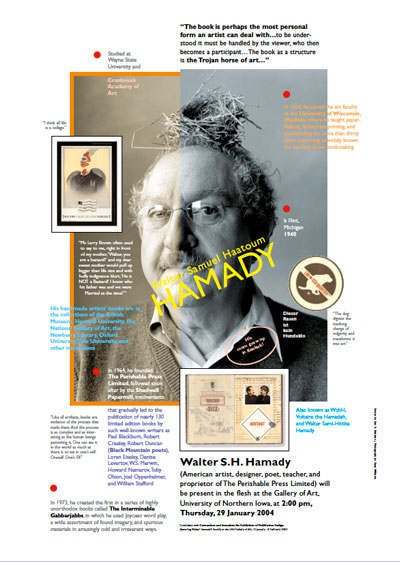
Walter Hamady | The Gabberjabbs


Years ago, a friend of Walter Hamady said (as Hamady himself recalls), "right in front of my mother, 'Walter, you are a bastard!' And my dear sweet mother pulled up bigger than life-size and with huffy indignation said, 'He is not a bastard! I know who his father was and we were married at the time!" more>>

Saturday, April 9, 2011

More Than A Few Least Favorite Things

The likes and many dislikes of Inez McAlister Faber in Out Here on Soap Creek (Ames: Iowa State University Press, 1982), pp. 23-24—

Probably many people wiser than I dislike some of the things I like, such as hoeing, canning, cleaning house, cutting corn fodder, living in the country, being in my thirties, dahlias, roses, meals on time, empty houses with flowers still growing in the yards, old furniture, small boys, books, newspaper editorials, astronomy, chickens, dogs, cows, horses, meat or gravy cooked in a cast-iron skillet, waffles, carrots and spinach. It is quite likely that others, and I have no quarrel with them, like many of the things I hate, including petunias, cats, children who have been taught that they are cute, grown-ups who try to act kiddish, male or female sissies, superiority complexes, machine hemstitching, tablecloths hemmed on the machine, cows with horns, weedy gardens, dwelling houses painted green, rain on washday, so-called living rooms that are only used for company, and overstuffed davenports. Large women in striped or checked dresses, bad table manners, being flatly contradicted, people who handle books roughly or who lay an open book face down upon a table, people who read over my shoulder, inquisitiveness, concrete walks in front of farm homes, fried parsnips, mashed potatoes, interruptions while ironing, washing milk pails, cleaning muddy overshoes, cooking for visitors who do not come, going to bed, getting up, washing yesterdays dishes, and talking over the telephone.

F. Scott Fitzgerald's Damaged Wings

Death's Head Moth
 
Ernest Hemingway describes F. Scott Fitzgerald as follows in A Moveable Feast (New York: Charles Scribner's Sons, 1964)—

His talent was as natural as the pattern that was made by the dust on a butterfly's wings. At one time he understood it no more than the butterfly did and he did not know when it was brushed or marred. Later he became conscious of his damaged wings and of their construction and he learned to think and could not fly anymore because the love of flight was gone and he could only remember when it had been effortless.

Thursday, April 7, 2011

Not Truss Worthy | Edward Marsh

Edward Marsh, Ambrosia and Small Beer (New York: Harcourt, Brace and World, 1965), p. 220—

A soldier up for medical exam proved to have been wearing a truss for the last 6 years, and was classified as P.E. or Permanently Exempt. On his way out he gave this news to his pal, who immediately asked for the loan of the truss, which was granted. The examiner asked how long he had been wearing it, and he said, "Six years," whereupon he was classified as M.E. "What's that?" he asked. "Middle East." "How can I go to the Middle East when I've been wearing a truss for 6 years?" "If you can wear a truss for 6 years upside-down, you can jolly well ride a camel for 6 months."

Get To Work | Richard Hugo

 Fine advice from poet Richard Hugo in The Triggering Town: Lectures and Essays on Poetry and Writing (New York: W.W. Norton, 1979)—

Lucky accidents seldom happen to writers who don't work. You will find that you may rewrite and rewrite a poem and it never seems quite right. Then a much better poem may come rather fast and you wonder why you bothered with all that work on the earlier poem. Actually, the hard work you do on one poem is put in on all poems. The hard work on the first poem is responsible for the sudden ease of the second. If you just sit around waiting for the easy ones, nothing will come. Get to work.

Eddie Marsh Meets H.M. Stanley

Sir Henry Morton Stanley (1872), with Kalulu, his adopted son


A couple of times in my life, when I first met in person someone who I had been wanting to meet for years, I became suddenly, atypically tongue-tied. As Edward Marsh describes in his memoir A Number of People (New York: Harper and Brothers, 1939), he had the same experience when he first met the famous journalist and explorer Sir Henry Morton Stanley (as in "Doctor Livingston, I presume") at a party (p. 41)—

At a party of old Mrs. Tennant's he [Stanley] crossed the room to where I was standing forlorn, and said: "I see you're looking neglected, so I've come to talk to you." This well-meant gambit completely froze the genial current of my soul, and neither of us could think of anything further to say.

Sunday, April 3, 2011

Implicitness, Closure and Flow | Csikszentmihalyi

Diagram © Roy R. Behrens (2011)


Mihaly Csikszentmihalyi, Flow: The Psychology of Optimal Experience. NY: Harper and Row, 1990, p. 53—

Whenever I took our hunting dog, Hussar, for a walk in the open fields he liked to play a very simple game—the prototype of the most culturally widespread game of human children, escape and pursuit. He would run circles around me at top speed, with his tongue hanging out and his eyes warily watching every move I made, daring me to catch him. Occasionally I would take a lunge, and if I was lucky I got to touch him. Now the interesting part is that whenever I was tired, and moved half-heartedly, Hussar would run much tighter circles, making it relatively easy for me to catch him; on the other hand, if I was in good shape and willing to extend myself, he would enlarge the diameter of his circle. In this way, the difficulty of the game was kept contant. With an uncanny sense for the fine balancings of challenges and skills, he would make sure that the game would yield the maximum enjoyment for us both.

[Compare Arthur Koestler's contention (in The Act of Creation) that the value of cryptic communication "is not to obscure the message, but to make it more luminous by compelling the recipient to work it out for himself—to re-create it."]

Saturday, April 2, 2011

Here's the Butter—But Where's the Cat?

Frances Simpson, Book of the Cat (1903)


Victor Frankl, "Reduction and Nihilism" in Arthur Koestler and J.R. Smythies, eds., Beyond Reductionism (Boston: Beacon Press, 1969), p. 403—

There were two neighbors; one of them contended that the other's cat had stolen and eaten five pounds of his butter; there was a bitter argument and finally they agreed to seek the advice of the rabbi. They went to the rabbi and the owner of the cat said: "It cannot be, my cat doesn't care for butter at all" but the other insisted that it was his cat and the rabbi said: "Bring me the scales." And they brought the scales and he asked: "How many pounds of butter?" "Five pounds." And believe it or not, the weight of the cat was exactly five pounds. So the rabbi said: "Now I have the butter, but where is the cat?"

Grasshopper Lecture | Louis Agassiz

Louis Agassiz statue at Stanford University, as toppled by the San Francisco earthquake in 1906


Louis Agassiz, in Lane Cooper, ed., Louis Agassiz as a Teacher: Illustrative Extracts on His Method of Instruction. Ithaca NY: Comstock Publishing, 1945, p. 82—

In 1847 I gave an address at Newton, Massachusetts, before a Teachers' Institute conducted by Horace Mann. My subject was grasshoppers. I passed around a large jar of these insects, and made every teacher take one and hold it while I was speaking. If any one dropped the insect, I stopped till he picked it up. This was at that time a great innovation, and excited much laughter and derision. There can be no true progress in the teaching of natural science until such methods become general.

Humphrey Howarth's Naked Duel

British poet Samuel Rogers, in Recollections of the Table-Talk of Samuel Rogers (1856)—

[In 1806] Humphrey Howarth, the [Army] surgeon [and Member of Parliament], was called out [challenged to a pistol duel], and made his appearance in the field stark naked, to the astonishment of the challenger, who asked him what he meant. "I know," said H., "that if any part of the clothing is carried into the body by a gunshot wound, festering ensues; and therefore I have met you thus." His antagonist declared that, fighting with a man in puris naturalibus would be quite ridiculous; and accordingly they parted without further discussion.

Drunk by God!

British poet Samuel Rogers, in Recollections of the Table-Talk of Samuel Rogers (1856)—

Dr. [George] Fordyce [a prominent Scottish physician] sometimes drank a good deal at dinner. He was summoned one evening to see a lady patient, when he was more than half-seas-over, and conscious that he was so. Feeling her pulse, and finding himself unable to count its beats, he muttered, "Drunk by God!" 

Next morning, recollecting the circumstance, he was greatly vexed: and just as he was thinking what explanation of his behavior he should offer to the lady, a letter from her was put into his hand. "She too well knew," said the letter, "that he had discovered the unfortunate condition in which she was when he last visited her; and she entreated him to keep the matter secret in consideration of the enclosed (a hundred-pound banknote)."

Mad Magazine in Collision

Frank Jacobs in The Mad World of William M. Gaines. New York: Bantam Books, 1973, p. 77—

In the fall of 1954, [William M.] Gaines [founder and publisher of MAD magazine] and Nancy [a close friend and staff member] were turning into a gas station on West 96th Street in Manhattan. As they made their turn, a car came down the street and barreled into them. No one was hurt, and Gaines exchanged the usual insurance data with the driver of the other car, whose name was Gene Zahn. About a year later, two blocks from the gas station, Gaines pulled up to a newspaper stand. After buying his paper, he returned to his car, backed out a few feet, and was struck by a car rounding the corner. No one was hurt, and Gaines exchanged the usual insurance data with the driver of the other car, whose name was Gene Zahn.

"Didn't we have an accident a year ago?" Gaines asked.

"I believe we did," answered Zahn, giving a polite nod to Nancy, whom he remembered from the previous run-in. "Say, don't you think it's time you two got married?"

Gaines thought if over and decided that the point was well-taken. Within a month, he and Nancy were married.

Tuesday, March 29, 2011

Growing Up on a Farm | Herbert Read

From the autobiography of British art theorist Sir Herbert Read, The Contrary Experience. New York: Horizon Press, 1963, pp. 22-23—

But the scenes [of growing up on a farm] that I have described, and many others of the same nature, such as the searing of horses' tails, the killing of poultry, the birth of cattle, even the lewdness of a half-witted laborer, were witnessed by us children with complete passivity—just as I have seen children of the same age watching a bullfight in Spain quite unmoved by its horrors. Pity, and even terror are emotions which develop when we are no longer innocent, and the sentimental adult who induces such emotions in the child is probably breaking through defenses which nature has wisely put round the tender mind. The child even has a natural craving for horrors. He survives just because he is without sentiment, for only in this way can his green heart harden sufficiently to withstand the wounds that wait for it.

Water Over the Dame

Anon, The Olio [1796] as quoted in Louis Kronenberger, Animal, Vegetable, Mineral. New York: Viking, 1972, p. 238—

One day Lady Onslow, being desirious of knowing the most remarkable planets and constellations, requested Mr. Harvest, on a fine starlight night, to point them out to her, which he undertook to do; but in the midst of his lecture, having occasion to make water, thought that need not interrupt it, and accordingly directing that operation with one hand, went on in his explanation, pointing out the constellations with the other.

Cutting Meat with Scissors | Context

German satirist G.C. Lichtenberg, as quoted in W.H. Auden, A Certain World (New York: Viking Press, 1970), pp. 136-137—

How much depends upon the way things are presented in this world can be seen from the very fact that coffee drunk out of wine glasses is really miserable stuff, as is meat cut at the table with a pair of scissors. Worst of all, as I once actually saw, is butter spread on a piece of bread with an old but very clean razor.

Inattentional Blindness | Thoreau

From Henry Petroski, The Pencil: A History of Design and Circumstance. New York: Knopf, 1989, pp. 3-4—

Henry David Thoreau seemed to think of everything when he made a list of essential supplies for a twelve-day excursion into the Maine woods. He included pins, needles, and thread among the items to be carried in an India-rubber knapsack, and he even gave the dimensions of an ample tent: "six by seven feet, and four feet high in the middle, will do." He wanted to be doubly sure to be able to start a fire and to wash up, and so he listed: "matches (some also in a small vial in the waist-coat pocket); soap, two pieces." He specified the number of old newspapers (three or four, presumably to be used for cleaning chores), the length of strong cord (twenty feet), the size of his blanket (seven feet long), and the amount of "soft hardbread" (twenty-eight pounds!)…
 
But there is one object that Thoreau neglected to mention, one that he most certainly carried himself. For without this object Thoreau could not have sketched either the fleeting fauna he would not shoot or the larger flora he could not uproot. Without it he could not label his blotting paper pressing leaves or his insect boxes holding beetles; without it he could not record the measurements he made; without it he could not write home on the paper he brought; without it he could not make his list. [He had forgotten to mention the pencil that enabled him to make the list.]

Saturday, March 26, 2011

Biblical Printing Errors | Bloopers

The following is adapted from the article "Bible, specially named editions" in Benet's Reader's Encyclopedia. Third Edition. (New York: Harper and Row, 1987)—

In the so-called Wicked Bible, printed in London by Baker and Lucas in 1632, the word not was omitted from the seventh commandment, to make it "Thou shalt commit adultery."
 
Genesis 24:61, which is supposed to read "Rebecca arose, and her damsels," was mistakenly printed as "Rebecca arose, and her camels" in an edition known as Rebecca's Camels Bible, printed in 1823.
 
Published in 1702, the Printers' Bible contained an error in Psalms 119:161 in which the word printers was substituted for princes, so that King David was said to complain that "printers have persecuted me without a cause."
 
In the Murderers' Bible, published in 1801, the word murmurers was misprinted as murderers in Jude 16, resulting in a verse that reads "These are murderers, complainers, walking after their own lusts..."
 
The To Remain Bible refers to a flawed edition, published at Cambridge in 1805, in which Galatians 4:29 was mistakenly printed as "he that was born after the flesh persecuted him that was born after the spirit to remain, even so it is now." The words to remain are erroneous. While checking the galleys, a proofreader questioned if there should be a comma after the word spirit. The editor responded by penciling "to remain" in the margin, which was then mistakenly typeset.

Shotgun Seminars at Princeton

From Freeman Dyson, Infinite in all Directions (New York: Harper and Row, 1988)— 

At our institute in Princeton we sometimes organize meetings which are announced as Shotgun Seminars. A Shotgun Seminar is a talk given by an Institute member to a volunteer audience. The subject of the talk is announced a week in advance, but the name of the speaker is not. Before the talk begins, the names of all people in the room are written on scraps of paper, the scraps of paper are put into a box, the box is ceremoniously shaken and one name is picked out at random. The name picked out is the name of the speaker. The unbreakable rule of the seminar is that nobody whose name is not in the box may listen to the talk. This rule ensures that everybody does the necessary homework. The audience is ready to argue and contradict whenever the speaker flounders. Anybody who has not given serious thought to the subject of the seminar had better not come.

The Evils of Hell Juice

From Bruce Siberts, in Walker D. Wyman, ed., Nothing But Prairie and Sky: Life on the Dakota Range in the Early Days (Norman: University of Oklahoma Press, 1954), pp. 5-6—

Our family were strict Methodists, attended church regular, and none of them ever got drunk, chewed or smoked tobacco, or used bad language. Only Uncle Ed, who bought cattle and hogs for the Chicago market, was different. He chewed tobacco, was suspected of drinking beer once, and had the reputation of seeing a show in Chicago called The Black Crook, in which women wore tights. As Uncle Ed and Mr. Crum, a neighbor, were the only Methodists who used tobacco, except on the sly, it was urged that they be expelled from the church. But in looking over the records, it was learned that they were the best in paying money for the support of the church so they were allowed to remain in good standing. However, the minister preached a good sermon on the evils of tobacco, saying, "There you sit with hell juice running out of your mouths," and on in that line for two hours. Uncle Ed said that the preacher could kiss his foot and go to hell. Only he didn't say foot.

Mail Art | Collage

Roy R. Behrens © Mail Art Collage (1980)


Back in the pre-computer days in the 1970s and 80s, it was common to complete a letter by making a collage on the envelope, using rubber stamps, labels, transfer type, hand-colored image fragments, or whatever. We mailed the best ones to ourselves, in the hope that the post office workers would contribute to it through multiple cancellations.

Monday, March 14, 2011

Joseph Langland | Something Well Said

From a Joseph Langland's essay on "Poetry! What in the World are You Saying?"—

One is drawn to poetry not nearly so much because someone thinks he has something important to say as that he thinks he can say something well. And when something is well said, it is more important than the same idea less well said. All those who care for civilization know the truth of this.

William H. Gass | Music of Prose

This astonishing passage is from "The Music of Prose" in William H. Gass, Finding a Form (Ithaca NY: Cornell University Press, 1997)—

For prose [like music] has a pace; it is dotted with stops and pauses, frequent rests, inflections rise and fall like a low range of hills; certain tones are prolonged; there are patterns of stress and harmonious measures; there is a proper method of pronunciation, even if it is rarely observed; alliteration will trouble the tongue, consonance ease its sound out, so that any mouth making that music will feel its performance even to the back of the teeth and to the glottal's stop; mellifluousness is not impossible, and harshness is easy; drum roll and clangor can be confidently called for—lisp, slur, and growl; so there will be a syllabic beat in imitation of the heart, while rhyme will recall a word we passed perhaps too indifferently; vowels will open and consonants close like blooming plants; repetitive schemes will act as refrains, and there will be phrases—little motifs—to return to, like the tonic; clauses will be balanced by other clauses the way a waiter carries trays; parallel lines will nevertheless meet in their common subject; clots of concepts will dissolve and then recombine, so we shall find endless variations on the same theme; a central idea, along with its many modifications, like soloist and chorus, will take their turns until, suddenly, all sing at once the same sound.

Sunday, January 2, 2011

Thursday, December 30, 2010