 |
| Roy R. Behrens / Montage Exhibition |
 |
| exhibition video |
 |
| Copyright © Jared Rogness |
Bravo!
Here is an online essay in which he talks about his work and provides more examples. In addition, we’ve blogged about him in the past, since I had the pleasure of working with him in the late 1990s and early 200os, when he was a university student in Iowa.
 |
| Copyright © Jared Rogness |


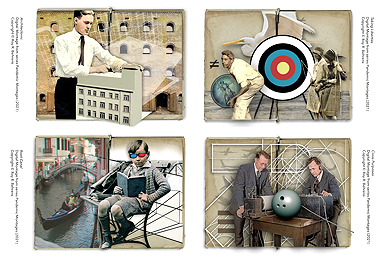 |
| Digital montages © Roy R. Behrens 2021 |
 |
| Pandemic Montage Exhibition (online) |
 |
| digital montages © Roy R. Behrens |
Paul Auster—
What I try to do is to leave enough room in the prose for the reader to enter it fully. All the books I’ve most enjoyed, the writers I most admire, have given me the space in which to imagine the details for myself.
•••
J.B. Priestley, A Visit to New Zealand—
What I couldn’t understand was why this wingless night-grubber [the kiwi] had ever been chosen as New Zealand’s national image. It was a bad move. New Zealanders should never have called themselves Kiwis. Perhaps it has been the Kiwi aspects of New Zealand life and character that encouraged visitors in the past to call them dull. Though not a unique native of the country, albatross would have been my first choice.
•••
George Ellis aka Gregory Gander [the twelve months of the year]—
Snowy, Flowy, Blowy,
Showery, Flowery, Bowery,
Hoppy, Croppy, Droppy,
Breezy, Sneezy, Freezy.
Afterthought: When I was in grade school, I remember that our teacher said that a sure way to spell geography correctly was to remember the following phrase: George Ellis' old grandmother rode a pig home yesterday. But it may be another George Ellis.
 |
| Pandemic montages © Roy R. Behrens 2021 |

•••
Edward Robb Ellis, Life in the United States 1914-1918. New York: Coward, McCann and Geoghegan, 1975, p. 428, describing the actions and attitudes of Americans during World War I, after the US declared war against Germany—
Anything mindful of German culture became suspect. Vigilantes inspected public libraries and invaded private homes and burned books by Goethe and Heine and Kant, broke Victrola records that preserved the music of Beethoven and Bach and Wagner. School after school forbade the teaching of the German language, while in clubs and churches and halls there was a ban against speaking German. [In the Iowa home of my father's parents, whose parents had immigrated from Germany in the 1850s, German was guardedly only spoken at home.]
With trembling fingers people plucked their gardens free of bachelor buttons, which was Germany’s national flower. Sauerkraut was renamed Liberty cabbage, hamburger became Salisbury steak. German measles were called Liberty measles, German dishes disappeared from restaurants, seed catalogs referred to German clover as Liberty clover, and bartenders removed pretzels from their free lunch counters.


Above Roy R. Behrens, Wavelength. Digital montage (©2021). 
view larger
•••
Edward Robb Ellis, A Diary of the Century. New York: Kodansha, 1995, p. 222—
Tuesday, March 1, 1955: In the city room today some of us were discussing a report that the New Testament has been published in Braille. Frank [Kappler] said: “Yes—but did you know that Lazarus was the original raised character?”
•••
James Joyce, Ulysses (Chapter Six)—
“Come forth, Lazarus! And he came fifth and lost the job.”

view larger
Above Roy R. Behrens, Snap Shot. Digital montage (©2021).
•••
Ione Robinson, A Wall to Paint On. New York: E.P. Dutton, 1946, pp. 152-153—
When I made a drawing of [American writer Sinclair] Lewis [who had just received the Nobel Prize] I had to take the train out to his country house. I was all in when I arrived but the afternoon and the trip back were so amusing I forgot how tired I was.
I made the drawing in his study, while Mr. Lewis wrote out checks to pay his bills with the Nobel Prize, and there were freshly-written checks all over the desk and the floor. I would have liked to paint him in that foreground of blue paper, which only increased the redness of his face and hair. He looked just like a carrot.
In a basket beside his desk there was a tiny baby with a wisp of red hair on the top of its head. Each time Mr. Lewis would finish a check, he would talk to the baby: “Isn’t it wonderful, Michael, that Daddy has won the Nobel Prize?” I had an awful time making the drawing because he was never still, but his face had made such an impression the moment I saw it that the drawing was fairly successful.
On the train back to New York Mr. Lewis joked a great deal about receiving the prize and the fuss that it had created throughout the country, especially among other contemporary writers. He told me how mad Theodore Dreiser was…and then he added that Dreiser ought to be tinting “fish plates.” I didn’t get the connection, and I don’t think there was any, as Mr. Lewis had had about ten highballs!

view larger
Above Roy R. Behrens, Beach Repair. Digital montage (©2021).
•••
Maurice Browne, Too Late to Lament: An Autobiography. Bloomington: Indiana University Press, 1956, p. 30—
Mr. Pickford was one of the finest Sanskrit scholars of his day. He was very poor; he had sacrificed his life to Sanskrit and his sister. His sister kept house for him in a little village where he was rector, a few miles outside Ipswich; a dour, bitter, selfish woman whom no one liked. So, for his sister's sake, he had put aside marriage, advancement, happiness, and had taken that obscure living in a poky village in a backward county, to make her a home where were few to hate her.
One day a letter came addressed to Mr. Pickford. Through several weeks he had been hoping for it; if it came, it might offer him an academic position where he could carry to fruition his life's work in Sanskrit. Every morning his sister went downstairs to meet the postman and see whether the letter had come: "No, John, it has not come today; perhaps it will come tomorrow."
Long afterwards the Vice-Chancellor in whose gift that position lay, meeting Mr. Pickford accidentally in the streets of Ipswich, greeted him coldly: "I considered it discourteous of you not even to have acknowledged the offer which I made you." Mr. Pickford made no comment. But, when he got back to the ugly, lonely, village rectory, he spoke to his sister. "Yes," she said defiantly, "of course the letter came; I read and burned it. I'm very happy where I am, and you're much better off in a place suited to you."
A little later…[Mr.] Pickford killed himself. My father [an Anglican clergy] preached his funeral sermon. There was no mention of, no hint of reference to, that story in it; but the Stoic view of self-murder was upheld by the Anglican preacher [who years later did the same].
Above Roy R. Behrens, Horn of Plenty. Digital montage (©2021). 
view larger
•••
Maurice Browne, Too Late to Lament: An Autobiography. Bloomington: Indiana University Press, 1956, pp. 257-258—
[This is Browne’s account of time spent at the home of the parents of his friend and associate Robert Bell, whose] father, an eminent banker, terrified me, but I sat rapturously at his mother's feet; she had as many laughter-wrinkles round her eyes as there are waves in a field of corn.
One evening her famous brother-in-law, Alexander Graham Bell—Telephone Bell, as we younger folk inevitably nicknamed him—brought his charming deaf-mute wife [née Mabel Hubbard] to dinner as it was her disability which had first led him to the study of sound. During dinner he talked of a new hydroplane which he was building, the intensive breeding of sheep and rudimentary multiple nipples on human beings. Not one of us had an elementary acquaintance with one of his subjects, yet he held us all spellbound. After dinner his nephew and I steered him carefully into a corner: “How on earth did you keep us so interested in things of which we knew nothing?” For two memorable hours the old man thought aloud. Finally he reached a conclusion. “It is not primarily what a speaker says which interests his hearers—be he conversationalist, preacher, lecturer, actor or even writer—nor the words in which he says it, nor his manner of delivery, nor his personality; these things help or hinder but are secondary. The primary cause of sustained interest, I believe, is this. Each time that a speaker—or writer—pauses, for however infinitesimally brief a moment, he builds a bridge in his own mind over the silence between the word which he has last uttered and the word which he will utter next. If his hearers cross that bridge before him, he bores them; if they fail to cross it, or cross it too late, he loses them; if they cross it with him, he holds and keeps them.”
 |
| larger view |
•••
In reading the following passage from the autobiography of American artist Abel Warshawsky, I was reminded of those times in my life when I have lived in parts of the country (Hawaii and the Deep South) where apartments were inhabited by huge cockroaches, as large as mice and quicker still.
I once climbed into the shower to find one on the curtain, and, on another occasion, I was typing in the living room on a Sunday morning when something fell from the ceiling and landed on my head—I knew immediately what it was. In the South, these are politely referred to as “pametto bugs,” but when we moved to Cincinnati, we had to pay admission to see the “live insect exhibit” at the zoo, to learn that in the North they're called the “American cockroach.” Not one of my favorite things to recall.
•••
Abel Warshawsky, The memories of an American Impressionist. Kent OH: Kent State University Press, 1980, p. 34—
[In a Paris studio] Once accustomed to the creaking wire mattress, I slept more soundly there than I have since in many a luxurious bed—this, despite the nightly incursions of roaches, which infested our building. My horror of these beasts was insurmountable. One Sunday morning, while lying on the counch, I was discussing with my companions ways and means for ridding ourselves of this pest. Glancing up at the ceiling, I saw three of the loathsome vampires. With a cry of horror I seized my shoes and started bombarding the enemy. Roars of laughter broke from my companions, The roaches had been painted on the ceiling, while I slept, for my special benefit!
Above Roy R. Behrens, Wind Instrument. Digital montage (©2021).
view larger
•••
Abel Warshawsky, The memories of an American Impressionist. Kent OH: Kent State University Press, 1980, p. 60—
What the pitfalls of literal translation from one language to another can be, I also learned to my cost. Spending the evening with some French people I had met, I was attacked by a splitting headache and felt I must get back to my studo. Desiring to make explanation to my hosts for leaving so abruptly, I made the literal translation of “I must leave, I feel bad,” which I phrased “Il faut que je pars, je sens mauvas,” not realizing that I should have said, “Je me sens mal,” for “sentir mauvais” means “to smell bad.” This astounding avowal was too much for even French politeness, and the laughter that greeted it still rings in my ears. Such verbal faux pas were a speciality of mine in those days, and caused me often great embarrassment, for I never knew to what I might commit myself.

Above Roy R. Behrens, Egg Head. Digital montage © 2021.
view larger
•••
Fritz Heider, The life of a psychologist. Lawrence: University Press of Kansas, 1983, pp. 5 and 30—
My brother and I had little cap pistols [at around the age of ten]. These caps seemed to have remarkable properties, and I decided to experiment to find out more about them. The upshot was that something exploded in my face. Several small pieces of lead became embedded in my cheeks and forehead, and a few entered my left eye, injuring the retina. My father took me to our doctor right away. He was rather pessimistic about the outlook for the eye. I remember that I had to stay in bed for two weeks, with my eyes covered. I had no pain as I lay there, but I had a dim feeling that something of importance had happened which would influence my whole life. I could not judge whether this would be beneficial or harmful—I only knew that there was something serious about it, though I do not remember that I was unduly worried.…
[Ten years later, during World War I] I tried several times to enter the military service. I began to wonder whether I was rejected because the draft board considered the possibility that my injured eye might become infected and affect the healthy eye. So, on one bleak, wintry day in 1916 I went to the hospital, accompanied by my father, and had the damaged eye removed, to be replaced by an artificial one. But even after that change in my physical condition, I was not taken on.

•••
Ogden Nash, "The Elephant," one of a series of comical animal poems written to accompany Camille Saint-Saëns' Carnival of the Animals . NY: Columbia Masterworks, 1949—
Elephants are useful friends,
Equipped with handles at both ends.
They have a wrinkled moth-proof hide.
Their teeth are upside down, outside.
If you think the elephant preposterous,
You've probably never seen a rhinosterous.
•••
VIDEO LINKS
Art, Women's Rights, and Camouflage
 |
| view larger |
Carl Sandburg, Abraham Lincoln: The War Years. NY: Harcourt Brace, 1939—
Just why Lincoln took to whiskers at this time nobody seemed to know. A girl in New York had begged him to raise a beard. But something more than her random wish guided him. Herndon, Whitney, Lamon, Nicolay, Hay, heard no explanation from him as to why after fifty-two years with a smooth face he should now change.
Would whiskers imply responsibility, gravity, a more sober and serene outlook on the phantasmagoria of life? Perhaps he would seem more like a serious farmer with crops to look after, or perhaps a church sexton in charge of grave affairs. Or he might have the look of a sea-captain handling a ship in a storm on a starless sea. Anyhow, with whiskers or without, he would be about the same-sized target.
VIDEO LINKS
Art, Women's Rights, and Camouflage
Embedded Figures, Art, and Camouflage
 |
| view larger |
•••
Samuel Johnson, in a letter to Joseph Baretti, July 20, 1762—
Last winter I went down to my native town, where I found the streets much narrower and shorter than I thought I had left them, inhabited by a new race of people, to whom I was little known. My playfellows were grown old, and forced me to suspect that I was no longer young.
VIDEO LINKS
Art, Women's Rights, and Camouflage
Embedded Figures, Art, and Camouflage
 |
| view larger |
•••
Fritz Heider, The Life of a Psychologist. Lawrence: University Press of Kansas, 1983, p. 12—
As I think back on the [Burg] Feistritz house [in Austria], I recall an anecdote of my parents' early married life. My father was teaching my mother to ride a bicycle. They decided to practice in the privacy of the spacious attic, where there were a few loose boards that seem to have given off a rumbling noise that sounded like thunder to people on the floor below as the bicycle was ridden back and forth. Two of my father’s elderly aunts, who had scientific interests, were living in the house. They mailed regular accounts of the Feistritz weather to the Graz newspaper—this being before the day of regular weather reporting and easy telephone communication, amateur reports like these were welcomed. According to the press, the weather that summer presented some unusual features: the skies were consistently clear and blue, yet daily periods of thunder were reported from the Feistritz area.
VIDEO LINKS
Art, Women's Rights, and Camouflage
Embedded Figures, Art, and Camouflage
 |
| view larger |
Fritz Heider, The Life of a Psychologist. Lawrence: University Press of Kansas, 1983, pp. 74-75—
When I think of those summer days in Naples [Italy], I have a dim memory of noisy movements of masses of people, a surging of multitudes with much laughter and cheerful, restless activity. People wanted to get in touch; everywhere one felt that they had a need for human contact. And this seemed especially strong when a stranger appeared—he stimulated them and aroused their curiosity. Perhaps the frequent cases of young people who begged may have stemmed less from poverty or greed than from a compulsion to get involved with a stranger and establish some sort of contact. What they seemed to love above everything were little games of joking make-believe, and begging provided lots of opportunities for that. Once I passed two boys sitting on a wall, and when they saw me, they begged for cigarettes. I had seen that one of them had a box full, and I said: “Why do you beg? I can see that you have lots already.” They protested, “No, no”; and one of them took the cigarettes out of his pocket and handed them to the other. He knew that I saw what he had done, and he said, laughing, “I have no cigarette!” When I told him that I had seen him give them to the other boy, he answered, “Those are my father's cigarettes.” All this was spoken in a sort of theatrical comic way, with much laughter and many playful gestures, all as if they were telling fairy tales and hoping that the listener would join with them in the game.
•••
VIDEO LINKS
Art, Women's Rights, and Camouflage
Embedded Figures, Art, and Camouflage

As a young man, Grimod was known around Paris for wearing a mechanical wig that would tip politely, and apparently automatically, as ladies passed.
In reading that, I was reminded of a US patent (shown above), No. 556,248, titled Saluting Device, that was filed in 1896 by someone named J.C. Boyle. It seems to be more or less comparable to Grimod’s “saluting wig,” but in this case of course it’s a tip of the hat.
Here is a newspaper account of Boyle's invention from The Democrat (Scotland Neck NC) on April 9, 1896, p. 1—
A patent has been granted J.C. Boyle of Spokane WA, for a "saluting device." It is a machine worn in the top of the hat. All you have to do is to slightly incline the head, and as the head starts forward the machine lefts the hat a little, holds it just long enough and in a graceful curve lets it back on your head.
Later that year, the following note was published in the Spokane Chronicle on September 30, p. 4—
J.C. Boyle, a member of the Drumheller Packing Company, but whose chief claim to notoriety rests in the fact that he invented the patent hat lift that removes the old labor of lifting the hat by hand, arrived home last evening after a prolonged visit to Kansas City and other portions of the east, where he has been for his health.
 |
| view larger |
•••
Christopher Falconer, British gardener, as quoted in Ronald Blythe, Akenfield: Portrait of an English Village (New York: Dell Publishing, 1969), p. 113—
The garden was huge. The pleasure grounds alone, and not including the park, covered seven acres. The kind of gardening we did there is not seen nowadays. It was a perfect art. Topiary, there was a lot of that. It was a very responsible job. You had only to make one bad clip and a pheasant became a duck. The gardeners usually made up these creatures themselves. We were tempted to cut out something terrible sometimes, so that it grew and grew…but of course we never did.
 |
| view larger |
•••
John Fontaine, Diary, excerpted in David Colbert, ed., Eyewitness to the American West (New York: Penguin Books, 1999)—
We had a good dinner, and after it we got the men together, and loaded all their arms, and we drank the King's health in champagne, and fired a volley—the Princess's health in Burgundy, and fired a volley, and all the rest of the Royal Family in claret, and a volley. We drank the Governor's health and fired another volley. We had several sorts of liquors, viz., Virginia red wine and white wine, Irish usquebaugh, brandy, shrub, two sorts of rum, champagne, canary, cherry, punch, water, cider, &c.…
At seven in the morning we mounted our horses, and parted with the rangers…
 |
| online version |
 |
| Article from The Iowa Source July 2021, p 10 |
Thaw had recently married a chorus girl and actress named Evelyn Nesbit. In an effort to be straightforward, she revealed to him that, several years earlier, as a teenager, she had been sedated and seduced by White. At the time of the shooting, the public was well-acquainted with Nesbit. She was a popular model for artists and photographers, and a “Gibson girl” celebrity.
The best-known portrait of Nesbit, made in 1903, is an iconic image in the history of photography. The woman who made it, Iowa native Gertrude Käsebier (1852-1934), is now widely considered to be one of the finest photographers of the Modernist era. That ranking is not only based on her portrait of Nesbit—indeed, she was far more accomplished than that.
Käsebier (née Gertrude Stanton) had a photographic studio on Fifth Avenue in New York at the time that she photographed Nesbit. Her photographic career had taken off late in the 1890s, when Alfred Stieglitz published and exhibited her photographs. She was, he asserted, “the leading artistic portrait photographer of the day.”
more>>>
Below Roy R. Behrens, Death Announced, 2021. Digital montage. Among the background components is a press photograph (not by Gertrude Käsebier) of the public appearance of Evelyn Nesbit (shrouded) after the assassination of Stanford White by her husband, Harry Thaw.
 |
| Roy R. Behrens, copyright © 2021 |
Above Roy R. Behrens, Kettle Moraine. Digital montage, © 2021.
view larger
•••
Daniel M. Wegner—
[There are two types of scientists:] bumblers, who plod along, only once in a while accomplishing something but enjoying the process even if they often end up being wrong, and the pointers, who do only one thing: point out that the bumblers are bumbling.
•••
People tell me one thing and out the other. I feel as much like I did yesterday as I did today. I never liked room temperature. My throat is closer than it seems. Likes and dislikes are among my favorites. No napkin is sanitary enough for me. I don’t like any of my loved ones.
Above Roy R. Behrens, Universality. Digital montage, © 2021.
view larger
•••
Victor Shklovsky, “Art as Technique” (1917)—
Habitualization devours works, clothes, furniture, ones wife, and the fear of war…And art exists that one may recover the sensation of life; it exists to make one feel things, to make the stone stony. The purpose of art is to impart the sensation of things as they are perceived and not as they are known. The technique of art is to make objects “unfamiliar,” to make forms difficult, to increase the difficulty and length of perception because the process of perception is an esthetic end in itself and must be prolonged. Art is a way of experiencing the artfulness of an object, the object is not important.
 |
| view larger |
•••
Groucho Marx [as Captain Jeffrey Spaulding in Animal Crackers (1930)]—
Well, sir, we left New York drunk and early on the morning of February second. After fifteen days on the water and six on the boat, we finally arrived on the shores of Africa. The first morning saw us up at six, breakfasted and back in bed at seven. This was our routine for the first three months. We finally got so we were in bed at six-thirty. The principal animals inhabiting the African jungle are moose, elks and Knights of Pythias. Of course, you know what a moose is. That's big game. The first day, I shot two bucks. That was the biggest game we had...The elks, on the other hand, live up in the hills, and in the spring they come down for their annual convention. It is very interesting to see them come to the water hole. What they’re looking for is an elkahole. One morning I shot an elephant in my pajamas. How he got in my pajamas, I don't know. Then we tried to remove the tusks, but they were embedded in so firmly that we couldn’t budge them. Of course, in Alabama, the Tuskaloosa. But that's entirely errelephant to what I was talking about. We took some pictures of the native girls, but they weren't developed; but we’re going back in a couple of weeks.
 |
| view larger |
•••
Excerpts from Jonathan Miller and Eric Korn, Under-Twenty Parade, a BBC radio panel, 1953—
Er, er, that was “Lift Up Your Socks”…Next week, “A Short Gap” recorded anonymously…the South of England is going to move in a westerly direction…Now here is a police message, published Methuen at twenty-one shillings. There was an accident last night on the Great North Circular Road, when an elderly chrysanthemum was knocked down by a steamroller and received injuries from which the Chief Constable of Hertfordshire has since died…The police are anxious to interview a man with long blue hair—they have never seen a man with long blue hair.
•••
Kate Bassett [in reference to the above radio script] In Two Minds: A biography of Jonathan Miller. London: Oberon Books, 2012, p. 55—
What is remarkable, more immediately, is this extract’s sheer craziness. It is garbled, elided and dreamlike, with slivers of the everyday made strange by being miscategorized, everything playfully grafted into the wrong slots. Miller’s own theory of comedy, expounded in later life, would home in on precisely that: laughter aroused by errors of classification.
 |
| view larger |
•••
Lawrence Crumb—
If you want to see the sisters in their wimples with the pimples on their dimples, making laces for the faces of the acolytes in surplices, with purples for the trimmings of the cassocks of the canons of the bishop of the diocese of Fond du Lac—you’re too late! They just passed by.
 |
| more |
•••
Alex Osborn, Applied Imagination. New York: Scribner’s, 1963—
What is a double petunia? A petunia is a flower like a begonia. A begonia is a meat like a sausage. A sausage-and-battery is a crime. Monkeys crime trees. Tree’s a crowd. A crow crowd in the morning and made a noise. A noise is on your face between your eyes. Eyes is the opposite of nays. A colt nays. You go to bed with a colt, and wake up in the morning with a case of double petunia.

•••
In an essay / memoir in the current issue (June 2021) of The Iowa Source magazine (Fairfield IA), I recall the story of the death of my paternal grandfather, Diedrich Joseph Behrens, an Iowa farmer, in 1918, in a harvesting machinery accident. My father, who was 17 that year, was the oldest of seven children. It was the third in a series of crop failures, and my grandmother was penniless. She could no longer lease the farm, and she and her children survived for the next year and a half by living in the ruins of an old US Army outpost, known as Fort Atkinson in northeast Iowa.
 |
| view larger |
•••
Man likes to bring two things together into one…He lives by making associations, and he is doing well by himself and in himself when he thinks of something in connection with something else that no one ever put with it before. That's what we call a metaphor.
Above Roy R. Behrens, Carry Out. Digital montage, © 2021.
view larger
•••
Francis A. Cartier—
There is only one way in which a person acquires a new idea: by the combination or association of two or more ideas he already has into a new juxtaposition in such a manner as to discover a relationship among them of which he was not previously aware. An idea is a feat of association.
 |
| view larger |
•••
Arthur Koestler, The Act of Creation—
The essence of discovery is that unlikely marriage of cabbages and kings—of previously unrelated frames of reference or universes of discourse—whose union will solve the previously unsoluable problem.
 |
| view larger |
•••
Norman Lewis, Jackdaw Cake: An Autobiography. London: Hamish Hamilton, 1985, pp. 7-8—
As confidence and sympathy began growing between us, my Aunt Li and I took to wandering round the countryside together. Li was a small woman, hardly any bigger than me. She would wet me with her tears, and I would listen to her sad ravings and sometimes stroke her hand. One day she must have come to the grand decision to tell me what lay at the root of her sorrow. We climbed a stile and went into a field and, fixing her glistening eyes upon me, she said, “What I am going to tell you now you will remember every single day of your life.” But whatever she revealed must have been so startling that memory rejected it, for not a word of what was said remains in my mind.
Above Roy R. Behrens, Rear End Collision. Digital montage, © 2021.
view larger
•••
In Mark Leyner's My Cousin, My Gastroenterologist (New York: Harmony Books, 1990), a fictional prison inmate, condemned to die in the electric chair, utters the following frolicsome note about Bauhaus-era furniture—
Luckily, I'd developed an unusually close relationship with the warden. Knowing how much I loved Mies van der Rohe, he had an electric Barcelona chair custom-built for my execution. And when the date finally came and I was led into the death chamber, I couldn't help but marvel at the delicate curvature of the X-shaped legs, the perfect finish of the plated steel and the leather upholstery, and the magnificent, almost monumental proportions that have made the Barcelona chair timeless.
Above Roy R. Behrens, Autodidact. Digital montage, © 2021.
view larger
•••
Robert Craft, An Improbable Life. Nashville TN: Vanderbilt University Press, 2002, p. 33—
On Sunday afternoon, December 7, 1941, my father and I were watching a football game in Rockville Center, Long Island, when a loudspeaker announced the bombing of Pearl Harbor. The game went on as though the statement had not been understood, or taken for another Orson Welles radio hoax, but when twice repeated, the stunned, disbelieving crowd in the bleachers began to drift away. As we drove back to Manhattan, the automobile radio sputtered news bulletins, one of which said that the Museum of Fine Arts in Boston had been cordoned by police because of concern that its great collection of Japanese Art might be endangered by reprisals.
 |
| view larger |
Above Roy R. Behrens, Twin Poseurs. Digital montage, © 2021.
•••
Glen Baxter in Les Coleman, Unthinking. UK: Littlewood Arc, 1993—
I spent my childhood in darkest Leeds. I had a problem. I stammered. One day my mother sent me down to the local haberdashery shop in Hunslet Carr to purchase a collar stud for my father's shirt. All the way down to the shop I practiced my speech, searching for ways to address the shop assistant without blocking on certain troublesome words. This was clearly an important mission and I must not fail. After a thorough rehearsal of every possible combination of words that would indicate to the person in the shop the nature of my visit, I stepped up and opened the door and marched boldly up to the shop counter. “Do you have any collar studs?” I blurted to the man behind the counter. He looked at me for a moment or two then replied slowly, “I'm afraid we seem to be right out at the moment, but if you care to pop next door to the haberdashery shop, they might indeed be able to help you.” I turned and made my exit through the furniture shop.

•••
Some many years ago, too long to clearly remember (it was more than three decades ago), I was teaching a course in basic design (not graphic design), the arrangement of visual components, regardless of media. I came up with a brilliant idea: Why not invite an especially capable graduate student to team-teach that course with me? My approach to team-teaching required the combined presence and participation of both teachers in the same classroom at all times.
But who to ask? It occurred to me that it should be someone who intended to teach in the future at the university level. And of course it should also be someone who had exceptional abilities as an artist / designer, as well as the skills that all teachers should have. To complicate matters, the experiment was non-funded. The student teacher would neither be paid nor would he / she receive course credit. But the experience could be listed on the person’s vita (when applying for teaching positions), with a letter of recommendation, and slide examples of the work that the students produced in the course.
So who did I choose? Without hesitation, I approached a graduate painting student named Craig Ede, whose recent self-portrait drawing is posted above. At the time, of course, he was three decades or more younger, and did not yet show the scars of the torment of living through both a pandemic and the threatened decay of civilized life. Craig, who has so vividly “captured” himself, is an old friend, a painter, and former professor who lives in Wisconsin. I haven’t seen him for years, but this is such a persuasive reminder, it is almost as if he were present. Or, as he himself explains, it is what he will look like about seven months from now, in December 2021. More than ever, I can clearly see why I invited him to team teach in my classroom. It was a memorable experience, for students as well as the teachers.