 |
| Intersections Between Word and Image |
Thursday, September 26, 2013
Luther College Writers Festival 2013

Monday, September 2, 2013
Block of Stamps | Amber Wessels
 |
| Synergistic Block of Stamps (2013) © Amber Wessels |
••
Rabbi David Aaron in Endless Light: The Ancient Path of the Kabbalah. Berkeley Trade, 1998—
One man who came to me for advice because he was contemplating a divorce told me mournfully why he thought the marriage went wrong. He said, "I know what my problem was. I was looking for a Ferrari and I got a Ford." I said, "I think the problem was you were looking for a car."
Promotional Poster | Elizabeth Philipp
 |
| Promotional poster (2013) © Elizabeth Philipp |
••
Eudora Welty in (her autobiography) One Writer's Beginnings. Cambridge MA: Harvard University Press, 1984, p. 10—
At around age six, perhaps, I was standing by myself in our front yard waiting for supper, just at that hour in a late summer day when the sun is already below the horizon and the risen full moon in the visible sky stops being chalky and begins to take on light. There comes the moment, and I saw it then, when the moon goes from flat to round. For the first time it met my eyes as a globe. The word "moon" came into my mouth as though fed to me out of a silver spoon. Held in my mouth the moon became a word. It had the roundness of a Concord grape Grandpa took off his vine and gave me to suck out of its skin and swallow whole, in Ohio.
Sunday, September 1, 2013
Lincoln Assassination | Melanie Walde

••
Joseph Epstein in A Line Out for a Walk. New York: W.W. Norton, 1991—
When I began teaching I worried gravely about being able to fill a fifty-minute class; now, a decade or so later, I have been known to run over when teaching a two-and-a-half-hour class. Whence did this extra steam and stamina derive? From my own ever-expanding wisdom and ever-increasing powers of intellectual penetration? How nice to be able to think so, which I for a moment don't. More likely a leak has been sprung in my modesty. In what kind of work other than teaching can one rattle on at such prodigious length without fear of being told, mate, stow it? Some of the most interesting people I know are professors, but so also are some of the most profound bores.
Collections & Recollections | Jessica McDowell

••
Stanley Elkin, quoted in George Plimpton, ed., The Writer's Chapbook. New York: Viking, 19189, p. 128—
My editor at Random House used to tell me, "Stanley, less is more." I had to fight him tooth and nail in the better restaurants to maintain excess because I don't believe that less is more. I believe that more is more. I believe that less is less, fat fat, thin thin and enough is enough. There's a famous exchange between [F. Scott] Fitzgerald and Thomas Wolfe in which Fitzgerald criticizes Wolfe for one of his novels. Fitzgerald tells him that [Gustave] Flaubert believed in the mot précis and that there are two kinds of writers—the putter-inners and the taker-outers. Wolfe, who probably was not as good a writer as Fitzgerald but evidently wrote a better letter, said, "Flaubert me no Flauberts. Shakespeare was a putter-inner, Melville was a putter-inner." I can't remember who else was a putter-inner, but I'd rather be a putter-inner than a taker-outer.
Saturday, August 3, 2013
Collections and Recollections | Danielle Shearer
 |
| Exhibition poster (2013) © Danielle Shearer |
••
Anne Brunson, quoted in Remar Sutton and Mary Abbott Waite, eds., The Common Ground Book: A Circle of Friends. Latham NY: British American Publishing, 1992, pp. 275-276—
My daddy never went shopping, but while my mother was sick, he had to take me to buy a bathing suit. I was four or five, and he bought me an adult size-fourteen bathing suit, a size which I have never worn in my whole life.
When he got us home, Mother asked, "Why did you get her that bathing suit?"
He said, "That's the one she wanted."
Evidently he had said, "Pick out a bathing suit," and I had—a white two-piece. I can still remember it because you can't return a bathing suit, and every year I would try it on thinking that it might be the right size. It never was.
Aubrey Beardsley Portrait | Morgan Moe
 |
| Aubrey Beardsley, digital montage by Morgan Moe © 2013 |
••
Mary Costigan, quoted in Remar Sutton and Mary Abbott Waite, eds., The Common Ground Book: A Circle of Friends. Latham NY: British American Publishing, 1992, p. 273—
When I taught kindergarten in a church basement, the men's room was a couple of doors down from the kindergarten proper. I missed a little boy but knew that he was probably in the rest room. I waited a little while and he never came back. So I went down and spoke to him through the door, asked him if he was having problems or anything. I didn't get an answer. I kept talking to him, telling him to hurry up. No answer. Finally, I told him I was going to come and get him. To which the pastor's voice replied, "I'm in here."
Wednesday, July 31, 2013
Promotional Poster | Ashley Fisher
 |
| Promotional poster (2013) © Ashley Fisher |
••
Michael Wertheimer, "Musings of Max Wertheimer's Octogenarian Son" in Gestalt Theory. Vol 35 No 2 (2013), p. 118 (recalling a story told by his father)—
Part of the duty of certain officials in the Ministry of Education in the old Austrian empire was to make periodic inspections of the schools. An inspector arrives at a village schoolroom, and at the end of the hour of observing the class, he stands up and says, "I am happy to see you children doing so well in your studies. But before I leave, there is one question I would like to ask: How many hairs does a horse have?" To the astonishment of both teacher and inspector, a little nine-year-old boy raises his hand. He stands up and says, "The horse has 543,871,962 hairs." Bewildered, the inspector asks, "And how do you know that this is the correct number?" The boy replies, "If you don't believe me, you can count them yourself." The inspector laughs out loud, thoroughly enjoying the boy's remark. As the teacher escorts the inspector to the door, the inspector says, "What an amusing story! I must tell it to my colleagues when I return to Vienna. They enjoy nothing better than a good joke." And with that he takes his leave.
A year later the inspector is back again at the village school for his annual visit. The teacher asks the inspector how his colleagues liked the story of the horse and the number of hairs. The inspector, a bit chagrined, says, "You know, I was really eager to tell the story—and a fine story it is—but, you see, I couldn't. When I got back to Vienna, I couldn't for the life of me remember the number of hairs."
Wednesday, July 24, 2013
Jorunn Musil | Juicebox Interactive
 |
| Book cover design (2008) Jorunn Musil |
In contrast, teachers are so fortunate. Our commitment to any one student is brief, while the illusion of having contributed to a young person's success—when and if a student excels—can remain in ones memory for decades, and in fact can even continue to grow, if a former student then moves on to other, greater accomplishments on his or her own.
I have so many memories of that kind. And in part they remain vivid because I also have thousands (thousands!) of slides, prints, publications, and digital image files of work that was made by my students in class.
Above is one example: it's the front cover (dust jacket) of a book by Geraldine Schwarz (pertaining to Norwegian immigration in Iowa) titled Our Natural Treasure: Genevieve Kroshus (South Bear Press, 2008). Not just the dust jacket, but the entire book (every aspect of it) was designed and prepared for printing by Jorunn Musil, who was at that time an undergraduate in one of my graphic design courses at the University of Northern Iowa.
There were twenty students in that class, each of whom submitted a proposal for how they might design the book, inside and out, and in the end, Jorunn's design was selected. Later, she went on to many more achievements (including a long list of student awards), earned her Bachelor of Fine Arts degree in 2010, then embarked on a highly successful career as a web designer.
And now she has taken an even more ambitious step—earlier this year, she and a couple of partners launched their own, new digital design agency in downtown Des Moines, called Juicebox Interactive. Here is the company website, as well as a feature on Jorunn herself.
Monday, June 24, 2013
Proposed T-Shirt Design | Stephanie Davison
 |
| T-shirt design (2013) © Stephanie Davison |
••
Buck Johnson, quoted in Remar Sutton and Mary Abbott Waite, eds., The Common Ground Book: A Circle of Friends. Latham NY: British American Publishing, 1992, p. 27—
One of my funniest early memories: Mama had back trouble, and one winter night—we all slept in the same room where it was warm—Mama said to Daddy, "Grady, you have got to rub my back." Well, we didn't have electric lights, so Daddy got up in the dark and got a bottle of liniment and rubbed Mama down. And she said, "Oh, that's the best stuff." Then she went to sleep in about thirty minutes, saying, "That is the best liniment I've ever seen." When we got up the next morning, we saw Daddy had rubbed her down with O-Cedar furniture polish. I was about six or seven then.
Digital Montage Parody | Kelly Cunningham
 |
| Self-Portrait Parody (2013), © Kelly Cunningham |
••
Bunny Johnson, quoted in Remar Sutton and Mary Abbott Waite, eds., The Common Ground Book: A Circle of Friends. Latham NY: British American Publishing, 1992, p. 274—
We've some good friends who put words together more entertainingly than most of us. For instance, at Christmas they put "ointments" on the tree. Once when she went to visit the Mennonites up in Jefferson County, she stopped to ask the policeman where the "morphodites" lived.
When his ulcer was acting up, he reported that the doctor had told him "not to eat any more plumage." That gives new insight into the meaning of "roughage," doesn't it?
World-class achievements go into the "Gideon's Book of Records." And once after a "hockey expedition game," they took us out to eat "garnished hen."
They've had such an influence on their friends that sometimes we can't remember whether the color, for instance, is really "burgamy" or not.
 |
| Charles-Amable Lenoir, Nymph in Forest (n.d.) |
Wednesday, June 19, 2013
Portrait of George Eastman | Kellie Heath
 |
| Interpretive portrait of George Eastman (2013) © Kellie Heath |
•••
Leo Rosten (recalling his father's death), People I Have Known, Loved or Admired. NY: McGraw-Hill, 1970—
After he died I swam a lot, every day. You can weep in the water, and when you come out red-eyed, people attribute it to the swimming. The sea my father loved is a fine place for crying.
Wednesday, June 5, 2013
Miami Art Deco Postage | Evan Seuren
 |
| Miami Art Deco stamps © Evan Seuren (2013) |
••
Richard Critchfield, Those Days: An American Album. New York: Dell, 1986, pp. 375-376—
The dining table [in the family's house] was round and solid oak, an extension table Jim bought when he was in medical school. The extra leaves hadn't come with it, so Jim sawed boards to fit, which we used when we needed to expand it for company. This gave the table considerable personality—you couldn't lean on the middle leaves with your elbows, or the other end came up like a teeter-totter and you got your dinner in your lap. The table was always in use. Here we ate on Sundays and holidays, brooded over jigsaw puzzles and chess sets, Monopoly games, Old Maid and ouija boards, built model airplanes, spread out magazines and newspapers, colored pictures with crayons, modeled with clay, wrote to Aunt Mary and Uncle Burke, puzzled over algebra problems, set sacks of groceries, piled up books or just sat and drank coffee and talked. At the height of the Depression there was a spell when everybody who was without work used to come over and spend hours sitting around our dining room table, decorating paper plates. Billy fringed a plate with tiny red diamonds he painstakingly cut from an old pack of cards; he put the Queen of Diamonds in the center. Jimmy cut out characters from "Boots and Her Buddies" and "Thimble Theater" in the funny papers and painted on "Pappy," his nickname for Pat, in gold letters. A friend of Betty's named Elaine dropped in out of the blue and did an exotic ram's-head design. After she'd gone, Billy said, "Elaine always looks like she's been up all night." Betty's comeback: "Probably has."
 |
| Miami Art Deco stamp © Evan Seuren (2013) |
In one corner of the dining room, by the hot-air register, was a big old Morris chair, where Betty, when she still worked at the bakery, would sit and fall asleep, she was so tired. Billy used to say, "Betty's spent half her waking life in a pink chenille robe." The stairwell to the attic was always loaded with things left there by somebody intending to take them up later: books, clothes, tennis rackets, skates, Tinker Toys, little trucks that always seemed to have a wheel missing. Like the road to hell, the stairs were paved with good intentions.
Monday, June 3, 2013
Miami Art Deco Postage | Cody Russell
 |
| Design © Cody Russell (2013) |
Above Hypothetical postage stamp by graphic design student Cody Russell, commemorating historic Art Deco architecture in Miami.
••
Elizabeth Pringle (aka Patience Pennington). A Woman Rice Planter. New York: Macmillan, 1905—
Mrs. R., one of the loveliest women in our community, was struck by lightning during the storm last evening. She had always had a great terror of lightning, though in every other respect she was a fearless woman, so that her family always gathered round her during a storm and tried as much as possible to shut out the sight and sound. On this occasion her husband and daughter were sitting one on each side of her on an old-fashioned mahogany sofa, she with her handkerchief thrown over her face. When the fatal flash came the husband and daughter were thrown forward to the floor and were stunned; as soon as they recovered consciousness they turned to reassure the mother as to their not being seriously hurt. She was still sitting straight up on the sofa with the handkerchief over her face; they lifted the handkerchief as they received no answer and found life extinct…There was only one small spot at the back of the neck.
Thursday, May 9, 2013
Grosz Injustice

Above Photograph of George Grosz (1930). Photographer unknown.
...
Hans
Richter, Dada: Art and Anti-Art. New York: Thames and Hudson, 1997, p. 145—
One day [artist Kurt] Schwitters decided
he wanted to meet George Grosz. George Grosz was decidedly surly; the hatred in
his pictures often overflowed into his private life. But Schwitters was not one
to be put off. He wanted to meet Grosz, so [Walter] Mehring took him up to
Grosz’s flat. Schwitters rang the bell and Grosz opened the door.
“Good
morning, Herr Grosz. My name is Schwitters.” “I am not Grosz,” answered the
other and slammed the door. There was nothing to be done.
Half way down the
stairs, Schwitters stopped suddenly and said, “Just a moment.”
Up the stairs he
went, and once more rang Grosz’s bell. Grosz, enraged by this continual
jangling, opened the door, but before he could say a word, Schwitters said “I
am not Schwitters either.” And went downstairs again. Finis. They never met
again.
Tuesday, April 16, 2013
UNI Art History Symposium | Roger Shimomura
 |
| Symposium Poster | Desiree Dahl (2013) |
About eight years ago, art historian William Lew (who was once my department head) produced an exhibition catalog about the artwork of Japanese-American artist Roger Shimomura. During World War II, simply because of their ethnicity, three generations of Shimomura's family (as a child, he was among them) were imprisoned in an American concentration camp, called Minidoka, in south central Idaho, about 20 miles from Twin Falls. That catalog, titled Minidoka Revisited: The Paintings of Roger Shimomura, was published by the Lee Gallery at Clemson University (2005), where Lew was teaching at the time. It was beautifully designed by one of our former students, Jessica Barness, who now teaches graphic design at Kent State University. I reviewed it for Leonardo Reviews, which I saw as an opportunity to remind myself and others of that deplorable episode in American history.
On Friday, April 19, on the campus of the University of Northern Iowa, there will be another chance to remember these injustices, in relation to the artwork of Roger Shimomura. Through the efforts of two UNI colleagues, art historians Charles Adelman and Elizabeth Sutton, William Lew is coming back to serve as the juror and guest lecturer at the UNI Department of Art's 3rd Annual Art History Symposium. The evening's events (to be held in the auditorium of the Kamerick Art Building) begin at 5:30 pm, with scholarly presentations by two current undergraduate art history students, Carlton James Miller ("Mauricio: For an Eye an Eye") and Brittany Deal ("Romare Bearden: The Great Migration as a Black Odyssey"). Following that, at 6:00 pm, will be the announcement of juror's awards, and the keynote address by William Lew, titled "Messages: An Asian American Perspective (The Art of Roger Shimomura)." This annual symposium, which is always interesting, is free and open to the public.
One final note: A hint of Shimomura's work can be seen on this web page, where I've posted two variations on the symposium poster, designed by Desiree Dahl, one of our current graphic design students who works as an intern in the publicity section (directed by Sarah Pauls) of the Dean's Office of the College of Humanities, Arts and Sciences. The second version (below) was the one that was actually published, but the first one is equally poignant, and, like King Solomon, I could not choose between the two.
 |
| Symposium Poster | Desiree Dahl (2013) |
Sunday, April 14, 2013
Schedule Posted for UNI Design Conference
 |
| Click here for complete schedule |
Available online is the complete schedule of events for ENVISIONING DESIGN: Education, Culture, Practice, a two-day series of presentations, panels, films and exhibits for design professionals, design educators, students and alumni. Events begin late Friday afternoon and evening, April 26, and continue throughout the day until 4:00 pm on Saturday, April 27, 2013.
Keynote speakers include designer Sang-Duck Seo, graphic design professor at the University of Nevada, Las Vegas, who will focus on various aspects of his experiences in design and design education (7:00 pm on Friday), and Claudia Covert, research scholar and librarian at the Fleet Library, Rhode Island School of Design, who will discuss that school's collection of 455 WWI dazzle camouflage plans, made by designers and artists (11:00 am on Saturday).
All events will be held in the Kamerick Art Building on the campus of the University of Northern Iowa, in Cedar Falls. The conference is open to the public. Everyone is invited, and there is no charge for attendance. For complete information click here.
Monday, March 11, 2013
Book Review | Taliesin Diary
 |
| Cover of Taliesin Diary (2012) |
Priscilla J. Henken, Taliesin Diary: A Year with Frank Lloyd Wright. New York, Norton, 2012. 272 pp., illus. 30 b&w photographs. Trade, $34.95. ISBN 978-0-393-73380-8.
Reviewed by Roy R. Behrens
IN 1934, AMERICAN expatriate author Gertrude Stein returned to the US for the first time since moving to Paris in 1905. Accompanied by her companion, Alice B. Toklas (whom she had secretly married in 1908), she toured the country giving talks to promote her new (and perhaps most enduring) book, The Autobiography of Alice B. Toklas.
When she spoke at the University of Wisconsin, architect Frank Lloyd Wright was in the audience (she said he looked familiar, but could not remember why). Apparently, Frank and Gertrude and Alice had met earlier in Paris, at which time (as this diary notes) his impression was that Stein was “the most unattractive, uninteresting and dull person he had ever spoken to.” She dominated the conversation, he recalled, while the mute compliance of Alice gave new significance to her name—she was of course, reported Wright, “Alice be talkless.” In Madison, Wright invited the pair to return with him to Taliesin, his famous home and school nearby, en route to their next engagement. But they demurred (exchanging nudge-nudge glances) for the reason, they said, that they liked to travel by airplane. “We want to fly to Milwaukee,” they said.
This book is called Taliesin Diary because its primary text is the diary of an American Jewish woman who lived (along with her husband) with Wright and his wife Oglivanna, their family, and student apprentices for nearly a year at Taliesin near Spring Green, Wisconsin. The diarist was Priscilla Henken, a New York-born high school English teacher, who traveled to Taliesin in October 1942 with her husband, research engineer David Henken. Together, they “slaved” as apprentices in Wright’s Taliesin Fellowship until she left (apparently rather abruptly) in August 1943, to return to teaching in New York, while her husband stayed on until later.
I have read dozens of published diaries from which I have concluded that not all diaries are worth reading. But this one is fascinating, largely because it is candid (albeit often painfully so) and well written. It is especially honest about the corrosive influence of Wright’s third wife Oglivanna (they had married in 1928), who, by more than one account, was the Rasputin of Taliesin. In page after page, don’t be surprised to be taken aback by the abrupt and usually damaging ways in which Mrs. Wright (“La Dame”) jostled to assert control over the apprentices, her aging husband (he was in his seventies then, and incapable of standing up to her), and others who were living and/or on the staff at Taliesin. more>>>
See also: Roy R. Behrens, FRANK LLOYD WRIGHT and Mason City: Architectural Heart of the Prairie (2016).

Sunday, March 10, 2013
Book Review | Faking It Before Photoshop
 |
| Cover of Faking It, with photomontage by Wanda Wulz (1932) |
Reviewed by Roy R. Behrens
THE TITLE of this book is well-chosen. But another appropriate title would be "Protoshop" (which is in fact the title of one of its chapters). Even more helpful is the subtitle—Manipulated Photography Before Photoshop—in the sense that its readers are forewarned about the thorny concerns and discussions inside. Better yet, inside is a bushel of visual delights since it turns out that this is the catalog for an ongoing exhibition that premiered in October 2012 at the Metropolitan Museum of Art, and, during 2013, will also be exhibited at the National Gallery of Art in Washington DC, and the Museum of Fine Arts in Houston. Not surprisingly, a major sponsor for all of this was the Adobe Corporation, whose Photoshop 1.0 was released in January 1990. Since then, as an essay in the catalog states, that now-famous software is commonly blamed for having undermined “photographic truthfulness” because of the widespread assumption “that photographs shot before 1990 captured the unvarnished truth and that the manipulations made possible by Photoshop compromised the truth.”
 |
| Anon, photomontage (photo collage rephotographed), c1930 |
After reading this book,
you will probably reach the conclusion that image alteration tricks attributed
to Photoshop are nothing new, and that equivalent techniques have been commonly
practiced since 1840 and before. Photoshop’s main contribution has been to make
photo manipulation less time staking and far less dependent on manual skills. It
has provided the greatest variety of people with access to the tricks long used
by photographers, despite our naïve assumption that a photograph is “a mirror
with a memory,” and, to follow, that the camera is an “innocent eye,” a “pencil
of nature,” or an objective observation device that “never lies.” Surely, that was
never the case, as this book shows persuasively. At best, as Picasso once said
of all guises of art, a photograph is “a lie that [sometimes] tells the truth.”
In the process of showing
the history of pre-Photoshop manipulation from about 1835 through 1990, this volume
inevitably also becomes a history of photography. Admittedly, it doesn’t cover
everything. For example, it lacks the time and space to say very much about
“faking it” by other means, like setting up a “factual” scene and claiming it
was found that way, or purposely posing ones subjects to look unposed, or
providing exotic subjects with culturally inappropriate props to make them more
compliant with ethnic stereotypes. more>>>
Tuesday, March 5, 2013
Envisioning Design | 2013 Conference
 |
| Designed by Kimberly Breuer, UNI graphic design student |
Recently announced is ENVISIONING DESIGN: Education, Culture, Practice, a two-day series of events for design professionals, design educators, students and alumni. Events are scheduled to take place on late Friday afternoon and evening, April 26, and throughout the day until 4:00 pm on Saturday, April 27, 2013. Everything will be held in the Kamerick Art Building on the campus of the University of Northern Iowa, in Cedar Falls. This is open to the public. Everyone is invited, and there is no charge for attendance. For complete information click here.
Tuesday, February 26, 2013
Synergistic Postage Stamp | Stephanie Mathena
 |
| Synergistic Stamp (2012) © Stephanie Mathena |
In the fall semester of 2012, I asked my beginning graphic design students at the University of Northern Iowa to design a synergistic postage stamp. This was done in two stages: First, they designed a single stamp, and second, they repeated that stamp so that it became a block (above). Once assembled as a block, the stamps produced new, unanticipated pattern consequences. In this particular solution, there's a wonderful interplay of figure and ground.
Friday, February 22, 2013
Animated Currency | Randy Timm
 |
| Self-Portrait Currency (2012) © Randy Timm |
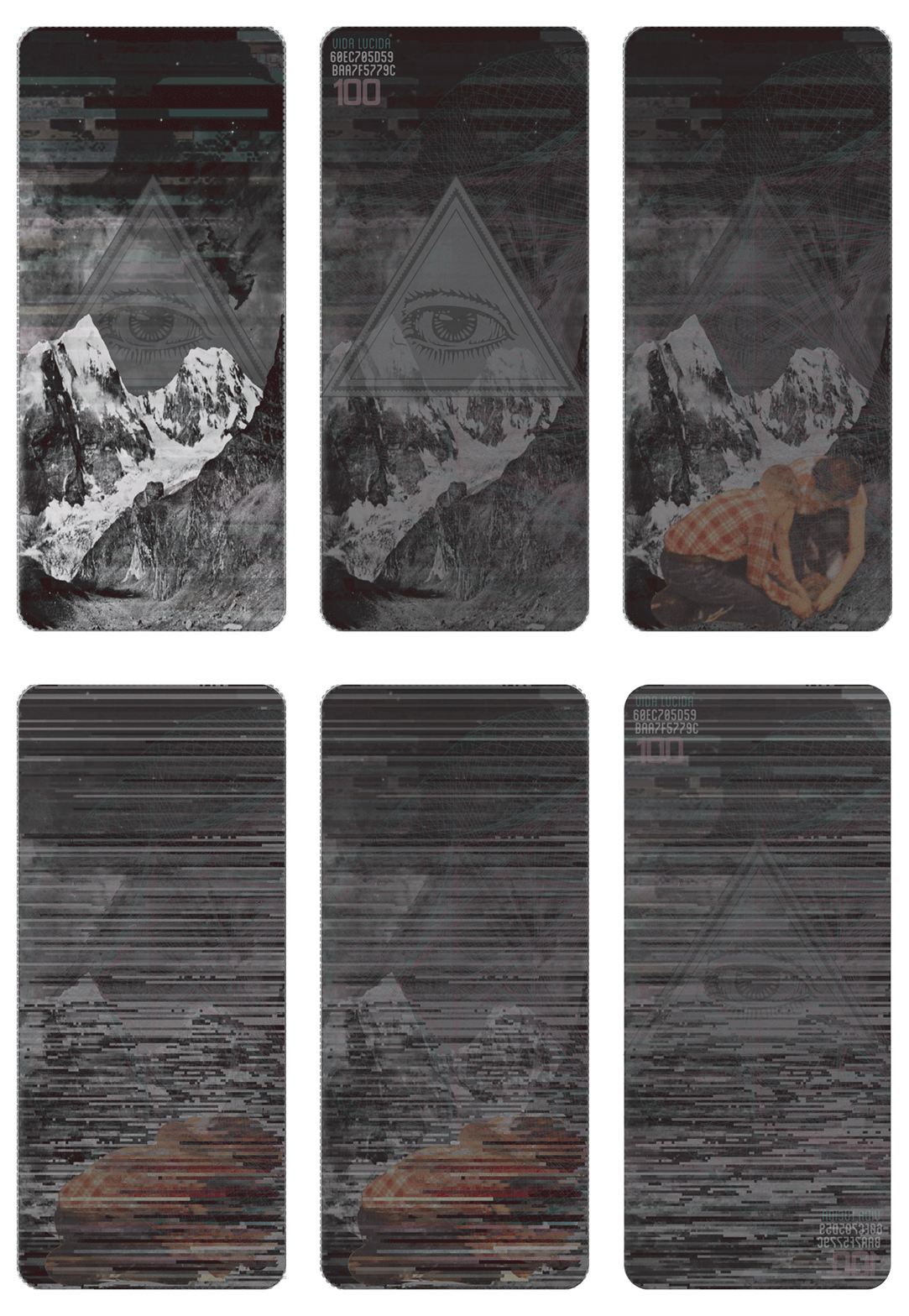
In the fall semester of 2012, I asked my beginning graphic design students at the University of Northern Iowa to design paper currency, for a fictitious country whose name was somehow related to theirs. It had to be self-portrait currency (in one way or another), with proposals for both front and back (as shown above). And then to make it more challenging, they were also asked to design an animated gif, based on the same banknote (below).
 |
| Animated Self-Portrait Currency (2012) © Randy Timm |
Thursday, February 21, 2013
Synergistic Postage Stamp | Danielle Shearer
 |
| Synergistic Stamp (2012) © Danielle Shearer |
In the fall semester of 2012, I asked my beginning graphic design students at the University of Northern Iowa to design a synergistic postage stamp. This was done in two stages: First, they designed a single stamp (above), and second, they repeated that stamp so that it became a block (below). Once assembled as a block, the stamps produced new, unanticipated pattern consequences.
 |
| Block of Stamps (2012) © Danielle Shearer |
Tuesday, February 19, 2013
Animated Currency | Kimber Bates
 |
| Animated Self-Portrait Currency (2012) © Kimber Bates |
In the fall semester of 2012, I asked my beginning graphic design students at the University of Northern Iowa to design paper currency, for a fictitious country whose name was somehow related to theirs. It had to be self-portrait currency (in one way or another). And then to make it more challenging, they were also asked to design an animated gif, based on the same banknote.
Sunday, February 17, 2013
Versluis | Behrens Beetle Montage
 |
| David Versluis & Roy R. Behrens, Beetle (©2012) |
In two earlier posts, I talked about a recent collaboration with my friend and fellow designer David Versluis, in which (in early 2012) we worked together on a series of digital montages about Iowa insects. We did all this by email, by taking turns (as if we were playing chess) while passing files back and forth. One of my favorites is Yellow Jacket, and another is Cicada. But a third one that I like a lot is shown above, titled Beetle.
•••
Kenneth Williams, in R. Davies, ed., The Kenneth Williams Diaries (1993)—
How impossible it is for me to make regular entries in the diary. I suddenly remember how I used to puzzle over that word at school. Always wondering why diary was so like Dairy and what the connection was. Never found out.
•••
Anon (an old joke)—
Question: What do you call a Frenchman in sandals?
Answer: Philippe Philoppe.
Sunday, February 10, 2013
Synergistic Postage Stamp | Randy Timm
 |
| Synergistic Stamp (2012) © Randy Timm |
In the fall semester of 2012, I asked my beginning graphic design students at the University of Northern Iowa to design a synergistic postage stamp. This was done in two stages: First, they designed a single stamp (above), and second, they repeated that stamp so that it became a block (below). Once assembled as a block, the stamps produced new, unanticipated pattern consequences.
 |
| Block of Stamps (2012) © Randy Timm |
Animated Currency | Christian Gargano
 |
| Animated Self-Portrait Currency (2012) © Christian Gargano |
Animated Currency | Kellie Heath
 |
| Animated Self-Portrait Currency (2012) © Kellie Heath |
In the fall semester of 2012, I asked my beginning graphic design students at the University of Northern Iowa to design paper currency, for a fictitious country whose name was somehow related to them. It had to be self-portrait currency (in one way or another). And then to make it more challenging, they were also asked to design an animated gif, based on the same banknote.
Saturday, January 26, 2013
A Farewell to Artist Les Coleman
 |
| Les Coleman / RIP |
Our friend of many years has died.
British artist Les Coleman liked to say that he was born "one day before peace broke out," making him one of the last World War II "war babies." He died peacefully on January 17, 2013, at Trinity Hospice in Clapham. I recall that we were introduced by another friend, Patrick Hughes. We never met, but for many years he sent me a torrent of "unthunks." In one of them, for example, he simply printed up a card (blank on the verso) that on the recto reads like this: THIS CARD IS TEMPORARILY OUT OF STOCK.
At the conclusion of one of his books, titled Meet the Art Students (1997), he added a brilliantly absurd author's note. Here it is—
Les Coleman moved to Clapham Junction in 1967. During the summer of that year, The Summer of Love, he lost his wallet on Dartmoor containing two pound notes. A doctor found the wallet and handed it in to the police. It took until the autumn to trace Coleman to his new address. He collected the wallet from the Lavender Hill Police Station to discover the money was still inside. In the autumn of 1996 he painted the walls of his front room Sunbeam with Moonshine on the woodwork. In keeping with this color scheme the room has a blue fitted carpet (80% wool) and yellow venetian blinds (made to measure). Among his possessions Coleman owns a small African sculpture which stands on his mantelpiece despite having one leg shorter than the other.
Over the years, I republished many of his unthunks and his drawings, some in Ballast Quarterly Review, and more recently on this blog. I "thunk" he would have chuckled at the gravestone that I've made for him (see above). His humor lives on—
The three letters of the alphabet I most dislike are D, I and Y.
One day America will turn into one big gun.
Why do rabbit droppings look like currants and taste like shit?
Once dead the artist falls into a rut.
He put on his dark glasses and rode off into the sunset.
Is turvy-topsy the same as topsy-turvy?
Wednesday, January 2, 2013
Book Review | Dard Hunter as Designer

Dard Hunter: The Graphic Works
by Lawrence Kreisman
Pomegranate, Petaluma, CA, 2012
112 pp., illus. 120 col. Trade, $29.95
ISBN: 978-0764961854.
In 1903, an Ohio chalk talk artist named William J. (Dard) Hunter (1883-1966) was touring the U.S. as an assistant for his brother, a stage magician. On a terribly hot day in California, their act was scheduled to follow a lecture by orator William Jennings Bryan (now famously remembered as the villain in Inherit the Wind). All the show props were in place when Bryan arrived, but backstage as he groped for the curtain, he became hopelessly entangled and ripped out wires, strings and threads. Annoyed by the great man’s clumsiness, Hunter secretly dumped red chalk dust into Bryan’s hat, which he had left backstage. After the talk, Bryan jauntily placed his hat on his already perspiring bald pate and walked out into the blazing sun, where he became—literally—red-faced.
I got that from Hunter’s autobiography, My Life with Paper (easily one of my favorite memoirs). That story is not in this welcome new book because its space is limited, and it is an effort to try to zoom in on his achievements as a graphic designer. In fact, it may be the first book to focus so intently on that aspect of his life, because he is far better known as the last century’s foremost authority on handmade papers, an interest that led him to travel the world and to write twenty books about the craft and history of papermaking. There is even a group that meets annually called Friends of Dard Hunter: American Contemporary Hand Papermaking.
Dard Hunter had come from a family of Ohio job printers and newspaper publishers, so, from a youthful age, he was well acquainted with type, inks, paper and printing. During that 1903 tour with his brother’s magic act, he stayed at the Mission Inn in Riverside, California, an early Arts and Crafts landmark. To see that building (and its interior furnishings) piqued his interest and changed his life.
In 1904, he moved to East Aurora, New York (near Buffalo), where he joined the Roycroft Workshops, headed by Arts and Crafts guru Elbert Hubbard. While there (he was allied with Roycroft, off and on, for about six years), he was able to experiment (without having to earn a living) with a range of handicraft media (especially jewelry, furniture and stained glass) and the design of such hand printed items as letterheads, business cards, postcards, advertising booklets, catalogs, bookplates, initial letters, title pages, and entire books. This book reproduces about 85 full-color images of his designs for print and stained glass, the majority of which most readers, even die-hard Hunter fans, are unlikely to have seen before.
 |
| Dard Hunter design for an Elbert Hubbard aphorism (1908) |
During and after his years with Roycroft, Hunter was able to make two research trips to Europe, initially to Vienna in 1908 (newly married, the trip was also a honeymoon), where he witnessed first hand the work of artist-designers allied with the Wiener Werkstatte. He met briefly with Vienna Secession leaders Josef Hoffman and Otto Wagner (neither of whom spoke English), and with architect Adolf Loos (who did speak English, and was especially gracious).
Returning to East Aurora, Hunter was excited about the possibilities of the Arts and Crafts Movement. Almost immediately, he began to prepare to return to Europe in 1910, this time not just as a tourist, but to stay longer and to study in Vienna, to visit Arts and Crafts centers in Germany, and lastly to live briefly in London, where he worked as a designer. In late 1911, he returned from Europe with his wife, distanced himself from the Roycroft Workshops, and soon set up a paper mill in Marlborough-on-Hudson in New York State, where he committed himself to the handmade production of paper. He eventually resettled in Ohio, where, in essence, he devoted his remaining life to the art, craft and science of papermaking. more…
Book Review | Design Before Designers
 |
| Ad for Chromatic Jobber printing press (c1886) |
Graphic Design Before Graphic Designers:
The Printer as Designer and Craftsman 1700-1914
by David Jury
Thames and Hudson, London and New York, 2012
312 pp., illus. 219 b&w/560 col. Trade, $60.00
ISBN: 978-0-500-51646-1.
This is a richly illustrated book on the history of printing—or, more accurately, on one area of printing. It is not a history of “book printing,” but of a less exalted branch called “job printing.” Historically, book printers (or so it has long been widely assumed) are prestigious purveyors of culture, while job printers are those who produce “ephemera,” the everyday stuff that is rarely preserved—handbills, posters, tickets, advertisements, trade cards, stationery, labels, receipts, passports, charts, certificates, postage stamps, banknotes and so on.
When Samuel Johnson wrote his Dictionary (1755), he made no distinction between designing and printing—a typographer, by his definition, was “a printer.” Continuing well into the twentieth century, arranging elements on a page was part and parcel of printing, so there was no additional cost for “graphic design,” a phrase that is commonly said (erroneously, I think) to have been used for the first time by book designer W.A. Dwiggins in 1921. Today, as designers and their clients know, graphic design is its own thriving category, and the work of a graphic designer is billed in addition to printing.
This well-written and beautiful book, titled Graphic Design Before Graphic Designers: The Printer as Designer and Craftsman 1700-1914, is a history of what printers did, as clandestine designers, in advance of the formal establishment of graphic design as a career field. It also provides an account of how the design services of craft-based printers were deliberately discredited by graphic and advertising designers in order to justify charging for a service that had once been gratis. Surely, it must have been argued, the author writes, “the modern businessman’s media requirements could only be addressed by a new profession made up of university-trained communication strategists.”
The book is organized in chronological, alternating chapters (there are six in all, plus other parts), each of which offers two components: First, a persuasively-written historical text, detailing what took place, in what order and why, including the names and achievements of individuals who were major players. These narratives are illustrated by well-chosen informative images from the history of printing. Second, each chapter also features about 30 pages of the most wonderful full-color images of examples of job printing, from every category imaginable. more…
Monday, December 17, 2012
Versluis | Behrens Cicada Montage
 |
| Cicada Digital Collage (2012) © David Versluis & Roy R. Behrens |
•••
From
R.V. Jones, “The theory of practical joking—its relevance to physics,” in R.L.
Weber, compiler, A Random Walk in Science.
London: Institute of Physics, 1973, pp. 10-11—
[American physicist] R.W. Wood is said to have spent some time in a flat in Paris where he discovered that the lady in the flat below kept a tortoise in a window pen. Wood fashioned a collecting device from a broom-handle,and bought a supply of tortoises of dispersed sizes. While the lady was out shopping, Wood replaced her tortoise by one slightly larger. He repeated this operation each day until the growth of the tortoise became so obvious to its owner that she consulted Wood who, having first played a subsidiary joke by sending her to consult a professor at the Sorbonne whom he considered to be devoid of humor, advised her to write the press. When the tortoise had grown to such a size that several pressmen were taking a daily interest, Wood then reversed the process, and in a week or so the tortoise mysteriously contracted to its original dimensions.
•••
From
Roy Paul Nelson, The Cartoonist.
Eugene OR: Seven Gables Press, 1994, pp. 57-58—
Combining frequent spraying with baby talk, Margaret [a
co-worker at a newspaper] worked hard to keep a bevy of plants alive in her
work area. She paid special attention to a demagnetized cactus plant she kept
next to her computer. This prompted a newsroom prank.
A.L. (Al) Blackerby’s wife ran the Cacti City store in New
Camden. With her cooperation, Al and I sneaked back to the office each Friday
night to substitute a slightly larger cactus for the one Margaret had grown
used to that week. As someone with an art background, I drew the job of finding
a cactus that matched the shape of the one to be replaced. The intervention of
the weekend helped mask any inconsistencies. The growth change was just enough
to catch her attention each Monday. She even wrote a feature, “Computer
Nearness Spurs Cactus Growth,” about the phenomenon.
Then, of course, we reversed the process, making
the plant grow smaller each week. Eventually we made the changes so dramatic
and erratic that she couldn’t help but catch on. She traced the prank to Al and
me, and, for a time, she wouldn’t speak to either of us.
One day, after we became friends again, she came to me to ask if
I would teach her to drive. It was something I didn’t particularly want to do.
"What about your husband?" I asked.
"Oh, he already knows how."
"What about your husband?" I asked.
"Oh, he already knows how."
Subscribe to:
Comments (Atom)