Monday, March 25, 2019

Walter SH Hamady | Books Boxes and Collages

According to someone, there are two types of people in the world: Those who believe that there are two types of people—and those who don’t. Among the former was the Greek poet Archilochus, who believed that people tend to be either foxes or hedgehogs. Foxes are centrifugal, hedgehogs centripetal. “The fox knows many things,” he said, “but the hedgehog knows one big thing.”
     
For years I have admired the work of Walter Hamady (his extraordinary handmade letterpress books, his collages and assemblages), but now and then I’ve asked myself: “Is Walter a fox or a hedgehog?”…more>>>

Thursday, March 21, 2019

National Parks Posters | Roy R. Behrens 2019

National Parks Posters
In late December and early January 2018-19, we designed twenty-three posters to commemorate National Parks and Monuments. These are currently on exhibit in the interpretive building at the Hartman Reserve Nature Center in Cedar Falls IA. They will remain on view throughout March and April 2019. The exhibition is free and open to the public. It can be viewed any time during building hours (it's open every day but Saturdays).

As of today, they have also been posted on our website in an online virtual exhibition.

Wednesday, March 20, 2019

Good, Bad—and Philip Evergood (in Iowa)

Philip Evergood in Iowa
Above Back in the late 1950s, the American painter Philip Evergood was a visiting artist for two summers at the Department of Art at the Iowa State Teachers College (now the University of Northern Iowa). Some people still remember it. We wrote an essay about it in 1998, which we've now revised and posted on our website. more>>>

Friday, March 15, 2019

Oh, the farmer and the cowman must be friends

Dude (2019)
Rodgers and Hammerstein, Oklahoma! (1943)—

The farmer and the cowman should be friends,
Oh, the farmer and the cowman should be friends.
The cowman ropes a cow with ease, the farmer steals her
butter and cheese,
But that's no reason why they cain't be friends—

Oh, the farmer and the cowman should be friends.

•••

The American poet Robert Penn Warren (whose voice I love to listen to) came from Southern roots, and some of his ancestors had served on the Confederate side during the American Civil War. In Warren's wonderful memoir (which I have just finished reading), Portrait of a Father (Lexington: University Press of Kentucky, 1988), he recalls a misunderstanding he had when, as a boy, he was visiting his maternal grandfather's home. Here's the story—

There was another remark among the daughters which seemed related to the notion that the old man [his grandfather] was a visionary. They had said, more than once in their protracted and loving diagnosis of their father, that he was a "Confederate reader." Or so it seemed. I would wonder what a "Confederate reader" might be. But as my vocabulary widened, it suddenly dawned on me that the old man was an "inveterate reader." In fact, he was. As long as eyes held out.

Sunday, March 10, 2019

New National Parks Posters | Hartman Reserve

National Parks Poster Exhibition (2019)
Above In recent days a new exhibition has been installed of full-color posters on the theme of National Parks and Monuments. The exhibition will remain on view throughout March and April 2019 in the interpretive building at the Hartman Reserve Nature Center at 657 Reserve Drive in Cedar Falls IA.

Of the twenty-six posters featured, three were designed in 2016 by Allison Rolinger, and can be viewed online here. Rolinger, a graphic designer at 5IVE in Minneapolis, is originally from Cedar Falls, and a graduate of the University of Northern Iowa, where she earned a BA degree in Graphic Design in 2017.

The remaining posters were designed in recent months by Roy R. Behrens, UNI Professor Emeritus and Distinguished Scholar. A graduate of the Rhode Island School of Design, he taught graphic design, illustration and the history of design for forty-six years at American universities and art schools, including UNI. He retired from teaching in December 2018. His National Parks posters can also be viewed online.

The Nature Center's interpretive building is open to the public from 8:00 am to 4:30 pm, Monday through Friday, and from 1:00 to 5:00 pm on Sunday. The building is not open on Saturdays. The exhibition is free and open to the public.


Poster (2019) © Roy R. Behrens


Monday, February 25, 2019

Long Lost Wedding Photograph Found

Mr. and Mrs. Arnold Finney (wedding photograph)
Above How fortunate. After all these years, we have at last recovered our long lost wedding photograph (c1434). At the time I was using the pseudonym of Arnold Finney, a cousin of the famous star Albert Finney (died recently). If I were only more observant, I surely would have noticed then that some of Mary's fingers are the length and proportion of string beans. No wonder those gloves I gave her didn't fit.

Wednesday, February 20, 2019

National Parks Poster Series | Yosemite

Poster (2019) © Roy R. Behrens
Above Yosemite National Park (2019). © Roy R. Behrens. From an on-going series of posters about wildlife habitats, and national parks and monuments.

Sunday, February 17, 2019

Monday, February 4, 2019

National Parks Poster Series | Rocky Mountain

Poster (2019) © Roy R. Behrens
Above Rocky Mountain National Park (2019). © Roy R. Behrens. From an on-going series of posters about wildlife habitats, and national parks and monuments.

National Parks Poster Series | Everglades

Poster (2019) © Roy R. Behrens
Above Everglades National Park (2019). © Roy R. Behrens. From an on-going series of posters about wildlife habitats, and national parks and monuments.

National Parks Poster Series | Chaco Canyon

Poster (2019) © Roy R. Behrens
Above Chaco Canyon National Park (2019). © Roy R. Behrens. From an on-going series of posters about wildlife habitats, and national parks and monuments.

National Parks Poster Series | Carlsbad Caverns

Postre (2019) © Roy R. Behrens
Above Carlsbad Caverns National Park (2019). © Roy R. Behrens. From an on-going series of posters about wildlife habitats, and national parks and monuments.

National Parks Poster Series | Bryce Canyon

Poster (2019) © Roy R. Behrens
Above Bryce Canyon National Park (2019). © Roy R. Behrens. From an on-going series of posters about wildlife habitats, and national parks and monuments.

National Parks Poster Series | Glacier

Poster (2019) © Roy R. Behrens
Above Glacier National Park (2019). © Roy R. Behrens. From an on-going series of posters about wildlife habitats, and national parks and monuments.

National Parks Poster Series | Grand Canyon

Poster (2019) © Roy R. Behrens
Above Grand Canyon National Park (2019). © Roy R. Behrens. From an on-going series of posters about wildlife habitats, and national parks and monuments.

National Parks Poster Sereis | Lincoln Memorial

Poster (2019) © Roy R. Behrens
Above Lincoln Memorial National Monument (2019). © Roy R. Behrens. From an on-going series of posters about wildlife habitats, and national parks and monuments.

National Parks Poster Series | Petrified Forest

Poster (2019) © Roy R. Behrens
Above Petrified Forest National Park (2019). © Roy R. Behrens. From an on-going series of posters about wildlife habitats, and national parks and monuments.

National Parks Poster Series | Sequoia

Poster (2019) © Roy R. Behrens
Above Sequoia National Park (2019). © Roy R. Behrens. From an on-going series of posters about wildlife habitats, and national parks and monuments.

National Parks Poster Series | Yellowstone

Poster (2019) © Roy R. Behrens
Above Yellowstone National Park (2019). © Roy R. Behrens. From an on-going series of posters about wildlife habitats, and national parks and monuments.

Sunday, February 3, 2019

National Parks Poster Series | Joshua Tree

Poster (2019) © Roy R. Behrens
Above Joshua Tree National Park (2019). © Roy R. Behrens. From an on-going series of posters about wildlife habitats, and national parks and monuments.

National Parks Poster Series | Mesa Verde

Poster (2019) © Roy R. Behrens
Above Mesa Verde National Park (2019). © Roy R. Behrens. From an on-going series of posters about wildlife habitats, and national parks and monuments.

National Parks Poster Series | Zion

Poster (2019) © Roy R. Behrens
Above Zion National Park (2019). © Roy R. Behrens. From an on-going series of posters about wildlife habitats, and national parks and monuments.

National Parks Poster Series | Great Smokies

Poster (2019) © Roy R. Behrens
Above Great Smoky Mountains National Park (2019). © Roy R. Behrens. From an on-going series of posters about wildlife habitats, and national parks and monuments.

National Parks Poster Series | Liberty Island

Poster (2019) © Roy R. Behrens
Above Liberty Island National Monument (2019). © Roy R. Behrens. From an on-going series of posters about wildlife habitats, and national parks and monuments.

National Parks Poster Series | Banff

Poster (2019) © Roy R. Behrens
Above Banff National Park (2019). © Roy R. Behrens. From an on-going series of posters about wildlife habitats, and national parks and monuments.

National Parks Poster Series | Badlands

Poster (2019) © Roy R. Behrens
Above Badlands National Park (2019). © Roy R. Behrens. From an on-going series of posters about wildlife habitats, and national parks and monuments.

National Parks Poster Series | Cuyahoga

Poster (2019) © Roy R. Behrens
Above Cuyahoga Valley National Park (2019). © Roy R. Behrens. From an on-going series of posters about wildlife habitats, and national parks and monuments.

National Parks Poster Series | Acadia

Poster (2019) © Roy R. Behrens
Above Acadia National Park (2019). © Roy R. Behrens. From an on-going series of posters about wildlife habitats, and national parks and monuments.

Monday, January 28, 2019

Ginger Rogers on the Treadmill | Testimonial

Weight loss evidence. Thank you, Ingres.
Above Thanks for all the appreciative notes with regard to my retirement. Not to mention the many good-natured inquiries about my plans to lose a little weight. From this, you'll notice the progress I've already made. I attribute most of it to my strenuous treadmill workouts. In particular, I have come up with a new exercise program, which I call the Ginger Rogers Routine. It's really quite simple: Dance backwards on the treadmill while wearing high heeled shoes. 

•••

Benvenuto Cellini, Autobiography (c1558)—

When I was about five years old my father happened to be in a basement chamber of our house, where they had been washing, and where a good fire of oak logs was still burning; he had viol in his hand and was playing and singing alone beside the fire. The weather was cold. Happening to look into the fire, he spied in the middle of those most burning flames a little creation like a lizard, which was sporting in the intensest coals. Becoming instantly aware of what the thing was, he had my sister and me called, and pointing it out to us children, he gave me a great box on the ears, which caused me to howl and weep with all my might. Then he pacified me good-humoredly, and spoke as follows: "My dear little boy, I am not striking you for any wrong that you have done, but only to make you remember that the lizard which you see in the fire is a salamander, a creature which has never been seen before by any one of which we have credible information." So saying, he kissed me and gave me some pieces of money.

Sunday, January 27, 2019

Find the Three Skulls in this Picture | Holbein

After Hans Holbein, The Ambassadors (1533)
Above The pleasures of having a name that means "king"; with apologies to Hans Holbein the Younger (saw the original recently). My official retirement portrait, complete with academic regalia. Can you find the three skulls in this picture?

•••

Edward King, Anecdotes (recalling his friendship with Jonathan Swift, the author of Gulliver's Travels)—

The last time I dined with [Jonathan] Swift, which was about three years before he fell into that distemper which totally deprived him of his understanding, I observed that he was affected by the wine which he drank, about a pint of claret. The next morning, as were were walking together in his garden, he complained much of his head, when I took the liberty to tell him (for I most sincerely loved him) that I was afraid he drank too much wine. He was a little startled, and answered, that as to his drinking, he had always looked on himself as a very temperate man, for he never exceeded the quanity which is physician had allowed and prescribed him. Now his physician never drank less than two bottles of claret after dinner.

Tuesday, January 22, 2019

Charles Henry Bennett / Shapeshifting Cat

C.H. Bennett, Poor Puss (1863)
Above One of a series of elaborate comic metamorphoses (aka shapeshifting) created by Victorian-era British illustrator Charles Henry Bennett (1863) in sardonic reference to Charles Darwin's theory of natural selection, this one titled "Poor Puss." Courtesy The Wellcome Library.

•••

The Reverend Benjamin Newton (Vicar of Landwit), Diary (September 1, 1816)—

An entertaining German dined here who teaches the girls music and plays delightfully and sings well with no voice having been shot through the lung. A Mr. Causer having been bit in a drunken frolic by a man of the name of Shipley in the leg last week is obliged to suffer amputation. During an armistice in which the Prussian and French officers were drinking together a son of [Prussian Field Marshall] Blücher gave for a toast the King of Prussia, which a French officer would not drink and soon after when it came to his turn gave [Napolean] Bonaparte which young Blücher would not drink, on which the officer went up to him and without saying anything struck him a smash in the face. Blücher said nothing but went out of the room and returned immediately with a pair of pistols, with one of which without uttering a word he shot the officer dead and then held up the other and said he had that ready for any man who would take up the quarrel. This came to his father's knowledge, who put him under arrest for six weeks.

Charles Henry Bennett / Shapeshifting Dog

C.H. Bennett, Good Dog (1863)
Above One of a series of elaborate comic metamorphoses (aka shapeshifting) created by Victorian-era British illustrator Charles Henry Bennett (1863) in sardonic reference to Charles Darwin's theory of natural selection, this one titled "Good dog." Courtesy The Wellcome Library.

•••

The Reverend Francis Kilvert, Diary (July 22, 1871)—

Mrs. Nott told me that Louie of the Cloggau was staying in Presteign with her aunt Miss Sylvester, the woman frog. This extraordinary being is partly a woman and partly a frog. Her head and face, her eyes and mouth are those of a frog, and she has a frog's legs and feet. She cannot walk but she hops. She wears very long dresses to cover and conceal her feet which are shod with something like a cow's hoof. She never goes out except to the Primitive Methodist Chapel. Mrs. Nott said she had seen this person's frog feet and had seen her in Presteign hopping to and from the Chapel exactly like a frog. She had never seen her hands. She is a very good person. The story about this unfortunate being is as follows. Shortly before she was born a woman came begging to her mother's door with two or three little children. Her mother was angry and ordered the woman away. "Get away with your young frogs," she said. And the child she was expecting was born partly in the form of a frog, as a punishment and a curse upon her.

Sunday, January 13, 2019

Audubon's Birds of America Re-Interpreted

Waterloo Courier (Waterloo IA), January 13, 2019
Above Screen grab of the cover page of the Sunday Living Section of the Waterloo Courier, January 13, 2019, with an article, written by Melody Parker, about an exhibition of Audubon-themed student posters at the Hartman Reserve Nature Center, in Cedar Falls IA. Many of the same posters were posted earlier on this blog in 2017.

•••

The posters in this exhibit here were produced in the fall of 2017 by undergraduate students at the University of Northern Iowa. They resulted from a problem that was given in an introductory course in graphic design. When the course began, most of the students had little if any experience in designing, whether the process of layout (arranging parts within a page) or the use of appropriate software.

Each student was asked to design a suite of three posters that would be used to advertise an exhibition of the posters they themselves had made. Titles, dates, locations and other text components were provided, as was the agreed upon emphasis on the exhibition’s title, RARA AVIS: A Poster Exhibition About Audubon’s Birds.

All images used in the posters were extracted from online high resolution images from American naturalist John James Audubon’s famous book, The Birds of America, first published in 1827 and 1838. His paintings are now in public domain, out-of-copyright, and available freely for download at their large, original size.

The series of posters was given the name RARA AVIS to signal that these are not merely unaltered reproductions of Audubon’s original artwork. Instead, the problem required that each student reinterpret Audubon’s work. They were free to extract fragments from any of his paintings, to dissemble them, to remix and rearrange the parts. The Latin term rara avis (which translates literally as “rare bird”) is suitable for the eccentric results.

Some of the student designers whose work is represented have since graduated. The work of nine designers is shown, including Sophia Grover, Ross Hellman, Sydney Hughes, Lydia Madsen, Hanna Seggerman, Cheyenne Strelow-Varney, Mallory Thurm, Samantha White, and Charles Williams. The course instructor, UNI Professor Emeritus and Distinguished Scholar Roy R. Behrens, retired at the end of 2018 after 46 years of teaching.

Saturday, December 29, 2018

Iowa's Buffalo Bill Is the Man in the Moon

View Larger
Vincent Starrett (Chicago Tribune book columnist Charles Vincent Emerson Starrett), Born in a Bookshop: Chapters from the Chicago Renascence. Norman: University of Oklahoma Press, 1965, p. 154—

My only other clear memory of Washington days is a visit to Keith's Theater, where I heard and met the famous old minstrel James Thornton and his wife Bonnie. The rest of the bill was a bust as far as I was concerned, but the opportunity to meet the man who had written "When You Were Sweet Sixteen"—to say nothing of "My Sweetheart's the Man in the Moon" and "The Irish Jubilee"—was too good to miss…But I was sorry to have missed an encounter, a few weeks earlier, between Jimmy and Colonel William F. Cody. The theater manager told me about it with great glee. Cody also had been eager to meet an old favorite, and Jimmy had been brought around to his box. The manager made the introductions. "Jimmy," he said, "I want you to meet the famous Buffalo Bill, who is an admirer of yours." "Glad to know you, Mr. Bill," said Jimmy, shaking hands solemnly. "What part of Buffalo do you come from?"

The secret handshake?

Charles Henry Bennett | Shapeshifting Fox

C.H. Bennett, Metamorphosis (1863)
Above One of a series of elaborate comic metamorphoses (aka shapeshifting) created by Victorian-era British illustrator Charles Henry Bennett (1863) in sardonic reference to Charles Darwin's theory of natural selection, this one titled "Beware of the goose when the fox preaches." Courtesy The Wellcome Library.

•••

Vincent Starrett (Chicago Tribune book columnist Charles Vincent Emerson Starrett), Born in a Bookshop: Chapters from the Chicago Renascence. Norman: University of Oklahoma Press, 1965, pp. 295-296—

It is curious how the faces of acquaintances repeat themselves in foreign lands. Uncanny, too, for what could be more disconcerting than to encounter an old friend jogging past dressed like a mandarin or selling chestnuts in coolie cloth? No sooner had I reached the Orient than this began to happen. Friends and associates I thought I had left behind in America, sometimes fellows I hadn't seen in years, popped up in Yokohama, Tokyo, Shanghai, and Peking, looking very much as I had seen them last, yet subtly altered by the native costumes they were wearing. It was as if one met them coming from a masquerade. In Yokohama it was an old school friend who had been dead for years. He was running a cigarette kiosk near the docks and I knew better than to speak to him. In Tokyo it was a genial barber who used to shave me in Chicago. And in Peking [Beijing] here were so many that my blood ran cold.

Among the friends I met in Chinese garb (and with Chinese faces) were some pretty distinguished fellows…I saw Alex Woollcott many times: once he was chirping seductively at a bird he was carrying through the streets in a bamboo cage. Once my dead mother turned out of a side street and gave me a turn that almost bowled me over. Once I met Bob Casey driving a small donkey attached to a two-wheeled cart: he was selling vegetables. After a time it became an amusing game to look for absent friends and sometimes to hail them genially, and no harm came of it for the Chinese were a friendly people, always ready to hail one in return.

But one day I really did get a shock. Rolling down one of the main thoroughfares of Peking in my rickshaw, I came suddenly abreast of another rickshaw rider headed in the opposite direction. He was bundled up in a fur coat and wore a fur hat, rather like a turban, at a rakish angle. He looked exactly like J. P. McEvoy and for a moment we looked hard at each other. Then I said, “Hello, Mac,” and he stopped his boy and said, “Why, hullo, Vince! What are you doing in Peking?”

Thursday, December 27, 2018

George Herriman | Are Cubists From Cuba?

George Herriman (1914)
Above A syndicated cartoon panel (repositioned vertically to read while scrolling) by the American master cartoonist, George Herriman, well-known because of Krazy Kat. This was one of his responses to the controversy surrounding the infamous Armory Show, the first US exhibition of Modern styles of art, Cubism among them.

Sunday, December 23, 2018

Milton Glaser on All Life as Transcendence

Above This image, created by Thomas Kent, was published in the Strand Magazine in 1909. It was one of a number of graphic peculiarities. A pencil-drawn portrait, it was accomplished with a single continuous line that originated at the tip of the nose.

•••

American graphic designer Milton Glaser, interviewed in Joan Evelyn Ames, Mastery: Interviews with 30 Remarkable People (Portland OR: Rudra Press, 1997), pp. 84-85—

I remember Rudi [a friend and teacher] saying once that all life is about transcendence. If you’re ugly you have to transcend your ugliness, if you’re beautiful you have to transcend your beauty, if you’re poor you have to transcend your poverty, if you’re rich you have to transcend your wealth… There is nothing worse than being born extraordinarily beautiful, nothing more potentially damaging to the self. You could say the same for being born inordinately rich. You suddenly realize how wise the idea is that you get nothing at birth except things to transcend. That’s all you get.

Tuesday, December 18, 2018

Robert Frost and Darwin | Metamorphosis

Visual metamorphosis
Above Fr. Schmidt, Table 2. Evolution of household articles, animals, etc. according to Darwin's doctrine. Hand-colored lithographic, c. 1870s. Courtesy the Wellcome Library. Creative Commons license CC by 4.0.

•••

Louis Untermeyer, Bygones: The Recollections of Louis Untermeyer. New York: Harcourt, Brace and World, 1965—

[As a young writer]…I was much given to a style that employed epigrammatic checks and balances, appositions, paradoxes, and puns. I remember dismissing a rather commonplace collection of Gaelic poetry as "A Child's Garden of Erse" and characterizing the author of an abortive American epic as "A Yankee Doodle Dante." I referred to a Dowson-Beardsley pastiche as being "less erotic than Pierrotic. I inquired, since much of the Restoration comedy of manners took place in elegant country houses, was it not a comedy of manors? [p. 44]…

[His friend] Robert Frost, the most penetrating as well as the most profound poet of our time, might be expected to have been an anti-punster. On the contrary, he made point after point by punning; one of the favorite games during our fifty-year friendship was hurling word-plays at each other. He insisted that the most American trait was a combination of patriotism and shrewdness; he called it "Americanniness." He made fun of Mussolini and his cultural pretentions as the poet's dictator, "the great Iamb." He wrote about the liberal lugubrious poetry of Conrad Aiken and spelled the name "Conrad Aching." Ezra Pound was, he said, a glittering confuser of showmansip and erudition, a "Greater Garbler." "T.S. Eliot and I have our similarities and our differences," he wrote to me. "We are both poets and we both like to play. That's the similarity. The difference is this: I like to play euchre; he likes to play Eucharist." [pp. 45-46]

Death Begins at Forty | Art Deco Illustration

Cover illustration (c1938)
Above, Artist unknown, "Death Begins at Forty." Magazine cover illustration published by Travelers Insurance Companies, c1938. Courtesy New York Public Library.

•••

Louis Untermeyer, Bygones: The Recollections of Louis Untermeyer. New York: Harcourt, Brace and World, 1965—

[Recalling his earlier immature writings] They were, as someone is supposed to have said, the kind of thing one should go to the trouble of not writing.…

It is as a poet that I most resent those resentful of puns, for the pun is, per se, a poetic device. Poetry is essential a form of play, a play of metaphor, a play of rhyme. The pun is another form of syllabic playfulness, a matching of sounds that, like rhyme, are similar yet not quite the same—a matching and shifting of vowels and consonants, an adroit assonance sometimes derided as jackassonance. Whatever form it takes, searching or silly, the pun springs spontaneously from the same combination of wit and imagination which speeds the poetic impulse.

[James] Joyce might well have tesitifed for the defense. Finnegans Wake, with its "Ibscenest nansence," "There's no plagues like Rome," "Wring out the clothes! Bring in the dew!" is a book-length frolic of puns. The nonrational logic of the man-level parable (or parody) of the life of everyman embodies more than a thousand word-plays, which makes Joyce the most riotous punster since Shakespeare (p. 45).

Saturday, December 15, 2018

Poster | Why Angels Take Themselves Lightly

Poster © Roy R. Behrens. Purchase online.
Cornelius Weygandt, On the Edge of the Evening: The Autobiography of a Teacher and Writer Who Holds to the Old Ways. New York: G.P. Putnam's Sons, 1946—
 
We had nearly all of us been brought up on the King James version of the Bible, Mother Goose, Pilgrim's Progress, Paradise Lost, and Shakespeare. We were much easier to teach than the classes of today, classes in which there is no common denominator of culture [p. 56].

•••

…Captain Makins' daughter had made the voyage to the Orient with her father on one of these trips. In her old age she was something of a Mrs. Malaprop, speaking of the cat licking her plumage and of the cedars of Zebulun. China was always Chiney to her and Portugal Portingale [p. 63].

•••

You are waiting for Dr. Phillips to haul you home by his car from the dentist's office at Fifteenth and Locust Streets. You have lost five teeth. An old man comes up to beg of you. He sees your despoiled gums. The hand that pockets your nickel withdraws from the pocket's depths a handful of teeth. "These are mine a dentist took out," he says, "at a dollar apiece. See how sound they all are. I wonder will I ever be able to sell them again for what they cost to have them pulled?" [pp. 76-77]

•••

[On first meeting him,] I got that impression of [Irish novelist] George Moore that I carry with me still. He was built like one of those little figures that you can not turn over, that are so heavy in their posteriors that no matter which way you put them down they come to a sitting posture. He had real eighteenth-century sloping shoulders and a seedy tobacco-stained lugubrious moustache not so walrus-like as [Irish linguist] Douglas Hyde's but incipiently walrus-like [p. 120].

Sunday, December 9, 2018

Tony Drehfal Engraving | Braiding Sweetgrass

Braided Sweetgrass © Tony Drehfal
Above In recent years, an old friend and fellow artist, Tony Drehfal from Nashotah WI, has become a devotée and skilled practitioner of one of our favorite art forms, wood engraving. He recently produced an image of strands of sweetgrass that had been braided by his wife, artist Jeanne Debbink. By the fortuitous meeting of minds, it has now been used as the cover of the Japanese edition of a book by Robin Wall Kimmerer, titled BRAIDING SWEETGRASS: Indigenous Wisdom, Scientific Knowledge and the Teachings of Plants (as shown below). You can learn more about Tony and his extraordinary prints at various online sites, including this one, and this one, and this one as well. And of course on Instagram.

Cover of Braiding Sweetgrass by Robin Wall Kimmerer

Tuesday, December 4, 2018

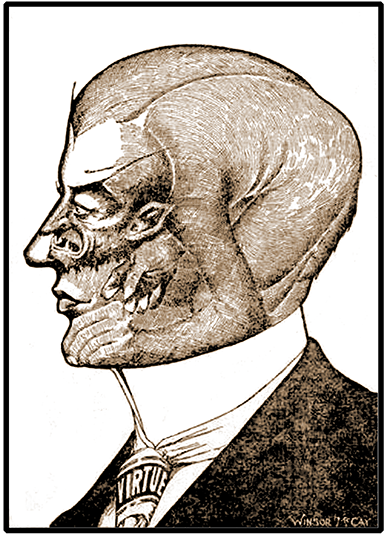
Winsor McCay | Brute in the Brain Illustration

The Brute in the Brain by Winsor McCay
Above An early uncharacteristic illustration by legendary comic page illustrator Winsor McCay, titled "The Brute in the Brain" (date and source unknown).

•••

Cornelius Weygandt, On the Edge of Evening: The Autobiography of a Teacher and Writer Who Holds to the Old Ways (New York: G.P. Putnam's Sons, 1946), p. 107—

In 1902 we went to Ireland…As we got off the ship there were women selling gooseberries on the quay. I had often heard of the proficiency in bad language of alewives. I was now to hear it. It was the time of the Boer War. A Tommy came by with a hat about the size of a teacup on one side of his head and the strap from it around under his chin to hold it in place. He said to the woman with the gooseberries, "Mother, how much the gooseberries?"

"You blank blank bastard of a blankety blank blank. I'm not your mother, and you may be very sure that I wouldn't have been. I'd have no child by a man that would get the like of you." And more of the same. And more of the same. I had been told by numerous kindly Irish people that the gooseberries in Ireland were as big as English walnuts in America. It is true they were. I was waiting for the old woman to show her dexterity by driving them at the offending Tommy, but she didn't. They were, I suppose, too previous. I had been intending to buy some, but she lost the sale. I was too afraid of what she might say to me to offer to buy any of them.

Let's Pretend | A Radio Series from the 1950s

Poster by Roy R. Behrens (2018)
Among the most vivid memories of my early childhood is that of listening to a fantastic children's radio program called Let's Pretend. I no longer recall any specific stories. All I remember is how powerfully engaging the performances were—as if they were visual, when in fact they consisted entirely of voices and sound effects.

Recently, I've been reading the autobiography of Terry Gilliam, the only American member of the Monty Python troupe, titled Gilliamesque (New York: HarperCollins, 2015). On page 9, he recalls his own American childhood, and the experience of reading books, in which a child may often engage in "translating that mental picture from two dimensional into three." How clearly I remember that in my early years of reading books. But then he goes on—

It's the same with the radio, which was all-powerful in America at that time [the early 1950s]. There was a children's radio show called Let's Pretend, which was one of my very first gateways to the fantastical. 

Mine too, for which I will always be grateful.