Louis Untermeyer, FROM ANOTHER WORLD: The Autobiography of Louis Untermeyer. New York: Harcourt, Brace and Company, 1939—
Nature-Themed Poster © Roy R. Behrens 2019
…[the poet Robert Frost] was the friend of [British poet and critic Lascelles] Abercrombie whom [American poet Ezra] Pound had challenged to a duel, the weapons to be unsold copies of their books at thirty paces. (p. 208)
[Frost] wrote to me: “There are two types of realist—the one who offers a good deal of dirt with his potato to show that it is a real one, and the one who is satisfied with the potato brushed clean. I’m inclined to be the second kind. To me the thing that art does for life is to clean it, to strip it to form.” (p. 209)
[Quoting from Frost’s preface to his own Collected Poems:] “Scholars and artists thrown together are often annoyed at the puzzle of where they differ. Both work from knowledge; but I suspect they differ more importantly in the way their knowledge is come by. Scholars get theirs with conscientious thoroughness along projected lines of logic; poets theirs cavalierly and as it happens in and out of books. They stick to nothing deliberately, but let what will stick to them like burrs where they walk in the fields.” (p. 210)
Thursday, March 31, 2022
Robert Frost / let what burrs will stick to them

Monday, March 21, 2022
too late / sick, dried up, and have no strength
Eleanor Ruggles, The West-Going Heart: A Life of Vachel Lindsay. New York: W.W. Norton, 1959—Vachel Lindsay album cover
From Cambridge, Massachusetts, the psychologist and philosopher William James acknowledged receipt of The Tramp’s Excuse and War Bulletin Number Three [which the poet Vachel Lindsay had sent him without asking]. Lindsay had read James’ The Varieties of Religious Experience, pondering it in the light of his [own] visions, and James was touched that this unknown youth should turn for “comradeship” to an academic personage like himself.
Only it was, he said, “too late, too late!”
He [James] was writing in October 1909, ten months before his death. “I am sick, dried up, have no strength to read aught but the barely needful for my own tasks, have grown, moreover, positively to hate poetry in these last years. I can only stand old poems learned by heart in my childhood and adolescence. How then should I shoot the rapids and ride the whirlwind and tramp the wilderness with you?”
James was not at all sure that he understood the “Map of the Universe.” “I do think Bulletin No. 3 anarchistic; I do think it incoherent; but I do think it may represent an excellent personal religion. Don’t enter the Catholic priesthood, whatever you do! Your semi-automatic inspirations are very interesting, in conjunction with your free attitude toward them…
“Go in peace and God be with you, brilliant being that you are, and leave me to my decrepitude.” [pp. 160-161].
•••
[Sixteen years later] In Washington [DC], in the dining room of the Wardman Park Hotel, a brown-skinned bus boy in a white jacket ignored senators and oil magnates, sidled shyly up to the wall table at which the only poet in the crowded room sat opposite his wife and laid a slim manuscript by [Vachel] Lindsay’s plate, That evening Lindsay opened his recital in the little theater of the hotel by reading the poems the boy had given him. It was the beginning of fame for the young Negro poet Langston Hughes” [p. 353].

Saturday, March 19, 2022
Vachel Lindsay | the fate of an unbroken colt
Eleanor Ruggles, The West-Going Heart: A Life of Vachel Lindsay. New York: W.W. Norton, 1959, pp. 185-186—Index of American Design (Public Domain)
Though by day the sky was a bright Kansas blue and the sun descended on the prairie like the stroke of a golden hammer, there was darkness and death at the Weaver place. Both Frank and his brother Forrest, who worked with him, had a certain hard attractiveness—“but their cruelty,” pronounced Lindsay in his diary, “was bottomless.”
On Sunday, July 7, he was in the sitting room writing letters when he heard a fearful row out beyond the barn. Frank and Forrest were exciting themselves by disciplining Dick, a frisky broncho colt, whom they had tied up and were beating over the head—one with a doubletree [a harnessing cross bar], the other with a pitchfork handle—while Forrest plied himself with swigs of whisky so that he could be as mean as Frank.
Lindsay heard the roars, oaths, thuds of the bar and stick, whinnies of pain and tattoo of hoofs all the long afternoon till at six o’clock Frank's fat and patient wife May ran over to the barn and protested, reminding the men it was Sunday and warning them they wouldn’t be blest and would lose a day’s harvest.
On Monday morning the little broncho Dick was hitched to the reaper along with three large mules. He went dancing out to the field, looking devilish, defiantly objecting to keeping his head on a line with the others and hauling the great load almost by himself. That night he came dancing home. On Tuesday he went out again dancing for battle, but returned at night dragging and panting.
On Wednesday, just past the hottest hour, Lindsay was working in the field with Forrest. About three o’clock the pony, who till then had been feebly dancing, went mad. He strained against his halter. His eyes were distended. Blood oozed from his mouth. His hide—a mass of wounds from Sunday’s torture—was clustered thick as fly paper with thirstily sucking flies.
Lindsay, who had never quite overcome his childhood terror of horses, put fear behind him and between them he and Forrest managed to pull the lunging animal away from the mules and restrain him by two halter ropes while Frank, the more savage brother, was sent for. Frank, cursing, tried to lead Dick back to the barn, but when they reached the pasture of long uncut prairie grass the pony sank down into it and kicked the air convulsively with all four feet. Then his heart broke and he died.
“If God gives me grace,” Lindsay pledged, alone with his diary, “some day I shall write his memorial—THE BRONCHO THAT WOULD NOT BE BROKEN.”
•••
NOTE In the decades following World War I, Nicholas Vachel Lindsay (1879-1931) was among the best-known poets in the US. His most popular poems include “General William Booth Enters Into Heaven” and “The Congo.” He traveled across the country, by walking, surviving in part by “singing” his poems and working as a short-term farm worker. Overcome by financial difficulties and depression, he took his own life on December 5, 1931, by drinking a bottle of lye.

The aesthetic value of rhymes, alliteration, and other language patterns, not unlike those that Lindsay used, are discussed in a 30-minute video here (free, with online access).
Saturday, March 12, 2022
as if jack were struck dumb in the pulpit of golf
Burges Johnson, As Much as I Dare: A Personal Recollection. New York: Ives Washburn, 1944, p. 105—a bouquet of golf clubs
After I had married and moved to Long Island, my cousin Tristam Burges Johnson died most dramatically in Washington DC.…While he was playing golf with Edgar Poe [a descendant of the writer] a storm threatened; there was no rain but some muttering of thunder. Poe went back to the club house, but Tristam walked across the links with an iron club over his shoulder to follow up one more shot, was struck by lightning and instantly killed. There was no other lightning flash and no rain storm followed. Naturally it made a dramatic story for the papers. Dr. [Henry L.] Stimson, who had not seen me for a long time, saw the headlines and [confusing Burges Johnson for his cousin] announced from his pulpit the death of a young man from his congregation. Then he wrote a letter to my young wife which I have always wanted to have framed because it seems to me that it is the only truly appreciative statement of my many virtues that I have ever read. Dr. Stimson was naturally embarrassed when he received my wife’s reply and I think always felt that the lightning had hit the wrong man.
* Edgar Allan Poe (1871-1961), who was Attorney General of the State of Maryland in 1911-1915, was a second cousin of Edgar Allan Poe (1809-1849), the celebrated writer. As a student at Princeton, he was the quarterback and captain of the football team in his junior and senior years, and was named All-American in 1889. After a football game in which Princeton beat Harvard, 41–15, someone from Harvard asked a Princeton alumnus whether Poe was related to “the great Edgar Allan Poe,” in response to which the alumnus said, “He is the great Edgar Allan Poe.”

Friday, March 11, 2022
recalling the death of Iowa poet Michael Andorf

When we did connect in person, it was largely because of our memories of a wonderful teacher of Literature and Theatre (at Independence High School), named Florence Helt. She was something, we agreed, and two of us were forever convinced that she had been a key factor in our shared thirst for writing.
In 2013, while I was teaching graphic design at the University of Northern Iowa, Michael agreed to come to my class as a visiting speaker. He read a number of his poems, which the students then responded to by designing digital images that "belonged with" each of those poems. When printed, multiples of the book were produced, assembled and bound in the form of a book. We gave signed copies to Michael, and a single copy was given to each student designer, as well as to regional archives.
In recent years, I've remained in touch with Michael, primarily through emails. I have always enjoyed his humor, and a chance to read his latest poems. I was saddened to learn that he died less than a week ago, on Saturday, on March 5, 2022. Here is an online connection to a pdf version of the book of poems that he, my students, and I produced just nine years ago. Please do share with others.
Saturday, March 5, 2022
the world's prettiest girls live in Des Moines IA

In the 1960s, as a high school student in Iowa, I was an avid follower of MAD Magazine. I also subscribed to the Village Voice. Concerned about my waywardness, my mother arranged for me to meet with a religious elder for an advisory conversation. I was a youthful artist then, and during that meeting the subject turned to visual art. The sagacious elder said to me that, only that morning, he had read an editorial in the Wall Street Journal that claimed that “Modern Art is a dung heap.”
Moments later, I was somewhat put at ease when he laughed goodnaturedly and said that it was his opinion that there was no reason for anyone to worry about me—I was simply going through a phase. Most likely, the source of my problem, he said, was that I was reading “too much MAD Magazine.” Out of politeness, I didn’t respond. But in my mind I wondered if the source of his problem was that he was reading “too much Wall Street Journal.”
I recall that a further concern at the time was my new-found interest in the Beat Generation and in writers referred to as “beatniks.” A few years earlier, a former football player from Lowell, Mass., named Jack Kerouac (one of whose high school classmates had been Ray Goulding of the hilarious Bob and Ray radio comedy team) had published a rambling, unorthodox novel called On the Road. Among my chief interests was literature, controversial or not. I had first read Kerouac’s book around 1962, including that now-famous passage in which he lamented having traveled through Iowa too quickly—“past the pretty girls, and the prettiest girls in the world live in Des Moines.”
When On the Road was first released in 1957, reactions from critics were radically mixed. As its notability spread, so did the fame of its author, who soon became referred to as the King of the Beats. His book was a pivotal influence on a generation of writers, musicians, and others, among them the Beatles, David Bowie, Bob Dylan, and Jim Morrison.… more>>>
Tuesday, March 1, 2022
in which William Bailey meets Albers at Yale
 |
| Josef Albers at Yale |
[While attending Cooper Union in 1953, and looking for an alternative school, someone] told me about Josef Albers and Yale. He said, "You might try going up there, because this man Albers has just arrived, and he’s changed everything there. And it should be a really interesting place.”
And so, I took a train up to Yale—to New Haven. I was told that I couldn't see Albers because I didn't have an appointment. Just then Albers opened the door to his office and said, “Do you want to see me, boy?” I said, “Yes.”…
I had this same little envelope of drawings, and a few black and white photographs of paintings that I had done. He showed me into his office, which was a spartan room with a door for the desk, and sawhorses holding the door up. Plain straight chairs, a huge plant by the window, glorious light coming in through the window, and this little man dressed [in] various grays, I remember. A gray suit, another kind of woven gray tie—probably woven by [his wife] Anni [Albers]—and a white shirt. Silver hair coming sort of Hitler-like across his brow. He looked at the things, and he proceeded to give me the most ferocious critique I'd ever had in my life. I was stunned, because people had always been very nice to me. They’d all agreed—whatever other things that were against me, yes, I was talented. He wouldn't grant me even talent! He just ripped into things! And then, here and there, he'd say, “But this is—here you see something! And here.”
So I was in this stunned state, when things calmed down. And he asked me about my life, and about the war, and what I’d been doing, and my ambitions and so on. And finally he said, “Okay, I take you!” I hadn't been applying. I mean, I just was there to find out about things. He said, “I take you.” I said, “Wait a minute! How much does it cost?” He said, “I don't know—ask the secretary!”
Monday, February 28, 2022
hurly burly Morris with few detachable phrases
Above Opening page of our published review of Linda Parry's biography of Arts and Crafts legend William Morris, as published in PRINT magazine (January / February 1997). Morris is featured briefly in the autobiography of one of his admirers, the Irish poet William Butler Yeats. In the passage quoted below, Yeats refers to Morris as having a "burly body." In reference to that, British satirist / caricaturist Max Beerhohm once wrote that Morris was "a wonderful all-round man, but the act of walking round him always tired me."Review of Linda Parry, William Morris

•••
William Butler Yeats, The Autobiography of William Butler Yeats: Consisting of reveries over childhood and youth, the trembling of the veil, and dramatic personae. New York: Macmillan, 1953, p. 89—
He had few detachable phrases, and I can remember little of his speech, which many thought the best of all good talk, except that it matched his burly body and seemed within definite boundaries inexhaustible in fact and expression. He alone of all the men I have known seemed guided by some beast-like instinct and never ate strange meat. “Balzac! Balzac!” he said to me once, “Oh, that was the man the French Bourgeoisie read so much a few years ago.” I can remember him at supper praising wine: “Why do people say it is prosaic to be inspired by wine? Has it not been made by the sunlight and the sap?” and his dispraising houses decorated by himself: “Do you suppose I like that kind of house? I would like a house like a big barn, where one ate in one corner, cooked in another corner, slept in the third corner, and in the fourth received one's friends”; and his complaining of Ruskin's objection to the underground railway [the Tube, the London subway]: “If you must have a railway the best thing you can do with it is to put it in a tube with a cork at each end." I remember, too, that when I asked what led up to his movement, he replied: "Oh, [John] Ruskin and [Thomas] Carlyle, but somebody should have been beside Carlyle and punched his head every five minutes.”
Wednesday, February 23, 2022
her broken cuckoo clock hoots at a stranger

•••
William Butler Yeats, The Autobiography of William Butler Yeats: Consisting of reveries over childhood and youth, the trembling of the veil, and dramatic personae. New York: Macmillan, 1953, pp. 106ff—
I found Madame Blavatsky in a little house at Norwood, with but, as she said, three followers left…and as one of the three followers sat in an outer room to keep out undesirable visitors, I was kept a long time kicking my heels. Presently I was admitted and found an old woman in a plain lose dark dress: a sort of old Irish peasant woman with an air of humor and audacious power. I was still kept waiting, but she was deep in conversation with a woman visitor. I strayed through folding doors into the next room and stood, in sheer idleness of mind, looking at a cuckoo clock. It was certainly stopped, for the weights were off and lying upon the ground, and yet, as I stood there the cuckoo came out and cuckooed at me. I interrupted Madame Blavatsky to say, “Your clock has hooted at me.” “It often hoots at a stranger,” she replied. “Is there a spirit in it?” I asked. “I should have to be alone to know what is in it.” I went back to the clock and began examining it and heard her say: “Do not break my clock.” I wondered if there was some hidden mechanism and I should have been put out, I suppose, had I found any, though [a friend, William Ernest] Henley had said to me, “Of course she gets up fradulent miracles, but a person of genius has to do something: Sarah Bernhardt sleeps in her coffin.” Presently the visitor went away and Madame Blavatsky explained that she [the visitor] was a propagandist for women’s rights who had called to find out “why men were so bad.” “What explanation did you give her?” I said. “That men were born bad, but women made themselves so,” and then she explained that I had been kept waiting because she had mistaken me for some man, whose name resembled mine and who wanted to persuade her of the flatness of the earth.…
A great passionate nature, a sort of female Dr. Johnson, impressive I think to every man or woman who had themselves any richness, she seemed impatient of the formalism and the shrill abstract idealism of those about her, and this impatience broke out in railing and many nicknames: “oh, you are a flap-doodle, but then you are a theosophist and a brother.” The most devout and learned of all her followers said to me, “[She] has just told me that there is another globe stuck on to this at the north pole, so that the earth has really a shape something like a dumbbell.”…
One American said to me, “She has become the most famous woman in the world by sitting in a big chair and permitting us to talk.” They talked and she played patience, and totted up her score on the green baise, and generally seemed to listen, but sometimes she would listen no more. There was a women who talked perpetually of “the divine spark” within her, until Madame Blavatsky stopped her with—“Yes, my dear, you have a divine spark within you and if you are not very careful you will hear it snore.”…
a poodle doth spare us the odium of a law suit
Above Giovanna Garzoni, Dog with Biscotti. Oil on canvas, 1648. Public domain.Giovanna Garzoni (1648)
•••
Abel G. Warshawky, The Memories of an American Impressionist. Kent State University Press, 1918, pp. 131—
An amusing story was told me in this connection by Robert Logan [1875-1942], the American etcher. A wealthy maiden lady of Boston had commissioned a local painter to do her portrait, and when it was finished had indignantly refused to take it on the grounds that the portrait was unrecognizable. Why even her pet poodle, she exclaimed, the loving companion of all her hours, had failed to recognize his mistress in the picture, which, as a matter of fact, was both an excellent painting and a first-rate likeness. Not wishing to risk the publicity and odium of a law suit to recover his fee, the portraitist in his dilemma turned for advice to a distinguished painter of his acquaintance, who also happened to know the recalcitrant lady. The latter in due course received a letter from the portrait painter, informing her that he had effected certain subtle changes in her picture and that if she would come to see it in his studio, she would, he felt sure, be highly satisfied with the result.
The invitation having been accepted, the friendly adviser appeared in the painter’s studio shortly before the hour appointed for the lady’s visit, bringing with him a piece of fresh bacon, which he proceeded to rub over the features of the portrait. When the lady arrived, bringing her poodle with her, she found the distinguished artist admiring her portrait and congratulating his colleague on the excellent resemblance he had obtained. To these eulogies the lady replied dryly that the portrait did not please her, and that even “darling Fido” did not recognize his mistress. “But, dear Madam,” insisted her friend, “are’t you aware that dogs, especially poodles, are notoriously shortsighted? Hold the little darling close to the picture, and then see if he does not recognize you.” Held close to the canvas, Fido, who sniffed the delicious aroma of bacon grease, made frantic efforts to kiss the painted image of his mistress, succeeding in applying several licks to her mouth, eyes, and nose. “See, Madam,” remarked the painter, “how the dog recognizes and adores your likeness.” Needless to say, the lady was won over to admiration and the portrait was paid for.

inoculated bodies, the stench of sick horses
Maurice Browne, Too Late to Lament: An autobiography. Bloomington: Indiana University Press, 1956, pp. 50-51. This is his eyewitness description of what it was like to be a British soldier aboard a troop ship, sailing to South Africa, during the Boer War in 1899. If this isn’t vivid enough, imagine later experiences of American soldiers on World War I troop ships, as they were being transported to France (c1918), stricken by mal de mer (seasickness) and the equivalent then of COVID-19, called Spanish flu—Marcel Ponty, travel poster (c1925)
A rolling, pitching ship; packed hammocks; beasts held upright by the sides of their narrow stalls; the stench of horses sick at both ends; on decks slippery with fifith, vomiting men leading voiding horses; a beast falling, a broken leg, a shot: another carcass heaved overboard; aching bodies, inoculated for typhoid, strewn about the deck; hard-bitten faces at poker round a barrel: “Keep out of this, young Browne—it’s no game for children”; the stillness of tropic seas; long glamorous days; endless blue; uproar amid endless hush.

Monday, February 21, 2022
imagine making your mother an arrangement
 |
| Title Slide (2013) © Roy R. Behrens |
No, that's not a nose bleed. It's a perfectly purposeful devious use of his fantastic signature—WBYeats. And below, don't miss out on the chance to read his autobiography. There's nothing quite like it. And it doesn't let up for a minute.
•••
William Butler Yeats, The Autobiography of William Butler Yeats: Consisting of reveries over childhood and youth, the trembling of the veil, and dramatic personae. New York: Macmillan, 1953—
My two sisters and my brother and myself had dancing lessons in a low, red-brick and tiled house that drove away dreams, long cherished, of some day living in a house made exactly like a ship’s cabin. The dining-room table, where Sinbad the sailor might have sat, was painted peacock-blue, and the woodwork was all peacock-blue and upstairs a window niche was so big and high up that there was a flight of steps to go up and down by and a table in the niche. The two sisters of the master of the house, a well-known pre-Raphaelite painter, were our teachers, and they and their old mother were dressed in peacock-blue and in dresses so simply cut that they seemed a part of every story. Once when I had been looking with delight at the old woman, my father [Irish painter John Butler Yeats] who had begun to be influenced by French art, muttered, “Imagine dressing up your old mother like that” (pp. 16-17).
…I was happy when partly through my father’s planning some Whistlers were brought over and exhibited, and did not agree when my father said: “Imagine making your old mother an arrangement in gray!” (p. 50).
•••
Maurice Browne, Too Late to Lament: An autobiography. Bloomington: Indiana University Press, 1956, pp. 138-139—
One day [in Chicago] a Skyscraper [member of an elite arts society club] called to see me; his chains of office clanked about his neck. I bowed deeply. He regarded me with disfavor: “You are a friend of Nicholas Vachel Lindsay [the American poet]?” I pleaded guilty; the Skyscrapers mocked Lindsay for the way he read his rhymes and despised him because he traded them for bread, hawking his pamphlets from door to door through the farmlands of the Middle West.…
“Do you know Lindsay’s address?” the clubman asked. I did, “may I have it?” I replied that I had not Mr. Lindsay’s authority to disclose his present whereabouts but would forward a letter. “The matter is rather urgent; could you reach him by telephone?” I could but didn’t. The clubman hummed and hawed, then plunged like Doris Keane [a well-known American stage actress] but the splash was louder: “We are giving a luncheon in honor of Mr. William Butler Yeats tomorrow and would like you and your friend to be our guests.” I trust that I concealed my amazement and was courteous in conveying my regret that despite my admiration for Mr. Yeats I would be unable to attend; I could not of course answer for Mr. Lindsay. The clubman grew urgent: “Do you think that he will come?” My silence was duly interpreted: “But we must get him; we have to.” The conversation was growing interesting; I waited. “The fact is,”and this time the diver took a bellyflop which resounded through Chicago—“we announced that Yeats was coming, and now he says he won’t unless we get Lindsay.”
When the clubman had departed…I went into the hotel next door where Lindsay was staying and we laughed ourselves sick. But Lindsay had never met Yeats, and the latter’s demand moved him deeply; so he decided to attend the luncheon and insisted on my coming with him to hold his hand.
[In the concluding half-hour of the luncheon] as though no one else were present Yeats talked directly to Lindsay, and to Lindsay alone. He spoke of the poet’s task, the poet’s reward, the poet’s joy; poet to poet, equal to equal. Then he [Yeats] walked down the room, shook hands, turned again to his hosts, thanked them once more in a sentence, bowed, left. The mandarins were too flabberghasted to show their chagrin; besides, Yeats was a great poet; they themselves had said so.… [pp. 138-139].
[At the end of 1931, two years after the Wall Street Crash, distraught by poor health and financial concerns, Vachel Lindsay took his own life, at age 52, by drinking a bottle of lye.]
Monday, February 14, 2022
i can always remember the place on a page…

I never remember anything without remembering its position. I can always predict the place on a page where I will find a missing quotation, even when I cannot remember the book that contained it. I can recall now the exact position in which I sat, and the position in which another person sat in relation to me, when he or she threw a cigarette stub and burned a hole in my sweater, but I cannot remember who it was, or where it was, or when it was, or what color the sweater was, or how I felt about it. This keen sense of spatial relation has something to do, I suppose, with my pleasure in putting things in order whether in a room, an essay, or an argument. I am not overconfident of my taste in colors or sounds, but I am always ready to state categorically whether a composition is good. Sometimes in a hotel room I feel so crisscross that I move the bed and bureau into their places before I can go happily to sleep.
Sunday, February 13, 2022
Samuel Chamberlain's elaborate failed volvelle

•••
Samuel Chamberlain, Etched in Sunlight: Fifty years in the graphiuc arts. Boston: Boston Public Library, 1968, pp. 94 and 98—
Along with so much printmaking, I spent most of my spare time [c1938] on a totally different project—a wine chart. My interest in the red and white wines of France has always been intense and relentless, and I was determined to combine the graphic arts with gastronomy in one package that would appeal to all gastronomes and oenophiles. A richly decorative chart, brightened with maps, vignettes and pen-and ink sketches, was the result. Everything was hand-lettered. Openings of various sizes were cut in the chart, and these revealed information on various wines, lettered on a disk. Turn the disk to the right place and all the pertinent data on red Bordeaux, red Burgundy, or Cotes-du-Rhone wines would be progressively revealed. There was a descriptive essay on each wine, mention of good culinary companions, proper serving temperature, good recent years, and the significant names of each type of wine. On the other side of the disk was assembled the same information on the great French white wines, those of Burgundy, Bordeaux, Champagne, Vouvray and Anjou, and Alsace. On the two faces of the chart were drawings of typical bottles and wine glasses, and suggestions of what harmonious wine to serve with food, from oysters, soups, fish, shellfish, chicken, red meats, game and cheese, down to desserts and pastry. There were pointers on the technique of serving wine and on secondary vintages, and a list of gastronomic enemies of wine, from anchovies to Tabasco sauce.
I am absolutely appalled at the magnitude of this undertaking, and feel now that my days would have been spent far more usefully…Once the chart was finished, I showed it to several publishers, all of whom turned it down because it presented too many production problems. It has been in my portfolio all these years, a reminder of a magnificent and earnest way to waste one's time.

Sunday, February 6, 2022
Iowa Source / beware gertrude drives herself

Saturday, February 5, 2022
ode to Phyllis / love and golf must not be mixed

•••
Alfred D. Godley, “Love and Golf” in VERSES TO ORDER. London: Methuen and Co, 1892, pp. 51-52—
Hear my swearing, fairest Phyllis!
—Golfers all know how to swear—
Though, of course, your presence still is
Most attractive everywhere,
Links were ne’er designed for lovers:
Do not, Phyllis, deem me rude,
When I hint that man discovers
Charms at time in solitude.
Lips like yours should never utter
Ugly words that golfers speak—
“Dormy,” “stimy,” “mashy,” “putter,”
“Driver,” “brassy,” “bunker,” “cleek”!
Sooner read—though Cultured Woman
Is a thing I hate and shun—
Horace, that distinguished Roman,
Than Horatius Hutchinson.
Though, in hours of deep dejection,
When the disappointing ball
Takes, if hit, the wrong direction,
Sometimes can’t be hit at all,—
Though whate’er the golfer says is
Justified by reason due,
Still I hold his Saxon phrases
Most unsuitable for you.
Tennis be your sole endeavor
If you must aspire to fame!
But at golf—believe me, never
Can you hope to play the game.
There, your “swing” but courts the scoffer,
Boors and clowns your “driving” mock;
Fate, who made the clown a golfer,
Meant you, Phyllis! for a “crock.”
Meet me then by lawn or river,
Meet me then at routs or rinks,
Meet me where the moonbeams quiver,
Anywhere—but on the links!
Thus of you I’ll fondly ponder
O’er the green where’er I roam,
(Absence makes the heart grow fonder),
Only, Phyllis, stay at home!
Thursday, February 3, 2022
new documentary about Gertrude Stein 2022

Titled COOK: The Man Who Taught Gertrude Stein to Drive, the film is freely available to everyone here online. More specifically, it is a detailed account of the life-long friendship of Cook with the American writer Gertrude Stein. It is based on her frequent adulation of him in her writings, as well as on the contents of 250 pages of their unpublished correspondence.
Cook was never a well-known artist, but he did acquire some renown for two other reasons: In 1907, he was the first American artist to be allowed to paint a portrait of Pope Pius X. Later, in 1926, he used his inheritance to commission the then-unknown Swiss-French architect Le Corbusier to design an early Modernist home (the "first true cubist house") in Boulogne-sur-Seine, which is still intact, and widely known as Maison Cook or Villa Cook.
The friendship of Gertrude Stein and William Edwards Cook (including the roles of their partners, Alice B. Toklas and Jeanne Moallic Cook) was first documented in (my earlier book) COOK BOOK: Gertrude Stein, William Cook and Le Corbusier (Bobolink Books, 2005). This new documentary film corrects, updates, and adds to the information in that book.
This film project (as well as the earlier book) was made possible by the earlier work of such Stein scholars as Ulla Dydo, Bruce Kellner, and Rosalind Moad, as well as the Stein / Cook correspondence in the collection of the Beinecke Library at Yale University.
In 2005, when COOK BOOK was released, Ulla Dydo (the pre-eminent expert on Stein, and author of The Language that Rises) praised it in the following way: "This book jumps out at my eyes, my ears. It comes from everywhere, never drags those even blocks of print that dull the mind. Look at it, read it, let it tease you: It's researched with all the care that keeps its sense of humor and its visual and voice delights. Travel with it, leave home, go and explore the many ways for a book to be a house for living."
The distinguished critic Guy Davenport wrote: "This is as good as topnotch Behrens gets!"
This film is not without humor, and at times it shares surprises. It may prove of particular value to viewers (both scholars and the rest of us) who are particularly interested in American literature, Modernism, Gertrude Stein, art, architecture, horse racing, Harvard, William James, art collectors, expatriates, Paris, Mallorca, the American Midwest, Iowa, art history, the training of artists, Cézanne, Cubism, Picasso, Le Corbusier, LGBT, and gender identity issues.
 |
| Maison Cook |
Wednesday, January 12, 2022
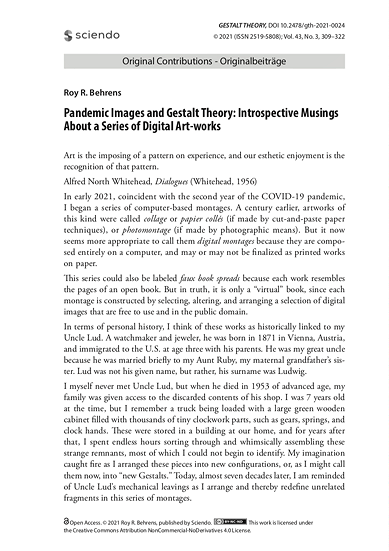
musings about digital art and gestalt theory

Monday, January 10, 2022
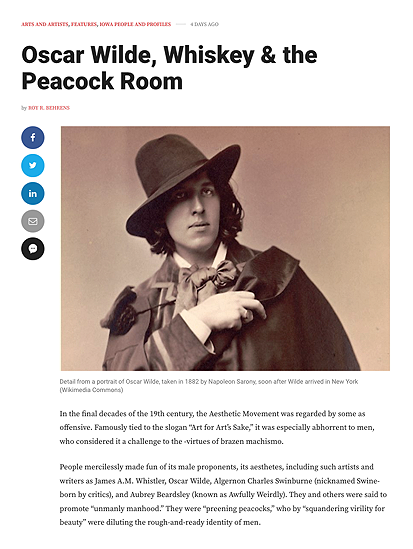
Oscar Wilde, Aestheticism, Whiskey & Peacocks
Saturday, December 18, 2021
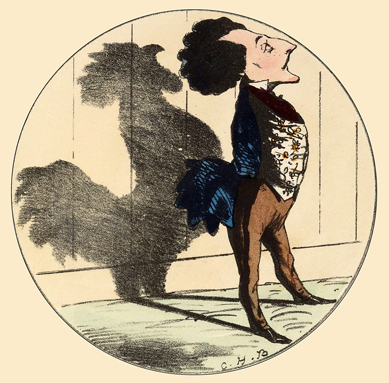
Stendhal Meets Rossini / Who Crows for You?
•••
Stendhal (Marie Henri Beyle), author of The Red and the Black, describing an incident in a visit to Italy in 1817—
We halted in Terracina, and there…we were invited to take supper with a party of travellers newly arrived out of Naples. Gathered about the table, I observed some seven or eight persons, amongst whom, in particular, my eyes lighted upon a fair-haired young man, of some five or six-and-twenty years of age, astonishingly handsome in spite of a slight touch of baldness. I pressed him for news of Naples, and in particular, of music in that city: he answered my curiosity with answers that were clear-cut, brilliant and humorous. I enquired of him whether, when I reach Naples, I might still hope to see [Gioachino] Rossini’s Otello. I pursued the topic, asserting that, in my opinion, Rossini was the bright hope of the Italian school; that he was the only living composer who had true genius as his birthright. At this point I noticed that my man seemed faintly embarrassed, while his companions were grinning openly. To cut a long story short, this was Rossini.
Thursday, December 16, 2021


Tuesday, December 14, 2021
new works by california artist jared rogness
 |
| Copyright © Jared Rogness |
Bravo!
Here is an online essay in which he talks about his work and provides more examples. In addition, we’ve blogged about him in the past, since I had the pleasure of working with him in the late 1990s and early 200os, when he was a university student in Iowa.
 |
| Copyright © Jared Rogness |
Monday, December 13, 2021
Phänomenal / Journal of Gestalt Psychotherapy


Saturday, December 11, 2021
set off when we began to make nature serve us
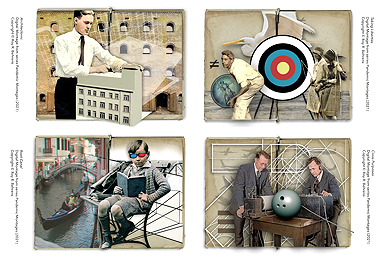 |
| Digital montages © Roy R. Behrens 2021 |
Edwin Muir, Autobiography. New York: William Sloane Associates, 1964, p. 194—
…the world has been divided into two hostile camps; and our concern has ceased to be the community or country we live in, and has become the single, disunited world: a vast abstraction, and at the same time a dilemma which, as it seems, we must all solve together or on which we must all be impaled together. This world was set going when we began to make nature serve us, hoping that we should eventually reach a stage where we would not have to adapt ourselves at all: machinery would save the trouble. We did not foresee that the machinery would grow into a great impersonal power, and that as it grew more perfect we should become more powerless and be forced at last into a position not chosen by us, or chosen in blindness before we knew where our desires were leading.
 |
| Pandemic Montage Exhibition (online) |
Saturday, December 4, 2021
my first choice would have been an albatross
 |
| digital montages © Roy R. Behrens |
Paul Auster—
What I try to do is to leave enough room in the prose for the reader to enter it fully. All the books I’ve most enjoyed, the writers I most admire, have given me the space in which to imagine the details for myself.
•••
J.B. Priestley, A Visit to New Zealand—
What I couldn’t understand was why this wingless night-grubber [the kiwi] had ever been chosen as New Zealand’s national image. It was a bad move. New Zealanders should never have called themselves Kiwis. Perhaps it has been the Kiwi aspects of New Zealand life and character that encouraged visitors in the past to call them dull. Though not a unique native of the country, albatross would have been my first choice.
•••
George Ellis aka Gregory Gander [the twelve months of the year]—
Snowy, Flowy, Blowy,
Showery, Flowery, Bowery,
Hoppy, Croppy, Droppy,
Breezy, Sneezy, Freezy.
Afterthought: When I was in grade school, I remember that our teacher said that a sure way to spell geography correctly was to remember the following phrase: George Ellis' old grandmother rode a pig home yesterday. But it may be another George Ellis.
Friday, December 3, 2021
abandon your cat at Clifford's Inn in London
 |
| Pandemic montages © Roy R. Behrens 2021 |
•••
In Lowell MA, Beat Generation novelist Jack Kerouac (author of On the Road) was in the same high school class as Ray Gouding, of the hilarious radio comedy team, Bob and Ray.
•••
Samuel Butler: “People when they want to get rid of their cats, and do not like killing them, bring them to the garden of Clifford’s Inn [in London], drop them there, and go away. In spite of all that is said about cats being able to find their way so wonderfully, they seldom do find it, and once in Clifford’s Inn the cat generally remains there.”
•••
E.L. Doctorow: “I have few vices, but one of them is moderation.”
Tuesday, November 23, 2021
WWI American actions and attitudes at home

•••
Edward Robb Ellis, Life in the United States 1914-1918. New York: Coward, McCann and Geoghegan, 1975, p. 428, describing the actions and attitudes of Americans during World War I, after the US declared war against Germany—
Anything mindful of German culture became suspect. Vigilantes inspected public libraries and invaded private homes and burned books by Goethe and Heine and Kant, broke Victrola records that preserved the music of Beethoven and Bach and Wagner. School after school forbade the teaching of the German language, while in clubs and churches and halls there was a ban against speaking German. [In the Iowa home of my father's parents, whose parents had immigrated from Germany in the 1850s, German was guardedly only spoken at home.]
With trembling fingers people plucked their gardens free of bachelor buttons, which was Germany’s national flower. Sauerkraut was renamed Liberty cabbage, hamburger became Salisbury steak. German measles were called Liberty measles, German dishes disappeared from restaurants, seed catalogs referred to German clover as Liberty clover, and bartenders removed pretzels from their free lunch counters.
Saturday, November 6, 2021
38th year of a rare and fortuitous marriage

Sunday, October 31, 2021
sights, sounds—and smells—of stockyard blood

•••
Maurice Browne, Too Late to Lament: An Autobiography. Bloomington: Indiana University Press, 1956, p. 127—
Chicago in the second decade of this [the 20th] century was a mentally disturbing and therefore, to a young man, a mentally exciting place. Metropolis of an inland empire, its god was the dollar and municipal corruption his handiwork. “No decent man will touch politics” was a phrase heard daily and self-defensively from the lips of every “decent” man. Extremes of luxury and squalor contrasted even more violently than in the Dublin of my childhood or the London of my youth. On the east its huge inland sea bounded the city; when the wind blew from the west, where the stockyards lay, the smell of blood, seeping through shuttered window and bolted door, filled every room of every house. In summer pitch from the city’s pavements bubbled underfoot. In winter the streets leading to Michigan Avenue had ropes waist-high round corner buildings, for foot-passengers to pull themselves past the corner against the gale; blizzards swept the city, paralyzing traffic. And in that climate, amid Chicago’s material and moral filth, mental life fought for existence like a sapling in a jungle.
Friday, October 29, 2021
that Lazarus was the original raised character
Above Roy R. Behrens, Wavelength. Digital montage (©2021). 
view larger
•••
Edward Robb Ellis, A Diary of the Century. New York: Kodansha, 1995, p. 222—
Tuesday, March 1, 1955: In the city room today some of us were discussing a report that the New Testament has been published in Braille. Frank [Kappler] said: “Yes—but did you know that Lazarus was the original raised character?”
•••
James Joyce, Ulysses (Chapter Six)—
“Come forth, Lazarus! And he came fifth and lost the job.”
Wednesday, October 20, 2021
Nobel Prize checks freshly written pay the bills

view larger
Above Roy R. Behrens, Snap Shot. Digital montage (©2021).
•••
Ione Robinson, A Wall to Paint On. New York: E.P. Dutton, 1946, pp. 152-153—
When I made a drawing of [American writer Sinclair] Lewis [who had just received the Nobel Prize] I had to take the train out to his country house. I was all in when I arrived but the afternoon and the trip back were so amusing I forgot how tired I was.
I made the drawing in his study, while Mr. Lewis wrote out checks to pay his bills with the Nobel Prize, and there were freshly-written checks all over the desk and the floor. I would have liked to paint him in that foreground of blue paper, which only increased the redness of his face and hair. He looked just like a carrot.
In a basket beside his desk there was a tiny baby with a wisp of red hair on the top of its head. Each time Mr. Lewis would finish a check, he would talk to the baby: “Isn’t it wonderful, Michael, that Daddy has won the Nobel Prize?” I had an awful time making the drawing because he was never still, but his face had made such an impression the moment I saw it that the drawing was fairly successful.
On the train back to New York Mr. Lewis joked a great deal about receiving the prize and the fuss that it had created throughout the country, especially among other contemporary writers. He told me how mad Theodore Dreiser was…and then he added that Dreiser ought to be tinting “fish plates.” I didn’t get the connection, and I don’t think there was any, as Mr. Lewis had had about ten highballs!
Tuesday, October 19, 2021
living in a poky village in a backward county

view larger
Above Roy R. Behrens, Beach Repair. Digital montage (©2021).
•••
Maurice Browne, Too Late to Lament: An Autobiography. Bloomington: Indiana University Press, 1956, p. 30—
Mr. Pickford was one of the finest Sanskrit scholars of his day. He was very poor; he had sacrificed his life to Sanskrit and his sister. His sister kept house for him in a little village where he was rector, a few miles outside Ipswich; a dour, bitter, selfish woman whom no one liked. So, for his sister's sake, he had put aside marriage, advancement, happiness, and had taken that obscure living in a poky village in a backward county, to make her a home where were few to hate her.
One day a letter came addressed to Mr. Pickford. Through several weeks he had been hoping for it; if it came, it might offer him an academic position where he could carry to fruition his life's work in Sanskrit. Every morning his sister went downstairs to meet the postman and see whether the letter had come: "No, John, it has not come today; perhaps it will come tomorrow."
Long afterwards the Vice-Chancellor in whose gift that position lay, meeting Mr. Pickford accidentally in the streets of Ipswich, greeted him coldly: "I considered it discourteous of you not even to have acknowledged the offer which I made you." Mr. Pickford made no comment. But, when he got back to the ugly, lonely, village rectory, he spoke to his sister. "Yes," she said defiantly, "of course the letter came; I read and burned it. I'm very happy where I am, and you're much better off in a place suited to you."
A little later…[Mr.] Pickford killed himself. My father [an Anglican clergy] preached his funeral sermon. There was no mention of, no hint of reference to, that story in it; but the Stoic view of self-murder was upheld by the Anglican preacher [who years later did the same].
Sunday, October 17, 2021
rudimentary multiple nipples on a hydroplane
Above Roy R. Behrens, Horn of Plenty. Digital montage (©2021). 
view larger
•••
Maurice Browne, Too Late to Lament: An Autobiography. Bloomington: Indiana University Press, 1956, pp. 257-258—
[This is Browne’s account of time spent at the home of the parents of his friend and associate Robert Bell, whose] father, an eminent banker, terrified me, but I sat rapturously at his mother's feet; she had as many laughter-wrinkles round her eyes as there are waves in a field of corn.
One evening her famous brother-in-law, Alexander Graham Bell—Telephone Bell, as we younger folk inevitably nicknamed him—brought his charming deaf-mute wife [née Mabel Hubbard] to dinner as it was her disability which had first led him to the study of sound. During dinner he talked of a new hydroplane which he was building, the intensive breeding of sheep and rudimentary multiple nipples on human beings. Not one of us had an elementary acquaintance with one of his subjects, yet he held us all spellbound. After dinner his nephew and I steered him carefully into a corner: “How on earth did you keep us so interested in things of which we knew nothing?” For two memorable hours the old man thought aloud. Finally he reached a conclusion. “It is not primarily what a speaker says which interests his hearers—be he conversationalist, preacher, lecturer, actor or even writer—nor the words in which he says it, nor his manner of delivery, nor his personality; these things help or hinder but are secondary. The primary cause of sustained interest, I believe, is this. Each time that a speaker—or writer—pauses, for however infinitesimally brief a moment, he builds a bridge in his own mind over the silence between the word which he has last uttered and the word which he will utter next. If his hearers cross that bridge before him, he bores them; if they fail to cross it, or cross it too late, he loses them; if they cross it with him, he holds and keeps them.”